A Practical Self-Review of SWPPP/SPPPs for Inaccurate Site Maps, Overlooked Exposure, Outdated Procedures, and Implementation Gaps, Plus the Limits of Checking Your Own Work
Your stormwater plan was written a few years ago, or maybe it came with the facility and lives in a binder nobody has opened since the last NJDEP visit. In New Jersey, NJDEP's permits call that document a Stormwater Pollution Prevention Plan, or SPPP. You'll also hear it called an SP3 or just a stormwater plan, and we'll use SWPPP here since that's the term most people search for. It's the document an inspector expects to match your site on the day they walk it, so the real question is how you find the problems in it before someone else does.
This article walks through a self-review in four areas: inaccurate site maps, overlooked exposure, outdated procedures, and gaps between what the plan says and what your records show. We'll also cover where checking your own work falls short, because it does, and when it makes sense to reach out to RMA for a second set of eyes.
Table of Contents
TL;DR
You can review your own New Jersey SWPPP by comparing it to your current permit and then walking the site with the plan in hand. Check that the site map matches the property, that nothing industrial sits outside where rain can reach it, that the procedures and team names are current, and that your inspection, training, and certification records back up what the plan promises. A self-review catches the obvious problems, but you can't see what you don't know to look for, and the annual certification puts your name on the result. If anything is unclear or your site has changed a lot, a fresh set of eyes from a consultant is worth it.
What Should You Know About Your New Jersey SWPPP Before Starting a Self-Review?
A New Jersey industrial SWPPP exists because your NJPDES permit requires it. NJPDES is the New Jersey Pollutant Discharge Elimination System, the state's version of the federal NPDES program, and NJDEP runs it. Which permit you're under decides what your plan has to contain. The Basic Industrial Stormwater General Permit (5G2) is written for facilities that have eliminated, or can eliminate within six months of authorization, exposure of industrial materials and activities to rain and snowmelt. The industry-specific general permits cover things like concrete products, hot mix asphalt, mining and quarrying, sand and gravel, scrap metal, vehicle recycling, and wood waste recycling, and they add their own requirements on top, sometimes including stormwater sampling. Individual permits are written for a single facility. If you're not sure which one applies to you, our guides to the 5G2 permit and to general, individual, and no-exposure permit types are a good place to start.
Two scope notes before you begin. This article is about the industrial SWPPP. Construction stormwater in New Jersey has its own coverage and its own plan, and RMA doesn't prepare construction-phase permits, so that work belongs with your engineer or contractor. And if your facility claimed a no exposure exclusion instead of holding a permit, the review looks different, since there's no plan to audit, only a claim that has to stay true. Our article on what no exposure means covers that situation.
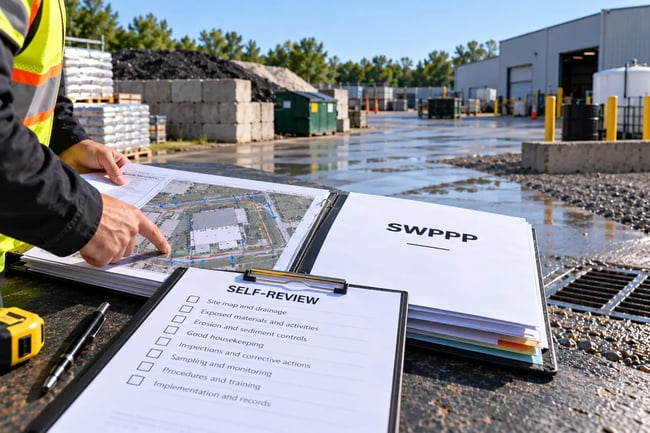
Gather your materials first: the current permit document (not a copy from the year you were authorized), your authorization, the SWPPP itself, the last annual certification you filed, your inspection logs, your training records, and the site map. Then work through four questions, each one comparing the plan to something real.
| Review Area |
Compare the Plan To |
Where It Usually Goes Wrong |
| Site map |
The property as it looks today |
New buildings, paving, drains, or outfalls that never made it onto the map |
| Exposure |
What's sitting outside right now |
Pallets, bins, equipment, and scrap that crept outdoors after the plan was written |
| Procedures and BMPs |
How the facility operates today |
Old team names, retired products, housekeeping tasks nobody does |
| Implementation |
Your permit's inspection, training, and certification requirements |
Missing logs, undocumented training, certification dates that slipped |
How Do You Check Your SWPPP Site Map for Inaccuracies?
Print the map from the plan and take it outside. Walk the property with it in your hand and mark every difference you see. Buildings get added, lots get repaved, a loading dock gets extended, a drain gets blocked or a new one gets installed, and the map written for the original plan quietly stops matching the ground. Your permit spells out what the map has to show, so read that section first and use it as your checklist. In general, a useful map shows the property boundary, the buildings, the storm drains and the direction water flows, where industrial materials and activities are located, and the points where runoff leaves your site.
That last item is the one we see wrong most often. Stand at each storm drain and ask where the water goes. Does it run to a municipal storm sewer, a stream, a retention basin, or onto the street and down the road? The answer matters because New Jersey treats discharges to surface water, to groundwater, and to a sewerage authority differently. Some older New Jersey cities have combined sewers, so where your runoff ends up can change which rules apply, and we can't tell you flatly what a site in a given town needs without knowing where its drains lead. If you can't trace a drain, check municipal storm sewer maps or ask your town's public works department before you assume anything.
Look at the date on the map, too. A map with no revision date, or one that predates a building project, is telling you the plan hasn't been touched since. That alone doesn't prove a violation, but it tells you where the rest of the review is likely to turn up trouble.
How Do You Find Overlooked Exposure in Your Stormwater Plan?
Exposure means industrial materials, products, waste, or equipment sitting outside where rain or snowmelt can touch them and carry pollutants off the site. For a 5G2 facility it's the central issue, since the permit assumes you've eliminated it. For every other permit it's the thing the plan exists to control. Either way, the plan has to describe what's outside, and your job is to find what it left out.
Walk the yard the way a stranger would, and do it after rain if you can, since water shows you where things leak, pond, and run. Look at the loading dock area, the dumpsters and roll-offs, the spot behind the building where old equipment collected, stacked pallets, drums or totes, scrap, vehicles and forklifts parked outside, outdoor maintenance or washing, and any stained pavement. Open dumpsters and bins without lids are a classic miss, and so is a temporary storage spot that became permanent over two years. Vendors and contractors leave things behind too, so look for materials that aren't yours.
Pay attention to water that isn't rain. A floor drain, a wash area, or a hose-down spot that connects to a storm drain moves process water into a system built for rainfall, and that's a separate regulatory problem from stormwater exposure. Our article on the difference between stormwater and process water explains why the two get treated so differently. If you find something like that, don't wait for the next annual review to deal with it.
Are Your SWPPP Procedures and BMPs Outdated?
Best management practices, or BMPs, are the day-to-day things your plan says you do to keep pollutants away from stormwater: sweeping, covering materials, spill cleanup, keeping dumpsters closed, maintaining drains and containment. Our overview of stormwater BMPs goes through the common ones. The review question is simple: does your plan describe what your facility does now, or what it did when the plan was written?
Start with the people. Plans name a stormwater team and list who's responsible for inspections and training, and those names go stale quickly when someone retires or changes jobs. Then check the products and processes. If the plan's spill procedures reference materials you no longer use, or skip the ones you started using last year, the procedures don't fit the site. A new production line, a new tenant, an acquisition, or a change in ownership should all trigger a look at the plan, and most facilities skip that step.
Finally, compare the plan to the current permit text. Permits get renewed, and the requirements move with them. A plan written for an earlier version of your permit may be missing something the current version asks for, such as an updated certification process or a training requirement. Read the plan's sections against the permit's section list and note anything the permit mentions that your plan doesn't. If your facility also has an SPCC plan for oil storage, check that the two documents don't contradict each other, and our article on the difference between an SPCC plan and a SWPPP shows where they overlap.
What Implementation Gaps Show Up in SWPPP Inspections, Training, and Certification Records?
A plan on paper doesn't satisfy a permit by itself. The permit expects you to carry it out, and your records are the proof. This is where the review turns from reading to checking dates, so pull the paperwork and look for holes.
Start with inspections. Your plan sets up a schedule of routine inspections, which for most 5G2 facilities we work with means monthly walks of the areas exposed to rain and snowmelt, plus one more thorough annual inspection. Confirm the frequency against your permit and then check your logs against it. Look for missing months, entries that read identically from one month to the next, and problems noted with no sign that anyone fixed them. Inspection records are supposed to be kept with the plan, so if they live in three different places, that's a finding in itself. Our guide to doing a stormwater visual inspection covers what a good one looks like.
Next, training. Under the 5G2, employees need annual training, and you should be able to show who attended, what was covered, how long it ran, where it took place, and who delivered it. If your records say "stormwater training, 2023" with no names, they won't hold up. We've written about taking 5G2 training online, and our online training library has courses your team can take on their own schedule.
Then the annual certification. The 5G2 calls for a certification filed with NJDEP each year, and the due date ties back to your authorization, so confirm the date against your permit instead of guessing. The form walks you through a list of permit requirements to check off, and it has you certify that the facility is in compliance with its plan and the permit. It says not to submit the plan itself, only the certification, and to keep the plan and a copy of the certification on file. Check your files for the last few years of certifications, and make sure the annual fee bill got paid, since an unpaid fee can put your coverage at risk. If your permit requires stormwater sampling, add your sampling records and results to the pile, and see why we tell clients to take their own stormwater samples.
Why Can't You Always Trust Your Own SWPPP Review to Catch Everything?
Because you can't see what you don't know to look for. If you wrote the plan, you'll read it the way you meant it, and your eye will skip right past the sentence that doesn't match reality. If you inherited it, you may not know which parts of the permit it was supposed to answer. And if you've never read the permit end to end, a whole requirement can go unnoticed for years. We've seen careful, capable people run a plan for a long time with one piece missing, and nothing felt wrong until someone outside looked at it.
Some mistakes are invisible from the inside. Being on the wrong permit category looks fine when you only check the plan against itself. A drain that carries process water looks like any other drain. A map that's wrong looks right to the person who drew it. It's also possible you're doing something wrong that you'd never think to question, and a self-review can't tell you about problems you didn't know existed. That's not a knock on you. It's how reviewing your own work goes for everyone. Our article on common NPDES permit problems lists the kinds of things that slip through.
There's a practical stake too. When you sign the annual certification, your name is on a statement that the facility complies with its plan and its permit. NJDEP decides how to respond to problems case by case, and a violation can mean a notice with a deadline to fix things or, in more serious situations, penalties. If you've already received a notice of violation, an inspection letter, or any other communication from NJDEP, talk to an environmental attorney before you respond or change anything. A self-review is for facilities that want to find problems on their own schedule, not for managing an open enforcement matter.
When Does Hiring an Environmental Consultant for a SWPPP Review Make Sense?
Sometimes it doesn't. If you're a small 5G2 facility with everything indoors or under cover, a short plan you understand, and someone on staff who reads the permit and keeps good records, your own review plus a walk-through with a coworker from another department may be all you need. We'd rather tell you that than sell you something you don't need.
A consultant earns the fee in other situations. You're not sure which permit category you belong in. You're under an industry-specific permit with sampling or other added requirements. The facility has changed a lot since the plan was written. You inherited a plan and don't know its history. Your own review turned up gaps and you want to know what else is out there. A lender, buyer, or customer has asked for proof of compliance. In those cases, someone who's read a lot of New Jersey plans and walked a lot of New Jersey sites will see things you won't. We cover the do-it-yourself question more broadly in our article on writing your own SWPPP.
What does a review cost? It depends on the permit category, the size and complexity of the site, how much the facility has changed, whether the plan is in decent shape or needs a rewrite, and whether you want training for your team as part of it. State fees are set by NJDEP and are separate from anything a consultant charges. The pricing calculator below gives you an estimate for RMA's help based on your own answers.
How Does RMA Help With New Jersey SWPPP Reviews and Updates?
We're a family-run firm based in New Jersey, and we've been helping facilities with NJDEP's permits since 1992. When we review a plan, a senior member of our team walks the site, compares the plan to your permit and to what's really on the ground, and gives you a clear list of what needs fixing. If the plan needs updating, we write it by hand, without AI, and we train your people on it so the plan lives in the facility and not just in a binder. After you're in good shape, we also offer annual support, such as reminders, inspection prep, help interpreting results, plan updates, and answers to your questions. You can keep that hands-off or hands-on, whichever fits.
A few limits worth knowing. We don't do your stormwater sampling for you, because storm events are unpredictable and you know your site best, but we'll train you to sample correctly. We're not the cheapest firm out there and we don't try to be, and we can't always meet very tight timelines, though we'll tell you up front what's realistic. If your site needs real engineering work, like designing a treatment system, that's engineering and we'd point you to the right people.
There's no pressure and no obligation. You can call us, email us, or fill out the form on our website, and we'll talk through where you stand. If you'd like a second opinion on your plan, contact RMA and tell us a little about your facility. We'll let you know whether we're the right fit, and if we're not, we'll point you in a better direction.