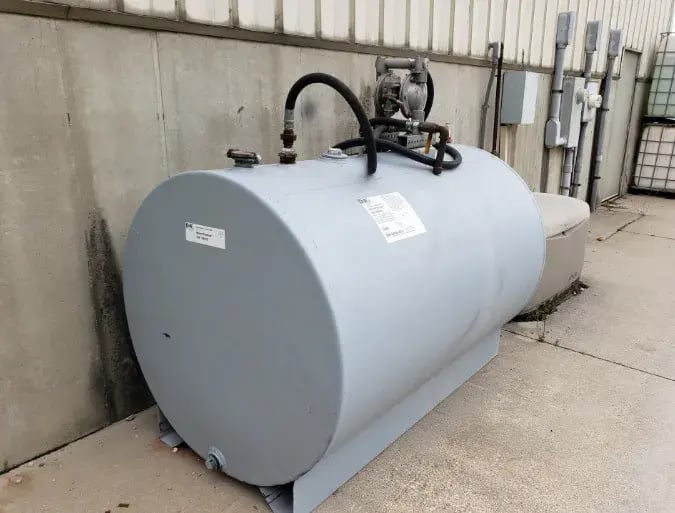
How to Document Oil Storage, Equipment Capacities, and Locations for Your New Jersey SPCC Plan
Before anyone can write an SPCC plan, someone has to walk the property and write down every place oil is stored or used. SPCC stands for Spill Prevention, Control, and Countermeasure, and it's the federal oil spill prevention rule found in 40 CFR Part 112. That list of containers and equipment drives almost everything else in the plan: whether your facility crosses the federal threshold at all, how big your secondary containment has to be, what the facility diagram looks like, and what your monthly inspections cover. In New Jersey, EPA Region 2 enforces the rule, and when an inspector shows up, the first thing they do is compare the plan's list to what's sitting in your yard.
The short answer to the question in the title is this: list every aboveground container and every piece of oil-filled equipment that can hold 55 gallons or more, record the type of oil, the full shell capacity, and the location of each one, and then mark them all on a facility diagram. This article covers what counts and what doesn't, how to run the site walk, what the inventory table should look like, where drums and equipment trip people up, and what New Jersey adds on top of the federal rule. If you'd rather hand the walk-through to people who do it every week, you can reach out to RMA at any point.
Table of Contents
TL;DR
To inventory oil for an SPCC plan, list every aboveground container and piece of oil-filled equipment that holds 55 gallons or more. Record the type of oil, the full shell capacity (not how full it is today), and the location of each one, then mark them on a facility diagram. Drums, totes, generator tanks, transformers, and hydraulic reservoirs all count toward the 1,320-gallon federal threshold. In New Jersey, the same list also helps you work out whether state programs like DPCC and DCR plans apply, and it needs updating whenever your oil storage changes.
Why Does an SPCC Plan Start With an Oil Storage Inventory?
The federal rule applies to a non-transportation-related facility that has more than 1,320 gallons of aboveground oil storage capacity, counting only containers of 55 gallons or more, and that could reasonably be expected to discharge oil to navigable waters or adjoining shorelines. You can't know whether you're over 1,320 gallons without adding up every container. Smaller facilities can land on the wrong side of that line once the drums, the generator tank, and the hydraulic reservoirs all get added in.
The inventory also feeds the plan's required content. Section 112.7(a)(3) says the plan has to include the type of oil in each fixed container and its storage capacity, along with a facility diagram that marks the location and contents of each fixed container and the storage areas where mobile or portable containers sit. If you want the full picture of what a plan has to contain, our guide on everything you need to know about SPCC plans covers the rest of the rule.
The "reasonable expectation" part of the test looks only at geography and location. It can't give you credit for manmade structures like berms or dikes, so a facility near a storm drain, a drainage ditch, or a stream generally has to assume the answer is yes. That's why most industrial sites with enough oil end up needing a plan, and why the inventory is where the work starts.
What Counts Toward Your SPCC Oil Storage Capacity?
"Oil" under the SPCC rule is a much broader category than gasoline and diesel. It covers petroleum, fuel oil, motor oil, hydraulic oil, mineral oil, synthetic oils, and non-petroleum oils like vegetable oils and animal fats. Propane and other gases don't count. The other detail that changes the math is that you count shell capacity, meaning the maximum volume the container can hold, rather than the amount of oil in it today. A 500-gallon tank holding 50 gallons of diesel is a 500-gallon container for SPCC purposes.
| Item |
Counts toward 1,320 gallons? |
What to know |
| Aboveground tanks (diesel, gasoline, heating oil, used oil) |
Yes |
Count full shell capacity, whatever the current fill level |
| 55-gallon drums and totes (IBCs) of oil |
Yes |
Each container of 55 gallons or more counts, empty or full |
| Containers under 55 gallons (5-gallon pails, 30-gallon drums) |
No |
Left out of the threshold math entirely |
| Oil-filled operational equipment of 55 gallons or more (hydraulic systems, lube systems, transformers, circuit breakers) |
Yes |
Not bulk storage, but it counts and has to be addressed in the plan |
| Emergency and backup generator fuel tanks |
Yes |
The fuel tank is a bulk storage container |
| Vegetable oil, cooking oil, and animal fat tanks or bins |
Yes |
Non-petroleum oils are oils under the rule |
| Propane, LPG, and LNG |
No |
Not oil under SPCC |
| Fuel tanks that power a vehicle's own engine (motive power containers) |
No |
A tank used to store or transfer fuel for further distribution is not a motive power container |
| Permanently closed containers |
No |
A tank that's merely idle or in standby still counts |
| Milk and milk product containers |
No |
Exempted by the rule |
| Completely buried tanks |
Separate count |
Measured against a 42,000-gallon buried threshold, and tanks covered by the federal UST rules are exempt but still shown on the diagram |
A few of these deserve a second look at your own site. Cooking oil and used oil are easy to leave off a list, so we've written separately about SPCC plans for cooking oil and about used oil regulations. For drums specifically, there's a dedicated answer to whether 55-gallon drums are included in SPCC plans.
How Do You Walk Your Site and Build an Oil Container List?
Start with a site plan or an aerial image printed large enough to write on, then walk the property in a consistent pattern, building by building or yard area by yard area, so nothing gets skipped. Bring a phone for photos, a tape measure, and a way to record what you find. On the first pass, list everything that might hold oil and sort out what counts afterward. Most of the surprises come from places nobody thinks of as oil storage: maintenance shops, loading docks, generator pads, fire pump rooms, electrical yards with pad-mounted transformers, hydraulic lifts and elevator machine rooms, compressor rooms, parts washers, forklift fueling spots, and storage trailers parked behind the building.
Talk to the people who buy and use the oil. Maintenance staff know about the drum that's been behind the shop since 2019. Purchasing knows what gets delivered. Anyone who's been on site a long time can tell you about tanks that were taken out of service but never properly closed. Under the rule, a container that's used for standby, seasonal, or temporary storage, or that isn't permanently closed as the rule defines it, is still covered, so an idle tank stays on the list until it's been closed the right way.
Where Do You Find the Capacity of a Tank or Piece of Equipment?
Check the manufacturer's data plate first, then any UL or STI label, then the equipment manual or spec sheet. If there's no label, you can calculate the capacity from the dimensions. For a horizontal cylinder, that's the volume of a cylinder in cubic feet multiplied by 7.48 gallons per cubic foot. Whatever method you use, record the shell capacity, which is the full volume the container can hold. Don't record the operating level or an administrative fill limit like 90 percent.
What Should Your SPCC Oil Container Inventory Table Include?
The rule's specific requirement is the type of oil in each fixed container and its storage capacity. A table that's useful to an inspector, a consultant, and your own maintenance team records a bit more: a unique ID that matches the facility diagram, a plain description of what the container is and where it sits, the type of oil, the shell capacity, whether it's fixed or mobile, and a notes column for things like construction type or whether it's operational equipment. Keep aboveground and completely buried storage in separate subtotals. The example below is fictional and shows the format.
| ID |
Description and location |
Oil type |
Shell capacity (gal) |
Fixed or mobile |
Notes |
| AST-1 |
Aboveground tank, east side of garage |
Diesel |
1,000 |
Fixed |
Fleet fueling, with dispenser |
| AST-2 |
Used oil tank, exterior wall of shop |
Used oil |
275 |
Fixed |
Collected by outside hauler |
| GEN-1 |
Backup generator base tank, rear pad |
Diesel |
300 |
Fixed |
Bulk storage container |
| TR-1 |
Pad-mounted transformer, rear yard |
Mineral oil |
250 |
Fixed |
Operational equipment |
| HYD-1 |
Hydraulic press reservoir, production floor |
Hydraulic oil |
120 |
Fixed |
Operational equipment |
| DRUM-A |
Drum storage area, loading dock (up to 8 drums) |
Motor and hydraulic oil |
440 |
Mobile |
8 drums at 55 gallons each |
| Total |
Aboveground capacity |
|
2,385 |
|
Over the 1,320-gallon threshold |
A clean table like this saves time and money later. How many containers you have, how they're arranged, and how complicated the containment is all drive the price of a plan, which we break down in our guide to SPCC plan costs. Depending on your facility's size and spill history, the plan may qualify for self-certification, or it may need a Professional Engineer to review and certify it. Our overview of the different types of SPCC plans and our page on Professional Engineers and SPCC plan requirements explain how that works.
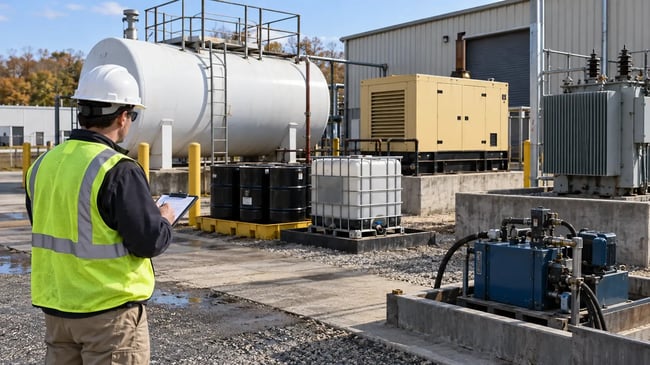
How Do You Inventory Drums, Totes, and Other Mobile Oil Containers?
Drums, totes, and mobile refuelers are the hardest items to inventory because the number on site changes from week to week. The rule accounts for that. For mobile or portable containers, the plan can either list the type of oil and capacity of each container, or it can give an estimate of how many containers are likely to be there, the types of oil, and their anticipated capacities. The estimate can be a range. A facility whose drum inventory swings between 10 and 100 drums can say so instead of trying to pin down a single count.
The practical approach is to define each storage area first, such as the drum rack in the shop, the pallet area on the loading dock, or the fuel storage cabinet by the equipment yard. Then estimate what that area holds. We usually recommend counting toward the high end of what you realistically keep on site, because the threshold and the secondary containment both have to work in your busiest week, not your slowest one. Each storage area then gets marked on the facility diagram. Containers under 55 gallons fall out of the math, so a shelf of 5-gallon pails doesn't add to your total. For sizing the containment around these areas, see our article on how big SPCC oil spill containment needs to be.
How Do You Inventory Oil-Filled Equipment and Generators for an SPCC Plan?
Oil-filled operational equipment is anything that holds oil only so the equipment can function: hydraulic systems, lubrication systems on pumps and compressors, gear boxes, transformers, circuit breakers, and electrical switches. The rule treats it differently from bulk storage. It isn't a bulk storage container, but if a piece of equipment can hold 55 gallons or more of oil, that capacity counts toward the 1,320-gallon threshold and the equipment has to be addressed in the plan. List each one with the capacity of its oil reservoir, and note that it's operational equipment so the plan can handle it correctly. EPA also lets an owner use an oil spill contingency plan, with an inspection or monitoring program, in place of secondary containment for qualified operational equipment, which can matter a lot if you have a transformer or press that would be hard to surround with a dike.
Generators are a combination of both categories. The generator's lubrication system may be operational equipment, while the fuel tank that feeds it is typically a bulk storage container. Emergency and backup generators count toward your total, so a site with several of them can reach the threshold from generator fuel alone. Data centers see this a lot, and we cover it in our data center guide to SPCC plans and our article on emergency backup generators and environmental permits.
How Do You Show Oil Containers on an SPCC Facility Diagram?
Your inventory table and your facility diagram have to agree with each other. The rule requires the diagram to mark the location and contents of each fixed oil storage container and the storage areas where mobile or portable containers are kept. EPA's guidance adds that the diagram should show completely buried tanks, even ones that are exempt from the rest of the rule, along with transfer areas and the connecting pipes. If the diagram gets crowded, the plan can label each container with its ID and let the inventory table carry the capacity and oil type, so the picture stays readable.
A scaled site plan works better than a sketch. Use the same IDs on the diagram that you used in the table, add a north arrow, and show the buildings, loading areas, and fuel transfer points. Most plans also show which way water would flow from each container and where the nearest storm drains, ditches, or streams are. The diagram doesn't need to be a survey, but it does need to match what's physically on site.
How Do New Jersey's Rules Affect Your Oil Storage Inventory?
The federal SPCC rule is the center of this process, and in New Jersey EPA Region 2 enforces it. But the same inventory feeds a stricter state layer, so it helps to know what that layer is before you finish the list.
The first piece is the Spill Compensation and Control Act, usually called the Spill Act. It applies to petroleum and many other hazardous substances regardless of how much you store, and it generally makes the party responsible for a discharge answerable for cleanup and removal costs, with liability that can be strict and joint and several. NJDEP also has its own discharge reporting requirements, separate from the federal ones, so check NJDEP's current reporting guidance for what applies to your facility. How the Spill Act plays out in a specific situation is a question for an environmental attorney.
The second piece is N.J.A.C. 7:1E, which requires "major facilities" to prepare and keep updated a Discharge Prevention, Containment and Countermeasure (DPCC) plan and a Discharge Cleanup and Removal (DCR) plan. Whether your facility counts as a major facility depends on its total storage capacity and what it stores, so check the rule against your own inventory, and keep in mind that NJDEP has revised and proposed changes to these rules over time, so read the current text rather than an old copy. That's one reason to track hazardous substances other than oil while you're walking the site, since the state program covers more than oil. We cover the basics in our guide to SPCC plans in New Jersey.
The third piece is underground tanks. Federally, a completely buried tank is measured against its own 42,000-gallon threshold, and tanks covered by the federal UST rules are exempt from SPCC but still get marked on the diagram. New Jersey also runs its own underground storage tank program under N.J.A.C. 7:14B, with NJDEP-certified contractors doing the regulated work. Whether a particular buried tank is regulated under the federal or state program depends on its use, size, and location, so don't assume a buried tank is out of scope. Record it, mark it, and confirm its status.
If you find staining, stressed vegetation, or signs of old leaks while you're walking the property, treat that as a separate issue from the inventory. Cleanups of discharges in New Jersey are generally overseen by a Licensed Site Remediation Professional (LSRP), and an environmental attorney can help sort out reporting obligations.
How Do You Keep Your SPCC Oil Inventory Current?
An inventory that was right on the day the plan was signed starts drifting immediately. The rule requires an amendment whenever there's a change in facility design, construction, operation, or maintenance that materially affects the potential for a discharge. A technical amendment has to be prepared within six months of the change and implemented as soon as possible, but no later than six months after it's prepared. Adding or removing a tank, changing the type of oil in a container, moving a drum storage area, installing a generator, and replacing a transformer are the usual triggers. If you're adding a tank or building new storage, the construction side, including installation permits, fire code approvals, and certified UST installers where they apply, is handled by your engineer, contractor, and local officials, and RMA doesn't prepare those. The SPCC plan amendment that follows once the tank is in service is where we come in.
On top of that, the plan has to be reviewed at least once every five years, and the review has to be documented. If yours is overdue, our articles on a plan that's over five years old and on SPCC five-year reviews explain your options, and whether your plan can simply be updated depends on how much has changed.
The easiest habit is to keep the inventory in a spreadsheet, give one person ownership of it, and make sure purchasing and maintenance tell that person whenever oil-holding equipment comes or goes. Your monthly inspection walk is a natural time to compare the list against what's physically there, and our list of the top 10 things to do during SPCC plan monthly inspections can help structure it. Oil-handling staff also need discharge prevention briefings at least once a year, and our online training library is one way to cover that.
How Can RMA Help With Your New Jersey SPCC Oil Inventory?
We're a family-run firm based in New Jersey, so NJDEP's programs and the way the Spill Act, DPCC and DCR plans, and the federal SPCC rule fit together are part of our daily work. We can walk the site with you, build and check the inventory, calculate shell capacities, and turn it into a new plan, an update, or a five-year review. When your plan needs a Professional Engineer to review and certify it, we'll tell you at the start so it doesn't surprise you at the end. If you'd like to build the inventory yourself and hand it to us, that's a perfectly good way to save money, and our write-up on how remote SPCC development works shows how that can go.
If your facility turns out to be small and a simpler path fits, we'll say so, and if you don't need a consultant, we'll tell you that too. There's no pressure and no obligation. You can call us at 888-RMA-0230, send us an email, or fill out the form on our website, and you can also contact RMA directly to talk through your oil storage and what your plan needs.