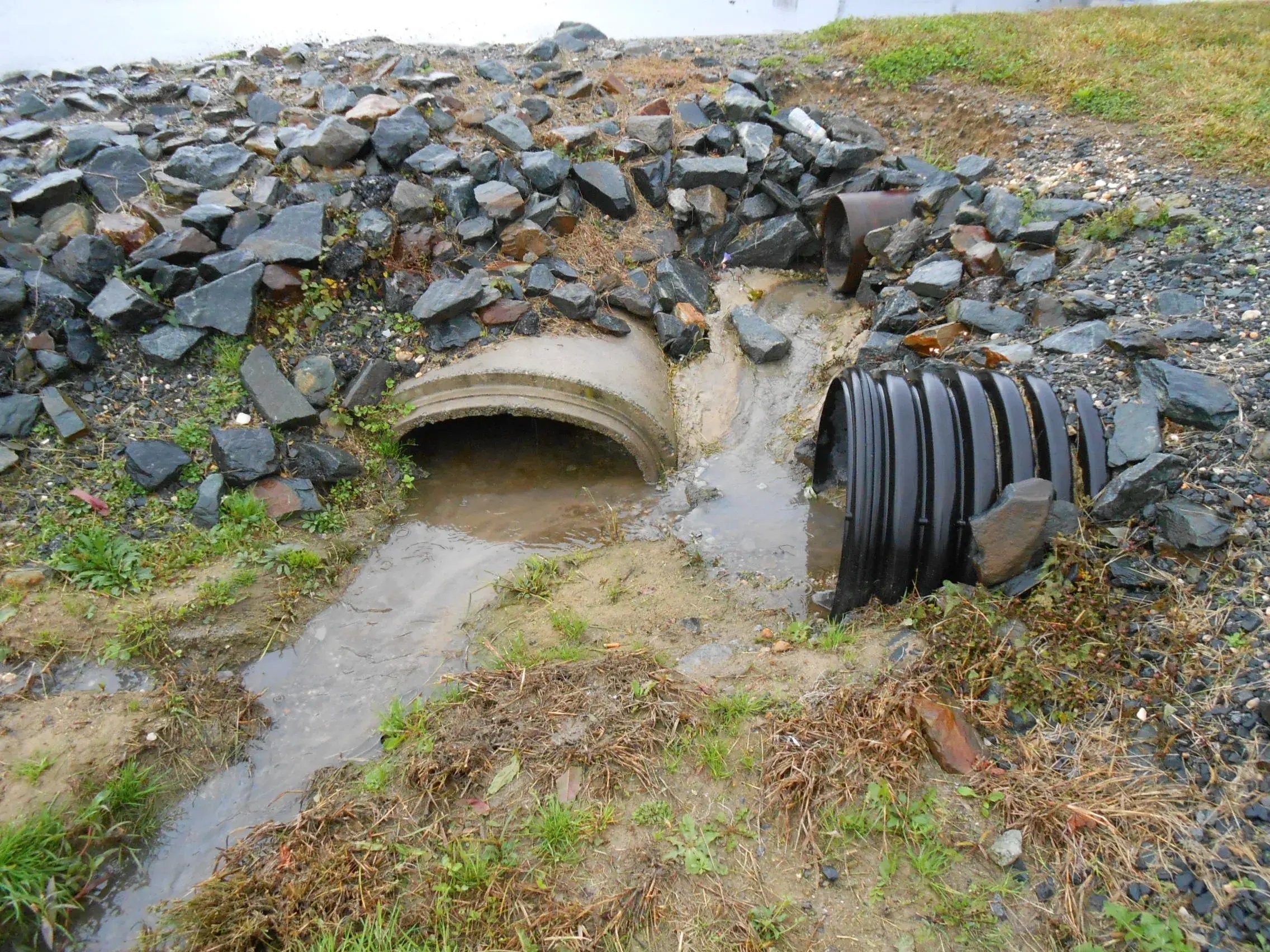
A Step-by-Step Walk Through Confirming Eligibility, Preparing Your SWPPP, Filing the RFA Through NJDEP Online, and What Happens Next
If rain or snowmelt runs off your New Jersey facility after touching industrial materials or activities, the New Jersey Department of Environmental Protection (NJDEP) expects you to be covered under its state stormwater permitting system, the New Jersey Pollutant Discharge Elimination System (NJPDES). For facilities that keep everything indoors or under cover, the usual choice is the Basic Industrial Stormwater General Permit, known as the 5G2. You don't apply for it the way you'd apply for a building permit. NJDEP already wrote the permit, so you file a Request for Authorization (RFA) asking to be covered by it. The short version: confirm you qualify, get your stormwater plan written, and submit the RFA electronically through NJDEP Online.
This post walks through each step in order: how to tell whether the 5G2 fits, how to get your stormwater plan ready, what goes into the RFA package, how the electronic submission works, what it costs, and what to expect while NJDEP reviews it. NJDEP updates its forms and systems from time to time, so we'll point you to where the current versions live instead of freezing every detail in place. If you'd rather hand off any part of this, feel free to reach out to RMA and we'll tell you plainly whether you need us.
Table of Contents
TL;DR
To get covered under New Jersey's 5G2 Basic Industrial Stormwater General Permit, you file a Request for Authorization (RFA) electronically through NJDEP Online. In our experience the package is three forms plus a site map, and your stormwater pollution prevention plan should be written and ready before you file. You qualify only if everything industrial at the site is indoors or under cover, or can be within six months of authorization. NJDEP bills an annual fee (the 5G2 minimum has been $800) instead of charging a separate application fee, and authorization can take anywhere from a few weeks to several months, so start your inspections and recordkeeping while you wait.
Do You Qualify for 5G2 Coverage Before You File an RFA?
The 5G2 is open to regulated industrial facilities that have eliminated, or can eliminate within six months of being authorized, all exposure of industrial materials and activities to rain and snowmelt. That sentence is the whole eligibility test, so spend your time here before you touch a form. In plain terms, nothing industrial can sit, run, or get stored where rain can reach it. Plenty of facilities qualify because they already work entirely inside a building. Others get there with small changes, and the table below shows the usual fixes.
| What's Outside Today |
Common Way to Get It Covered |
| Dumpsters and trash bins |
A lidded or fully enclosed container, kept closed when it isn't being loaded |
| Stockpiled or stacked material |
Move it indoors or into a storage building |
| Drums, totes, and other containers |
Store them inside, or in a sealed shipping container |
| Equipment parked or used in the yard |
Keep it indoors, or under permanent cover when it isn't in use |
| Fueling, washing, or maintenance areas |
Move the activity inside, or stop doing it outdoors |
Walk the property with that list in hand, ideally during or just after a rain, and photograph every outdoor area with the date on the photo. You'll use those photos again when you write your plan. Also check whether you need coverage at all. Offices, most warehouses, data centers, and plenty of service businesses fall outside NJDEP's industrial stormwater program, and our guide to who needs a stormwater permit shows where regulators draw the line.
Two more checks before you move on. The 5G2 excludes certain discharges, such as ones that need coverage under another NJPDES permit, and the RFA has you certify that none of your discharges fall into those exclusions, so read Part I of the current permit. And trace where your water goes. If your site drains only to a combined sewer, which several older New Jersey cities have, your local sewerage authority's rules may apply instead of, or alongside, an NJPDES permit. Confirm that with the authority instead of guessing from your town's name.
If you can't get exposure eliminated, the 5G2 isn't your permit. Your other options are an industry-specific general permit (Concrete Products Manufacturing (CPM), Hot Mix Asphalt (R4), Mining and Quarrying (R13), Sand and Gravel (RSG), Scrap Metal (SM2), Vehicle Recycling (RVR), and Wood Waste Recycling and Leaf Composting (WRC)), an individual NJPDES permit, or the no exposure exclusion for facilities where everything sits inside permanent buildings. Our article on which NPDES permit you need compares them side by side, and our explainers on what no exposure means and whether you need an individual NJPDES permit cover the other two.
One boundary if you're building or expanding. Construction-phase requirements, such as 5G3 construction stormwater coverage and soil erosion and sediment control certification, are separate programs, and RMA doesn't prepare them. Your engineer or contractor usually handles that piece. The 5G2 is the operating permit you request once the facility is running, and that's the part this post covers.
How Do You Prepare the SWPPP Before Submitting Your 5G2 RFA?
Before you file, have your stormwater pollution prevention plan written. We'll call it a SWPPP in this post (pronounced "swip"), though you'll also hear it called an SPPP, an SP3, or just a stormwater plan, and NJDEP's own 5G2 forms say SPPP. It's the document that describes your site, the materials on it, and the steps you take to keep them out of runoff, and it's the first thing an inspector asks to see. Our guide to what a SWPPP is covers what goes in it.
The 5G2 is the one New Jersey stormwater permit where a free starting point exists. NJDEP publishes a set of SPPP forms and a guidance document for 5G2 facilities on its 5G2 permit page, and for a site where everything is indoors or covered, those forms can carry most of the load. Our article on writing your own SWPPP walks through how to approach it. The site map you draw for the plan does double duty, because NJDEP asks for a site map with the RFA too.
We recommend having the plan finished before you file, even though you don't send it in. The 5G2 certification form is where you state that you'll prepare and implement the plan, and NJDEP's version of that form says not to submit the plan along with it. So nobody reviews the plan at filing time, but an inspector can ask for it the day you're authorized, and signing a certification with nothing written behind it is a bad spot to be in.
What Goes Into a 5G2 Request for Authorization Package?
In our experience, the 5G2 package is three forms: the general NJPDES-1 application form, the Supplemental Application Form to NJPDES-1 for 5G2 stormwater permits, and the 5G2 certification form. NJDEP also publishes a 5G2 Request for Authorization Checklist, and that checklist is the authority on what a complete package contains, so print it and check off each item. NJDEP revises its forms now and then, so always pull the versions currently posted on its permit forms page instead of reusing an old copy from a colleague or another state.
Gather the facts those forms ask for before you sit down to fill them out. Most of it is information you already know, and the rest comes from a quick walk around the site.
| What NJDEP Asks For |
Where to Find It |
| Legal name of the owner and operator, mailing address, and a facility contact |
Corporate records, deed, or lease |
| Facility address and location |
Property records and online mapping |
| Whether the facility is existing or new, and the date activities begin |
Your own operating plans |
| SIC code for the facility |
Your business classification, checked against the categories NJDEP regulates |
| Description of operations and the materials you use, store, make, and throw away |
Your site walk-through |
| Site map showing buildings, drains, outfalls, and outdoor areas |
Existing plans, or an accurate hand-drawn map |
| Where your stormwater goes |
A rainy-day walk, municipal storm drain maps, or your sewerage authority |
| Existing NJPDES permits or pending applications for the site |
Authorization letters in your files |
| The person authorized to sign for the company |
NJDEP's form instructions spell out who qualifies |
Pay attention to the signer. Whoever signs is certifying that the information is accurate and that you'll carry out the permit's conditions, so have the right person at your company review everything before it goes out. A form signed by someone NJDEP's instructions don't recognize is an easy way to lose weeks.
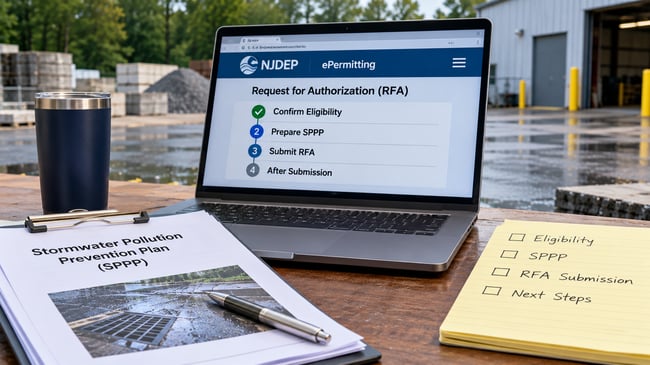
How Do You Submit a 5G2 RFA Through NJDEP Online?
NJDEP requires RFAs for the 5G2 to be submitted electronically through its NJDEP Online portal. Older guides and older versions of the forms still tell you to mail an original to NJDEP's Permit Administration Section, but a paper package isn't how it works anymore. NJDEP's Division of Water Quality processes applications and sends its correspondence electronically as well, so expect questions and your authorization to arrive that way too. Here's the sequence we follow.
- Pull the current 5G2 permit, the RFA checklist, and the forms from NJDEP's 5G2 page and permit forms page, and read the permit itself. It's short, and it's what an inspector holds you to.
- Complete the NJPDES-1 with your owner, operator, facility, and contact information.
- Complete the 5G2 supplemental form, which asks about exposed materials and activities. If you qualify, it's brief, because nothing should be exposed.
- Sign the 5G2 certification form, after the right person has reviewed it.
- Assemble the package against NJDEP's checklist, including the site map, and scan everything cleanly.
- Sign in to NJDEP Online and submit the package following the portal's current instructions.
- Save a complete copy of what you sent, along with any confirmation the portal gives you.
Get your portal access sorted out early, because you can't file without it, and the person who handles it may not be the person who's been working on the forms. NJDEP changes the portal's screens and menu names from time to time, so treat the steps above as the shape of the process and follow NJDEP's current on-screen instructions for the exact clicks.
What Does a 5G2 Request for Authorization Cost?
New Jersey's stormwater program runs on annual fees. In our experience there's no separate application fee for the 5G2, and your first bill arrives after NJDEP authorizes you. The 5G2 minimum annual fee has been $800 in NJDEP's fee reports, and that's the lowest of New Jersey's industrial stormwater permits. The fee schedule sits in N.J.A.C. 7:14A-3.1, and NJDEP publishes an annual fee report each fiscal year, so check the current one before you budget. Payment is due within 30 days of NJDEP assessing the fee. If the bill never shows up, you still owe it, and we've seen facilities lose coverage over an invoice the state forgot to send, so call NJDEP and ask for it.
The fee is the smaller part of what most facilities spend. Getting to the 5G2 can mean buying a lidded dumpster, putting up a small storage shed, or paying for regular sweeping, and some of those costs repeat every year. There's also staff time for the forms, the SWPPP, inspections, and annual training. If you bring in a consultant, the price depends on the site's size and complexity, whether a plan already exists, and whether you want training and inspection support folded in. Our article on what an NPDES permit costs in 2026 breaks those drivers down. If you'd like a price for RMA's help with your own facility, the pricing calculator below gives you a quick estimate.
What Happens After You Submit Your 5G2 RFA?
NJDEP reviews the package, may come back with questions, and then issues an authorization letter. That letter names the permit category you're covered under and gives your facility's NJPDES number, which starts with NJG for general permits. Keep it where you can find it, because landlords, lenders, customers, and inspectors all ask for it eventually. The first annual fee bill follows the authorization.
The wait is the part nobody can predict. It can run a few weeks or the better part of several months, and our article on how long it takes to get a New Jersey stormwater permit covers what drives that range. Don't sit idle while you wait. Start your inspections, training, and recordkeeping as if you were already covered, so you have records from day one if anyone asks about your application.
Once you're covered, the 5G2's ongoing work is lighter than most NJPDES permits. You'll follow your SWPPP, run and document regular inspections, complete one comprehensive annual inspection and the annual certification, and train staff each year. In our experience the 5G2 doesn't require stormwater sampling, which is a big reason it's the simplest permit NJDEP offers. If training is the piece you want a low-cost answer for, see our article on taking 5G2 training online or browse our online training library. For a fuller picture of day-to-day requirements, our guide to the 5G2 permit goes through them.
Also watch for renewals. NJDEP's current 5G2 master permit took effect February 1, 2023, and general permits run on multi-year terms, so check NJDEP's 5G2 page for the current permit before you file and again whenever NJDEP reissues it. When a new version comes out, confirm your coverage rolled over so you don't learn otherwise during an inspection.
What Mistakes Slow Down a 5G2 Request for Authorization?
The most common one is filing before the site actually qualifies. Someone reads that the 5G2 is the cheap, simple permit, files for it, and then an inspector finds a pallet yard behind the building. Certifying that nothing is exposed when something is puts you in a worse position than not having filed, so be sure about the walk-through before anyone signs. If you're close but not there, make the changes first or file with a real plan to complete them inside the six-month window.
The next group is paperwork. Using an outdated form, leaving the site map off, or having the wrong person sign can each stall a package, and so can an owner and operator name that doesn't match your corporate records. After that come the gaps that show up later: a SWPPP that was never finished, inspection and training records that started late, and an annual fee that went unpaid because the invoice went to someone who left. Our article on common NPDES permit problems covers the ones we see most.
One more habit is worth building. A facility that qualified for the 5G2 years ago may have added an outdoor storage area, a new dumpster location, or a loading operation since. Compare your site to your authorization every so often, and fix drift before an inspector finds it.
Should You File the 5G2 RFA Yourself or Get Help?
For the 5G2, doing it yourself is realistic. If someone on your staff can read the permit, fill out the forms, write a SWPPP from NJDEP's template, and run the inspections and training, you don't need us or anyone else, and you can keep the consulting money. Our general guide to applying for a stormwater permit yourself lays out the tradeoffs.
Help starts to pay off in a few situations: you're not sure the 5G2 fits, you're close to qualifying and want to know what changes would get you there, or nobody on your team has the time to own the program after it's issued. A consultant can also tell you early whether a different permit makes more sense for your operation.
We should be clear about where RMA fits. We use senior staff, we're not the cheapest option, and we're a small firm, so we can't always meet very tight timelines. We also don't do engineering design, treatment system construction, or construction-phase permits, and if your situation needs one of those, we'll say so and point you toward the right people.
How Does RMA Help With 5G2 Coverage?
We're based in New Jersey, and we've been helping facilities with environmental compliance since 1992. For the 5G2, that usually means confirming your site qualifies, suggesting the small changes that would get a close site over the line, preparing the RFA package, writing a SWPPP built for your facility, and training your team to run it. We don't take your stormwater samples, and under the 5G2 you won't have any to take. After you're permitted, we offer annual support, such as reminders, SWPPP updates, inspection prep, and answers to questions as they come up. You can lean on us as much or as little as you like.
There's no pressure and no obligation. You can call us, email us, or fill out the form on our website, and we'll look at your situation and tell you where we can help and where we can't. When you're ready, contact RMA and we'll help you work out the right next step.