How SIC Codes Decide Whether a New Jersey Business Needs an Industrial Stormwater Permit, With Real Examples of Who's Covered and Who Isn't
A lot of New Jersey business owners don't know the state regulates the rainwater running off their property at all, let alone that it might treat their business as "industrial." Here's the short answer. For stormwater purposes, "industrial" doesn't mean smokestacks, big buildings, or heavy equipment. It means your site's SIC code, a four-digit federal code that describes what a location mainly does, shows up on a specific list in the stormwater rules. If your code is on that list, the New Jersey Department of Environmental Protection (NJDEP) treats rain and snowmelt running off your work areas as industrial stormwater, and you need permit coverage or a formal exclusion no matter how small you are. If your code isn't on the list, you generally don't need an industrial stormwater permit, even if your shop looks a lot grittier than some businesses that do.
That code-based test produces some results that surprise people. A small bakery that sells bread wholesale is on the list, while a busy collision repair shop isn't. A craft brewery is covered, but a car dealership with a full service department isn't. Trucking companies land somewhere in between, because only certain parts of their yards count. In this article, we'll walk through what "industrial" means under New Jersey's rules, how to find and check your SIC code, a table of common New Jersey business types and where they fall, the special rule for transportation businesses, and the mistakes we see when businesses check their own codes. If you'd rather have someone look at your specific site, you can always reach out to RMA and we'll tell you where you stand.
Table of Contents
TL;DR
Your New Jersey business is "industrial" for stormwater purposes if the main activity at your site has an SIC code on the federal list New Jersey uses, which covers most manufacturing, recycling, mining, landfills, warehousing, and a few others. Size doesn't matter, and plenty of small shops like commercial bakeries, breweries, print shops, and cabinet makers are on the list, while auto body shops, dealerships, quick lubes, contractor yards, and data centers generally aren't. Trucking, bus, marina, and similar transportation businesses are only covered for their vehicle maintenance, fueling, equipment cleaning, and deicing areas. If you're on the list, you'll need a stormwater permit or a no exposure exclusion, so check your code against the actual list instead of trusting a code from a tax form or database.
What Does "Industrial" Mean Under New Jersey Stormwater Rules?
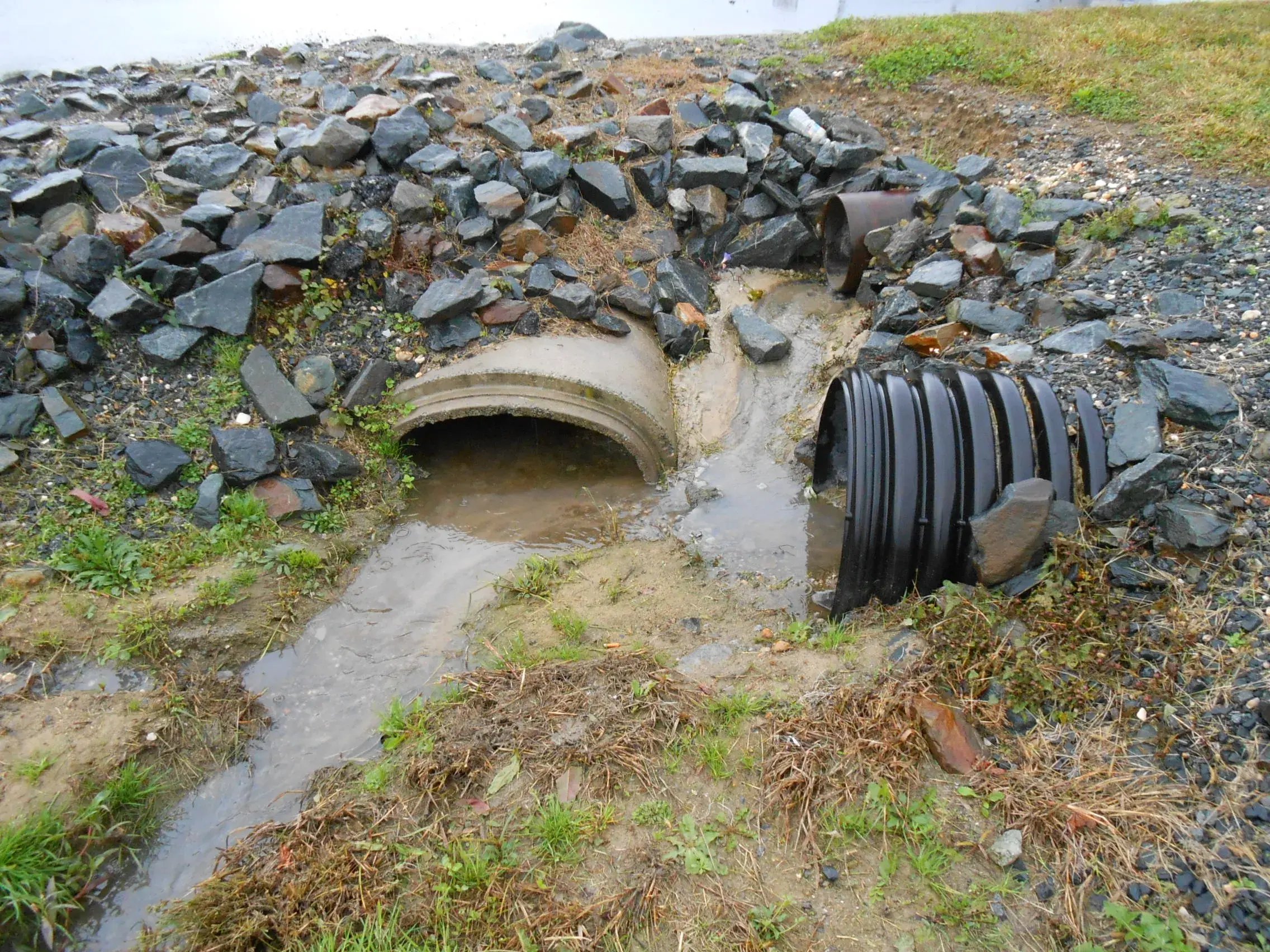
Stormwater is just rain and melted snow running off roofs, parking areas, and yards. When it runs across places where materials are stored, products are made, or equipment is fixed, it picks up whatever is sitting there and carries it to a storm drain, a ditch, a stream, or into the ground. That's the problem the industrial stormwater program is built to address.
In New Jersey, NJDEP runs that program through NJPDES, the New Jersey Pollutant Discharge Elimination System. NJPDES is the state's permit program for anything discharged to New Jersey's waters, and it's the state version of the federal NPDES program. The rules live in N.J.A.C. 7:14A, and they define something called "stormwater discharge associated with industrial activity." That definition follows the federal one at 40 CFR 122.26(b)(14), which sorts regulated businesses into 11 categories. Most of those categories are defined by SIC code. A few are defined by a description of the activity, like landfills or hazardous waste facilities. If you want the longer background on that federal term, our article on stormwater associated with industrial activity covers it.
Two things about this definition trip people up. First, it's a label test, not a measurement of how dirty your site is. There's no employee count, revenue threshold, or acreage cutoff for industrial facilities. A three-person sign shop and a 300-person factory are judged the same way. Second, it isn't the whole property that counts. The definition specifically leaves out areas like office buildings and their parking lots, as long as their drainage isn't mixed with runoff from the industrial areas. What's regulated is the runoff from the places where industrial work and materials meet the weather.
How Does the SIC Code Test Decide If You Need a New Jersey Stormwater Permit?
SIC stands for Standard Industrial Classification. It's a numbering system the federal government built to sort businesses by what they do, and the version the stormwater rules rely on dates to 1987. The federal government mostly replaced SIC with the newer NAICS system (the North American Industry Classification System) in the late 1990s, but the stormwater rules were written in SIC and still use it. NJDEP's guidance on regulated facilities recognizes equivalent NAICS codes, so if you only know your NAICS code, you can translate it using a NAICS to SIC crosswalk.
The code that matters is your site's primary SIC code, meaning the code that best describes the main activity at that location. It's about what happens at the property, not what your company does overall. A manufacturer's standalone sales office isn't a manufacturing site, and a distribution company that also runs a small production line at one building may need to look at that building differently from the rest.
In practice, the test runs in three steps. You figure out the primary activity at your site and the SIC code that matches it. You check that code against the categories in the rules. If it's on the list, you then look at the details that change the answer, like whether you're a transportation business that's only partly covered and whether any industrial materials or activities are exposed to rain. If your code isn't on the list and none of the activity-based categories apply, you're generally not in the industrial stormwater program at all. Our broader guide on who needs a stormwater permit walks through the same logic at the national level.
The SIC Manual itself describes each code in plain words, and OSHA hosts a searchable copy online. Reading the actual description is worth the few minutes it takes, because the four-digit labels can be misleading on their own.
Which SIC Codes Make a Business "Industrial" for New Jersey Stormwater?
Here's the full set of categories in plain language. The Roman numerals match the federal definition, and New Jersey's definition follows the same structure. Where a category lists two-digit codes, every four-digit code that starts with those digits is included unless an exception is noted.
| Category |
What It Covers |
SIC Codes or Description |
| (i) |
Industries with federal stormwater effluent limits |
Defined by federal effluent guidelines, such as cement manufacturing and asphalt emulsion |
| (ii) |
Heavier manufacturing |
24 (lumber and wood, except 2434), 26 (paper, except 265 and 267), 28 (chemicals, except 283), 29 (petroleum and asphalt products), 311, 32 (stone, clay, glass, and concrete, except 323), 33, 3441, 373 |
| (iii) |
Mining, quarrying, oil and gas |
10 through 14, active or inactive |
| (iv) |
Hazardous waste facilities |
Hazardous waste treatment, storage, or disposal facilities |
| (v) |
Landfills and land application |
Landfills, land application sites, and open dumps that receive industrial waste |
| (vi) |
Recycling |
Scrap yards, salvage yards, auto junkyards, battery reclaimers, including 5015 and 5093 |
| (vii) |
Power plants |
Steam electric generating facilities, including coal handling |
| (viii) |
Transportation (partial coverage) |
40, 41, 42 (except 4221 to 4225), 43, 44, 45, and 5171, only for maintenance, equipment cleaning, and airport deicing areas |
| (ix) |
Sewage treatment |
Treatment works of 1.0 million gallons per day or more, or with an approved pretreatment program |
| (x) |
Construction |
Land disturbance during construction, handled under a separate construction permit |
| (xi) |
Lighter manufacturing and warehousing |
20 (food and beverage), 21, 22, 23, 2434, 25, 265, 267, 27 (printing), 283, 285, 30, 31 (except 311), 323, 34 (except 3441), 35, 36, 37 (except 373), 38, 39, and 4221 to 4225 |
A few things stand out once you see it laid out. Almost every kind of manufacturing is on the list somewhere, from chemical plants in category (ii) down to jewelry and sign making in category (xi). Recycling is on the list by description, so scrap and salvage businesses are covered even though they don't make anything. Warehousing shows up twice: general and refrigerated warehousing (4221 to 4225) is carved out of the transportation category and placed in category (xi) instead, so a third-party warehouse is fully on the list.
What's missing matters just as much. Retail, restaurants, offices, most wholesale distribution, construction contractors' own yards, and nearly all service businesses (auto repair, equipment rental, laundries, data processing) aren't on the list. Construction is on the list in category (x), but it's handled through New Jersey's separate construction stormwater coverage (the 5G3 permit) along with soil erosion and sediment control approvals. Those are construction-phase requirements that a project's engineer or contractor usually handles, and RMA doesn't prepare them. Once a new building is up and running, the operational question in this article is the one that applies.
Which New Jersey Business Types Need Industrial Stormwater Permits?
The table below shows where common New Jersey business types usually land. Treat the SIC codes as typical, not automatic. Your code depends on what your specific site mainly does, and two businesses with similar names can fall on opposite sides of the line.
| Business Type |
Typical SIC Code |
On the List? |
Notes |
| Ready-mix concrete plant |
3273 |
Yes |
New Jersey has a general permit written for concrete products manufacturing |
| Precast concrete or block maker |
3271, 3272 |
Yes |
Same family as ready-mix |
| Hot mix asphalt plant |
2951 |
Yes |
Has its own New Jersey general permit |
| Quarry or sand and gravel pit |
1422, 1442 |
Yes |
Mining category, with industry-specific permits |
| Scrap metal yard |
5093 |
Yes |
Covered as recycling even though it's a wholesale code |
| Auto salvage or junkyard |
5015 |
Yes |
Covered as recycling |
| Commercial (wholesale) bakery |
2051 |
Yes |
A retail bakery selling on site (5461) isn't |
| Brewery, winery, or distillery |
2082, 2084, 2085 |
Yes |
Beverage manufacturing is in the food group |
| Coffee roaster |
2095 |
Yes |
A cafe that roasts a little for its own counter is usually classified as a restaurant |
| Packaged ice maker |
2097 |
Yes |
Food manufacturing, even though the product is frozen water |
| Commercial printer |
2752 |
Yes |
A copy and print shop classified as photocopying (7334) isn't |
| Kitchen cabinet shop |
2434 |
Yes |
Listed by name in category (xi) |
| Sign maker |
3993 |
Yes |
Miscellaneous manufacturing |
| Machine shop |
3599 |
Yes |
Industrial machinery group |
| Third-party or cold storage warehouse |
4222, 4225 |
Yes |
Many keep everything indoors and qualify for the no exposure exclusion |
| Trucking terminal |
4213, 4231 |
Partly |
Only maintenance, fueling, and washing areas |
| School bus depot |
4151 |
Partly |
Only maintenance, fueling, and washing areas |
| Marina with boat repair |
4493 |
Partly |
Repair, painting, fueling, and washing areas |
| Fuel distributor with a bulk plant |
5171 |
Partly |
A retail heating oil dealer (5983) generally isn't |
| Wholesale distributor warehouse |
50xx, 51xx |
No |
Exceptions are scrap (5093), salvage (5015), and bulk petroleum (5171) |
| Auto repair or body shop |
7538, 7532 |
No |
Service businesses aren't on the list |
| Quick lube |
7549 |
No |
Service business |
| Car dealership |
5511 |
No |
Car wash water is a separate wastewater question |
| Gas station |
5541 |
No |
Retail, not transportation |
| Construction contractor's yard |
15xx to 17xx |
No |
The yard isn't listed, even with equipment and materials stored outside |
| Equipment rental yard |
7353, 7359 |
No |
Service business |
| Landscaping company |
0782 |
No |
Wood waste recycling or leaf composting is a different story |
| Data center |
7374 |
No |
Data processing services aren't on the list |
| Dry cleaner or commercial laundry |
7216, 7211 |
No |
Service business |
The pattern behind the surprises is simple once you see it: the list follows what a business makes or processes, not how messy the work looks. A collision shop full of paint, solvents, and used oil is a service business, so it's off the list. A wholesale bakery with nothing outside but a dumpster and a loading dock is a food manufacturer, so it's on. The same goes for the copy shop and the commercial printer down the street, which can do similar work under codes that fall on opposite sides of the line.
Being off the list doesn't mean anything goes. Pollution that runs off any property can still violate New Jersey's water pollution laws, local ordinances still apply, and wash water or other process water is regulated separately from stormwater. It just means you aren't required to get industrial stormwater permit coverage based on your SIC code.
Why Are New Jersey Trucking and Transportation Businesses Only Partly Covered by Stormwater Rules?
Transportation businesses get their own rule, category (viii), and it's the one people most often misread. It covers railroads (SIC 40), local transit and school buses (41), trucking and courier companies (42, except warehousing), the Postal Service (43), water transportation including marinas (44), air transportation including airports (45), and petroleum bulk stations and terminals (5171). But being in one of those groups doesn't pull in the whole site. Only the parts of the facility used for vehicle maintenance, equipment cleaning, or airport deicing count as industrial.
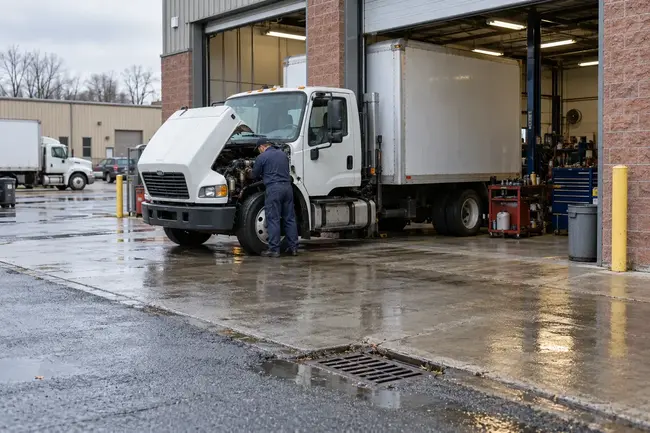
Vehicle maintenance is defined broadly. It includes mechanical repairs, vehicle rehabilitation, painting, fueling, and lubrication. So a trucking company that parks its tractors overnight, fuels at public truck stops, and sends its rigs to a dealer for service generally has no industrial area at all, and therefore no industrial stormwater permit obligation. Add a fuel island, a two-bay repair garage, and an outdoor wash pad, and those areas, along with the runoff draining from them, are now industrial stormwater. The parking rows, office, and driver lounge still aren't, as long as their drainage stays separate.
The same logic plays out across New Jersey's transportation businesses. A school bus contractor with an on-site garage and fueling has covered areas. A marina is covered where boats get hauled, sanded, bottom painted, pressure washed, or fueled, not where they sit in slips. An airport is covered where aircraft are maintained, fueled, or deiced. A fuel distributor with a bulk plant classified as 5171 is covered for its truck maintenance and cleaning areas, while a retail heating oil dealer classified as 5983 isn't in the transportation category at all.
Equipment cleaning deserves a separate note. Washing trucks or equipment creates wash water, and wash water isn't stormwater. If that water leaves the site or soaks into the ground, it's a process water discharge that needs its own handling. Our article on the difference between stormwater and process water explains why that distinction changes what you need.
What Happens If Your SIC Code Is on New Jersey's Industrial Stormwater List?
Being on the list means you need to do something, but it doesn't always mean a full permit. New Jersey gives covered businesses a few paths, and we'll only touch on them here since each has its own article.
If every industrial material and activity at your site is under a storm-resistant roof or otherwise kept out of the weather, you may qualify for New Jersey's Permanent No Exposure Certification under N.J.A.C. 7:14A-24.6. That's a formal exclusion, not a permit, and it's common for indoor manufacturers and warehouses. Our article on what no exposure means covers how strict that standard is.
If you do have exposure, most covered businesses that don't fit an industry-specific permit end up under the 5G2 Basic Industrial Stormwater General Permit. Certain industries have their own general permits instead: Concrete Products Manufacturing (CPM), Hot Mix Asphalt (R4), Mining and Quarrying (R13), Sand and Gravel (RSG), Scrap Metal (SM and SM2), Vehicle Recycling (RVR), and Wood Waste Recycling and Leaf Composting (WRC). Our guides to concrete plant stormwater permits and the SM2 scrap metal permit go deeper on two of them. Sites that can't fit any general permit may need an individual NJPDES industrial permit. For a side-by-side look at the general, individual, and no exposure options, see which NPDES permit you need.
Permitted facilities generally keep a written stormwater plan called a SWPPP (pronounced "swip"). In New Jersey you'll also hear it called an SPPP, an SP3, or just a stormwater plan. The exact requirements that come with each permit vary, so read the permit that fits your category before assuming what applies. Our overview of NJPDES stormwater permit requirements is a good starting point, and our SWPPP explainer covers what goes into the plan.
One more thing to know: ignoring the question doesn't make it go away. NJDEP's rules allow it to send a written notice to a business it believes has industrial stormwater, asking it to apply for a permit, submit a Permanent No Exposure Certification, or explain why neither is required. It's far easier to answer that letter if you've already checked your code.
Common Mistakes When New Jersey Businesses Check Their SIC Code for Stormwater
The most common mistake is grabbing a code from the wrong place. Tax returns, insurance applications, credit reports, and business databases all assign industry codes, but they're often NAICS rather than SIC, sometimes describe the parent company instead of the site, and are occasionally just wrong. A lender's database might call your business "concrete contractor" when your site is a precast plant, or "trucking" when your main activity at that address is warehousing. What matters for stormwater is an honest description of what happens at the property, matched to the SIC Manual's definitions.
The second mistake is assuming the main business is the only thing that counts. Some sites run more than one kind of operation, like a distributor with a small manufacturing or repackaging line, or a contractor with an on-site concrete batch operation. A listed activity happening at a site whose primary business isn't listed can still bring that part of the property into the program. If you've got something like that going on, it's worth a closer look before deciding you're exempt.
The third is thinking water has to reach a stream to matter. New Jersey's industrial stormwater permits cover discharges to groundwater as well as surface water, so runoff that drains into an infiltration basin, a dry well, or just soaks into a gravel yard can still be a regulated discharge. "Our water never leaves the property" isn't an exemption in New Jersey.
The opposite mistake shows up in some of the state's older urban areas, where storm drains on a property may connect to a combined sewer that carries both sewage and stormwater to a treatment plant. If all of a site's runoff goes into that kind of system, the sewerage authority's rules may apply instead of, or alongside, an NJPDES stormwater permit. That depends on exactly where your site drains, so confirm it with your sewerage authority or NJDEP rather than assuming either way.
Finally, people forget that businesses change. A warehouse that starts light assembly, a distributor that starts mixing products, or a landscaper that starts accepting wood waste from other companies may have moved into a new category. When your operations change, check your code again.
How RMA Helps New Jersey Businesses Sort Out Industrial Stormwater Coverage
We're a family-run environmental consulting firm based in New Jersey, and we've been working with NJDEP's stormwater program and its permit categories since we started in 1992. A big part of that work starts with the exact question in this article: is this site in or out? We'll look at what happens at your property, figure out the right SIC code, check whether only part of the site is covered, and tell you whether you're looking at a no exposure certification, a general permit, or nothing at all.
If the answer is that you don't need a permit, we'll say so plainly. And if you do need one and your situation is straightforward, you may be able to handle it yourself, which we cover in our article on whether you can get a stormwater permit yourself. When a site is more complicated, we help with permit coverage, SWPPPs, inspections, training, and the annual work that keeps you in compliance. You can call us, send an email, or fill out the form on our website, and there's no obligation. If you're not sure where your business falls, contact RMA and we'll help you find out.