How New Jersey's Permanent No Exposure Certification Can Stand In for a Stormwater Permit When Everything Happens Under Cover, and What Disqualifies a Site
Plenty of New Jersey business owners hear "stormwater permit" and assume it can't be about them. Everything happens inside a building. Nothing sits in the yard. Rain lands on the roof and runs down a drain, just like it does at an office or a store. That instinct is often right, but not always, and the answer depends less on your building than on what kind of business you run. The state regulates runoff from certain industrial categories, and an indoor operation in one of those categories isn't automatically off the hook. It may need to file a certification that says so.
Here's the short version. If you're in a covered industrial category and every industrial material and activity at your site is truly sheltered, New Jersey lets you claim an exclusion called Permanent No Exposure instead of getting a stormwater permit. If you're not in a covered category, you probably have nothing to file at all. Below, we'll cover who's covered, how the exclusion works, what disqualifies a site, what filing involves, and what to do if you can't qualify. If you'd rather talk it through with someone, you can always reach out to RMA.
Table of Contents
TL;DR
An all-indoor New Jersey business may have little to do about stormwater, but it isn't always nothing. If your type of business is covered by NJDEP's industrial stormwater rules, you need either a permit or a Permanent No Exposure Certification, which excludes you from the permit requirement when every industrial material and activity is under permanent cover. Any outdoor exposure, even a small one, can disqualify the whole facility. The certification is renewed every five years, doesn't transfer to a new operator, and NJDEP can inspect, so confirm the current form and process before you file. If your business isn't in a covered category, you probably don't need either one.
What Does Stormwater Mean for a Business That's All Indoors in New Jersey?
Stormwater is just rain and snowmelt running off your property. It lands on the roof, the pavement, and anything left outside, picks up what it touches, and leaves through a storm drain, a ditch, a creek, or a basin that lets it soak into the ground. In New Jersey, the agency that regulates this at industrial sites is the New Jersey Department of Environmental Protection (NJDEP). It does so through the New Jersey Pollutant Discharge Elimination System, or NJPDES, which is the state's version of the federal NPDES permit program. The rules sit at N.J.A.C. 7:14A and rest on the state's Water Pollution Control Act.
The regulation isn't aimed at rain itself. It's aimed at rain that touches industrial materials or activities and carries pollutants away. That's why an indoor business is in a different position than a plant with stockpiles in the yard. If nothing industrial is exposed, the runoff from your roof and lot isn't what the program is worried about, and New Jersey built the no exposure exclusion for exactly that situation.
There's a catch, though. The exclusion isn't automatic. A covered business that keeps everything inside still has to claim it, and staying silent isn't the same as being excluded. NJDEP can send a written request to a business it believes is regulated, asking it to apply for a permit, certify no exposure, or explain why it needs neither. Getting that letter without a certification on file is an uncomfortable place to start. Our article on what stormwater associated with industrial activity means explains the term the rules use for the runoff they cover.
Which Indoor Businesses Does New Jersey's Industrial Stormwater Program Cover?
Whether you're covered comes down to your Standard Industrial Classification (SIC) code, a four-digit code describing the main activity at your specific site. The covered list is shared with the federal rules and includes most manufacturing, mining and quarrying, recycling and salvage, waste facilities, and utilities and treatment plants. Transportation businesses are covered only for the parts of the site involved in vehicle maintenance, equipment cleaning, fueling, and deicing. Getting the code wrong is a common way to file for something you don't need, or to skip something you do, so it's worth confirming before you decide.
| Your situation |
What it usually means |
| Manufacturer in a covered category, all work and storage inside |
A Permanent No Exposure Certification may fit |
| Warehouse storing packaged goods indoors |
Often not a covered category, but confirm the SIC code |
| Office, retail store, restaurant |
Typically not covered at all |
| Data center, auto body shop, dealership, quick-lube |
Often not covered, though a fueling or maintenance area can change that |
| Recycler or scrap operation |
Rarely fully indoors, and usually needs an industry-specific permit |
Where your runoff goes matters too. New Jersey's rules reach water that flows to streams and storm sewers as well as water that soaks into the ground. Runoff that goes into a sanitary or combined sewer (one pipe carrying both sewage and rainwater to a treatment plant) is handled differently, and the local sewerage authority's rules may apply instead of, or alongside, NJPDES. Several older New Jersey cities have combined sewers in at least part of town, and a single property can drain more than one way, so find out where your own roof drains and inlets send the water.
What Is New Jersey's Permanent No Exposure Certification?
New Jersey's version of the exclusion is the Permanent No Exposure Certification, and its rules are in N.J.A.C. 7:14A-24.6. It isn't a permit. It's a signed certification, filed with NJDEP on its form, saying that no stormwater at your facility is exposed to industrial materials or activities. If you qualify, you're excluded from the NJPDES industrial stormwater permit requirement, so you skip the permit routine of a stormwater plan, inspections, and annual certification.
The word "permanent" does a lot of work. As NJDEP defines it, all industrial materials have to be stored, and all industrial activities have to happen, inside a permanent structure. In practice that means a building anchored to a foundation, with a roof and walls. A tarp over a pile, a canopy open on the sides, or a trailer parked in the yard doesn't meet that standard as we read it. It's stricter than the federal version of the same exclusion, which accepts any storm-resistant shelter, so a site that would pass federally can still fail in New Jersey.
The certification isn't a loophole either. You're signing a statement about your site, NJDEP can come out and check it, and an inaccurate certification can create bigger problems than the permit would have. Our guide to general, individual, and no exposure options compares the paths side by side, and our article on what no exposure means under a stormwater permit covers the general concept.
What Disqualifies a Site From the New Jersey No Exposure Exclusion?
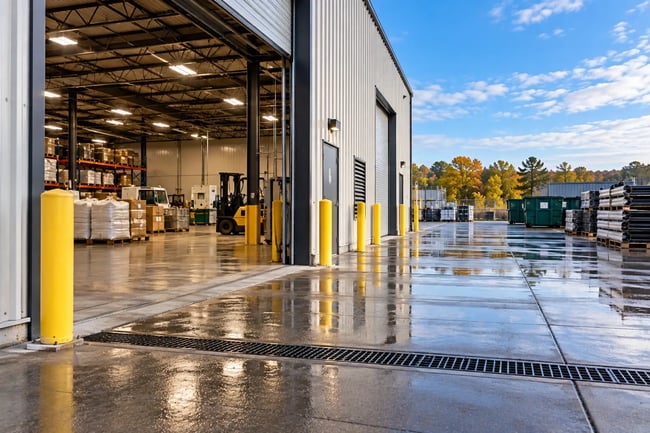
Exposure covers a wider range of things than the production floor. The trouble usually starts at the loading dock, the back corner, and the things nobody thinks of as part of the operation. The table below lists what generally counts as exposure under the no exposure rules. NJDEP's current form and instructions control, so treat this as a way to spot problems, not as a final checklist.
| What counts as exposure |
Where indoor businesses commonly run into it |
| Materials, products, or waste stored outdoors |
Pallets by the dock, a scrap bin or bale of cardboard by the back door |
| Open, rusted, or leaking drums, tanks, and containers |
An open-top roll-off, a drum with a bad bung, an uncovered dumpster with industrial waste in it |
| Loading, unloading, or transporting materials in the open |
Trucks unloaded at an uncovered dock, even when everything goes straight inside |
| Spills, leaks, or residue on the ground or in storm inlets |
Oil stains where a forklift parks, staining around a dock drain |
| Using or cleaning machinery and equipment outside |
Pressure-washing equipment in the lot, a compressor or chiller sitting outdoors |
| Material handling equipment left outside |
Forklifts and similar equipment parked in the yard overnight |
| Leftover materials from past operations |
Residue on a pad where an old process used to run |
| Process wastewater applied or disposed of outdoors |
Washwater dumped in the yard (see our guide to stormwater versus process water) |
| Dust or deposits from stacks and vents showing up in runoff |
Visible residue on the roof or near a vent that washes off in the rain |
| Partial cover that isn't a permanent structure |
A tarp, a canopy open on the sides, a temporary shelter |
A few things may be allowed to stay outside under the rules: a watertight, covered dumpster used only for routine waste, vehicles used for material handling that are kept in good condition, and intact piping. Whether any of those apply to your site is a question for NJDEP's current form, and it's worth confirming before you rely on one.
The exclusion is facility-wide. You can't exclude the clean building and leave the exposed corner for later. One exposed item on the site can disqualify the whole facility. And even when a site otherwise qualifies, regulators generally keep the authority to require a permit if the runoff is contributing to a water quality problem. That's rare for a site that's truly indoors.
How Does Filing a New Jersey No Exposure Certification Work, and How Long Does It Last?
You file the certification with NJDEP on its Permanent No Exposure Certification form, and you resubmit it every five years. NJDEP updates its forms and online systems from time to time, so check the current form, instructions, and submission method on NJDEP's website before you file, or have us confirm them for you. Fees and processing times are worth confirming against NJDEP's current information too.
A few conditions travel with the exclusion. It doesn't transfer, so if a new company takes over the operation, the new operator has to file its own certification. NJDEP can inspect the site to confirm that the condition of no exposure exists. And if conditions change and something becomes exposed, the exclusion stops applying, and the discharge can be treated as unpermitted. The safe approach for a business that expects a change, like a new outdoor storage area, is to sort out the permit before the change happens, not after.
How to Check Your Site Before You Sign
Before you certify anything, walk the whole property during an actual rain. Look at the dock, the dumpster area, the lot, the roof drains, and the ground under anything parked outside. Water shows you where things pool and what it crosses on the way out. Take dated photos, write down your SIC code and where each drain goes, and keep that record with the certification. If something turns up, ask whether it's an easy fix. Moving a few drums inside costs far less than living with a permit.
What Happens If Your Indoor Business Can't Qualify for No Exposure in New Jersey?
Sometimes the honest answer is that a site can't get everything under cover. Then you're back to a permit, and for a business that's mostly indoors the usual fit is the Basic Industrial Stormwater General Permit, called the 5G2. NJDEP makes it available to facilities that have eliminated, or can eliminate within six months of authorization, all exposure of industrial materials and activities to rain and snowmelt. A lot of that is simple "remove and cover" work, like moving drums inside or putting a lid on a container.
Coverage starts with a Request for Authorization (RFA) filed with NJDEP. At the center of the permit is a stormwater pollution prevention plan, which we call a SWPPP. You'll also hear it called an SPPP (New Jersey's term), an SP3, or just a stormwater plan. It describes your site, where water flows, what's exposed, and how you keep pollutants out of runoff. From there you can expect inspections, training, and annual certification to NJDEP. Sampling depends on the permit category, so check the requirements for the one you land in. Our guides to the 5G2 Basic Industrial Stormwater Permit and to NJPDES stormwater permit requirements walk through what that looks like.
Some industries have their own permits instead, including concrete products, hot mix asphalt, mining and quarrying, sand and gravel, scrap metal, vehicle recycling, and wood waste recycling and leaf composting. And a site that can't eliminate exposure and doesn't fit a general permit may need an individual NJPDES permit, which we cover in our article on when you need an individual NJPDES industrial permit. Plenty of small facilities handle the basic permit on their own. Our article on whether you can get a stormwater permit yourself lays out when that works, and our online environmental training library can help with employee training.
Do Construction Permits Come Into Play When You Move Operations Indoors?
Sometimes they do. If getting to no exposure means building an addition, a new enclosed storage building, or a permanent cover over a dock, that work can trigger construction-phase requirements while it's happening. Depending on how much land is disturbed, those can include soil erosion and sediment control certification through the local Soil Conservation District, construction stormwater coverage under New Jersey's 5G3 general permit, municipal site plan approvals, and stormwater management design rules for major development under N.J.A.C. 7:8.
RMA doesn't prepare construction-phase permits or approvals. For that side of the project, you'll usually work with your engineer, your contractor, or a soil erosion specialist. What we can do is help you work out what the construction phase is likely to need and point you toward the right people. Once the building is up and the facility is running, the operational question comes back around, which is whether you need the no exposure certification or a permit, and that's the part we handle.
How RMA Helps New Jersey Businesses With Stormwater Permits and No Exposure Certifications
We're a family-run firm based in New Jersey, and we've been helping facilities with environmental compliance since 1992. A senior member of our team will look at your SIC code, your site, and where your water goes, and tell you whether you need a permit at all, whether no exposure is realistic, or whether the basic permit fits better. If you don't need us, or you can handle it yourself, we'll tell you that.
When you do want help, we can review your site, prepare the certification or the permit paperwork, write your SWPPP, and set up the inspections and annual certification that come with a permit. There's no pressure and no obligation. You can call us, send an email, or fill out the form on our website, and we'll talk through your situation. Whenever you're ready, just contact RMA and we'll help you find the right next step.