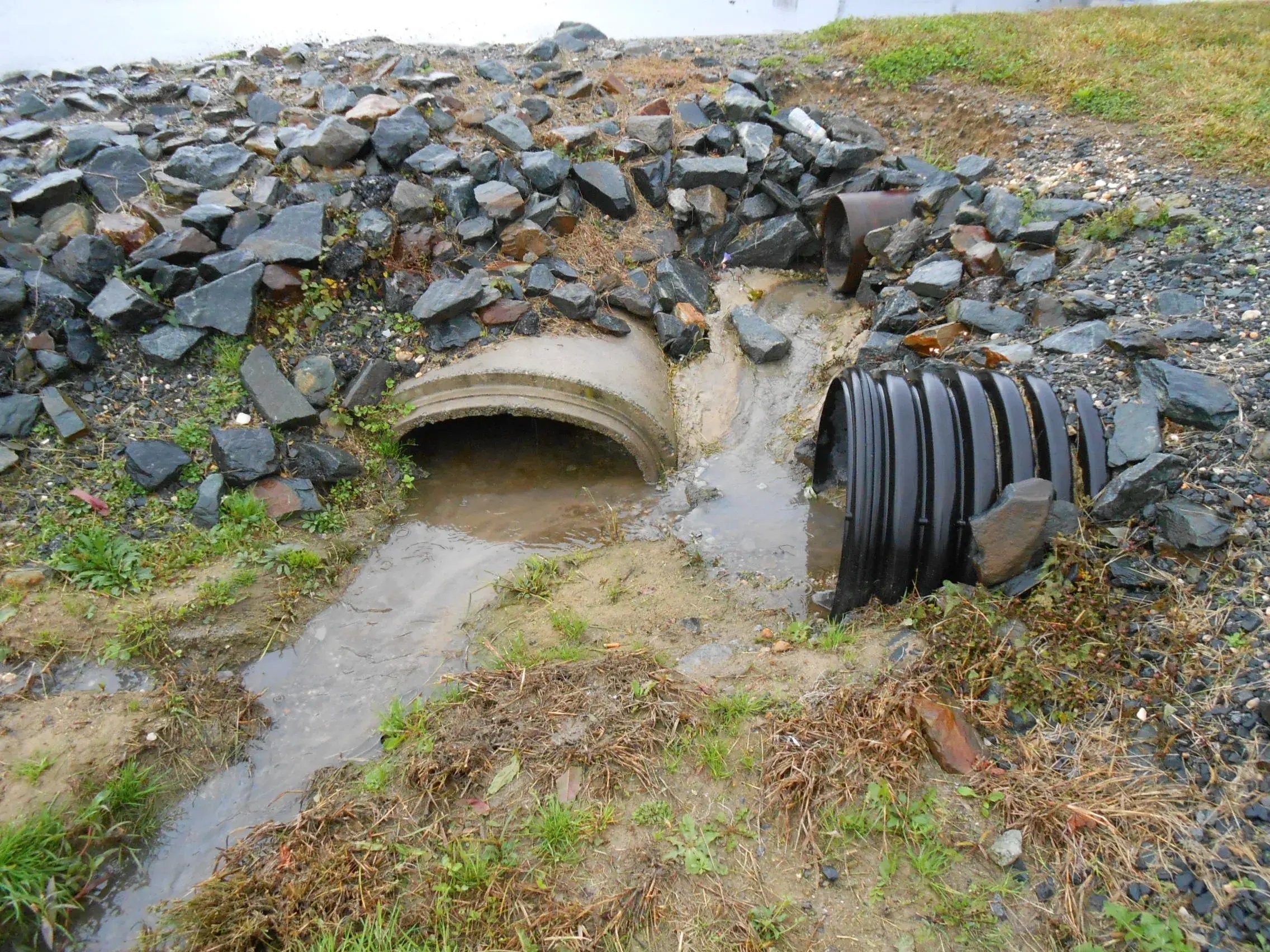
Stormwater Utilities in New Jersey: Your Town's Fee vs. Your NJDEP Permit
If your New Jersey business just got a bill from the town or county with the word "stormwater" on it, your first question is probably whether it has anything to do with the stormwater permit from the state. It doesn't, at least not directly. A stormwater utility fee is a local charge that pays for storm drains, basins, pipes, and flood projects. A stormwater permit from the New Jersey Department of Environmental Protection (NJDEP) is a state requirement about the rainwater that runs off your own site. A business can owe one, the other, both, or neither, and the answer depends on where you're located and what you do there.
This article walks through how New Jersey's stormwater utility law works, how the fees are calculated, how a fee differs from an NJDEP industrial stormwater permit, whether credits can bring a fee down, and how to find out what your own town charges. We're keeping town-level details general on purpose, because every utility sets its own rules. If you'd rather talk through your situation with people who work with NJDEP stormwater permits for a living, you can reach out to RMA any time.
Table of Contents
TL;DR
A stormwater utility fee is a local charge, created by a town, county, or authority under New Jersey's Clean Stormwater and Flood Reduction Act, that pays for local stormwater infrastructure. It's usually based on how much paved and roofed surface your property has. An NJDEP industrial stormwater permit is a separate state requirement about the runoff leaving your facility, and neither one replaces the other. A business can face both, and plenty of towns don't have a utility at all, so check your local ordinance and your bills, then confirm which NJDEP permit, if any, your site needs.
What Is a Stormwater Utility in New Jersey?
In March 2019, New Jersey passed the Clean Stormwater and Flood Reduction Act, which lets local governments set up stormwater utilities. A stormwater utility works a lot like a water or sewer utility, except the service is handling rain. It collects fees from property owners and uses the money to maintain and improve the drainage systems that carry runoff away from streets, lots, and buildings. The law allows these utilities but doesn't require them, so some towns have one and many don't.
The law lets several kinds of local entities create a utility: municipalities, counties, groups of municipalities, sewerage authorities, municipal and county utilities authorities, and county improvement authorities. Most of the pressure behind them is financial. Aging storm drains, flooding, and the permits that towns hold from NJDEP all cost money, including the municipal stormwater permits that cover a town's storm sewer system (known as MS4 permits) and the combined sewer overflow permits in older cities. NJDEP's guidance says utility fees can pay for work required under those permits and for maintaining stormwater facilities. The revenue is dedicated to stormwater, so it can't be folded into a town's general budget.
How Do New Jersey Stormwater Utility Fees Work?
The Act says a fee has to be a fair and equitable approximation of how much stormwater runoff a property contributes. It doesn't prescribe one formula, and NJDEP has said it can't set the dollar amount for any individual utility. In practice, most utilities use impervious surface as the measure, meaning the pavement, gravel that behaves like pavement, and rooftops that shed water instead of letting it soak in. The more of that a property has, the more runoff it produces, and the more it pays.
A common method is the equivalent residential unit, or ERU. The utility decides how much impervious surface a typical single-family lot has and calls that one ERU. A house might be billed as one unit, while a facility with a large building, a truck yard, and a paved storage area might be billed for dozens or hundreds, either by direct measurement or by tiers. That's why industrial and commercial properties often see a much bigger bill than the homes around them. Farmland assessed properties are generally not charged, and other exemptions vary by utility, so the local ordinance is the final word on who pays and how much.
How Is an NJDEP Industrial Stormwater Permit Different From a Utility Fee?
The state's permit program is called the New Jersey Pollutant Discharge Elimination System, or NJPDES. For industrial facilities, the concern is rain or snowmelt that touches industrial materials or activities outdoors, such as stockpiles, equipment, vehicle areas, or open storage, and then carries pollutants off the site. NJDEP handles this through a few paths: the Basic Industrial Stormwater General Permit (5G2), industry-specific general permits for categories like concrete products, scrap metal, and sand and gravel, individual permits, or an exclusion for facilities that truly have no exposure. Our articles on the 5G2 Basic Industrial Stormwater Permit and on NJPDES stormwater permit requirements cover those categories in more detail.
Permit coverage comes with duties that fall on the facility itself. You develop and follow a stormwater pollution prevention plan, which New Jersey's permits call an SPPP and which people also call an SP3 or just a stormwater plan. We'll use SWPPP, the term most people know. You also carry out inspections and an annual certification, and depending on the permit category there may be additional monitoring requirements. The local utility fee asks none of that. It's a bill for a share of the public drainage system. The table below puts the two side by side.
| |
Local Stormwater Utility Fee |
NJDEP Industrial Stormwater Permit |
| Who sets it |
A town, county, or authority that created a utility |
NJDEP, under NJPDES |
| What it is |
A recurring charge for the cost of managing local stormwater |
Permission to discharge industrial stormwater, with conditions |
| What triggers it |
Owning developed property where a utility exists |
Industrial activity or materials exposed to rain, depending on the category |
| How it's measured |
Usually by impervious surface on your property |
By what your facility does and what leaves the site |
| What you have to do |
Pay the bill, and apply for any credits you want |
Keep a SWPPP, inspect, train, certify, and follow permit conditions |
Can a Business Owe a Stormwater Utility Fee and Need an NJPDES Permit?
Yes, and that's a common surprise. A concrete plant in a town with a stormwater utility could pay a fee based on its paved yard and roofs, and it would still need to have the right NJDEP permit for what happens on that yard. The fee doesn't authorize you to discharge anything, and the permit doesn't pay for the town's drains. They answer different questions, so one can't stand in for the other.
It works the other way too. A warehouse or data center that keeps its materials and activities indoors often doesn't need an industrial stormwater permit at all, and may qualify for the no exposure exclusion, but it can still get a utility bill because it has a lot of roof and parking. Our article on what no exposure means explains how that exclusion works. And a facility with a permit in a town without a utility pays no fee, because nothing exists to charge it.
One wrinkle is worth knowing about. Some older New Jersey cities have combined sewers, where stormwater and sewage share pipes, and in those areas a sewerage authority's rules may apply to your runoff in addition to, or instead of, a state stormwater permit. Whether that touches your site depends on where your site drains, so confirm it with your local authority before assuming anything either way.
Do Stormwater Utility Credits Reduce a Business's Fee?
They can. The Act requires every utility to offer partial fee credits, and it describes three kinds. The first goes to properties that maintain and operate a stormwater system that met state and local standards when it was approved and that reduces, retains, or treats stormwater onsite. The second is an additional credit for properties with current best management practices (BMPs) that the municipality, county, or authority has approved. The third is an additional credit for green infrastructure that goes beyond the stormwater requirements that apply to the property. The Act doesn't say how large any credit is. Each utility decides that, along with how you apply and what proof it wants.
Notice what the credits are tied to: controls you've built and maintain on your property. They aren't tied to holding a state permit. Utilities in some other states give a credit for having an industrial stormwater permit, but we can't tell you whether yours does, and holding an NJPDES permit shouldn't be treated as a reason the fee goes away. Read the ordinance and the credit manual if one exists. If you have a detention basin, an infiltration system, or other controls, the paperwork that proves they're maintained is what usually earns the credit. A well-kept SWPPP that maps your drainage and documents your stormwater BMPs is a good place to pull that information from, though it doesn't replace whatever application the utility requires.
How Do You Find Out What Your Town's Stormwater Fee Is?
Start with the municipal website and look for a stormwater utility page or ordinance. If your town doesn't have one, check the county and the local sewerage or utilities authority, since any of them can run a utility. Then look at the actual bill. It should show how the utility measured your impervious area, and that number deserves a check against your site plan, because mistakes in aerial measurements happen and a pond, a gravel lot, or a demolished building can change the count. Many utilities have an adjustment or appeal process, but the deadlines and steps are local, so ask early instead of waiting for the next bill.
Next, ask about credits. Find out what the utility accepts as proof, how often you have to renew, and what the application costs, if anything. An engineer who knows your site is usually the right person to prepare a credit application when stormwater controls are involved. In parallel, confirm where you stand with the state. If you aren't sure whether your facility needs an NJDEP stormwater permit, our guide on who needs a stormwater permit is a good starting point, and our NPDES and stormwater learning center collects everything we've written on the topic. The NJDEP permit fees and the town's utility fee are separate charges, so budget for them separately.
How Does RMA Help With NJDEP Stormwater Permits?
We're a family-run environmental consulting firm based in New Jersey, and NJDEP stormwater permitting is a big part of what we do. We help facilities work out which permit applies to them, whether that's the 5G2, an industry-specific general permit, an individual permit, or the no exposure exclusion. We write and update SWPPPs, and we help with the inspections and annual certification that keep a permit in good standing.
There are also things we don't do. We don't set up or contest local stormwater utility fees, and we don't engineer the drainage systems that earn credits, so your town and your engineer handle that side. If all you have is a utility bill and nothing industrial happens outdoors at your site, you may not need us at all. If you'd like a second opinion on whether the state permit applies to you, you can call us, email us, or fill out the form on our website. You're welcome to reach out to RMA with no obligation, and we'll tell you honestly where you stand.