A Calm, Plain-English Look at New Jersey's Environmental Agency, Why Rainwater Running Off Your Property Can Be Its Business, and What That Means for You
If you've only recently heard the letters "NJDEP," maybe from a neighbor, a customer's paperwork, or a letter on your desk, it's natural to wonder who they are and why they'd have any interest in the rain that falls on your business. NJDEP is the New Jersey Department of Environmental Protection, the state agency in charge of protecting New Jersey's water, air, and land. It cares about rain at certain businesses because rainwater that runs across work areas picks up oil, dust, metals, and other material, then carries it into streams, bays, and groundwater. For most businesses, that doesn't mean trouble. It means understanding whether your site falls under the rules, and if it does, taking a few practical steps to keep runoff clean.
In this article, we'll explain what NJDEP is and what it oversees, why runoff from a business can become the agency's concern, what kinds of pollution rain picks up at work sites, how NJDEP regulates it, and what inspections and complaints look like in real life. We'll finish with a few calm next steps if you're not sure where your business stands. If you'd like someone to walk through your situation with you, you can always reach out to RMA, and we'll help you figure out whether any of this applies to you.
Table of Contents
TL;DR
NJDEP is New Jersey's environmental agency, based in Trenton, and it oversees water, air, waste, site cleanups, land use, parks, and wildlife across the state. It cares about rain at businesses because runoff from work areas carries oil, sediment, metals, and other pollutants into streams, bays, and groundwater, so certain industrial businesses need a stormwater permit or proof that nothing on site is exposed to rain. NJDEP checks on this through facility inspections and by responding to complaints. Most offices, stores, and service businesses aren't affected, and businesses that are can usually stay in good shape with a clear plan and some routine housekeeping.
What Is NJDEP, the New Jersey Department of Environmental Protection?
NJDEP is the state agency responsible for protecting New Jersey's natural resources and public health from pollution. It was created on April 22, 1970, the first Earth Day, which made New Jersey one of the earliest states to pull its environmental programs together under a single department. Its headquarters is on East State Street in Trenton, and it has staff and field offices working across the state.
The easiest way to understand NJDEP is to look at what it covers. It's a large agency with a wide reach, and most businesses only deal with one or two parts of it. Here's a simple breakdown.
| Area NJDEP Oversees |
What It Covers |
How a Business Might Run Into It |
| Water |
Streams, rivers, bays, and groundwater |
Stormwater permits, wastewater discharges |
| Air |
Emissions from equipment and processes |
Air permits for boilers, generators, or process equipment |
| Solid and hazardous waste |
How waste is stored, moved, recycled, and disposed of |
Hazardous waste handling, recycling approvals |
| Site remediation |
Cleanup of contaminated soil and groundwater |
Buying, selling, or closing certain industrial properties |
| Land use |
Wetlands, flood areas, and coastal zones |
Building or expanding near water or wetlands |
| Parks, forests, fish, and wildlife |
State parks and natural resources |
Rarely, outside of specific projects |
NJDEP works alongside the U.S. Environmental Protection Agency (EPA), but for most day-to-day matters in New Jersey, including stormwater, NJDEP is the agency you'll deal with. The federal government sets national water rules, and New Jersey runs its own program under state law, with some requirements that go further than the federal baseline. So when a business in New Jersey talks about its stormwater permit, it's almost always talking about something issued by NJDEP, not EPA.
Why Does NJDEP Care About Rain at New Jersey Businesses?
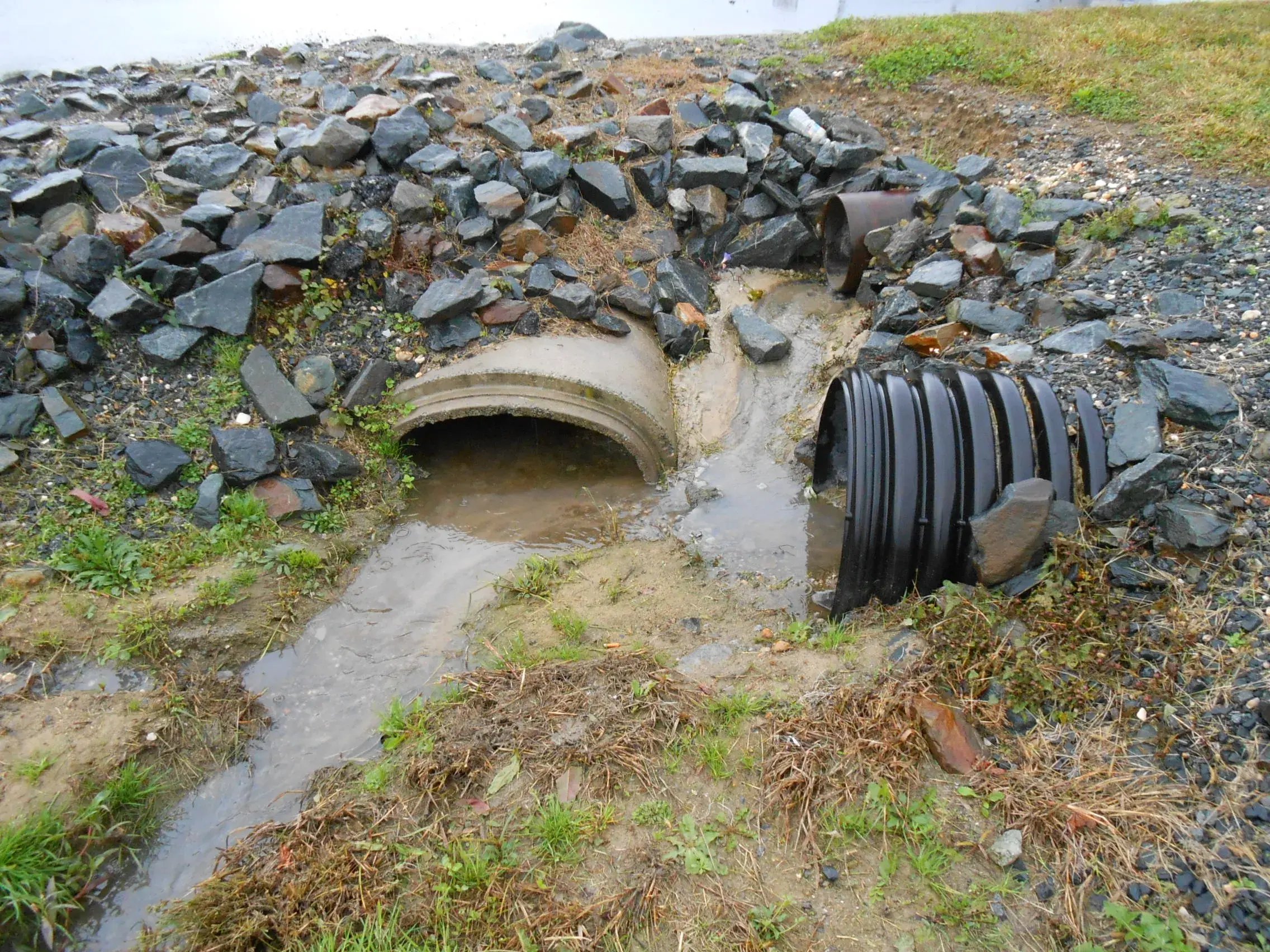
Rain itself isn't the problem. The issue is what rain touches on the way off your property. When it lands on a roof or a paved yard, it doesn't soak in. It runs downhill, gathering whatever is on the surface, and leaves the site through a storm drain, a ditch, or a basin. Most storm drains don't go to a treatment plant. They empty straight into the nearest stream or river, often with no filtering at all. That water then moves on toward places like the Raritan, the Passaic, the Delaware River, Barnegat Bay, and eventually the ocean.
Polluted runoff is one of the biggest water quality problems in New Jersey. The state is small, densely developed, and full of paved surfaces sitting close to waterways, so a lot of rain hits hard surfaces and moves fast. Runoff from one site might seem small, but thousands of sites draining into the same stream adds up. That's why the rules focus on businesses where industrial work happens outside or where materials are stored where rain can reach them.
Groundwater is part of the picture too. Many New Jersey residents get their drinking water from wells and aquifers, and runoff that soaks into the ground at a work site can carry pollutants down with it. New Jersey's water rules cover discharges to groundwater as well as discharges to surface water, which is one of the ways the state's program differs from the federal one. A business with no pipe leaving the property can still be in the program if its runoff soaks into the ground through a basin or a gravel yard.
What Pollution Does Stormwater Pick Up at a Business Site?
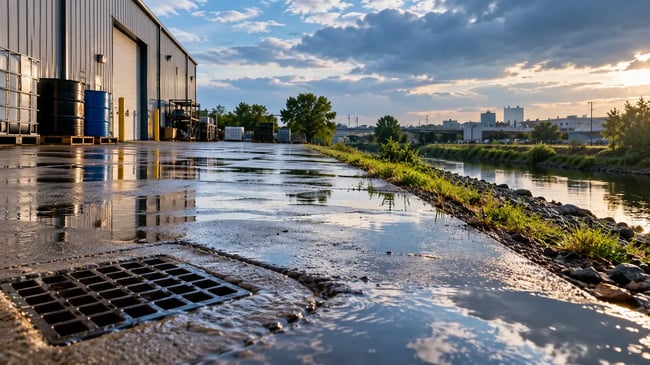
The pollutants in runoff depend on what happens at the site. A clean office park with a parking lot doesn't give NJDEP much to worry about. A yard with stockpiles, trucks, and outdoor equipment is a different story. The table below shows common sources and what rain carries away from them.
| Source at the Site |
What Runoff Picks Up |
Why It's a Problem Downstream |
| Stockpiles of soil, sand, stone, or mulch |
Sediment and fine particles |
Clouds water, smothers stream habitat |
| Vehicles, forklifts, and fueling areas |
Oil, grease, and fuel |
Causes sheens, harms fish and wildlife |
| Scrap metal and outdoor metal storage |
Metals like zinc, copper, and iron |
Toxic to aquatic life even in small amounts |
| Concrete and cement operations |
High-pH water and solids |
Changes water chemistry in streams |
| Compost, leaves, and organic material |
Nutrients and organic matter |
Feeds algae blooms in lakes and bays |
| Dumpsters and open containers |
Leachate, residue, and litter |
Adds a mix of pollutants and trash |
None of this requires a spill or an accident. It happens a little at a time, every time it rains. A few drips under a loader or a dusty yard don't look like much on a dry day, but they're exactly what ends up in the runoff. The good news is that the fixes are often simple: covering materials, moving things indoors, cleaning up regularly, and keeping containers closed. Our article on stormwater best management practices walks through the most common ones.
How Does NJDEP Regulate Stormwater at Businesses?
NJDEP regulates stormwater through the New Jersey Pollutant Discharge Elimination System, or NJPDES. That's the state's permit program for anything discharged into New Jersey's waters, built on the state's Water Pollution Control Act. You can think of it as New Jersey's version of the federal NPDES program. Under it, a discharge that hasn't been authorized by a permit isn't allowed, and certain kinds of stormwater count as discharges.
Not every business is covered. The stormwater rules apply to businesses that do specific kinds of industrial work, like manufacturing, recycling and scrap, mining, landfills and other waste facilities, and the maintenance and fueling areas of transportation operations. Our article on what stormwater associated with industrial activity means explains the categories in more detail. Offices, stores, restaurants, and many service businesses generally aren't part of the program. Neither are many warehouses, data centers, and auto shops, though a specific site can change the answer.
For businesses that are covered, New Jersey offers a few paths. Most use the Basic Industrial Stormwater General Permit, known as the 5G2, which focuses on keeping materials and activities out of the rain. Certain industries, like concrete, asphalt, scrap metal, vehicle recycling, and mining, have permits written specifically for them. Sites that don't fit any of those can get an individual permit. And businesses that keep everything inside a permanent building can file a Permanent No Exposure Certification instead of getting a permit. Our guide to the 5G2 Basic Industrial Stormwater Permit covers the most common path, and our article on general, individual, and no exposure options compares them.
Most permits come with a Stormwater Pollution Prevention Plan, which New Jersey calls an SPPP. It's a written plan that describes your site, where water flows, what's exposed, and what you're doing to keep runoff clean. Permits also come with regular inspections, employee training, and annual certification to NJDEP, and some industry-specific permits require sampling. Our plain-English guide to NJPDES stormwater permit requirements goes through what's involved.
Does NJDEP Inspect Businesses for Stormwater Compliance?
Yes. NJDEP has a compliance and enforcement program that inspects regulated facilities, and stormwater is part of what inspectors look at. Some inspections are routine and scheduled, some follow up on an earlier issue, and some happen because someone reported a concern. In parts of the state, county environmental health agencies also do inspection and complaint work in partnership with NJDEP, so the person who shows up may work for your county rather than the state.
Complaints are a common way NJDEP learns about a site. The agency runs a toll-free hotline for reporting environmental incidents and complaints, and neighbors, passersby, and even competitors use it. A cloudy stream after a storm, an oily sheen in a ditch, or muddy water running out of a driveway can all prompt a call. Municipal staff who manage local storm sewers can also flag problems. A complaint doesn't mean you've done something wrong, but it often leads to someone taking a look.
During a stormwater inspection, an inspector typically walks the site, looks at outdoor storage and work areas, checks where water leaves the property, and asks to see your permit, your SPPP, and records of inspections and training. If you have a No Exposure Certification, they'll look at whether everything is still indoors. NJDEP also keeps inspection and violation records for facilities, and many of them are available to the public through the agency's online lookup tools.
The best way to handle an inspection is to be ready before one is scheduled. Keep your permit, your SPPP, and your inspection and training records together in one place where anyone on site can find them, not in the files of someone who left two years ago. Make sure the person who greets an inspector knows where those documents are and who to call. Walk the yard with fresh eyes every so often and fix the small things, like an open dumpster lid or a leaking drum, before they become findings. Inspectors notice when a site is organized and the paperwork matches what they see on the ground.
What Happens If NJDEP Finds a Stormwater Problem
Most issues found during inspections are fixable, and many are resolved by correcting the problem and documenting the fix. That said, the penalties available under New Jersey's water pollution rules are real. Under N.J.A.C. 7:14-8.5, NJDEP can assess a civil administrative penalty of up to $50,000 for each violation, and each day a violation continues counts as a separate violation. Actual penalties depend on the seriousness of the problem, the business's history, and how it responds. If you're already facing an enforcement action or a notice of violation, talking with an environmental attorney may make sense alongside any technical help.
What Should You Do If You're Unsure Where You Stand With NJDEP on Stormwater?
Start by figuring out whether your business is in one of the industrial categories at all. The Standard Industrial Classification (SIC) code for the main activity at your site is the usual starting point. If your business isn't on the list, you may not need to do anything, though it's worth writing down how you reached that answer in case anyone ever asks. Our article on who needs a stormwater permit is a good companion for this step.
If you are in a covered category, take a walk around your property, ideally during a rain. Look for anything outdoors that rain can touch: stockpiles, equipment, drums, dumpsters, fueling areas, and loading docks. Notice where the water goes when it leaves. Then check whether your site already has a permit or certification on file, especially if you bought or leased the property recently. A previous owner or tenant may have had coverage that needs to be transferred or updated.
If you find something that needs attention, don't panic. Many businesses discover they should have had coverage, or that their plan is out of date, and they sort it out without drama. The most useful thing is to start moving. Our article on common stormwater permit problems and how we fix them covers the issues we see most often. Plenty of small businesses handle the basics themselves, and our article on whether you can get a stormwater permit yourself explains when that works well. For employee training, our online environmental training library is an option.
How RMA Helps New Jersey Businesses Work With NJDEP on Stormwater
We're a family-run environmental consulting firm based in New Jersey, and we've been helping facilities with environmental compliance since 1992. We work with NJDEP's stormwater program all the time, so we know how the agency operates, what inspectors look for, and where businesses tend to get tripped up. A senior member of our team will help you figure out whether your business falls under the stormwater rules, which permit or certification fits if it does, and what it will take to get your site in good shape. From there, we can prepare your filing, write your SPPP, set up inspections and training, and help you prepare for NJDEP visits.
If you don't need us, we'll tell you so. There's no pressure and no obligation. You can call us, send an email, or fill out the form on our website, and we'll talk through your situation in plain terms. When you're ready, just contact RMA and we'll help you take the next step.