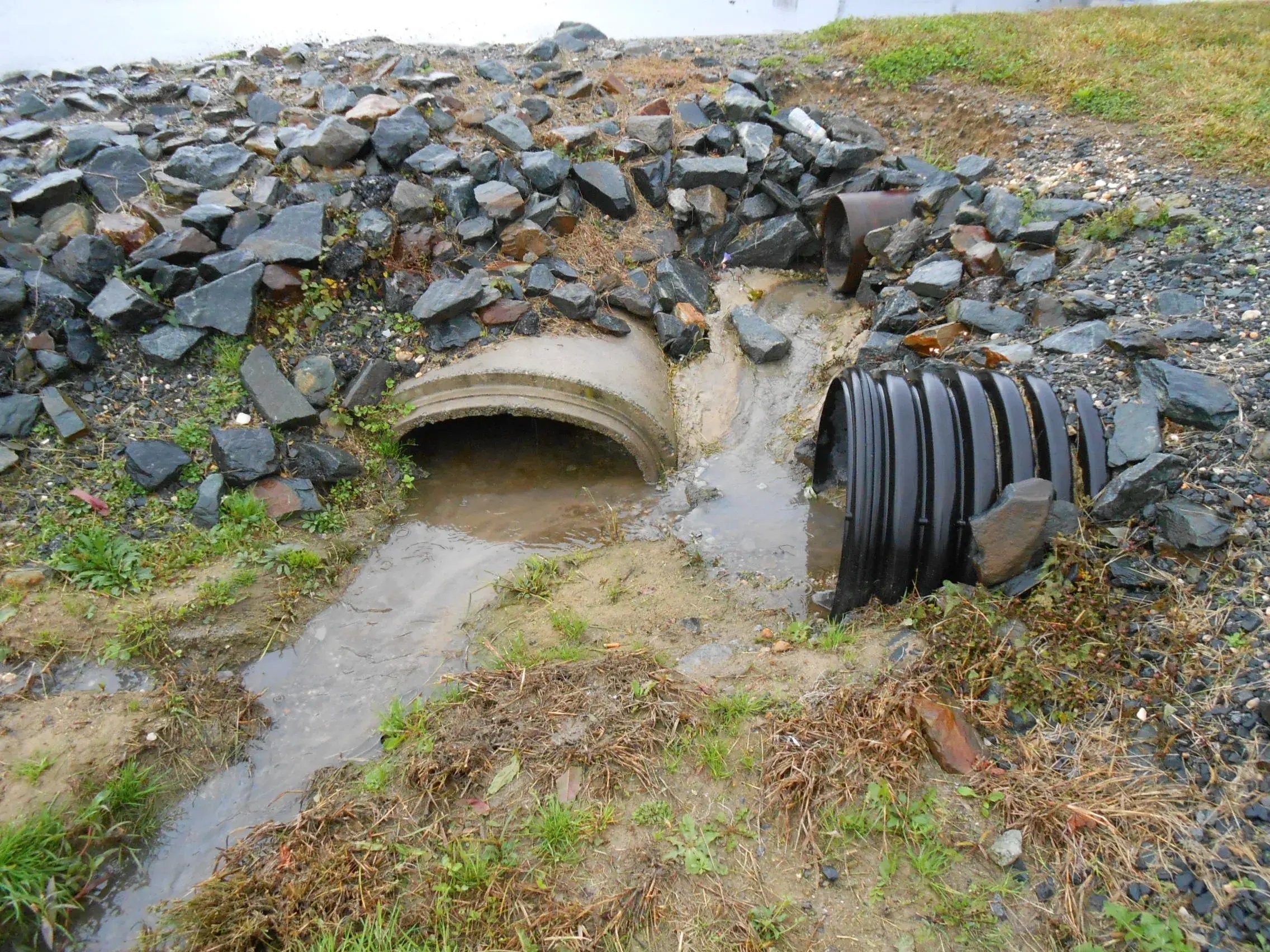
How NJDEP Decides Whether Your Facility Uses the Basic 5G2 Permit, an Industry-Specific General Permit, or an Individual Permit
If a lender, a landlord, or an NJDEP inspector has asked whether your New Jersey facility has a stormwater permit, the name you've probably heard is the 5G2. Its full name is the Basic Industrial Stormwater General Permit, and the word "basic" makes it sound like the default for any business whose rainwater runs off a yard or a loading dock. It isn't. The 5G2 has a narrow eligibility test, and plenty of facilities that think they're on it, or headed toward it, belong on a different permit.
The short answer is that the 5G2 is for facilities that have eliminated, or can eliminate within six months of authorization, all exposure of industrial materials and activities to rain and snowmelt. Concrete, asphalt, quarrying, sand and gravel, scrap metal, vehicle recycling, and wood waste and leaf composting operations generally use their own industry-specific permits instead, and facilities that can't meet either test may need an individual permit written for their site. Below, we'll walk through how the 5G2 test works, which discharges it won't cover, which industries get pushed elsewhere, and a decision table you can use to sort your own situation. If you'd rather talk it through, feel free to reach out to RMA and we'll help you figure out where you fit.
Table of Contents
TL;DR
The 5G2 is New Jersey's basic industrial stormwater permit, but it only works for facilities that have eliminated, or can eliminate within six months, all exposure of industrial materials and activities to rain and snowmelt, usually by covering things or moving them indoors. Concrete plants, asphalt plants, mines and quarries, sand and gravel operations, scrap yards, vehicle recyclers, and wood waste and leaf composting sites generally use their own industry-specific permits instead. Facilities that can't eliminate exposure and don't fit an industry permit, or that have discharges the 5G2 excludes, may need an individual permit. Sites with everything inside a permanent building may qualify for a no exposure exclusion instead of any permit.
What Is the 5G2 Basic Industrial Stormwater Permit in New Jersey?
New Jersey doesn't run industrial stormwater the way most states do. The New Jersey Department of Environmental Protection (NJDEP) regulates the rain and snowmelt that runs off industrial sites through its own permit program, the New Jersey Pollutant Discharge Elimination System (NJPDES), which is the state's version of the federal NPDES program. Instead of one general permit for every industrial site, NJDEP sorts facilities into four paths: the Basic Industrial Stormwater General Permit (5G2), a set of industry-specific general permits, individual permits written for one facility, and an exclusion for sites with nothing exposed to the weather.
A general permit is a single master permit NJDEP wrote once for a whole category of facilities. You apply to be covered under it by filing a Request for Authorization (RFA), and once NJDEP authorizes you, you follow the rules in that master document. An individual permit works differently, because NJDEP writes it for one specific site. The 5G2 is the general permit that isn't tied to any one industry, and NJDEP renewed it with a master permit that took effect on February 1, 2023.
Both the 5G2 and the industry-specific permits require a stormwater pollution prevention plan with best management practices (BMPs) to eliminate or minimize exposure of source materials to stormwater. NJDEP's paperwork calls that plan an SPPP, and you'll also hear it called an SP3 or just a stormwater plan. We call it a SWPPP (pronounced "swip"), so that's the term we'll use here. Our guide on what a SWPPP is and what goes in one covers the plan itself.
How Does the 5G2 Eligibility Test Work for Industrial Stormwater Exposure?
NJDEP describes the 5G2 as a "remove and cover" permit. It's available to regulated industrial facilities that have eliminated, or can eliminate within six months of authorization, all exposure of industrial materials or activities to stormwater. You eliminate exposure by covering the materials or activities or by moving them indoors. The permit requires every facility it authorizes to do that through the BMPs in its SWPPP, so the plan isn't a formality. It's the way you prove the exposure is gone.
The word "all" is where most facilities run into trouble. NJDEP defines source materials broadly, and the definition reaches raw materials, finished products, waste, by-products, machinery, fuels, lubricants, solvents, and the containers that hold them. An uncovered dumpster with industrial waste in it, a stockpile of sand or aggregate, steel stacked in the yard, drums or totes stored outside, a piece of equipment parked in the weather, or an outdoor generator can each be enough to knock a site off the 5G2. A facility that's mostly indoors with a couple of items outside that it can cover or bring in within six months is a good fit. A facility whose business is the outdoor pile or the outdoor process isn't.
The 5G2 also isn't a permit for every business with a parking lot. The facility has to be a regulated industrial facility in the first place, which NJDEP determines by industrial category and SIC code. Our explainer on stormwater associated with industrial activity shows how regulators draw that line, and our companion guide to the 5G2 Basic Industrial Stormwater Permit in New Jersey goes through the forms and day-to-day requirements once you're covered.
Which Stormwater Discharges Can't Use the 5G2 Permit?
Even a facility that has covered everything can still be shut out of the 5G2 because of what's in the water or what else covers it. NJDEP's fact sheet for the renewed 5G2 lists several exclusions. Stormwater discharges that are subject to federal effluent guideline limitations for stormwater aren't eligible. Neither are stormwater discharges that are already authorized under another NJPDES discharge permit, including an expired one, or that are combined with domestic wastewater or process wastewater before treatment. Certain landfills are excluded too, unless they've been closed properly and haven't been disturbed.
The process wastewater exclusion is the one we see trip up facilities most often. Process wastewater is water that touches your product or your process, such as concrete washout, equipment wash water, or cooling water that comes into contact with material. The 5G2 covers stormwater only. If your site sends stormwater and process water down the same pipe, the stormwater doesn't qualify on its own, and the process water needs separate attention. Our article on the difference between stormwater and process water explains why NJDEP treats them so differently.
Construction stormwater sits in its own lane as well. The 5G2 doesn't authorize it. Land disturbance during a building project falls under a separate construction permit (the 5G3) and the soil erosion and sediment control process, and RMA doesn't prepare those. Most facilities work with their engineer, contractor, or a soil erosion specialist on that piece. Where we come in is the operational side once the facility is running, which is exactly where the 5G2 versus industry permit question lives.
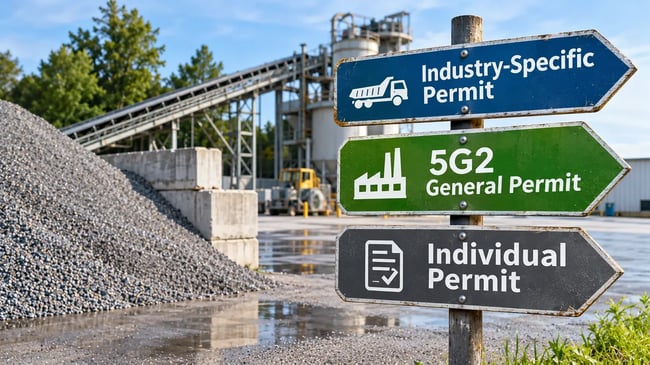
Which Industries Use Their Own New Jersey Stormwater General Permit Instead?
NJDEP has written separate general permits for industries whose outdoor operations can't be covered up and moved inside. These are the permits NJDEP lists for industrial stormwater, along with the kinds of facilities each one is written for.
| Code |
Permit Name |
Who It's Written For |
| CPM |
Concrete Products Manufacturing |
Ready mixed concrete plants, block and brick producers, and facilities NJDEP classifies as concrete manufacturers |
| R4 |
Hot Mix Asphalt Producers |
Facilities that manufacture hot mix asphalt |
| R13 |
Mining and Quarrying Activity |
Mines and quarries |
| RSG |
Sand and Gravel Activity |
Sand and gravel operations whose stormwater goes to groundwater with no discharge to surface water |
| SM2 |
Scrap Metal |
Scrap metal processors and recyclers, including yards that also handle used vehicle parts |
| RVR |
Vehicle Recycling |
Auto salvage and vehicle recycling yards |
| WRC |
Wood Waste Recycling and Leaf Composting |
Wood recyclers, mulch producers, and leaf composting sites |
If your facility sits in one of these industries, the industry permit is generally your path, and the 5G2 generally isn't. The practical reason is simple. A quarry, a concrete plant, or a scrap yard has stockpiles, equipment, and process areas outdoors by nature, so it couldn't pass the 5G2's remove and cover test anyway. Mines and quarries aren't authorized under the 5G2 at all. The permits are also tied to specific industry classifications. The R4, for example, is written for hot mix asphalt manufacturing and not for a paving contractor's equipment yard, and where your stormwater ends up can decide between the RSG and the R13 for a sand and gravel or mining site. Our guides to concrete plants and stormwater permits and the SM2 scrap metal permit show what an industry permit looks like in practice.
Industry permits don't all ask for the same things. Some include sampling, monitoring, or reporting beyond the plan and the annual inspection, and others don't, so read the one that applies to you instead of assuming it works like the 5G2. General permits also run on fixed terms, and several of the industry-specific permits are past their original expiration dates. Whether a particular permit is open to a brand-new facility is worth confirming on NJDEP's industrial stormwater general permits page before you build your plans around it. If it isn't, an individual permit may be the route.
When Does a Facility Need an Individual NJPDES Stormwater Permit?
An individual permit is the fallback for facilities that don't fit a general permit. NJDEP writes it for a single site, so the conditions are tailored to your operations and can differ from a similar facility down the road. NJDEP generally uses individual permits for discharges that aren't eligible for a general permit and need a more site-specific approach, and that tends to mean more detailed requirements than a general permit carries.
Three situations commonly land a facility here. The first is a facility that can't eliminate exposure and doesn't have an industry permit written for it. Metal fabrication, chemicals, plastics, food and beverage, printing, and other manufacturing with outdoor storage or outdoor activity often fall in this group, because NJDEP doesn't have an industry-specific general permit for them. The second is a facility with a discharge the 5G2 excludes, such as stormwater combined with process wastewater before treatment, where a general permit won't stretch to cover it. The third is a facility in an industry that does have a general permit, when that permit isn't available or doesn't fit the site, and NJDEP decides a site-specific permit is the better tool.
Because NJDEP reviews individual permits site by site, expect a longer road than a general permit authorization. Our article on whether you need an individual NJPDES industrial permit goes through how that plays out, and our breakdown of how long it takes to get a New Jersey stormwater permit covers what to expect on timing. If you're on the 5G2 today and discover you can't keep everything covered, talk to NJDEP or a consultant before the next annual certification, not after an inspector finds it.
Which NJ Stormwater Permit Fits? A 5G2, Industry Permit, Individual Permit, and No Exposure Decision Table
This table sorts the common situations we see. Treat it as a starting point and not a final answer, since eligibility depends on your industry classification, what's outside, and where your water goes.
| Your Situation |
Likely Path |
What Decides It |
| Every industrial material and activity is inside a permanent, fully enclosed building |
No exposure exclusion (not a permit) |
The building has to be a permanent structure, and a tarp over a pile doesn't count |
| Mostly indoors, with a few items outside that you can cover or move inside within six months |
5G2 |
Passing the six month remove and cover test, with no excluded discharges |
| Concrete or asphalt plant, mine or quarry, sand and gravel pit, scrap yard, vehicle recycler, or wood waste and leaf composting site |
Industry-specific permit (CPM, R4, R13, RSG, SM2, RVR, WRC) |
Your industry classification, where your water goes, and whether the permit is open to new facilities |
| Outdoor storage or activity you can't cover, and no industry permit fits (metal fabrication, chemicals, plastics, food and beverage) |
Individual NJPDES permit |
Whether exposure can realistically be eliminated |
| Stormwater mixes with process wastewater or sanitary wastewater before treatment, or the site already has another discharge permit |
Not the 5G2 for that discharge, so likely an individual permit or other permit |
What's in the water and which permit already covers it |
| Warehouse, data center, body shop, dealership, or quick-lube |
Often none |
Industry code, and whether vehicle maintenance, fueling, equipment cleaning, or deicing happens outdoors |
That last row surprises people. Plenty of businesses worry they need a stormwater permit when they probably don't, and for transportation-type operations it's generally only the maintenance, equipment cleaning, fueling, and deicing areas that bring a site into the program. Where your water goes matters too. Rain that drains to a sanitary or combined sewer is handled by the local sewerage authority's rules, and those may apply instead of, or alongside, an NJDEP industrial stormwater permit. Whether that's your situation depends on exactly where your site drains, so confirm it with your sewerage authority or municipality rather than assuming based on your town. If you think you might qualify for the exclusion, read our explainer on what no exposure means first, because New Jersey is strict about what counts.
How Can You Confirm Which NJ Stormwater Permit Your Facility Qualifies For?
Start with your industry code. Look up your SIC code and the matching NAICS code, then compare them against the eligibility language of the permit you think fits. Next, walk your site and write down everything that sits outside: stockpiles, dumpsters, drums and totes, equipment, generators, fueling areas, wash areas, and loading docks. Then trace where rain goes when it leaves each of those areas, whether that's a storm drain, a ditch, a stream, a basin where it soaks into the ground, or a sewer. If the outside list is short and coverable, the 5G2 or no exposure is in play. If it's long, or it's the whole point of your operation, you're looking at an industry permit or an individual permit.
After that, check current permit status on NJDEP's industrial stormwater general permits page, and if you're already permitted, pull your authorization letter and make sure the permit category on it still matches what you do today. A site that qualified for the 5G2 a decade ago may have added an outdoor storage area since. If your facility is fully indoors and your situation is simple, you may be able to file on your own, and our article on whether you can get a stormwater permit yourself explains what that involves. For the broader picture of how general, individual, and no exposure options compare, see our guide to which NPDES permit you need, and our summary of NJPDES stormwater permit requirements shows what each path asks of you once you're on it.
How Does RMA Help New Jersey Facilities Choose the Right Stormwater Permit?
We're based in New Jersey, and we've worked with NJDEP's industrial stormwater permits for decades, including mining and quarrying, concrete, asphalt, and manufacturing sites. We usually start by helping a facility figure out which of these paths applies, because that choice decides everything that follows. From there we can help prepare the RFA, write a SWPPP built for the specific permit you're covered under, and train your team to run it, and we offer annual support after you're permitted if you want reminders, inspection prep, and help with the yearly certification. We'll also tell you when you don't need us. If your site is fully indoors or sits outside the program, a short conversation may be all you need.
There are things we don't do. We don't design covers, buildings, or stormwater treatment systems, which is engineering work, and we don't prepare construction-phase permits. If your facility needs either, we'll say so up front and point you toward the right professionals. If you're not sure where your facility fits, or you suspect you're on the wrong permit, there's no pressure and no obligation to talk it through. You can call us, email us, or fill out the form on our website, and when you're ready, contact RMA and we'll help you figure out the right next step. Our online training library can help your team run the plan.