How New Jersey's Regional Land-Use Agencies Affect Industrial Stormwater Compliance
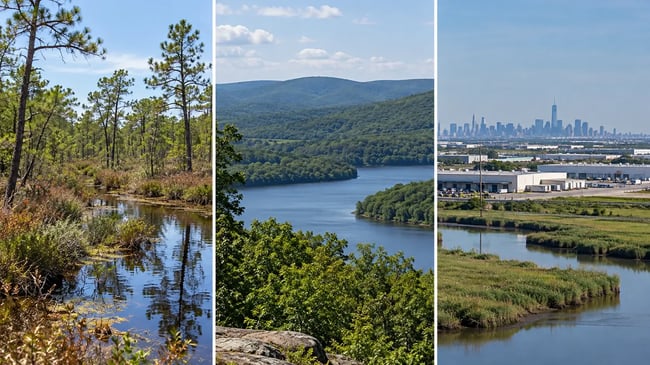
If your facility sits in the Pine Barrens of southern New Jersey, up in the Highlands, or in the Hackensack Meadowlands, you've probably heard that your area has its own rules. Each of those three regions has a state agency that controls land use and development on top of your local town, and each exists largely to protect water. So it's reasonable to wonder whether the rain running off your yard is treated differently there than anywhere else in the state.
The short answer is that the permit for rainwater at industrial sites, an NJPDES stormwater permit, depends on what your facility does and how its water leaves the property, not on which region you're in. (NJPDES is the New Jersey Pollutant Discharge Elimination System, the state's permit program for discharges to water, and NJDEP, the Department of Environmental Protection, runs it.) What changes is the layer on top: the Pinelands Commission, the Highlands Council, and the New Jersey Sports and Exposition Authority (NJSEA) in the Meadowlands can each have a say in what you build, pave, or change, and that can include how you handle stormwater. Below we walk through each region, what we could confirm about each agency's role, where the line sits between those agencies and your NJDEP permit, and what to check before you expand. If you'd rather talk through your own site, you can reach out to RMA any time.
Table of Contents
TL;DR
Being in the Pinelands, Highlands, or Meadowlands doesn't by itself decide which NJPDES stormwater permit your facility needs. NJDEP issues that permit based on what you do and how water leaves your site. The Pinelands Commission, the Highlands Council, and the NJSEA control land use and development in their regions, so they can weigh in when you build, pave, or change your drainage. Confirm where your parcel sits and what approvals apply before you start any work.
Who Regulates Land Use in the Pinelands, Highlands, and Meadowlands?
Each region was set up by its own state law, and each agency has its own rulebook. Their work overlaps with NJDEP's stormwater program, but it isn't the same program. NJDEP issues NJPDES permits statewide. The regional agencies control land use and development inside their boundaries, usually through municipal ordinances, zoning, or direct project review. Here's how the three compare.
| Region |
Agency |
Law and rules behind it |
Size and location |
What it mainly controls |
| Pinelands |
Pinelands Commission |
Pinelands Protection Act (1979) and the Comprehensive Management Plan, N.J.A.C. 7:50 |
About 938,000 acres in parts of seven southern counties and all or part of 53 municipalities |
Land use, development review, and natural resource protection |
| Highlands |
Highlands Water Protection and Planning Council |
Highlands Water Protection and Planning Act (2004), the Regional Master Plan, and NJDEP's Highlands Rules, N.J.A.C. 7:38 |
Roughly 850,000 acres in northern New Jersey, split into a Preservation Area and a Planning Area |
Regional planning, municipal conformance, and stricter NJDEP review in the Preservation Area |
| Meadowlands |
New Jersey Sports and Exposition Authority (NJSEA) |
Hackensack Meadowlands Reclamation and Development Act and the District Zoning Regulations, N.J.A.C. 19:4 |
About 30 square miles covering parts of 14 municipalities in Bergen and Hudson counties |
Regional planning and zoning, including zoning certificates for development |
A single facility can answer to a town, a regional agency, and NJDEP at the same time, and each one asks different questions. The town cares about zoning and site plans. The regional agency cares about whether your project fits its master plan and water protection standards. NJDEP cares about what's coming off your site and whether you hold the right NJPDES coverage. Keeping those three straight is most of the work.
How Does the Pinelands Commission Affect Business Stormwater?
The Pinelands Commission carries out the Comprehensive Management Plan (CMP), which governs land use, development, and natural resource protection across the state-designated Pinelands Area. That area covers parts of Atlantic, Burlington, Camden, Cape May, Cumberland, Gloucester, and Ocean counties. Every municipality with land in it has to keep its master plan and zoning ordinances consistent with the CMP, and the Commission certifies them. Proposed development projects also go through Commission project review, which includes on-site inspections.
Stormwater is built into that plan. The CMP incorporates NJDEP's Stormwater Management Rules (N.J.A.C. 7:8), which set standards for water quality, groundwater recharge, and water quantity when "major development" happens, and the Commission adopted its own stormwater amendments that took effect on January 18, 2022. Pinelands towns then write those standards into their local ordinances. For a business, this mostly shows up when you build or expand. How you collect, treat, and recharge runoff from new roofs and pavement can be reviewed by the Commission and by your town, and a site whose runoff carries industrial pollutants can expect that part of the design to get a closer look.
We can't tell you the CMP adds specific sampling or reporting duties to an NJPDES permit, and we won't guess at it. The CMP is a land use and development standard, and the duties that apply to your discharge live in the NJDEP permit document itself. If you're in the Pinelands Area and planning ground disturbance, NJDEP's own guidance for land use permit applicants there is to contact the division or the Commission before filing, and that's a sensible habit for any project.
How Does the Highlands Council Affect Business Stormwater?
The Highlands Water Protection and Planning Act became law in 2004 to protect the water supply of more than five million New Jersey residents. It created the Highlands Council and divided the roughly 850,000-acre Highlands Region into a Preservation Area and a Planning Area. The Council adopted its Regional Master Plan in 2008, and the plan took effect that September.
The two areas are treated very differently. In the Preservation Area, NJDEP's Highlands Rules (N.J.A.C. 7:38) apply, and the Act defines "major Highlands development" to include any non-residential development there unless an exemption covers it. A factory, yard, or warehouse is non-residential, so building, expanding, or adding paved surface at a Preservation Area site can call for a Highlands Applicability Determination (a ruling on whether your project is covered or exempt) or a Highlands Preservation Area Approval from NJDEP. The Act lists 17 exemptions. Some can be decided by municipalities the Council has certified, and others have to go to NJDEP or the Highlands Council.
The Planning Area works differently. The Act doesn't set new NJDEP standards there, but the Regional Master Plan opens a path to enhanced standards, and municipalities in the Planning Area can choose to conform to it. Municipalities with Preservation Area land have to conform. Two neighboring facilities in the Highlands can therefore face quite different local rules depending on which area they're in and whether their town has conformed. Exemptions also turn on specific dates and conditions, such as the amount of lawfully existing impervious surface as of August 10, 2004 in the Preservation Area, so get any exemption determination in writing before you rely on it.
How Does the NJSEA Affect Business Stormwater in the Meadowlands District?
The Hackensack Meadowlands District covers about 30 square miles and parts of 14 municipalities. In Bergen County those are Carlstadt, East Rutherford, Little Ferry, Lyndhurst, Moonachie, North Arlington, Ridgefield, Rutherford, South Hackensack, and Teterboro. In Hudson County they're Jersey City, Kearny, North Bergen, and Secaucus. The NJSEA took over regional planning and zoning from the former New Jersey Meadowlands Commission in 2015, and it applies the District Zoning Regulations (N.J.A.C. 19:4) along with a master plan it updated in 2020.
Inside the District, the NJSEA, not your town, is the zoning authority, and development generally goes through the NJSEA with a zoning certificate. Parts of these towns sit outside the District and are zoned locally, so one town can have both situations. Your mailing address doesn't tell you which applies. Your parcel's location does. NJDEP and the Meadowlands agency's predecessor also signed a memorandum of agreement in 2005 spelling out who reviews which coastal activities and development in the District, which is a good reminder that more than one agency can be involved in a single project.
On the stormwater side, the District is a major industrial and commercial center with a lot of warehouse and distribution sites. Many of those don't need an industrial stormwater permit at all, because their materials and activities stay indoors, but that call depends on the site. Where your runoff goes also matters. If it flows to a sewerage authority instead of a waterway, that authority's rules may apply instead of, or alongside, an NJPDES permit, so confirm where your site drains before you decide anything.
Does an NJPDES Stormwater Permit Change in These Regions?
NJDEP is the permitting authority for NJPDES, and it sorts industrial facilities into a handful of paths. Coverage depends on your industry, whether your materials and activities are exposed to rain, and where your water goes. Your region isn't one of those factors, though it can affect other approvals around the same site.
| NJDEP path |
Who it generally fits |
| Basic Industrial Stormwater General Permit (5G2) |
Industrial facilities with exposed activities that no industry-specific permit covers |
| Industry-specific general permits |
Concrete products manufacturing (CPM), hot mix asphalt (R4), mining and quarrying (R13), sand and gravel (RSG), scrap metal (SM and SM2), vehicle recycling (RVR), and wood waste recycling and leaf composting (WRC) |
| Individual permit |
Sites with circumstances a general permit doesn't cover |
| No exposure exclusion |
Facilities whose industrial materials and activities stay sheltered from rain and runoff |
If you want the full breakdown of how those paths work, our guides on the 5G2 basic industrial stormwater permit, individual NJPDES industrial permits, and general, individual, and no exposure options cover each one. For the broader picture, our article on NJPDES stormwater permit requirements is a good place to start, and it helps to understand what counts as stormwater associated with industrial activity before you decide where you fit.
Where regional rules can touch your permit situation is in how you manage water on the site. A facility that sends runoff into the ground through a basin or infiltration area is dealing with a different kind of discharge than one that pipes to a stream, and Pinelands standards in particular call for groundwater recharge on major development. We won't tell you a regional label adds particular sampling, reporting, or monitoring duties to an NJPDES permit, because those duties are written in the permit for your category. Read the current permit, then ask the regional agency whether anything sits on top of it for your project.
What Should Facilities Know Before Building or Expanding in These Regions?
Construction is where the regional agencies come into play most. A new building, an expansion, added paving, or a change to your drainage can need approval from the Pinelands Commission, a Highlands applicability or exemption determination, or an NJSEA zoning certificate, plus municipal site plan approval. On top of that, earth disturbance during construction generally brings its own requirements, including NJDEP's construction stormwater general permit (5G3), soil erosion and sediment control certification through the local Soil Conservation District, and stormwater management design for major development under N.J.A.C. 7:8.
RMA doesn't prepare any of those construction-phase permits or approvals. Most people handle them with their engineer, contractor, or a soil erosion specialist, and we're happy to help you work out what the construction phase is likely to need and point you toward the right professionals. Here's how the pieces usually divide up.
| Piece of the project |
Who usually handles it |
| Regional approval or exemption (Pinelands Commission, Highlands, NJSEA) |
Your engineer or land use professional, working with the agency |
| Municipal site plan approval |
Your engineer and your town's land use board |
| Construction stormwater (5G3), soil erosion certification, N.J.A.C. 7:8 design |
Your engineer, contractor, or soil erosion specialist |
| Operating permits and plans once the facility is running |
RMA |
That last row is where a new or expanded facility often needs help. Once it's running, you may need the right NJPDES industrial permit or a no exposure exclusion, a stormwater pollution prevention plan, inspections and annual certification, sampling where your permit requires it, and often an SPCC plan or Community Right to Know reporting too. Those requirements are the same whether you're in the Pinelands, the Highlands, the Meadowlands, or anywhere else in New Jersey, and they're easy to overlook while a construction schedule is driving every decision.
How Do You Check Whether Your Facility Is in a Pinelands, Highlands, or Meadowlands Area?
Start with your municipal zoning or planning office. Staff there know whether your town has land in the Pinelands Area, the Highlands Preservation Area or Planning Area, or the Meadowlands District, and they know which parcels are affected. Then confirm with the agency itself. The NJSEA publishes a Meadowlands zoning map, and the Highlands Council and Pinelands Commission each maintain maps and staff who answer these questions. Have your block and lot number ready, because a town can be partly inside a region and partly outside it.
When you reach the agency, a few questions get you most of what you need. Is my parcel inside your boundary, and in which management area or zone? Would my planned project count as development under your rules? Are there exemptions that could apply, and can I get that determination in writing? Does your review cover stormwater design or drainage changes for my project? Keep the answers with your permit files so the next person who inherits the site doesn't have to start over.
If you're operating and not changing anything, your day-to-day stormwater duties run through your NJDEP permit and your stormwater pollution prevention plan, which people also call an SPPP, an SP3, or just a stormwater plan. We'll use SWPPP from here on. Our guide on what a SWPPP is and what it should contain walks through the plan itself, and our article on who needs a stormwater permit helps if you're still deciding whether you need coverage at all. Training your team is part of keeping a plan alive, and our online environmental training library is one place to build that knowledge.
How Can RMA Help With Stormwater Compliance in These Regions?
We're a New Jersey firm, and we work with NJDEP's permit categories every day. We can help you figure out whether your facility needs an NJPDES permit, which one fits, or whether you qualify for a no exposure exclusion. We write and update SWPPPs, train your team, and where your permit calls for sampling, we teach your people to collect samples correctly. After you're permitted, we offer annual support with reminders, help interpreting results, SWPPP and annual reporting updates, and inspection prep, as hands-off or hands-on as you want it to be.
We're also clear about what we don't do. We don't prepare Pinelands, Highlands, or NJSEA approvals, construction-phase permits, or engineering designs, and sometimes you won't need us at all. If a no exposure exclusion or a simple do-it-yourself path fits your site, we'll say so. If you'd like to talk it through, there's no obligation. You can call us, email us, or fill out the form on our website, and you can also contact RMA directly to start a conversation about your site.