Your Customer Asked for Your NJPDES Permit Number. Here's Where to Look, What It Looks Like, and What to Say If You Don't Have One
A customer sends over a vendor compliance form, or a lender's due diligence checklist lands in your inbox, and one of the lines asks for your NJPDES permit number. If you weren't the person who set up your facility's stormwater coverage, you may not know what that number is, where it's written down, or whether your facility has one at all.
This article walks through where NJPDES permit numbers show up in your paperwork and in NJDEP's records, what they look like for general permits, and how to answer honestly when there isn't one. If you can't track it down after reading it, you can reach out to RMA and we'll help you sort out what you have.
Table of Contents
TL;DR
Your NJPDES permit number is usually printed on the Authorization to Discharge that NJDEP issued when your facility got coverage under a general permit, and it also shows up in your NJDEP Online records and your annual certification paperwork. Facility authorizations under a general permit typically carry a number starting with NJG, which is different from the master permit number that every covered facility shares. If you don't have a number because you filed a no exposure certification, your stormwater goes to a sewer, or your operations aren't regulated, say so plainly and explain why. Never make a number up.
What Is an NJPDES Permit Number and Why Do Customers Ask for It?
NJDEP regulates stormwater runoff from industrial sites through the New Jersey Pollutant Discharge Elimination System, or NJPDES. Very few facilities have a permit written just for them. Most are covered by a general permit, which is one set of rules NJDEP wrote for a whole category of facilities, such as the Basic Industrial Stormwater General Permit (5G2) or an industry-specific permit like the Concrete Products Manufacturing (CPM) general permit. When a facility files its Request for Authorization (RFA), NJDEP sends back an authorization that places the facility under that permit, and the authorization carries a number that identifies it.
Customers ask for that number because it's the quickest way to confirm your site is in the program. Large buyers put it on supplier questionnaires, lenders and buyers ask for it during due diligence, insurers sometimes want it, and bid packages occasionally call for it. Nobody is trying to trip you up. They want something they can check. The confusion starts because two different numbers float around. The master general permit has one number that every covered facility shares (the 5G2 permit is NJ0088315), and your facility's authorization has its own. When a customer asks for your NJPDES permit number, they usually mean the second one. Our guides to the 5G2 Basic Industrial Stormwater Permit in New Jersey and to which NPDES permit you need explain how the general permit categories fit together.
Where Can You Find Your NJPDES Permit Number?
Start with the Authorization to Discharge. It's the document NJDEP issued when your facility was authorized, and the permit number sits near the top, along with the effective date of your authorization. If you only have one piece of paper, this is the one to look for. Many facilities keep it at the front of their stormwater pollution prevention plan binder. That plan is the SWPPP, which NJDEP calls an SPPP and some people call an SP3 or just the stormwater plan. If the authorization isn't there, the table below lists the other places we'd check, roughly in the order we'd check them.
| Where to Look |
What You're Likely to Find |
| Authorization to Discharge letter or PDF |
The permit number, the permit category, and the effective date of your authorization |
| Your NJDEP Online account |
Authorization records, if your RFA or annual certification was filed online |
| Annual certification confirmations |
The permit number on what you've submitted each year |
| SWPPP binder cover and first pages |
Many plans list the number, though it can be out of date if the plan was never updated |
| Whoever filed your RFA |
A consultant, a former environmental manager, or a corporate office often holds the original authorization |
| A prior owner's files |
If you bought or took over the facility, the authorization and any transfer paperwork may have come with it |
| NJDEP's DataMiner reports |
Public NJPDES data you can search as a last resort, though what's available there changes over time |
One thing trips people up when they're digging through NJDEP printouts. NJDEP's systems assign a facility several identification numbers, such as a PI ID and a portal ID, and some printouts show them right next to the permit number. Those aren't permit numbers. Read the label beside the number, and use the one that says Permit Number or NJPDES Permit No. If you're not sure whether your facility is authorized at all, our guide to NJPDES stormwater permit requirements for New Jersey facilities walks through what coverage involves.
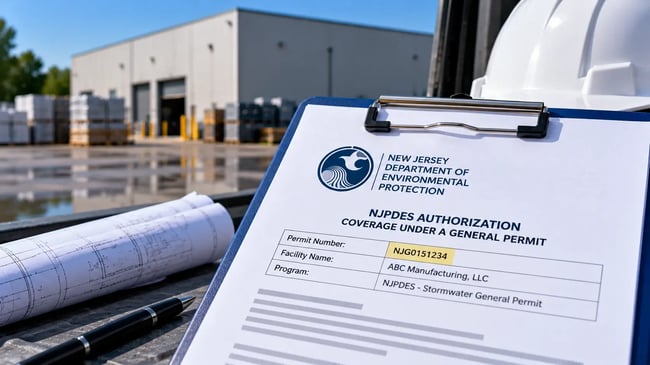
NJDEP's permit numbers follow a consistent pattern, which makes a wrong number easy to spot. Master general permits carry an NJ prefix followed by seven digits. Facility authorizations issued under a general permit typically start with NJG instead. The table shows the pattern with two public examples.
| What It Is |
Example |
Who It Belongs To |
| Master general permit, Basic Industrial Stormwater (5G2) |
NJ0088315 |
Every facility covered by that general permit |
| Facility authorization under a general permit |
NJG0155101 (a highway agency's authorization under a different general permit category) |
One facility |
Each industry-specific general permit, such as CPM for concrete products or the scrap metal permits, has its own master permit number too, so the number on your letter depends on which permit you're under. We're not listing them all here, because NJDEP reissues these permits on its own schedule and your authorization letter is the best place to copy from. Individual NJPDES permits have their own numbers as well, printed on the permit itself.
If the paperwork in your hand is a construction stormwater authorization (the 5G3 permit), that's a separate authorization for the build phase, and it isn't the number a customer wants for an operating facility. RMA doesn't prepare construction-phase permits. Those usually go through your engineer or contractor and the local Soil Conservation District. We do help with the industrial permit and plan a facility needs once it's running.
What Should You Say If You Don't Have an NJPDES Permit Number?
Not having a number isn't automatically a problem. Whether a facility needs NJDEP coverage depends on its industry code, whether materials and activities are exposed to rain, the industry category it falls into, and where its stormwater ends up. Warehouses, data centers, body shops, and dealerships often don't need an industrial stormwater permit, and some facilities hold a no exposure certification instead of a permit. The right answer depends on which situation you're in.
| Your Situation |
What to Tell the Customer |
| You filed a no exposure certification |
There's no permit, so there's no permit number. Say you hold a no exposure certification with NJDEP and share your confirmation if you have it. |
| Your stormwater goes to a sewer instead of to surface or ground water |
Explain where the site drains. The sewerage authority's rules may apply, so confirm with them before you describe your status. |
| An individual permit or a discharge to groundwater permit covers your stormwater |
Give that permit's number, which is printed on the permit. |
| Your operations aren't in a regulated category |
Describe what you do and say you aren't in a regulated category, and be ready to explain why. |
| You need coverage and don't have it, or it lapsed |
Don't fill in the blank. This is a compliance gap, and the fix is getting coverage in place. |
Don't copy the 5G2 master permit number off NJDEP's website and send it as if it belongs to your facility, and don't write N/A if you should be covered. Customers and lenders do check these numbers. A plain sentence works better, something like "our facility discharges to the municipal sewer and doesn't hold an NJPDES stormwater permit, and here's the documentation." Adjust the wording to your real situation.
If you can't tell which row you fit, these guides help sort it out: what no exposure means for stormwater permits, whether you need an individual NJPDES industrial permit, and who needs a stormwater permit. If the answer turns out to be that you should have coverage and don't, it's worth reading about common NPDES permit problems before you respond to the customer.
How Can RMA Help With Your NJPDES Permit Paperwork?
If you can find your authorization yourself, you don't need us, and that's all most customer forms ask for. If you can't find it, or you're not sure whether your facility should have one, we can help you work out which situation you're in. We're based in New Jersey and work with NJDEP's permit categories regularly. We also help with what comes after the number: confirming coverage, getting a permit when one is needed, writing and updating the SWPPP, and keeping up with annual certifications. We're not the right fit for everything, and if you need engineering design or a treatment system, we'll tell you so.
There's no pressure and no obligation. You can call us at 888-RMA-0230, send an email, or fill out the form on our website, and you're welcome to reach out to RMA from the contact page with whatever you've got, even if it's just a customer's questionnaire and a question mark.