How Coastal New Jersey's Bays, Beaches, and Shellfish Beds Shape Stormwater Expectations for Marinas, Boat Yards, and Shore Industrial Businesses
If you run a marina, a boat yard, or any other business near Barnegat Bay or the Jersey Shore, you may have noticed that rain runoff gets more attention here than it does inland. Part of that is geography. The bays are shallow and slow to flush, so whatever washes off the land tends to stay in the water. The other part is money. Beaches, boating, and shellfish bring a huge amount of business to the shore, and all three depend on clean water. So the New Jersey Department of Environmental Protection (NJDEP) watches runoff from marinas, boat yards, and industrial sites closely, and that attention shows up as permits, written plans, and inspections.
Below, we'll explain why this part of New Jersey is treated differently, how runoff from a business site ends up in the bay, which stormwater permits apply to marinas, boat yards, and other shore industrial businesses, and what to know before you build or upgrade a waterfront facility. The short version is that if you fuel, repair, sand, paint, or wash boats outdoors, you probably need stormwater permit coverage. If you'd like to talk through your own site, feel free to reach out to RMA.
Table of Contents
TL;DR
Barnegat Bay is a shallow estuary that has struggled with too much nitrogen, and the shore's economy depends on clean beaches and shellfish beds, so NJDEP watches business runoff closely. A marina or boat yard generally needs a stormwater permit when fueling, engine repair, or boat maintenance like sanding, scraping, and power washing happens on site. Most can use the Basic Industrial Stormwater General Permit (5G2) if they can get industrial activity under cover, and need an individual permit if they can't. NJDEP is also working on a nitrogen limit for the bay that could add conditions to stormwater permits in parts of the watershed.
What Makes Barnegat Bay So Sensitive to Runoff From Business Sites?
Barnegat Bay isn't one big open bay. The Barnegat Bay Partnership describes it as an estuary of about 75 square miles made up of three shallow, micro-tidal bays: Barnegat Bay, Manahawkin Bay, and Little Egg Harbor. The land that drains into it covers more than 600 square miles and sends water in through 11 rivers and streams. That means a parking lot or storage yard well inland can feed the same bay as a marina sitting right on the water.
The pollutant that gets the most attention is nitrogen. Too much of it feeds algae, and in Barnegat Bay that has meant nuisance algal blooms, low dissolved oxygen, stinging sea nettles, and large algae like sea lettuce that can smother eelgrass and shellfish habitat. Nitrogen reaches the bay from fertilizer, pet waste, air pollution, and general runoff from developed land, and stormwater carries a large share of it.
New Jersey has treated the bay as a statewide priority since December 2010, when the governor announced a ten-point action plan. One piece of it became a fertilizer law, signed in January 2011, that was widely described as the most restrictive in the country at the time.
The Barnegat Bay Partnership's 2026 State of the Bay report paints a mixed picture. Total nitrogen concentrations haven't increased at any monitoring station over the last ten years or more. But many stations, especially in the northern bay, still don't meet the water quality criterion for nitrogen. That gap is why regulators keep looking at every source of runoff, including business sites.
Why Do Tourism, Beaches, and Shellfish Raise the Stakes for Coastal Stormwater?
The shore is a working economy, and clean water is part of the product. New Jersey visitor spending reached about $51.9 billion in 2025, and the four beach counties of Atlantic, Cape May, Monmouth, and Ocean generated roughly $26 billion of it, about half the statewide total. When a beach closes for bacteria or a bay turns green, those towns feel it right away, and so do the marinas, charter boats, restaurants, and bait shops that depend on the same water.
Shellfish are even more direct. Clams, oysters, and mussels filter water as they feed, so they can accumulate harmful bacteria that stormwater carries into the bay. NJDEP classifies shellfish growing waters and can suspend harvest immediately when a water body doesn't meet the standard for its classification. In 2011, ahead of Hurricane Irene, the state shut down shellfish harvest statewide because of concerns about stormwater. As recently as November 2025, part of northern Barnegat Bay in Brick was closed to shellfishing after NJDEP found fecal coliform bacteria above the permitted levels.
NJDEP's own reporting on shellfish waters says closures are frequently tied to bacterial contamination from many sources, and it lists marinas and boating activity right alongside wastewater discharges, stormwater, and agricultural runoff. NJDEP has also published stormwater guidance written just for marinas, starting with a 2007 guidance document for the Basic Industrial Stormwater General Permit. Our article on stormwater permits and hurricanes covers how storms affect permitted facilities.
How Does Runoff From a Marina, Boat Yard, or Shore Business Reach the Bay?
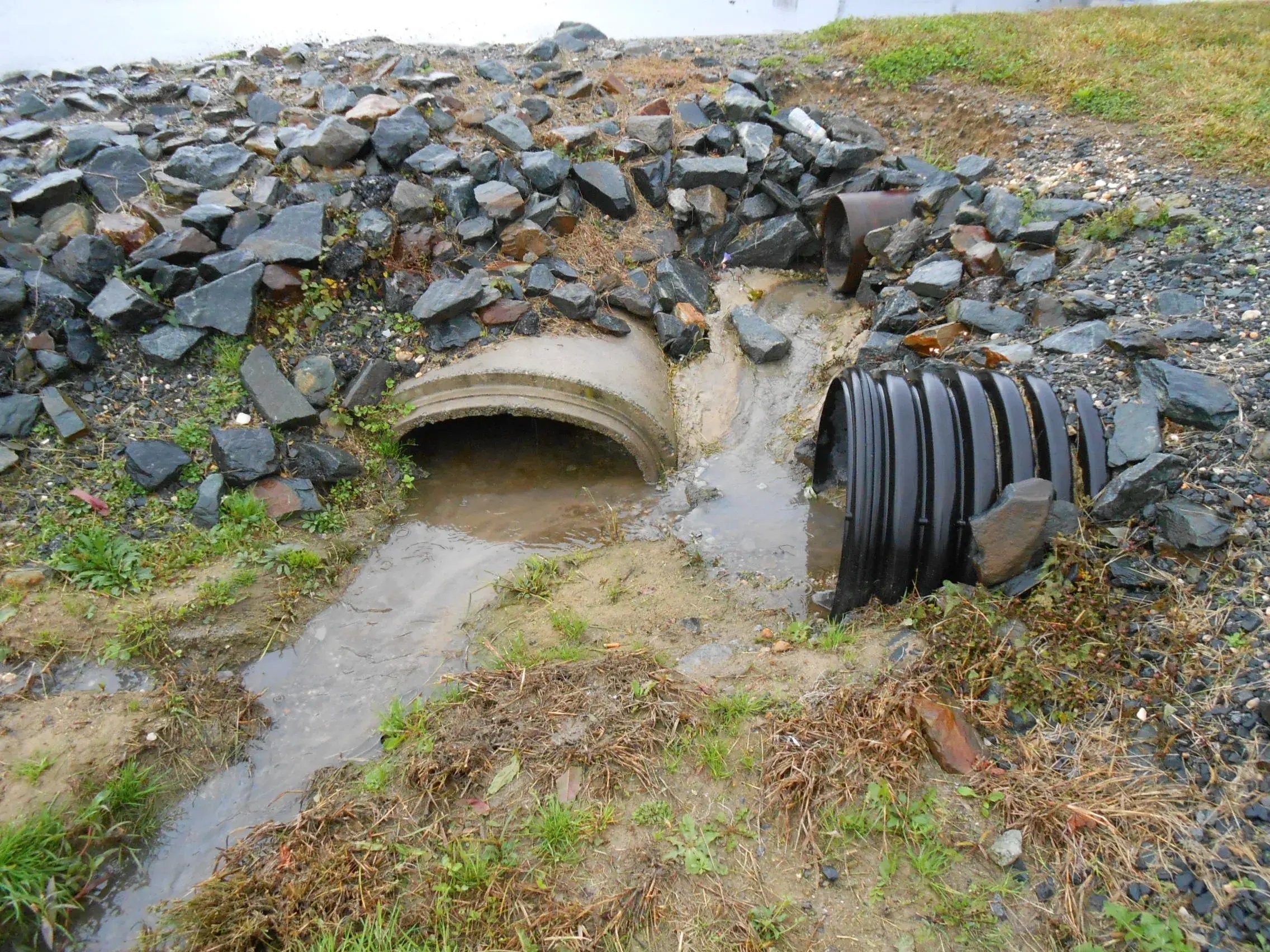
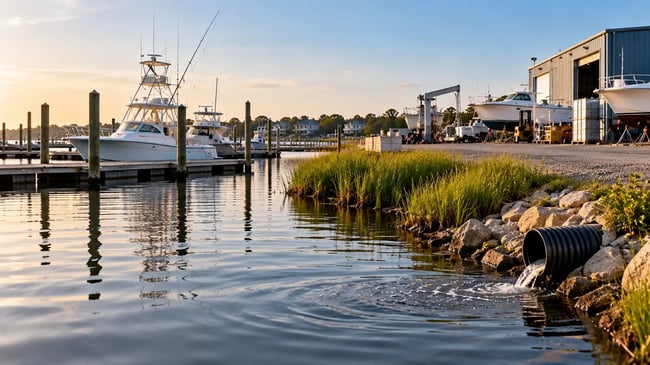
An inland facility usually has a pipe, a ditch, or a stream between the work area and the water. A waterfront boat yard often has none of that. Rain falls on the yard, picks up whatever's on the ground, and runs across the pavement or gravel and over the bulkhead. Where soils are sandy and the water table sits close to the surface, which is often the case near the shore, some of the water soaks into the ground instead. NJDEP's permit program, called NJPDES (the New Jersey Pollutant Discharge Elimination System), covers stormwater that goes to groundwater as well as water that flows to a stream or bay.
What the water picks up depends on the work. Sanding and scraping bottom paint leaves fine, copper-bearing dust on the ground, and zinc and lead can come from older coatings, galvanized hardware, and sacrificial anodes. Fueling and engine work leave oil, fuel, and solvents. Pressure washing a hull sends paint particles, soap, and whatever was growing on the bottom to wherever the wash water goes. Our article on why marinas keep failing stormwater metals monitoring explains how copper, zinc, and lead from years of boat work can stay in the soil long after the work stops, so a marina can see metals in its runoff even when today's housekeeping is good.
The tool that ties all of this together is the stormwater pollution prevention plan, which we call a SWPPP (pronounced "swip"). In New Jersey you'll also hear it called an SPPP, an SP3, or just a stormwater plan. It's a written plan that maps your site, shows where water goes, lists what could pollute it, and spells out the best management practices (BMPs) you use to keep it clean. Our guides on what a SWPPP is and stormwater BMPs go into more detail.
What Could a Barnegat Bay Nitrogen TMDL Mean for Industrial Stormwater Permits?
A TMDL, short for total maximum daily load, is a pollution budget. It sets the most of a pollutant a water body can take in from all sources and still stay healthy. NJDEP has been working toward a nutrient TMDL for Barnegat Bay for years, built on monitoring and modeling of how total nitrogen affects sensitive bottom-dwelling organisms. NJDEP's Barnegat Bay pages say reductions would come through regional and local actions, including additional measures written into NJPDES municipal and industrial stormwater permits in the contributing watershed. Based on current monitoring and modeling, NJDEP has said that potentially 18 of the 37 municipalities in the watershed could be affected.
As of the Barnegat Bay Partnership's 2026 report, the nitrogen TMDL is still described as upcoming, so the specific permit conditions aren't final. NJDEP's Barnegat Bay TMDL page is the place to check for the current status. Our article on TMDLs, impaired waters, and stormwater permits explains how those budgets generally connect to permits.
Business sites are one piece of a much bigger land use picture, and nobody expects a single marina to solve a bay-wide nitrogen problem. But if a TMDL does add conditions to stormwater permits in your part of the watershed, a facility with a current SWPPP, tight housekeeping, and well-documented inspections will have a much easier time adjusting.
Which NJPDES Stormwater Permit Applies to a Marina or Boat Yard?
Not every marina needs a stormwater permit. NJDEP's guidance says a marina or boat yard needs one when it does fueling of any kind, mechanical or engine repair, or boat maintenance such as sanding, scraping, and power washing. A marina that only rents slips and stores boats, with none of that going on, may fall outside the program. Marinas generally fall under industry code SIC 4493, and for them it's the maintenance, cleaning, and fueling areas that bring a site into the program, not the whole property. Facilities that build or repair boats are covered under SIC 373, ship and boat building and repairing. Whether your site is in depends on your code and on what happens outside, so it's worth confirming instead of assuming.
Facilities that are in the program usually start with the Basic Industrial Stormwater General Permit, called the 5G2. NJDEP makes it available to regulated facilities that have eliminated, or can eliminate within six months of authorization, all exposure of industrial materials and activities to rain and snowmelt. NJDEP wrote marina-specific guidance for it, and the idea is simple. Where a marina can move boat repair, sanding, painting, and parts cleaning indoors or under cover, the 5G2 can fit. It requires a SWPPP, regular inspections, an annual certification, and annual training, and it doesn't require stormwater sampling. NJDEP renewed it with a master general permit that took effect February 1, 2023. Our guide to the 5G2 permit in New Jersey walks through the forms and day-to-day requirements.
One 5G2 condition catches boat yards by surprise. The permit's equipment and vehicle washing provisions require marinas to stop discharging boat bottom wash water, so hull washing needs a way to capture the water instead of letting it run across the yard or off the dock. NJDEP created a coastal permit-by-rule to make installing boat wash wastewater systems easier, and we'll come back to it in the construction section below.
If you can't get your work under cover, for example because haul-out, blocking, and bottom work have to happen in the open yard, the 5G2 doesn't fit, and the usual path is an individual NJPDES permit written for your site. Individual permits can carry their own monitoring, limits, and conditions, so the workload and timeline look different, and NJDEP's review times for them run long. Our guide to individual NJPDES industrial permits covers what to expect. A third path, the permanent no exposure exclusion, requires every industrial material and activity to sit inside a permanent, fully enclosed building. That's rare for a boat yard, but our article on what no exposure means explains why New Jersey's version is so strict.
| Marina or Boat Yard Activity |
Where It Stands for Stormwater |
Likely Permit Path |
| Slip rental and boat storage only |
May fall outside the program, depending on industry code and what happens on site |
Confirm before assuming. It may be none |
| Fueling of any kind |
Brings the fueling area into the program |
5G2 if exposure can be eliminated, otherwise an individual permit |
| Engine and mechanical repair |
Brings the work area into the program |
5G2 if done indoors or under cover, otherwise an individual permit |
| Sanding, scraping, and painting |
Brings the work area into the program, with a higher risk of copper and zinc in runoff |
5G2 if done indoors or under cover, otherwise an individual permit |
| Boat bottom washing |
Under the 5G2, wash water can't be discharged |
Capture and handle the wash water, plus the permit that fits the rest of the site |
| Boat building or repair as the main business (SIC 373) |
Regulated industrial activity |
5G2 if exposure is eliminated, otherwise an individual permit |
What Stormwater Controls Do Regulators Expect at Marinas and Boat Yards?
Whatever permit you land on, the controls look similar, and most of them are habits rather than equipment. Designate work areas for sanding, painting, and engine work, and put them under cover or indoors where you can. Use dustless sanders with vacuum collection instead of open sanding, and sweep or vacuum paint dust instead of hosing it down. Keep paints, solvents, used oil, and batteries off bare ground, inside containment and out of the rain. Keep spill kits and drip pans at fueling and engine work areas, and train staff to use them. Protect storm drains near work areas, and walk the yard regularly. Our guide to doing a stormwater visual inspection the right way shows what to look for on that walk.
Fuel and oil need their own attention because they're the pollutants customers and inspectors can see. A sheen on the water is something you may have to report, and the rules are covered in our article on when you have to report an oil spill. If a spill does reach the water, make the emergency calls first and sort out the paperwork afterward.
New Jersey also runs a voluntary Clean Marina Program through NJDEP's Coastal Management Office and the New Jersey Sea Grant Consortium. It's incentive-based, and a marina earns designation by scoring at least 80 percent on a best management practices checklist. The program offers free guidance and a guidebook that covers stormwater, wash water, fueling, and waste. It's a good housekeeping framework, but it isn't a substitute for a permit.
Which Other Coastal Industrial Businesses Need Stormwater Permits Near the Bay?
Marinas get most of the attention near the water, but other businesses along the shore and up the tributaries are in the same program. NJDEP sorts facilities into the 5G2, industry-specific general permits, individual permits, and a no exposure exclusion, and several of the industry permits are long past their expiration dates, which can push new facilities toward individual permits. The table shows common paths for coastal and bay-adjacent industries, including the ones that don't use the 5G2. Manufacturers with outdoor activity usually need an individual permit, and auto salvage and wood recycling yards have their own general permits.
| Business Type |
Likely Permit |
What to Watch For |
| Ready mix, precast, block, or brick plant |
Concrete Products Manufacturing (CPM) |
Truck washout and process water are handled differently from stormwater |
| Hot mix asphalt plant |
Hot Mix Asphalt (R4) |
Written for asphalt manufacturing, not a paving contractor's yard |
| Quarry, mine, or sand and gravel pit |
Mining and Quarrying (R13) or Sand and Gravel (RSG) |
RSG is for sites whose stormwater goes only to groundwater. A surface water discharge usually points to R13 |
| Scrap metal yard |
Scrap Metal (SM2) |
Stormwater sampling applies, and a separate recycling approval is often needed |
| Fleet, trucking, or equipment yard |
Depends on activities |
Usually only the maintenance, cleaning, fueling, and deicing areas bring the site in |
| Warehouse, data center, body shop, dealership, or quick-lube |
Often none |
Depends on industry code and whether maintenance, fueling, or washing happens outdoors |
Two cautions go with that table. First, each permit is tied to industry codes and conditions, so a facility that looks like it fits can still fall outside the eligibility rules. Second, check current permit status on NJDEP's stormwater website before you file, because an expired general permit generally can't take new applicants. If you already hold coverage, make sure the category on your authorization letter still matches what you do, since facilities change over the years. If your runoff goes to a sewer run by a local sewerage authority, that authority's rules may apply instead of, or alongside, an NJPDES permit, so confirm where your water goes. Our guides on general, individual, and no exposure permits and stormwater associated with industrial activity help you sort out which category you're in.
What If You're Building, Expanding, or Upgrading a Waterfront Facility?
Waterfront work brings its own set of approvals, and we want to be plain about which ones we handle, because RMA doesn't prepare construction-phase permits. Docks, bulkheads, wash pads, and yard expansions often involve NJDEP's coastal permit program under N.J.A.C. 7:7, depending on where the site sits. That program includes a permit-by-rule for installing boat wash wastewater systems at marinas, boat yards, and boat sales facilities. It covers one to three wash pads and up to three systems at a single site, and it doesn't replace other permits, such as a Treatment Works Approval for a sanitary sewer connection or the 5G2 itself. Land disturbance during construction is a separate matter. Construction stormwater coverage, called the 5G3, is issued through the local Soil Conservation District, along with soil erosion and sediment control certification. Projects that qualify as major development also have to meet NJDEP's stormwater management rules at N.J.A.C. 7:8, which require green infrastructure under amendments adopted in 2020 that became operative in 2021.
We don't prepare or file any of that, and designing and installing a wash system is engineering and construction work, which we don't do either. We can help you work out which construction-phase approvals your project is likely to need and point you toward the right professionals.
Where we do come in is what a facility needs once it's running. A new or expanded marina or boat yard almost always needs the right NJPDES industrial permit or a no exposure exclusion, a SWPPP, inspections and annual certification, and sampling where the permit requires it. It pays to think about that early, because the layout you build decides how much of your work can happen under cover, and that can decide whether the 5G2 fits or you end up with an individual permit.
How Does RMA Help Marinas and Coastal Businesses With Stormwater Permits?
We're based in New Jersey and have worked with NJDEP's stormwater program since we opened in 1992, so we know how the permit categories fit together and what inspectors look for. For a marina, boat yard, or shore industrial business, we help you figure out whether you need coverage at all, which permit fits, and what changes to your site would let you qualify for a simpler one. We write a SWPPP built for your specific permit and train your team. After you're permitted, we offer annual support, such as reminders, help interpreting results, SWPPP updates, inspection prep, and answers when questions come up, either hands-off or hands-on. If your permit requires sampling, we don't collect the samples ourselves, because your team knows the site and storm windows are hard to hit on short notice. We train your people to sample correctly instead, and our article on why you should take your own stormwater samples explains the reasoning. Our online training library is there for your staff as well.
We're a small firm with senior staff doing the work, so we're sometimes pricier than other consultants, and we're not the right fit for engineering design, treatment system construction, large construction stormwater projects, or anyone shopping only on the lowest price. If you just need to know whether your yard is in the program, we'll tell you, and if you don't need us, we'll say that too. There's no pressure and no obligation. You can call us, email us, or fill out the form on our website, and when you're ready, contact RMA and we'll help you work out the next step.