How PAG-03, Metals Monitoring, and Covered Storage Work for Battery Recycling Sites
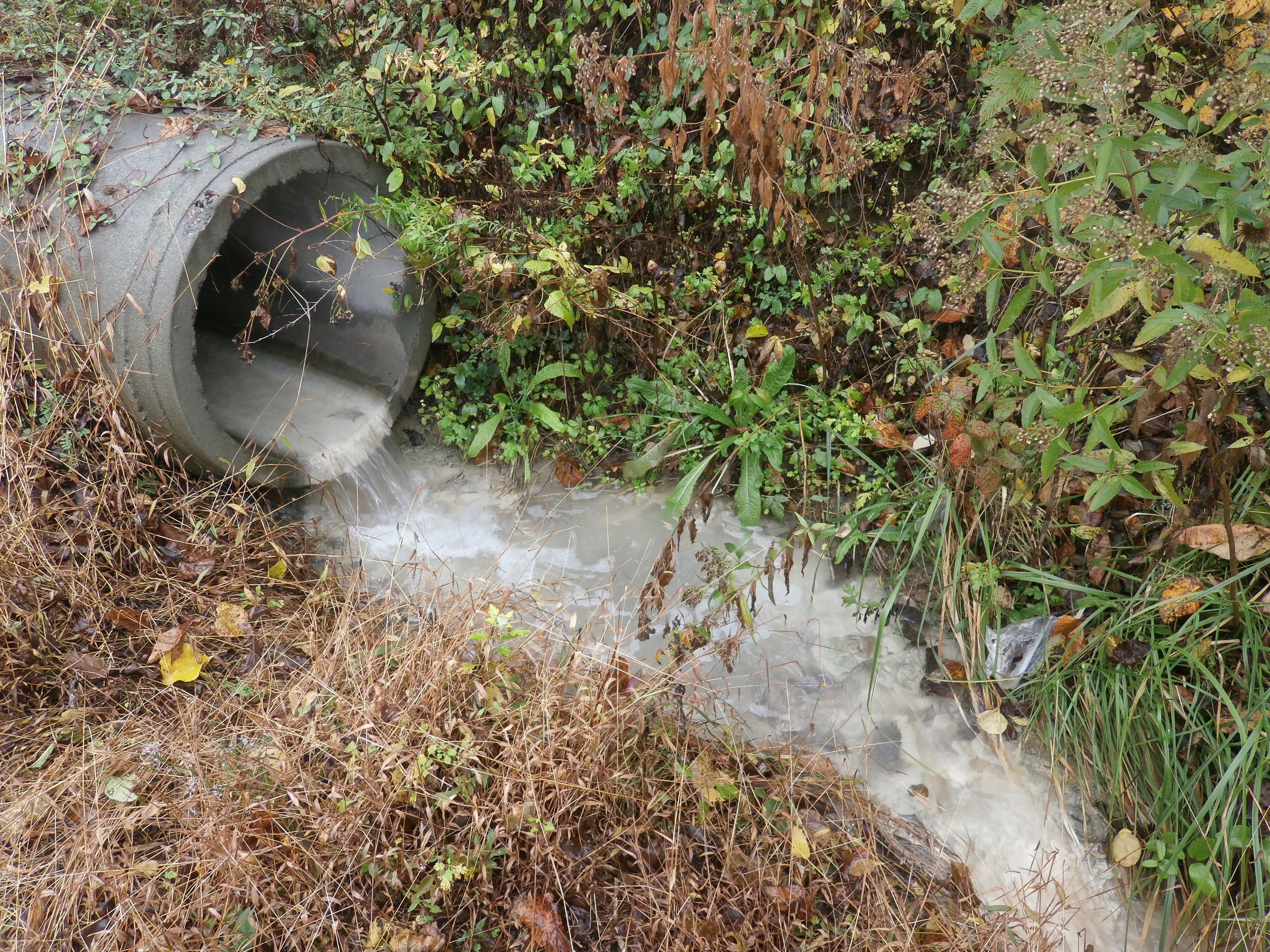
Few industries put as many stormwater pollutants in one place as battery recycling. Lead plates and paste, sulfuric acid, cracked cases, and the dust that comes with all of it can end up on the ground, on roofs, and on truck tires. If any of that sits or moves outside, rain and snowmelt can carry it off the property and into a storm drain or a stream. So do Pennsylvania battery recyclers need a stormwater permit? Most of them do, and the permit is usually PAG-03, Pennsylvania DEP's general stormwater permit for industrial sites. The exceptions are real, though, and they depend on what you do on site, how DEP classifies your business, and where your runoff goes.
This article covers which PAG-03 appendix fits a battery recycler, the pollution sources DEP expects you to control, how sampling and metals monitoring work, and when an individual permit or a No Exposure Certification comes into the picture. If you'd rather talk it through for your specific site, you can reach out to RMA at any point.
Table of Contents
TL;DR
Most Pennsylvania battery recyclers that store or handle batteries outdoors need stormwater permit coverage, and most get it through PAG-03, DEP's general permit for industrial stormwater. Which appendix applies depends on your industry code. Secondary lead and nonferrous smelting points to the primary metals appendix, and scrap-style battery recycling points to the scrap and waste recycling appendix. Expect twice-yearly sampling, a Preparedness, Prevention and Contingency (PPC) Plan, and close attention to metals and sediment in your runoff. A facility that keeps everything indoors or under roof may qualify for a No Exposure Certification instead, and a site that discharges process wastewater or sits on a high quality stream may need an individual permit.
Do Pennsylvania Battery Recyclers Need Stormwater Permit Coverage?
In most cases, yes. NPDES stands for the National Pollutant Discharge Elimination System, the federal program that controls what goes into streams and rivers. DEP runs it in Pennsylvania, and stormwater that touches industrial activity is part of it. PAG-03 is DEP's general permit for that stormwater. A general permit is one standard set of conditions that eligible facilities join by filing a Notice of Intent (NOI) with DEP, instead of negotiating a permit of their own. The current PAG-03 took effect on March 24, 2023 and runs through March 23, 2028.
The federal stormwater rules name your industry directly. They list facilities involved in the recycling of materials, including metal scrapyards, battery reclaimers, and salvage yards, as industrial activity. That puts a battery recycler in a covered category by default. Whether you need coverage comes down to three things: how DEP classifies your primary business, whether batteries, battery scrap, or other industrial materials and activities are exposed to rain and snowmelt, and where your site's runoff ends up. If runoff goes to a combined sewer or sanitary sewer instead of a stream, the local sewer authority may set the rules instead of a DEP stormwater permit, so confirm that before assuming either way.
If you want the broader picture of how the options compare, our guides on which Pennsylvania stormwater permit you need and what counts as stormwater associated with industrial activity cover the basics.
Which PAG-03 Appendix Applies to a Battery Recycling Facility?
PAG-03 has a main body that applies to everyone and a set of sector appendices lettered A through U. Each appendix sets the sampling, benchmarks, and best management practices (BMPs, meaning the physical and procedural controls that keep pollutants out of runoff) for a type of facility. DEP matches your primary SIC code to an appendix. An SIC code is a four-digit number that describes what a business does, and your primary code is the one tied to the activity that brings in the most revenue.
Battery recyclers don't all share one code, which is why this step trips people up. The table below shows the usual paths.
| What the facility mostly does |
Typical SIC code |
PAG-03 path |
| Smelts and refines recovered lead or other nonferrous metals |
3341 |
Appendix B (Primary Metals) |
| Collects, sorts, and processes spent batteries and other scrap for resale |
5093 |
Appendix P (Scrap and Waste Recycling Facilities) |
| Manufactures batteries, or does something no appendix describes |
3691 and 3692 aren't listed in DEP's table |
DEP may approve coverage under Appendix J (Additional Facilities), or the site applies for an individual permit |
Treat that table as a starting point. A facility that smelts lead and also runs a scrap yard can fall under more than one appendix, and DEP can require a facility to follow the appendix closest to its activities even when the code isn't a perfect match. Pull your code, then check it against Table 1 in DEP's current PAG-03 NOI instructions before you file anything. Choosing the wrong appendix means sampling for the wrong things, and that tends to surface during a DEP inspection.
What Stormwater Pollution Sources Show Up at a Battery Recycling Site?
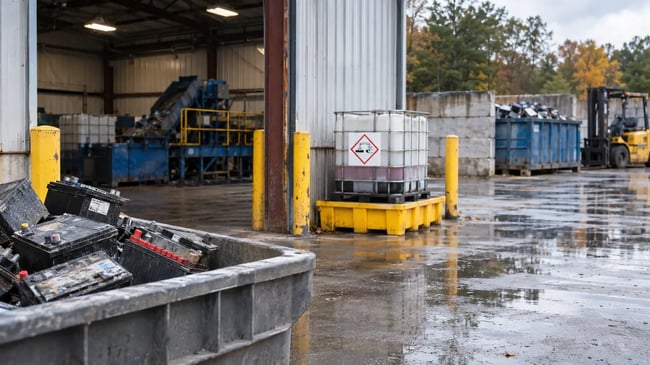
Battery recycling sites tend to have the same four exposure points, and each one needs its own fix. A good PAG-03 program starts by walking the site and writing down where each of these exists.
| Exposure point |
How it reaches your runoff |
Typical control |
| Battery storage and breaking areas |
Cracked cases leak electrolyte, and rain hits exposed lead plates, paste, and casing fragments |
Roofed or indoor storage, leak-proof containers, curbed and sealed pads |
| Lead-contaminated dust |
Dust from handling and processing settles on yards, roofs, and equipment, then washes off in the next rain |
Enclosed processing, dry sweeping or vacuuming, regular roof and surface cleaning |
| Truck traffic |
Tires and undercarriages carry sediment and residue from loading areas onto roads and drains |
Paved lanes, track-out controls, loading under cover, sweeping exit routes |
| Acid spills |
Unloading, handling, and transfers release acid that runs to drains before anyone sees it |
Secondary containment, spill kits at transfer points, drain covers, trained staff |
Lead is the pollutant that gives this industry its reputation. It doesn't break down, it binds to soil and sediment, and it travels with the particles in runoff, so a muddy discharge from a battery site carries more than dirt. Acid works differently. A single spill can push the pH of runoff well outside the range DEP expects, and it does so quickly. Track-out is the quiet one. Nobody sees a single truck leave, but a few hundred trips a month leave a steady film of residue along every route out of the yard.
Most PAG-03 appendices call for sampling twice a year, once in each half of the year, from a qualifying storm. A qualifying storm produces more than 0.1 inch of rain, causes a discharge, and comes at least 72 hours after the previous storm. You sample at each outfall, which is the point where stormwater leaves your site, and your results go to DEP through the electronic Discharge Monitoring Report (eDMR) system. Our guide to PAG-03 stormwater sampling walks through the mechanics, and our eDMR reporting guide covers the submission side.
The exact list of pollutants depends on your appendix and on the authorization DEP sends you, so read both. For context, the 2023 permit added total nitrogen and total phosphorus to every appendix, total aluminum to Appendix P, and oil and grease to Appendix B. Total suspended solids, a lab measure of how much particulate matter is in the sample, carries a 100 mg/L benchmark. For a battery recycler, that number does a lot of work, because lead and other metals ride on sediment. We can't tell you from here which metals your appendix lists, and a metal missing from the list doesn't mean it's missing from your runoff. If lead is part of what you handle, a result that looks fine on paper can still hide a housekeeping problem at the yard.
Benchmarks aren't permit limits. DEP uses them to judge whether your BMPs are working, and the response to going over escalates in steps:
- Two consecutive exceedances of the same pollutant at the same outfall trigger a corrective action plan, due within 90 days after the end of the monitoring period.
- Four consecutive exceedances mean the plan has to include DEP's Stormwater BMPs Checklist.
- Continued exceedances can lead DEP to require an individual NPDES permit.
For a deeper look at what to do when numbers come back high, see our article on benchmark values versus effluent limits. We also recommend taking your own stormwater samples where you can, since you know your yard better than a contractor visiting twice a year.
When Does a Battery Recycler Need an Individual NPDES Permit or a No Exposure Certification?
PAG-03 isn't open to every site. Three situations commonly push a battery recycler toward an individual NPDES permit, which is a permit written for one facility rather than a standard set of conditions:
- Your site discharges stormwater directly to a stream DEP classifies as High Quality or Exceptional Value. DEP can't approve PAG-03 coverage in that case.
- Your facility already has, or is required to have, an individual NPDES permit for a non-stormwater discharge such as process wastewater. In that case the stormwater typically gets handled under that individual permit instead of PAG-03.
- Repeated benchmark exceedances lead DEP to require an individual permit.
On the other end, a No Exposure Certification (NEC) lets an industrial facility skip PAG-03 coverage when its materials and activities never touch rain. DEP's standard is strict: in general, all industrial materials and activities must be stored and conducted indoors or under roof. A recycler with outdoor battery yards, open loading areas, or dust on its roofs won't qualify. A facility that keeps its inventory, processing, and loading inside might. The NEC also isn't available for direct discharges to High Quality or Exceptional Value waters, and the application can require a PPC Plan depending on the answers. Our explainer on no exposure under an NPDES stormwater permit and our comparison of general, individual, and no exposure permits go further on each option.
How Do Covered Storage, Containment, and a PPC Plan Protect a Battery Recycler's Stormwater?
Rain only carries what it touches. A pallet of spent batteries under a roof gives runoff nothing to pick up, while the same pallet in the open turns every storm into a sampling event. That's why covered storage is the strongest control a battery recycler has, and why moving material indoors or under cover removes a pollution source instead of just treating one. Containment is the backstop. Curbed pads, sealed floors, leak-proof bins, and secondary containment around acid handling keep a failure on your site and out of your drains.
PAG-03 also requires a Preparedness, Prevention and Contingency Plan, usually called a PPC Plan. It's a written plan for how you prevent spills and leaks and how you respond when one happens, and it goes to DEP with your NOI. For a battery recycler, the plan should name where acid and lead-bearing material are stored and moved, what containment protects each area, who responds to a spill, and how you clean up. Reviewing it on a regular schedule and updating it when the site changes keeps it from going stale. Our comparison of SWPPPs and PPC Plans for PAG-03 explains how the plans differ.
The day-to-day habits count as much as the hardware: dry sweeping or vacuuming instead of hosing down the yard, cleaning roofs and equipment on a schedule, keeping spill kits where transfers happen, inspecting containment after heavy rain, and training everyone who handles batteries on what to do when something leaks. Our overview of stormwater BMPs covers the options in more detail.
How Can RMA Help a Pennsylvania Battery Recycler With PAG-03?
We work with Pennsylvania facilities on PAG-03 all the time. For a battery recycler, that usually starts with the questions this article raises: which SIC code and appendix fit your operation, whether you belong under PAG-03, an individual permit, or a No Exposure Certification, and what your site walk shows about exposure. From there we can help with the NOI, write or update your PPC Plan, set up your sampling and eDMR reporting, and work through a corrective action plan if your results run high. Our overview of what PAG-03 costs in Pennsylvania explains what drives the price.
There's no pressure and no obligation. If you're still sorting out whether you need coverage at all, we'll tell you straight, including when the answer is that you don't need us. You can call, email, or fill out the form on our website, and you can also reach out to RMA directly with your questions.