Pennsylvania Salvage Yard Stormwater Permits: When PAG-03 Applies, What DEP Expects, and How PennDOT Licensing Fits In
If you run a junkyard or auto salvage yard in Pennsylvania, you probably know your way around PennDOT licensing, screening fences, and what to do with used oil. Stormwater permits come up far less often, which is exactly why a letter or inspection from PA DEP (the Pennsylvania Department of Environmental Protection) can catch yard owners off guard. The short answer is that most yards that dismantle or store vehicles outdoors fall under Pennsylvania's industrial stormwater rules, and the usual route is coverage under DEP's PAG-03 general permit.
This article explains why salvage yards are covered, which fluids, batteries, and sediment cause the problems, what PAG-03 coverage involves, what good fluid management looks like on the ground, and what DEP looks at when it checks a yard. We'll also cover why your PennDOT license doesn't replace any of it. If you'd rather talk through your own yard, you can reach out to RMA and we'll tell you plainly whether you need coverage at all.
Table of Contents
TL;DR
Most Pennsylvania junkyards and auto salvage yards that dismantle or store vehicles outdoors need stormwater coverage from PA DEP, usually under the PAG-03 general permit, because salvage yards are a covered industrial category. The main exceptions are yards whose stormwater goes only to a public sanitary or combined sewer, and yards that keep everything indoors or under shelter and qualify for a No Exposure Certification. A yard that discharges to a High Quality or Exceptional Value stream needs an individual permit instead. PennDOT salvage licensing is a separate program and doesn't cover stormwater.
Do Pennsylvania Salvage Yards Need PAG-03 Stormwater Permit Coverage?
PAG-03 is Pennsylvania's general permit for stormwater from industrial sites. It's a type of NPDES permit, which stands for National Pollutant Discharge Elimination System, the federal Clean Water Act program that DEP runs in Pennsylvania. A general permit is a standard set of rules DEP offers to a whole category of facilities, so each yard doesn't need a custom permit written from scratch. Federal stormwater rules list facilities involved in recycling materials, including salvage yards and automobile junkyards, as industrial activity. DEP's industrial stormwater FAQ says a facility in a listed category has to apply for permit coverage or, if it qualifies, a No Exposure Certification.
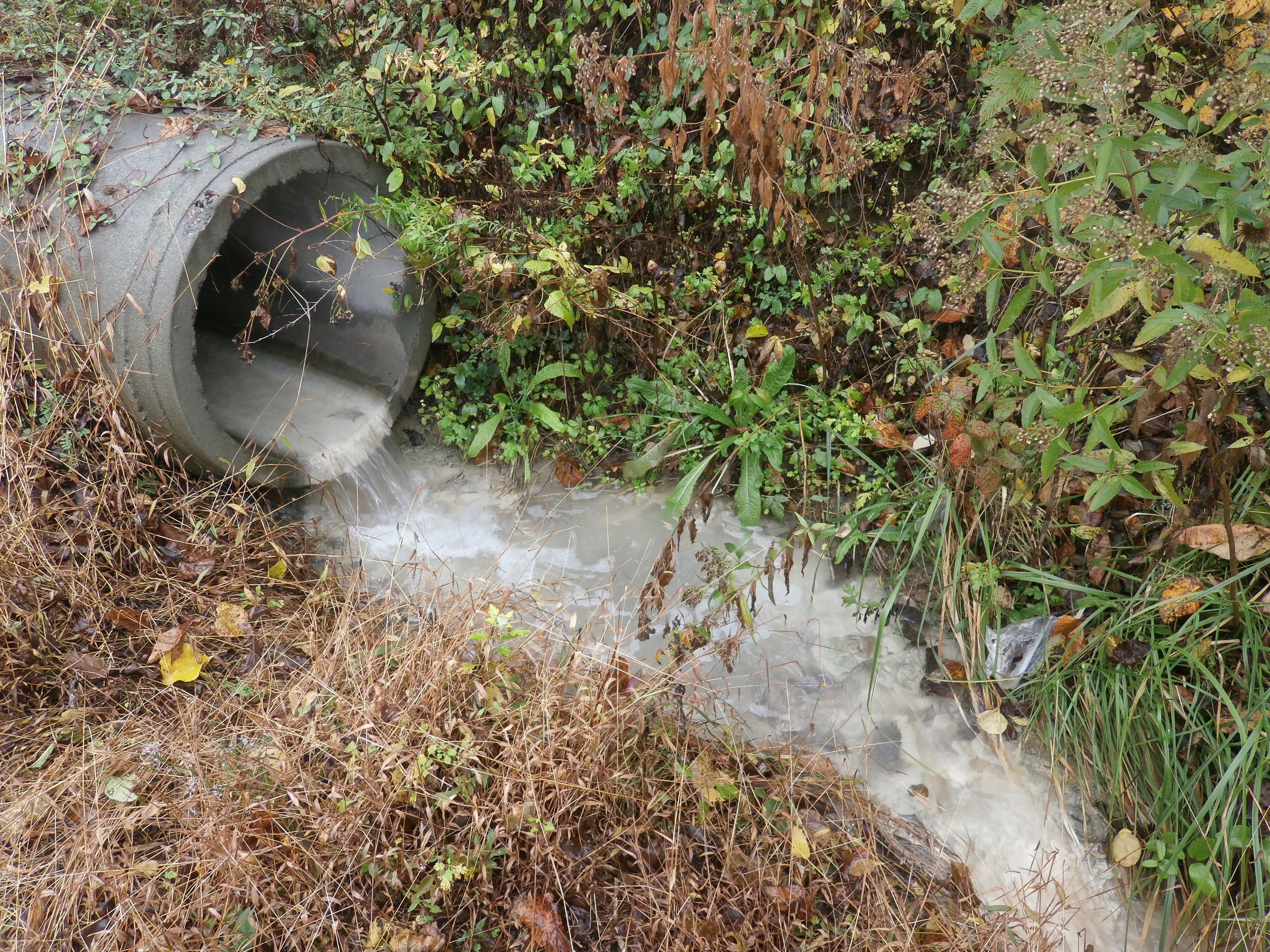
Rain and snowmelt hit the vehicles, parts, batteries, and bare ground in your yard, pick up whatever's there, and leave the property. That runoff counts as a discharge whether it leaves through a pipe, a ditch, a storm sewer, or just sheet flow across the edge of the lot. DEP's FAQ says the lack of an outfall structure doesn't exempt a facility, and a retention basin that rarely overflows doesn't either, since any possibility of a discharge, even in a large storm, keeps the requirement in place. If you want the broader picture first, we've written a plain-language explanation of stormwater associated with industrial activity.
There are real exceptions, and we'd rather you know them. If all of your stormwater goes to a sanitary or combined sewer that's part of a public sewage treatment plant, DEP says permit coverage isn't required, though pretreatment rules and notice to the sewer authority may apply. Some older cities, including parts of Philadelphia and Pittsburgh, have combined sewers, so a city yard may answer to the sewer authority instead of a DEP stormwater permit. Local rules and fees differ, so confirm your situation with the authority and with DEP before assuming either way. A yard that keeps every industrial activity and material indoors or under a storm-resistant shelter may qualify for a No Exposure Certification, which we cover below, but a typical yard with vehicles stored in the open won't.
One more boundary. If you're building a new yard or expanding an existing one, the earth disturbance falls under construction stormwater rules, such as the erosion and sediment control requirements in Chapter 102 of the Pennsylvania Code. RMA doesn't prepare construction-phase permits or plans, and your engineer, contractor, or an erosion and sediment control specialist usually handles them. Once the yard is up and running, you'll almost certainly need the operational permits and plans in this article, and that's the part we help with.
Which SIC Code and PAG-03 Appendix Apply to an Auto Salvage Yard?
Stormwater permitting works off industry codes. A Standard Industrial Classification (SIC) code is a four-digit number that describes what a business does, and DEP matches your code to a section of PAG-03 called an appendix. Each appendix spells out the sampling, benchmarks, and best management practices (BMPs, meaning the physical and procedural controls that keep pollutants out of runoff) for that kind of facility.
Yards that dismantle vehicles to sell used parts generally fall under SIC code 5015, motor vehicle parts, used, and PAG-03 has an appendix written for automobile salvage yards. Yards that mostly take vehicles apart for scrap metal are usually classified under SIC code 5093, scrap and waste materials, which has its own appendix for scrap and waste recycling facilities. Plenty of Pennsylvania yards do some of both.
DEP determines your primary code by revenue, so whichever activity brings in the most money at the site is the one that counts. A yard that earns most of its income from selling parts is a 5015 yard even if it also sells scrap. Don't read that as a loophole, though. The federal rule also describes covered facilities by activity, naming salvage yards and automobile junkyards outright, so a different code on your paperwork doesn't take you out of the program. When a site has more than one industrial activity, the requirements of each matching appendix apply, outfall by outfall. We'd rather confirm the classification than guess, because it decides what you sample for.
What Stormwater Pollution Comes From Junkyards and Auto Salvage Yards?
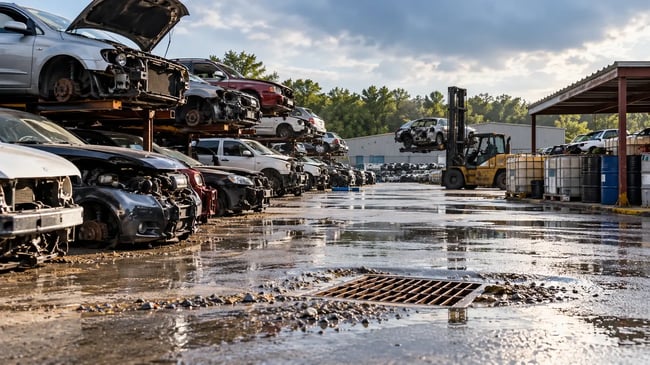
A salvage yard puts a lot of small pollution sources in one open area. Every vehicle that arrives is carrying fluids, and how the yard handles those fluids in the first hours after a car comes in decides most of what shows up in the runoff.
Fluids are the obvious concern: motor oil, transmission fluid, fuel, brake fluid, power steering fluid, and antifreeze, which is typically ethylene glycol and is toxic to wildlife. A vehicle set down on bare ground before it's drained can leak onto that ground for weeks, and the next rain moves it. Small drips add up across hundreds of vehicles.
Batteries come next. Lead-acid batteries hold lead and sulfuric acid, and a cracked case sitting in the rain is a direct source of both. Older vehicles can also contain mercury switches, in places like trunk and hood lights and some anti-lock brake sensors. Those switches should come out intact and go to a mercury recovery program rather than get crushed with the car.
Then there's the ground itself. Many yards are unpaved, and bare soil, gravel, and tracked mud send sediment off the property every time it rains. Sediment is a pollutant in its own right, and it carries oil, metals, and other contaminants with it. Total suspended solids (TSS), a lab measure of how much particulate matter is in a water sample, is tracked under PAG-03 with a benchmark of 100 mg/L. Metals from vehicle bodies and parts, such as iron, aluminum, lead, and zinc, also commonly show up in salvage yard runoff. Your appendix lists the exact parameters, and our guide to benchmark values versus effluent limits explains how to read your results.
What Does PAG-03 Coverage Involve for a Salvage Yard?
Getting covered takes more than a short form. You submit a Notice of Intent (NOI), which is the application DEP uses to grant PAG-03 coverage, along with a site plan, a topographic map, a PPC Plan, and a $500 filing fee. A PPC Plan, short for Preparedness, Prevention and Contingency Plan, is the written plan describing how your yard prevents spills and leaks and what you do when one happens. New discharges also require notification to the municipality and county, and existing yards provide stormwater sampling information with the NOI. The current permit runs from March 24, 2023 through March 23, 2028. Our guides to the PAG-03 permit and how to take stormwater samples and to Pennsylvania PPC Plans compared with SWPPPs go deeper on both pieces.
Once you have coverage, the work becomes a routine your yard repeats every year.
| Requirement |
What it involves for a salvage yard |
| Semiannual sampling |
Grab samples of the pollutants in your appendix at least once every six months, taken during a storm that produces more than 0.1 inch of precipitation and follows at least 72 hours without a prior storm. The 2023 permit added total nitrogen and total phosphorus to every appendix. |
| eDMR reporting |
Results go to DEP through the electronic Discharge Monitoring Report (eDMR) system, which all industrial stormwater permittees must use. Reports follow each six-month period. |
| Corrective Action Plan |
If the same pollutant exceeds its benchmark at the same outfall in two or more consecutive monitoring periods, you submit a plan to DEP within 90 days of the end of the monitoring period explaining the additional controls you'll put in place. |
| Annual report and fee |
An annual report covering the previous calendar year and the annual NOI installment fee, $500, are due each March 23. Fees can be paid online through DEP's GreenPort. |
Benchmarks work as targets that tell you whether your controls are working, not as pass-fail effluent limits, but repeated exceedances can lead DEP to revoke general permit coverage and require an individual permit. Our guides to Pennsylvania eDMR reporting and to what to do when your sampling results are high cover what to do at each step.
When a Salvage Yard Needs an Individual Permit Instead of PAG-03
If your yard discharges to a High Quality or Exceptional Value stream, which are special protection designations under Chapter 93 of the Pennsylvania Code, PAG-03 coverage isn't available. You'd apply for an individual NPDES permit instead, a more involved application written around your specific site. Our overview of general, individual, and No Exposure permits shows how the three paths compare.
Why Most Salvage Yards Don't Qualify for No Exposure
A No Exposure Certification costs $500 every five years with no annual fee, which makes it attractive, but it only works when every industrial material and activity at the site is indoors or under a storm-resistant shelter. Vehicles parked in an open yard, uncovered fluid containers, and outdoor dismantling rule it out, and DEP won't certify only part of a site. If your yard has changed and you think you might now qualify, our explanation of what No Exposure means is a good place to check the criteria.
What Does Good Fluid and Battery Management Look Like at a Salvage Yard?
Good management starts the day a vehicle comes in. The yards that stay out of trouble treat draining as the first step, done in one controlled spot, rather than something that happens eventually. A PPC Plan should describe whichever of these practices you use, and the table below lays out what we'd look for.
| Source |
What goes wrong |
What good looks like |
| Vehicle fluids |
Cars sit in the yard undrained and leak onto bare ground. |
Draining on a contained, impervious pad with drip pans and absorbent on hand, before the vehicle goes into storage. |
| Drained fluids |
Open or unlabeled containers and drums sit in the rain. |
Closed, labeled containers on secondary containment, stored under cover, with a stocked spill kit nearby. |
| Batteries |
Batteries stack up on the ground or in open bins, and cases crack. |
Prompt removal, then storage upright in acid-resistant containment under cover and away from drains. |
| Mercury switches and other removed parts |
Switches go into the crusher with the vehicle. |
Removal before crushing, with switches kept in sealed, labeled containers until they're sent for recovery. |
| Unpaved lots |
Mud and sediment leave at the entrance and low spots. |
Stabilized high-traffic areas, sediment controls where runoff leaves the lot, and a clean entrance. |
| Wash water |
Vehicle or parts washing flows across the yard with stormwater. |
Wash water kept separate from stormwater and recycled or sent to a sanitary sewer in line with local pretreatment rules. |
The wash water row deserves a second look. DEP's FAQ says vehicle wash water isn't an authorized non-stormwater discharge under PAG-03, so a yard that rinses vehicles or parts onto the ground has a problem the permit doesn't cover. Our guide to stormwater best management practices goes through the full range of controls, from covers and berms to sediment traps.
The controls only work if the people doing the draining and stacking know why they matter. Your crew handles the fluids every day, and a short training session on spill response and housekeeping usually does more than any piece of equipment. Our online environmental training library is one option, and we've also covered whether stormwater training is required.
What Does PA DEP Look For at a Salvage Yard?
An inspector checks two things and compares them: the paperwork and the ground. On the paperwork side, that means a PPC Plan that matches how your yard operates, sampling results collected correctly and reported through eDMR, annual reports and fees filed on time, and Corrective Action Plans where benchmarks were exceeded. A plan that describes a drained-on-a-pad routine doesn't help if the inspector walks past a row of undrained cars.
On the ground, the signs are easy to spot. Oil staining under stored vehicles, leaking or uncovered containers, sheen on puddles, sediment in ditches or at the entrance, batteries sitting in the open, and any water leaving the property that doesn't look like stormwater all tell an inspector the plan isn't being followed. Run-on from neighboring property can also affect your sample results, so it helps to document it. We walk through the process in what happens during a PA DEP stormwater inspection, and a routine stormwater visual inspection of your own is the best way to find problems first.
If you've already received a notice of violation, an environmental attorney may be appropriate alongside a consultant, since the technical fix and the legal response are separate jobs.
Does PennDOT Salvage Licensing Replace a DEP Stormwater Permit?
No. They're separate programs with separate purposes, and holding one tells you nothing about the other. PennDOT licenses junkyards and automotive dismantlers and recyclers located within the highway zone of control under highway beautification rules in Chapter 451 of Title 67 of the Pennsylvania Code. That license is tied to screening, meaning the fence or barrier that keeps the yard out of view from the road, and it runs on a calendar-year cycle.
Vehicle dealer and salvage licensing is another layer. Dealers are licensed through the Pennsylvania Department of State's State Board of Vehicle Dealers, Manufacturers and Salespersons, and PennDOT publishes requirements for miscellaneous dealers, including vehicle salvage. Your township may also license junkyards under its own ordinance.
None of those programs looks at what leaves your yard when it rains. A screening fence doesn't control runoff, and a clean PennDOT inspection doesn't mean DEP considers you covered. PAG-03 sits with DEP's Bureau of Clean Water, so treat it as its own item on your compliance list.
What Does Stormwater Compliance Cost for a Salvage Yard?
DEP's fees are modest: $500 to file the NOI and $500 each year after that. The larger cost is preparing everything the permit requires, such as the site evaluation, drainage mapping, PPC Plan, and application package. For a relatively straightforward facility, professional help with the full application typically runs about $5,000 to $10,000, and ongoing compliance support may run another $3,000 to $6,000 per year, depending on the site and how much help you want. A yard with many outfalls, complicated drainage, or a bad sampling history can fall outside those ranges.
Several things move the number: how many outfalls the yard has, how large and complex the drainage is, whether a PPC Plan already exists, and how much of the sampling and reporting you want handled for you. A small yard with simple drainage and an owner who's comfortable with paperwork can do part of this on their own, and we've written an honest look at doing PAG-03 yourself versus hiring a consultant. For a fuller breakdown, see how much a PAG-03 permit costs in Pennsylvania. The calculator below gives an instant estimate of what RMA's help would cost for your facility, with no email and no sales call.
How Can RMA Help With Pennsylvania Salvage Yard Stormwater Permits?
We work with Pennsylvania facilities all the time, and the first thing we do is figure out whether you need coverage at all. From there we determine whether PAG-03, an individual permit, or a No Exposure Certification fits your yard, then walk the site to identify pollutant sources, drainage areas, and outfalls. We turn that into site maps and a PPC Plan built around your yard, coordinate the stormwater sampling, prepare the NOI and application package, and stay involved through DEP's review. After you're covered, we can keep helping with sampling, inspections, training, eDMR reporting, annual reports, and corrective actions. If you're weighing consultants, our guide to choosing a PAG-03 consultant in Pennsylvania lists what to ask.
There's no pressure and no obligation. If you'd like to talk through your yard, you can call us, email us, or fill out the form on our website, and you can contact RMA to get started. If it turns out you don't need us, we'll say so.