How PAG-03 and No Exposure Certification Apply to Pennsylvania Craft Beverage Producers, and What Spent Grain, Tanks, and Cleaning Chemicals Do to Your Runoff
Pennsylvania's craft beverage scene has grown fast, and a lot of the people running these businesses came up through brewing, winemaking, or distilling, not environmental law. So it's a surprise when a letter from the Pennsylvania Department of Environmental Protection (DEP), a lender, or an insurer asks about a stormwater permit. The short answer is that breweries, wineries, and distilleries sit in a category DEP treats as industrial, so most of them need one of two things: coverage under DEP's industrial stormwater general permit, called PAG-03, or an approved No Exposure Certification. Which one depends on what you keep outside, and a few producers may need neither.
Below we cover how to check your SIC code, what separates a No Exposure producer from a PAG-03 producer, and why spent grain and process wastewater stay out of storm drains on either path. If you'd rather talk through your own site, you can reach out to RMA any time.
Table of Contents
- Are Breweries, Wineries, and Distilleries Covered by Pennsylvania's Industrial Stormwater Rules?
- How Do You Check Whether Your SIC Code Is on the PAG-03 List?
- When Is a Small Craft Producer a Good No Exposure Candidate?
- What Creates Stormwater Exposure at a Brewery, Winery, or Distillery?
- What Does PAG-03 Require From Producers With Outdoor Operations?
- Why Can't Spent Grain and Process Wastewater Reach Storm Drains?
- How Much Does Stormwater Permit Coverage Cost a Craft Producer?
- What About New Builds, Local Sewer Rules, and Combined Sewers?
- How Can RMA Help Pennsylvania Breweries, Wineries, and Distilleries?
- Additional Information About Brewery, Winery, and Distillery Stormwater Permits
TL;DR
Breweries, wineries, and distilleries are a covered category under Pennsylvania's industrial stormwater permit, PAG-03, when industrial materials or activities are exposed to rain and snow. A small producer that keeps grain, spent grain, chemicals, and kegs indoors or in sealed containers can usually file a No Exposure Certification instead. Producers with outdoor silos, spent grain storage, open loading areas, or tank farms need PAG-03 coverage, which comes with a written PPC Plan, twice-yearly sampling, and annual reporting. Spent grain and process wastewater don't belong in storm drains on either path, and your SIC code is the first test for whether the rules apply to you.
Are Breweries, Wineries, and Distilleries Covered by Pennsylvania's Industrial Stormwater Rules?
When rain and snowmelt running off an industrial site pick up pollutants and reach a creek, directly or through a storm drain, the federal Clean Water Act treats it as a discharge that needs a National Pollutant Discharge Elimination System (NPDES) permit unless the site qualifies for an exclusion. DEP runs that program in Pennsylvania, and for most industrial sites it uses PAG-03, a general permit that many facilities can sign onto by filing a Notice of Intent (NOI) instead of having a custom permit written for them.
Beverage manufacturers are a named category in PAG-03. The permit's food and kindred products appendix lists Standard Industrial Classification (SIC) codes 2082 through 2087, which take in malt beverages, wines and brandy, and distilled and blended liquors. The federal rule behind that listing reaches these facilities when materials or activities are exposed to stormwater, so the practical question is what you keep outside. Our guide on whether you need a stormwater permit in Pennsylvania covers the possible paths for any industry. For a beverage producer, they tend to sort out like this:
| Your situation |
Where you usually land |
| Everything industrial stays indoors or in sealed containers |
A No Exposure Certification, renewed every five years |
| Grain silos, spent grain, chemical storage, open loading areas, or crush pads sit outside |
PAG-03 coverage, with a PPC Plan, sampling, and reporting |
| You discharge process wastewater to a stream, or runoff reaches High Quality or Exceptional Value waters |
An individual NPDES permit |
| Your main business is classified outside the covered list, or runoff goes only to a sanitary or combined sewer |
Possibly no stormwater permit, but confirm before you assume it |
How Do You Check Whether Your SIC Code Is on the PAG-03 List?
SIC codes are four-digit numbers from an older system that sorts businesses by their main activity. DEP still uses them to decide which PAG-03 appendix applies, so your primary SIC code is the first thing to pin down. Breweries fall under 2082 (malt beverages), wineries under 2084 (wines, brandy, and brandy spirits), and distilleries under 2085 (distilled and blended liquors). One line trips some businesses up: bottling malt beverages that someone else made is classified as wholesale, not manufacturing, so a business that only bottles or distributes other producers' product isn't in the manufacturing code.
If you only have a North American Industry Classification System (NAICS) code, that's the newer system, and crosswalks will convert it back to an SIC code. Mixed operations take more thought. A brewpub that earns most of its revenue from the kitchen, a farm with a winery attached, or a cidery may be classified by its primary activity. If you can't tell where you land, ask DEP's regional office or ask us before you decide you're out of scope.
When Is a Small Craft Producer a Good No Exposure Candidate?
No Exposure means every industrial material and activity at the site is protected by a storm-resistant shelter, so rain, snow, and runoff never touch it. Industrial materials include raw materials, by-products, final products, and waste. DEP doesn't require a shelter for tightly sealed drums, barrels, and tanks in good shape with no operational taps or valves, for adequately maintained vehicles, or for final products that wouldn't wash away. The condition has to hold across the whole industrial area. Existing facilities also submit at least one stormwater sample result with the application.
The small producers that fit tend to look alike. A taproom brewery in a leased industrial unit mills and stores grain inside, loads spent grain into covered containers from an indoor dock door, keeps sanitizers and kegs inside, and has nothing outdoors but a car or two. A small winery that crushes and ferments inside can fit too. Gray areas trip people up, like an outdoor dumpster or a fermenter with a working valve on an outside pad, so confirm those with DEP before you certify. DEP approves No Exposure for five years at most, and if outdoor storage returns later you'd need PAG-03 or an individual permit. Our article on what No Exposure means under an NPDES stormwater permit goes through the concept in more detail.
What Creates Stormwater Exposure at a Brewery, Winery, or Distillery?
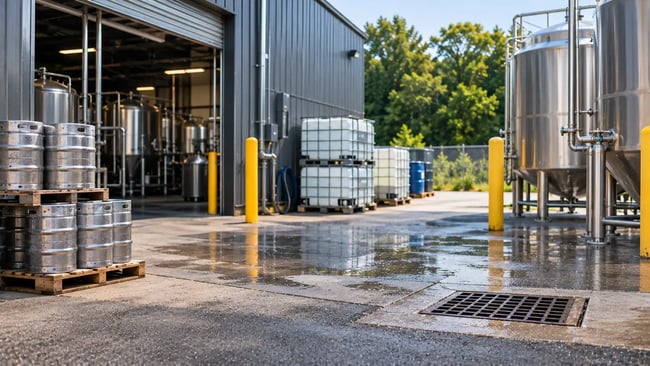
The food appendix in PAG-03 asks for covered storage of dry raw materials and dust control on silos and holding bins, so grain handling is the first place DEP looks.
| Item |
How it creates exposure |
What usually fixes it |
| Grain silos and truck unloading |
Dust and spilled grain at the fill point wash into drains |
Covered unloading, dust collection, dry sweeping |
| Spent grain bins, trailers, and loadout |
Wet, sugary residue drips and spills on pavement |
Covered containers, indoor loadout, dry cleanup |
| Cleaning and sanitizing chemicals |
Totes and drums outdoors can leak or tip |
Indoor storage, secondary containment |
| Outdoor fermenters, brite tanks, and tank farms |
Working valves and hoses drip, and tanks with taps don't meet the sealed-container exception |
Move indoors, or add containment and a spill program |
| Crush pads, pomace, lees, and spent mash |
Harvest-season processing leaves organic residue on the ground |
Cover or move indoors, collect solids promptly |
Fixing these can move a producer from PAG-03 to No Exposure. When only parts of a site are sheltered, a PAG-03 permittee can mark individual outfalls as No Exposure, and those outfalls don't need sampling as long as the condition holds.
What Does PAG-03 Require From Producers With Outdoor Operations?
If grain silos, spent grain storage, open loading, or a tank farm keep you from qualifying for No Exposure, PAG-03 is the usual route. You file an NOI with DEP's regional office, attach a site plan and a Preparedness, Prevention, and Contingency (PPC) Plan, and describe each outfall, which is any pipe, ditch, or channel where runoff leaves your site. A PPC Plan is a written plan for what on your site could pollute runoff, how you prevent it, and what you do in a spill. New facilities file at least 60 days before the discharge begins. Once covered, you inspect twice a year, with at least one inspection during a rain event, and train employees annually. Our comparison of SWPPPs and PPC Plans and guide on when to update your PPC Plan cover the details.
Sampling is where beverage producers feel PAG-03 most. Under the food appendix, you collect a grab sample at representative outfalls twice a year and test for nitrogen, phosphorus, pH, five-day biochemical oxygen demand (BOD), total suspended solids, chemical oxygen demand (COD), nitrate plus nitrite, and oil and grease. Some results have benchmark values, which aren't legal limits. Two consecutive periods above a benchmark triggers a corrective action plan within 90 days, and four adds a checklist of additional controls. Results go into DEP's electronic Discharge Monitoring Report (eDMR) system within 28 days after each six-month period, and an annual report and $500 annual fee are due May 1. Our articles on benchmark values versus effluent limits, the PAG-03 sampling process, and eDMR reporting walk through each piece.
Two situations push a producer past PAG-03. The food appendix doesn't cover boiler blowdown, cooling tower overflow, ammonia refrigeration purging, or vehicle washing, and a facility that already needs an individual NPDES permit for process wastewater can't use PAG-03 for its stormwater. DEP also can't approve PAG-03 or No Exposure for a discharge directly to a stream classified as High Quality or Exceptional Value, so a rural winery or distillery near a cold-water creek should check DEP's mapping tools early.
Why Can't Spent Grain and Process Wastewater Reach Storm Drains?
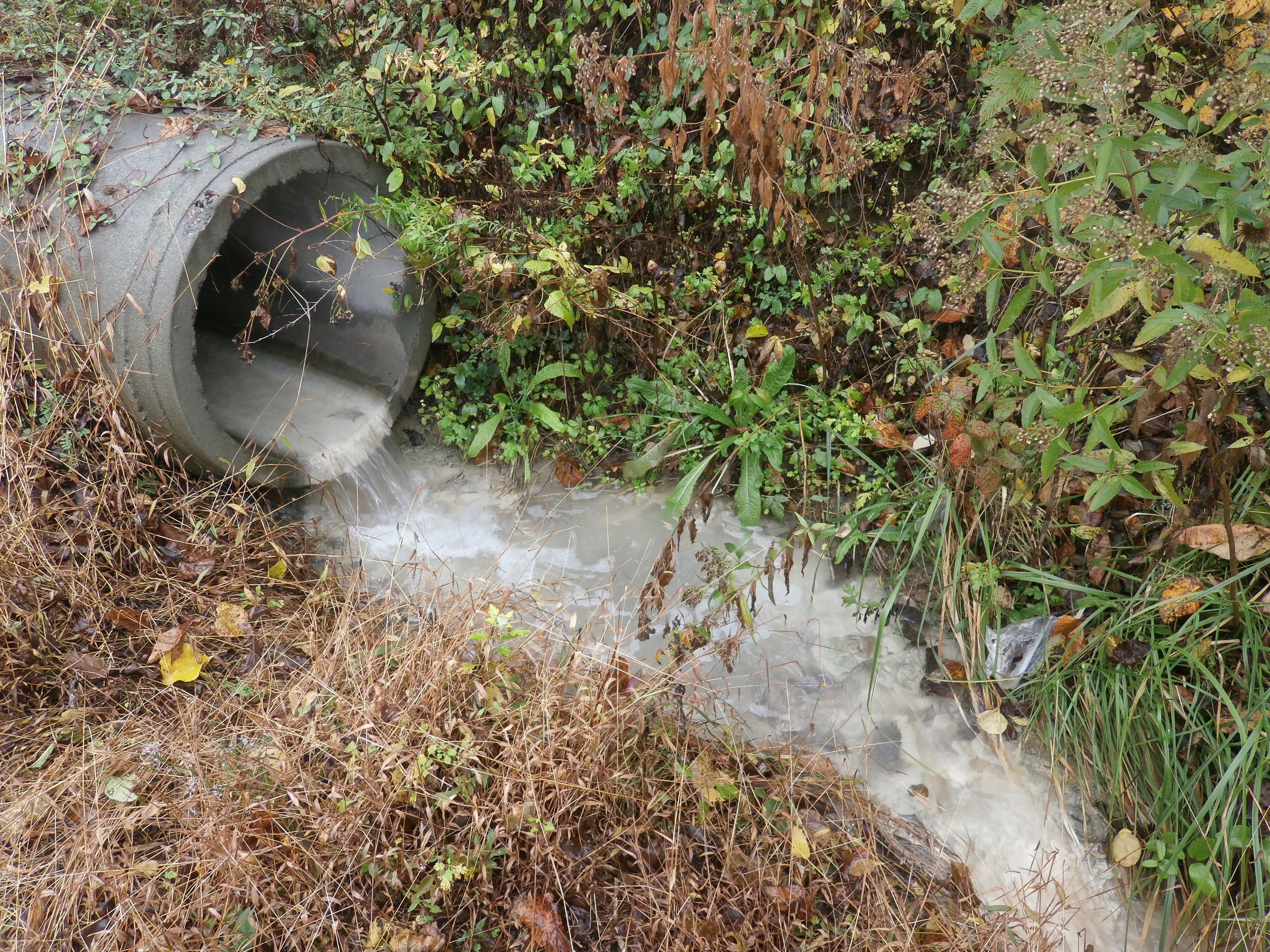
A storm drain is usually a straight pipe to a creek, with no treatment in between. Your sanitary drain goes to a treatment plant, and a storm drain doesn't. PAG-03 authorizes stormwater plus a short list of clean non-stormwater flows, such as fire-fighting water, uncontaminated air conditioner condensate, and washdown water that contains no detergents or hazardous cleaning products. Tank rinse water, cleaning-in-place rinsate, and anything that's been through your brewhouse isn't on that list. Floor drain connections to the storm sewer have to be eliminated. Spent grain, yeast, lees, pomace, and stillage are full of sugar and organic matter, and when they reach a stream, the microbes that feed on them pull oxygen out of the water. That's the reason BOD and COD are on the sampling list.
Where process wastewater goes depends on the site. Most producers send it to the sanitary sewer under the local sewer authority's industrial user rules, which can include permits, limits, and pretreatment, and a producer that discharges to a stream needs an individual NPDES permit. In 2016, the Department of Justice and EPA announced a consent decree with a Pennsylvania brewer over wastewater sent to a municipal treatment plant, with a $2.8 million penalty and about $7 million in required improvements. That case involved sewer pretreatment, not stormwater, but it shows how seriously regulators treat brewery wastewater. If you've already received a notice of violation, an environmental attorney may be the right first call. Our article on the difference between stormwater and process water explains the line between the two.
How Much Does Stormwater Permit Coverage Cost a Craft Producer?
DEP's charges are small next to the work behind the application. A No Exposure Certification and new PAG-03 coverage each carry a $500 fee with the NOI. PAG-03 permittees pay another $500 each year by May 1, while No Exposure holders don't pay that installment but renew every five years. For a relatively straightforward facility, professional help with a full PAG-03 application typically runs about $5,000 to $10,000, with ongoing support of about $3,000 to $6,000 per year depending on how much sampling, reporting, and annual work you want handled. A No Exposure filing usually takes less work, since there's no sampling program or annual report. The number of outfalls, site size, whether a plan already exists, and how much outdoor activity you need to document all move the price.
Some small producers with nothing outside can handle a No Exposure filing themselves, and we'd rather tell you that. Our articles on what a PAG-03 permit costs in Pennsylvania and getting a PAG-03 permit yourself show where that line usually falls. For a number on your own site, the pricing calculator below gives an instant estimate of what RMA's help would run, with no email and no sales call.
What About New Builds, Local Sewer Rules, and Combined Sewers?
Cities, townships, and sewer authorities can have their own rules and fees on top of DEP's, so treat this as the state-level picture and confirm your local situation. Older Pennsylvania cities, including Philadelphia and Pittsburgh, have combined sewers where stormwater and sanitary flow share pipes. DEP's instructions say stormwater discharges to a sanitary or combined sewer don't need independent permit coverage, so the local sewer authority may govern instead. We wouldn't tell a producer in any specific city that they do or don't need PAG-03 without looking at where their runoff goes.
New builds add a second layer. Bigger earth-disturbing projects need construction stormwater approvals under Pennsylvania's Chapter 102 rules, including erosion and sediment control plans reviewed by county conservation districts and, for larger projects, PAG-02 coverage. RMA doesn't prepare construction-phase permits or approvals, and that work usually goes through your engineer, contractor, or an erosion and sediment control specialist. What a new or expanded producer almost always needs once it's running is the operational side: PAG-03 coverage or a No Exposure Certification, a PPC Plan, and inspections and sampling if you're covered. That's where we help, and we can point you toward the right construction-phase professionals. Our article on how long PAG-03 coverage takes in Pennsylvania will help you plan an opening timeline.
How Can RMA Help Pennsylvania Breweries, Wineries, and Distilleries?
We help Pennsylvania facilities sort out which stormwater path fits, and we're upfront when the answer is that you don't need us. We can confirm your SIC code, walk your site to see what's exposed, and tell you whether No Exposure is realistic. From there we can prepare a No Exposure Certification or a PAG-03 NOI and PPC Plan, coordinate sampling, handle eDMR and annual reporting, and update plans as your operation grows. Our online environmental training library covers spill response training, and you can browse our Pennsylvania NPDES and stormwater services and broader NPDES and stormwater library.
There's no pressure and no obligation. You can call us at 888-RMA-0230, email us, or fill out the form on our website, and we'll tell you where you stand. When you're ready, contact RMA and tell us what's going on at your brewery, winery, or distillery.