How Outdoor Steel, Scrap Bins, and Coolant Drums Decide Between PAG-03 Coverage and a No Exposure Certification
If you run a metal fabrication shop in Pennsylvania, you've probably heard that DEP, the Pennsylvania Department of Environmental Protection, regulates industrial stormwater. What's harder to tell is whether that reaches a shop with a few overhead doors and a rack of steel out back. In most cases it does. A shop whose main business is fabricating metal usually falls into a category DEP regulates, so the real question is which route you take. If steel, scrap bins, coolant drums, or equipment are stored or used outside, there's exposure to rain and snow, and PAG-03, Pennsylvania's general permit for industrial stormwater, is likely. If everything stays indoors and dumpsters are covered, a No Exposure Certification may work, but you still apply for it and DEP still has to approve it.
This article walks through how DEP sorts fabrication shops, which outdoor activities count as exposure, what typical Pennsylvania shops look like on each side of the line, and what each route involves. We'll also cover the few situations where a shop doesn't need either one. If you'd rather talk through your own shop, you can reach out to RMA and we'll tell you where you land, even when the answer is that you don't need us.
Table of Contents
TL;DR
Most Pennsylvania metal fabrication shops fall into a category DEP regulates for stormwater, so the question is which route to take. If steel, scrap bins, coolant drums, or machinery are stored or used outdoors, PAG-03 permit coverage is likely. If everything is indoors or properly covered, a No Exposure Certification may work, though DEP has to approve it. Your exact industry code and the stream your runoff reaches can change the answer, so check both first.
DEP follows federal rules that identify regulated industries by SIC code, short for Standard Industrial Classification, a four-digit number describing what your business mainly does. Anything covered is what regulators call stormwater associated with industrial activity. Fabrication shops usually sit in the 3400s: fabricated structural metal (3441), sheet metalwork (3444), miscellaneous metalwork (3449), metal stampings (3469), and fabricated metal products not elsewhere classified (3499), among others. DEP's instructions for the PAG-03 Notice of Intent, or NOI (the application form for general permit coverage), put fabricated metal products from 3411 through 3499 in one sector. That sector also takes in industrial machinery (3511 through 3599, which includes machine shops) and jewelry, silverware, and plated ware (3911 through 3915).
The code that counts is your primary one, which DEP defines as the activity bringing in the most revenue at the site. If your primary code is on the regulated list, you need PAG-03 coverage or a No Exposure Certification. If only a secondary code is on the list, DEP doesn't require either unless it decides your stormwater carries enough pollution to call for one. This comes up for shops that split their work, such as a company that fabricates some of what it sells but earns most of its revenue erecting steel or repairing equipment at customer sites.
One code deserves a second look. The federal rule lists SIC 3441, fabricated structural metal, alongside heavier industries like primary metals and chemicals, while the rest of the 3400s fall into a separate category, so structural steel shops have historically been treated more like heavy industry. DEP's NOI instructions put 3441 in the same fabricated metal sector as its neighbors, so the permit-or-No-Exposure question works the same way. Still, confirm your exact code. Your NOI has to name the sector that fits your primary code, and DEP can reassign you if it decides a different one fits better.
How Does Outdoor Exposure Decide Between PAG-03 and a No Exposure Certification?
PAG-03 is Pennsylvania's version of an NPDES permit, short for National Pollutant Discharge Elimination System, the federal program that regulates what leaves a site and reaches waterways. It's a general permit, meaning one standard permit that many facilities join by filing an NOI instead of getting a permit written just for them. Joining comes with conditions: a written plan, stormwater sampling, and regular reporting. A No Exposure Certification, or NEC, is the alternative. It's a DEP-approved way to stay out of the permit program when nothing industrial can touch rain, snow, or runoff.
Exposure is the dividing line. Under the federal rule DEP follows, no exposure means all industrial materials and activities are protected by a storm-resistant shelter. For a fab shop, that covers the steel you buy, the pieces you cut and weld, the scrap that comes off them, the equipment doing the work, and the finished product. If any of it sits outside unprotected, you're on the PAG-03 side.
The test applies to the whole facility. DEP won't approve no exposure for only part of a site, so one outdoor steel rack or one open scrap bin can keep an otherwise spotless shop out of the NEC route. Our guide to whether you need a stormwater permit in Pennsylvania covers PAG-03, individual permits, and No Exposure side by side, and our article on what no exposure means under an NPDES stormwater permit explains the concept more broadly.
What Counts as Outdoor Exposure at a Pennsylvania Metal Fabrication Shop?
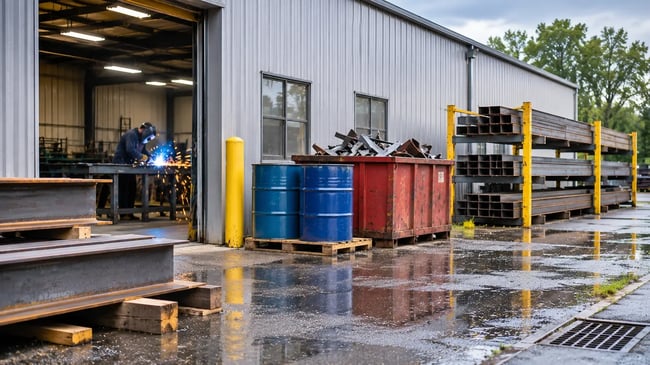
DEP's guidance is more specific than "keep everything inside." Some items can stay outdoors without costing you eligibility, and some that look harmless can't. This table covers what comes up most often in fab shops.
| Outdoor activity or item |
Exposure? |
What it means |
| Steel plate, bar, tube, or beams stored in a yard |
Exposed |
Raw materials stored outside rule out No Exposure. PAG-03 is likely. |
| Finished fabrications staged outside before delivery |
Often allowed |
Final products usually don't need shelter, unless they're the kind of product stormwater can wash away. |
| Open scrap bin or roll-off box with no cover |
Exposed |
Waste outdoors needs a cover or a shelter. An uncovered bin in the weather doesn't qualify. |
| Covered dumpster or roll-off box in good condition |
Not exposed |
Acceptable if it isn't draining or leaking. |
| Coolant, cutting oil, or hydraulic oil drums that are sealed and intact |
Not exposed |
Allowed outdoors when banded or secured, with no working tap, and not rusted or leaking. |
| Open, rusted, or leaking drums, or totes with a spigot |
Exposed |
Containers that aren't truly sealed count as exposure, even when they're full and stationary. |
| Gantry crane, outdoor cutting table, shear, or other machinery |
Exposed |
Machinery and material handling equipment used outside need shelter. |
| Forklifts and trucks in good repair |
Not exposed |
Adequately maintained vehicles used in material handling are an exception. |
| Unloading steel deliveries in an open yard or dock |
Exposed |
Loading and unloading outdoors counts. A properly built roofed dock may solve it. |
| Oil stains, metal dust, or residue on pavement or near storm inlets |
Exposed |
Leftover residue from spills, leaks, or past work counts until it's cleaned up. |
| Dust collector or fume vent leaving residue on the roof or pavement |
Exposed |
Counts when visible deposits show up in runoff and an air permit doesn't already regulate them. |
| Wooden pallets stacked outside |
Often allowed |
Pallets in good condition that don't contaminate stormwater may be eligible. |
Some of these terms have narrower meanings than they sound like. "Sealed" means banded or otherwise secured, with no working tap or valve, and not rusted through or leaking, so a drum with a spigot doesn't count. A dumpster lid isn't enough by itself either. DEP wants the container covered, in good condition, and not draining or leaking, and a box without a lid qualifies only under a storm-resistant shelter. Exhaust is easy to overlook: if a dust collector or fume vent leaves visible residue that shows up in your runoff, and an air permit doesn't already regulate it, that counts as exposure too.
What Do Typical Pennsylvania Metal Fab Shops Look Like on Each Side of the Line?
These are illustrations, not specific shops, but each reflects a common pattern. Picture a structural steel fabricator with a laydown yard. Beams and plate sit on racks outside, a gantry crane moves them, and finished pieces wait for trucks on the same pavement. Each of those is exposure, so this shop is looking at PAG-03: a written plan, an NOI, sampling twice a year, and electronic reporting. Our PAG-03 stormwater permit and sampling guide explains how the sampling works.
Now picture a sheet metal shop in one unit of an industrial park. Stock, brakes, shears, and welding stations are inside. Scrap goes into a lidded roll-off box in good condition beside the dock, coolants are in sealed containers, and the forklift is kept in good repair. This shop is a realistic No Exposure candidate, provided nothing else sits outside and no vent is leaving residue on the roof. If the building houses other tenants, DEP evaluates each tenant's primary code separately, and when none of them can qualify for NEC, the owner can apply for one permit or the tenants can apply together.
The most frequent surprise is the shop that does everything inside except one thing. A rack of bar stock along the side wall, an open-top scrap hopper by the back door, or a few coolant totes with spigots at the loading dock is enough. Because DEP looks at the whole facility, that single item moves the shop from No Exposure to PAG-03 unless you relocate it or cover it properly first.
Which Metal Fab Shops Don't Need PAG-03, and Who Needs an Individual Permit Instead?
A fab shop may not need either option in a few situations. If your primary SIC code isn't on the regulated list, DEP doesn't require PAG-03 or No Exposure, though it can still require coverage if it finds pollutants in your stormwater. If your runoff goes to a sanitary or combined sewer that's part of a publicly owned treatment plant, DEP says neither is required, but federal pretreatment rules can apply and the plant should know about it. In cities with combined sewers, the local sewer authority may set its own rules and fees, so confirm your situation with them before deciding anything.
A few things don't get you out of it. A retention basin that rarely discharges still counts if it could overflow in a large storm, and sheet flow with no pipe or outfall, the point where runoff leaves your site, doesn't exempt you either. A shop that sends runoff into a municipal storm sewer is still responsible for its own coverage, because DEP doesn't treat the municipality's permit as covering you.
The other exception runs the opposite direction. Pennsylvania designates some streams as High Quality or Exceptional Value waters, its special protection classes. A shop that discharges directly to one can't use PAG-03 or No Exposure and has to apply for an individual NPDES permit, which is written for one facility and involves a more detailed application and DEP review. DEP's eMAP mapping tool shows stream classifications, and our article on which NPDES permit you need covers how individual permits, general permits, and No Exposure differ.
How Do PAG-03 and a No Exposure Certification Compare for a Metal Fabrication Shop?
Once you know which side you're on, here's how the two routes compare.
| Item |
PAG-03 coverage |
No Exposure Certification |
| What you file |
NOI, site maps, and a written PPC Plan |
NOI, the NEC form, site maps, and lab results for existing shops |
| DEP filing fee |
$500 |
$500 |
| Annual fee |
$500 each year |
None |
| Sampling |
Twice a year, with pollutants set by the sector appendix |
Results for the parameters on DEP's form with the application, with no sector-based sampling |
| Ongoing reporting |
eDMR results plus an annual report |
Renewal, plus notice to DEP if conditions change |
| Term |
Current PAG-03 runs through March 23, 2028 |
Generally five years, renewed at least 180 days before expiration |
| If your shop changes |
Amend coverage with a new NOI before changes that add outfalls or increase runoff |
Tell DEP immediately and apply for permit coverage if materials become exposed |
On the PAG-03 side, the plan is called a PPC Plan, short for Preparedness, Prevention, and Contingency Plan. It's Pennsylvania's version of a stormwater pollution prevention plan, written around your site's materials, drainage, and how you'd prevent and respond to spills and runoff problems. DEP will accept a stormwater or oil spill plan written for another program if it follows DEP's guidance. Our article comparing SWPPPs and PPC Plans for PAG-03 explains the differences.
Sampling drives most of the ongoing work under PAG-03. Facilities collect samples from their outfalls twice a year, and results go to DEP through eDMR, the state's electronic discharge monitoring report system that every industrial stormwater permittee uses. DEP added total nitrogen and total phosphorus monitoring to every sector appendix when it reissued PAG-03 in 2023. If the same pollutant exceeds a benchmark value at the same outfall in two consecutive monitoring periods, you submit a corrective action plan to DEP. Our guides to Pennsylvania eDMR reporting and what happens during a PA DEP stormwater inspection cover the day-to-day.
No Exposure has lighter ongoing duties, but it isn't paperwork-free. DEP can inspect to confirm that nothing is exposed, and if that changes, you have to tell DEP right away and apply for permit coverage. Whoever on your team walks the yard or takes samples needs to know what they're looking for, and our online environmental training library is one place to start.
Start with what DEP charges, since that part is fixed. Both routes carry a $500 filing fee with the NOI. PAG-03 adds a $500 annual fee for every year you stay covered. No Exposure has no annual fee, and the $500 is due again with each five-year renewal.
The larger cost is usually the work behind the paperwork. For PAG-03, that includes walking the site, mapping drainage and outfalls, writing the PPC Plan, arranging sampling and lab analysis, and keeping up with reporting each year. What drives the price is the number of outfalls, the size and complexity of the site, whether a usable stormwater plan already exists, and how much of the sampling and reporting you'd rather hand off. No Exposure takes less ongoing effort, though getting there can mean moving materials indoors, which has its own cost. If one scrap bin and a couple of drums are all that keep a shop on the PAG-03 side, relocating or covering them can cost far less than years of sampling and reporting. If the work depends on a yard for long structural pieces, PAG-03 is the realistic route. Our breakdown of how much a PAG-03 permit costs in Pennsylvania goes deeper.
If you want a number for RMA's help with your situation, the pricing calculator below gives you an estimate.
Can a Metal Fab Shop Qualify for No Exposure by Adding a Canopy or Moving Indoors?
Often, yes, but the cover has to do the job DEP expects. DEP describes a storm-resistant shelter as a fully roofed and walled building, or a structure with only a roof, as long as stormwater can't flow through it and wind-blown rain or snow can't run back out, usually handled with a curb or berm. Tarps and similar flexible covers can serve as a temporary measure, such as over a dumpster, but DEP generally doesn't accept them as a permanent installation unless it approves them. A carport-style canopy over a steel rack might work if it's built so runoff can't wash through. A tarp stretched over the same rack year-round generally won't.
Before you pour concrete or order a canopy, know that building or expanding has its own permitting. Depending on how much ground you disturb, a project can trigger Pennsylvania's earth disturbance and erosion and sediment control rules under Chapter 102, review by your county conservation district, and township land development or building approvals. RMA doesn't prepare construction-phase permits or approvals, and your engineer, contractor, or an erosion and sediment control specialist usually handles them. We can help you work out what the construction side is likely to involve and point you toward the right people. Once the structure is up and the shop is running, the operating side takes over: confirming you qualify, preparing the No Exposure application or the PAG-03 package, and keeping plans and records current. That's where we help.
We work with Pennsylvania facilities all the time, and the first thing we do is figure out which route fits your shop: PAG-03, a No Exposure Certification, an individual permit, or none of the above. That starts with your primary SIC code, a look at what sits outside, and where your runoff goes. From there, we can prepare the NOI and PPC Plan, set up sampling, handle eDMR reporting and renewals, or review your site and tell you what to move indoors to qualify for No Exposure. Our senior staff do the work themselves.
If you'd like to try it yourself first, our article on whether you can get a PAG-03 permit yourself lays out what that involves. And if it turns out you don't need a permit, we'll say so. There's no pressure and no obligation either way. You can call, email, or fill out the form on our website, or get in touch with our team whenever it suits you.