Trucking Terminals, Truck Yards, and PAG-03: Which Parts of Your Facility DEP Cares About and Which It Doesn't
Trucking is one of the grayer areas in Pennsylvania's industrial stormwater rules. The I-81 and I-78 corridors are lined with terminals, truck yards, and cross-dock operations, and plenty of the people running them have never been sure whether the Pennsylvania Department of Environmental Protection (DEP) expects them to hold a stormwater permit. The short answer is that a trucking company needs permit coverage only for the parts of its facility where trucks are maintained, washed, or fueled. A yard that only parks trucks generally doesn't need one, while a terminal that does oil changes, repairs, or washing outdoors generally does, at least for those areas. In Pennsylvania, that permit is usually coverage under a general permit called PAG-03.
Below, we walk through how DEP decides, which areas of a terminal it focuses on, and how moving maintenance indoors or under cover can change the answer. There's also a table of common terminal activities and whether each one typically triggers coverage, plus a look at what coverage involves if you land on the permit side of the line. If you'd rather have someone look at your yard with you, you can reach out to RMA at any point.
Table of Contents
TL;DR
A trucking company's SIC code doesn't decide whether it needs a stormwater permit in Pennsylvania. What happens in the yard does. Areas where vehicles are repaired, lubricated, washed, or fueled are covered, and so is the outdoor storage that supports that work, while a terminal that only parks trucks usually isn't. If all of that work happens indoors or under cover, a No Exposure Certification can replace a PAG-03 permit, but DEP only approves it for the whole facility, not just one corner of it.
How Does DEP Decide Whether a Trucking Company Needs a Stormwater Permit?
Pennsylvania runs its industrial stormwater program under the federal National Pollutant Discharge Elimination System, usually shortened to NPDES. In plain terms, NPDES says that if rain or snowmelt runs across an industrial area, picks up pollutants, and leaves your site, that runoff needs a permit. Most Pennsylvania facilities get that permit through PAG-03, a general permit DEP issues to a whole class of facilities instead of writing a separate permit for each one. To get coverage, a facility files a Notice of Intent (NOI), which is the application, with the DEP regional office for its county.
Whether a trucking company falls under that program starts with a code. Every facility is assigned a Standard Industrial Classification (SIC) code based on its primary activity, which DEP's guidance defines as whichever activity brings in the most revenue at the site. Motor freight transportation, SIC codes 4212 through 4231, is listed in PAG-03's land transportation appendix, called Appendix L. The federal rule behind that listing is narrower than the code, though. It applies to transportation facilities that have vehicle maintenance shops or equipment cleaning operations, and it says only the portions of the facility involved in vehicle maintenance (including repairs, painting, fueling, and lubrication) or equipment cleaning count as industrial activity. The same logic covers bus operations, rail yards, and petroleum bulk terminals. So the code gets you into the conversation, and what happens in the yard settles it.
One caution before the details. A clean-looking yard isn't a guarantee, because DEP can require a permit from any facility whose runoff is putting pollutants into the water, trucking or not. You can read DEP's own explanation on its industrial stormwater page. If you want the background on what the term covers, we explain stormwater associated with industrial activity in a separate article, and our guide to general, individual, and No Exposure permit options shows how the three paths compare.
Which Trucking Terminal Activities Trigger PAG-03 Coverage?
The table below lists the activities we see most often at Pennsylvania terminals and how each one usually lands. Treat it as a screening tool, not a ruling. DEP looks at the whole site, and one outdoor activity can change a facility's answer.
| What's happening at the terminal |
Does it typically trigger coverage? |
What to know |
| Parking and staging tractors and trailers, with no maintenance, washing, or fueling on site |
Usually no |
The trucking SIC code alone doesn't bring in the rule. The shop, wash, or fueling activity does. DEP can still require a permit if it finds pollutants in your runoff. |
| Oil changes, lubrication, and mechanical repairs done outdoors |
Typically yes, for the work area and its drainage |
These are the core vehicle maintenance activities. Runoff from the work area is industrial stormwater. |
| Repairs done entirely inside a building, with nothing industrial left outside |
Needs either a permit or a No Exposure Certification |
DEP's guidance says a transportation facility with all maintenance and cleaning indoors should qualify for No Exposure. |
| Fueling trucks at an outdoor pump or island with no roof |
Typically yes |
Fueling counts as vehicle maintenance. DEP says a fueling area with no roof, canopy, or cover can't qualify for No Exposure. |
| Fueling under a roof or canopy |
Needs either a permit or a No Exposure Certification |
With aboveground tanks, it matters whether the secondary containment is exposed to rain and blowing snow. Exposed containment rules out No Exposure. |
| Washing tractors or trailers outdoors |
Typically yes |
Vehicle wash water isn't an authorized discharge under PAG-03, so it has to be kept completely separate from stormwater. |
| Washing trucks in an indoor wash bay, with wash water recycled or sent to a sanitary sewer |
Needs either a permit or a No Exposure Certification |
DEP requires wash areas to be indoors for No Exposure. Sewer discharges also bring local pretreatment rules. |
| Vehicles waiting for repair parked outside, especially ones that leak |
Typically yes |
DEP treats storage of vehicles awaiting maintenance as industrial activity, and doing it outdoors rules out No Exposure. |
| Used oil, antifreeze, batteries, tires, or parts stored outdoors |
Typically yes |
Tightly sealed, non-leaking containers and covered dumpsters don't need a shelter for No Exposure. Open, damaged, or leaking ones do. |
| Driver and office parking that drains separately from the yard |
Usually no |
If that runoff mixes with runoff from an industrial area, DEP treats the combined discharge as covered. |
Two patterns run through nearly every row. Fueling, repairs, lubrication, and washing are what pull a terminal in, and parking trucks isn't. And "covered" doesn't always mean "permit," because a facility in the covered category can sometimes request a No Exposure Certification instead. The rows above come from DEP's published industrial stormwater FAQ, which is worth skimming if your yard doesn't match any of them neatly.
Which Areas of a Trucking Yard Does DEP Treat as Industrial Stormwater?
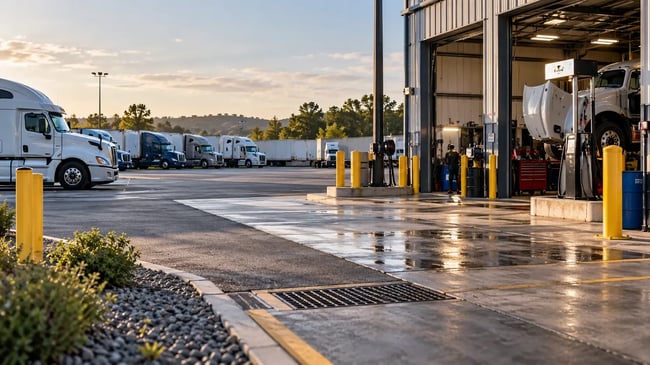
The best way to sort this out is to walk the yard the way an inspector would, following the water. Start with the spots where the covered activities happen: shop doors and the pavement around them, the fueling area, wash pads, and anywhere trucks sit waiting for repairs. Then add the support areas, such as where you keep used oil, antifreeze, batteries, tires, and parts. For each of those spots, note where the water goes when it rains. Does it flow to a storm drain, a ditch, a retention basin, or just off the edge of the pavement?
That last question trips up a lot of terminals, because several things people assume keep them out of the program don't. DEP's guidance says a basin that rarely overflows still counts if there's any possibility of a discharge, even in a large storm. It also says water that leaves as sheet flow, with no pipe or outfall structure at all, is still a discharge. The commingling rule matters just as much in a typical yard. Driver parking and office roofs aren't industrial areas on their own, but if their runoff joins runoff from the shop apron or fueling area, DEP covers the combined drainage. Many terminals have one drainage system for the whole property, so the practical question is often whether one area can be separated from the rest, and what it would take to do that.
A simple site sketch makes this much easier. Mark the buildings, the fueling and wash areas, the places vehicles wait for repairs, the storm drains, and every point where water leaves the property. That sketch is also the starting point for a PAG-03 application or a No Exposure Certification if you end up needing either one.
Can Moving Trucking Maintenance Indoors Change the Stormwater Permit Answer?
Yes, and it's one of the few cases where a physical change at the facility changes the regulatory answer. A No Exposure Certification is a conditional exclusion from permit coverage. If every industrial material and activity at the site is protected by a storm-resistant shelter, so rain, snow, and runoff never touch them, DEP can approve the certification in place of a PAG-03 permit. DEP's own example involves transportation facilities. When all vehicle maintenance and equipment cleaning happens indoors, the facility should qualify. When some industrial activity stays outdoors, such as materials or vehicles waiting for maintenance, it doesn't, and stormwater from the roofs of the buildings where industrial work happens would need permit coverage too. Our article on what No Exposure means under an NPDES stormwater permit covers the general concept.
The details decide whether a terminal can get there. A storm-resistant shelter can be a fully roofed and walled building, or a roof alone as long as water can't flow through and wind-blown rain can't run out, for example because of a curb or berm. Tarps work as a temporary measure over something like a dumpster, but DEP generally doesn't accept flexible covers over a permanent installation. Some things don't need a shelter at all: tightly sealed, non-leaking drums and tanks, covered dumpsters in good condition, and adequately maintained vehicles used in material handling. On a trucking site, that means fueling needs a roof, the wash bay has to be indoors, and a row of leaking tractors waiting for a mechanic is a problem no matter how clean the shop floor is.
The other catch is that No Exposure is all or nothing. DEP won't approve it for part of a site, so every industrial area has to meet the conditions. It's also not available if you discharge directly to a stream DEP classifies as High Quality or Exceptional Value, which affects some sites no matter how they're run. The certification lasts up to five years, and the renewal application is due at least 180 days before it expires. Existing facilities have to submit stormwater sample results with the application, and a Preparedness, Prevention, and Contingency (PPC) Plan is needed if the application's screening questions call for one. The fee is $500 every five years, with no annual fee. If conditions change and you can no longer certify no exposure, you have to notify DEP and apply for permit coverage, so storing vehicles or materials outside again isn't something you can just start doing.
Whether moving work indoors makes sense is a business decision. For a small terminal with one bay and a few outdoor tasks, enclosing those tasks can cost less than years of sampling and reporting under PAG-03. For a large yard with dozens of trucks waiting on repairs at any given time, it often isn't realistic. We can help you run the numbers both ways before you spend money on construction.
What Does PAG-03 Coverage Involve, and What Does It Cost for a Trucking Terminal?
If your terminal lands on the permit side, coverage starts with the NOI, the site map and topographic map, and a PPC Plan, which is DEP's version of a plan for preventing and responding to spills and polluted runoff. We compare it to the plans other states use in our article on SWPPPs versus PPC Plans for PAG-03. Existing facilities also submit two years of stormwater quality data with the application. DEP expects the NOI to cover the permit appendix for your activities, which for trucking is Appendix L, and the appendix sets the best management practices and the sampling parameters that apply to you.
After approval, the work becomes routine. PAG-03 permittees sample stormwater every six months, collecting a sample from a storm event of more than 0.1 inch that's at least 72 hours after the last one, ideally within the first 30 minutes of the discharge. Results go into DEP's electronic Discharge Monitoring Report (eDMR) system, which all industrial stormwater permittees have to use, and we walk through it in our guide to Pennsylvania eDMR reporting. There's also an annual report and an annual fee, both due by March 23. If the same pollutant exceeds its benchmark value at the same outfall for two monitoring periods in a row, you have to submit a corrective action plan to DEP. Our guide to PAG-03 permits and stormwater sampling covers the practical side, and what happens during a PA DEP stormwater inspection explains what to expect if an inspector visits. The people doing the inspections and sampling need to know how, and our online environmental training library is one place to start.
Trucking has one wrinkle that other industries don't. Vehicle wash water can't be discharged under PAG-03, so it has to be separated from stormwater and recycled, reused, or sent to a sanitary sewer in line with pretreatment rules. We explain the difference in stormwater versus process water, and it's often the first thing we look at in a terminal's drainage.
On cost, DEP charges a $500 filing fee for new PAG-03 coverage and a separate annual fee after that. The larger expense is usually the work behind the application and the years of sampling and reporting that follow. What drives it is the number of outfalls and how complicated the drainage is, whether you already have a usable PPC Plan, how much sampling and reporting your team can handle in-house, and whether your site discharges to waters that push you toward an individual permit. We break the numbers down in how much a PAG-03 permit costs in Pennsylvania. If you'd like a number for your own terminal, the pricing calculator below estimates what it would cost for us to handle the permitting work for you.
What About Private Fleets, Sewer Connections, and New Trucking Terminals?
Private fleets get a different answer than for-hire carriers. If a company runs its own trucks but its main business is something else, like distributing food or supplying building materials, DEP classifies the facility by that main business. An off-site shop that only supports that company's own fleet isn't evaluated as a trucking facility, but a shop on the same property as the main operation is part of the industrial area that has to be addressed if the main business is covered. Tenants at a shared terminal or industrial park are each evaluated by their own activities, and they can sometimes share one permit.
Where your water goes matters too. If stormwater from a covered site flows to a sanitary or combined sewer that's part of a publicly owned treatment plant, DEP says a stormwater permit or No Exposure Certification isn't required, but the discharge falls under pretreatment rules and the sewer authority should be told about it. Local rules and fees vary by municipality and sewer authority, so confirm your situation with them. Discharges to a storm sewer or a municipal storm drain system still need coverage.
If you're building or expanding a terminal, there are two separate stormwater phases. The first is construction, which involves erosion and sediment control plans under Chapter 102 of Pennsylvania's regulations, construction stormwater permit coverage, and local land development approvals. RMA doesn't prepare those, and most owners handle them through their engineer, contractor, or an erosion and sediment control specialist. We can help you figure out what the construction phase needs and point you toward the right people. The second phase starts once the terminal is operating. PAG-03 coverage or a No Exposure Certification, a PPC Plan, and inspection and sampling all belong to that phase, and it's the part we do. Since the permitting paperwork has to be in place before discharges begin, our article on how long PAG-03 coverage takes in Pennsylvania is worth reading while the building plans are still on paper.
How Can RMA Help a Pennsylvania Trucking Company With Stormwater Permits?
If you're not sure which side of the line your terminal falls on, that's a good first conversation. We look at your SIC code, your shop, wash, and fueling setup, and where your water goes, then tell you whether you need PAG-03 coverage, whether a No Exposure Certification is realistic, or whether you don't need either. If the answer is that you don't need us, we'll say so. We work with Pennsylvania facilities all the time, and we'd rather give you a straight answer than sell you a permit you don't need. You can call, email, or fill out the form on our website, and there's no obligation. When you're ready, just reach out to RMA and tell us about your yard.