Who Actually Needs Environmental Training at a Small Business, and How to Build a Program That Doesn't Overcomplicate It
Environmental training sounds like something only a large industrial facility with a dedicated environmental department needs to worry about. It isn't. Whether training is required at your business depends on what your facility does, which permits and plans apply to it, and what your employees are actually responsible for, not on how many people are on the payroll. A ten-person shop with a hazardous waste stream can have real training obligations that a much larger office building down the street doesn't.
Below we'll cover which environmental programs commonly come with training obligations, who at a small business typically needs to be trained, when that training has to happen, what to document, and how to build a program that's sized to your actual operations instead of a generic corporate course nobody needed. If you'd rather have someone sort out what applies to your facility specifically, you can reach out to RMA and we'll help you figure it out.
Table of Contents
TL;DR
Environmental training obligations come from your facility's permits, plans, and waste streams, not from your business's size. Hazardous waste, stormwater, SPCC, and air permits each carry their own training expectations, and the people who need that training are the ones actually doing the work, not everyone on staff. There's no single universal schedule; some programs call for annual refreshers, others simply require training before someone takes on a responsibility and again when something changes. The most common failure isn't skipping training entirely, it's training the wrong people, using generic content, or not documenting it well enough to prove it happened.
Required Training vs. Training That's Just a Good Idea
It helps to separate environmental training into two buckets from the start. The first is training that's specifically required by a regulation, a permit, or a plan you already hold. The second is training nobody is making you do, but that strengthens your program anyway by helping employees avoid mistakes, keep things consistent, and catch problems before they become violations.
Confusing the two is where a lot of small businesses either overbuild or underbuild their program. Some spend money on broad sustainability or awareness courses while skipping the specific hazardous waste training their generator status actually requires. Others assume that because they've never gotten an official notice demanding training, none exists, when in fact it's baked into a permit condition they haven't read closely. The sections below walk through the programs that most often carry a required training component, but it's worth seeing both buckets side by side before diving in.
Training that's typically required:
- Hazardous waste management, scaled to your generator status
- Stormwater compliance, if you hold an industrial permit or SWPPP
- SPCC and oil management, if you have a spill prevention plan
- Air permit procedures tied to specific permitted equipment
- Environmental inspection, reporting, or recordkeeping duties assigned by a permit or plan
Training that's not required but strengthens your program anyway:
- Sustainability program training
- Environmental Management System training
- General environmental awareness for staff outside the regulated roles
- Facility-specific Best Management Practices that go beyond what a permit strictly demands
- Waste reduction and recycling procedures
- Pollution prevention initiatives
- Broader environmental responsibilities for managers and supervisors
- Training tied to environmental goals, metrics, or continuous improvement
Neither list is exhaustive, and which items land in which bucket for your facility depends on your specific permits and plans. But most small businesses find it easier to prioritize once they can see the required list is actually shorter than they assumed, and the voluntary list is where the real judgment calls live.
Hazardous Waste Management Training
If your facility generates hazardous waste, the employees who handle it may need training on proper handling procedures, container management, labeling, emergency response, and whatever specific responsibilities the regulations assign to your generator category. How much training is expected, and how formal it has to be, generally scales with generator status: a facility generating small amounts has lighter obligations than one generating enough to be classified as a large quantity generator, where training requirements are more detailed and typically expected to occur within six months of an employee taking on the role, with annual review afterward.
Generic hazardous waste training that doesn't reflect what's actually stored, handled, and shipped at your facility is one of the more common gaps we see. A course that talks about waste streams your facility doesn't have, while skipping the training your generator status actually requires, doesn't hold up well during an inspection. If you're not sure which category your facility falls into, our generator status estimator is a good place to start, since the category drives most of what your training needs to cover.
Stormwater Compliance Training
If your facility holds an industrial stormwater permit or maintains a Stormwater Pollution Prevention Plan, employees responsible for inspections or outdoor operations typically need to understand pollution prevention, good housekeeping, spill response, and the facility-specific Best Management Practices your plan describes. That usually includes knowing what the inspection and monitoring procedures actually require, not just that inspections happen.
What counts as adequate stormwater training varies by permit and by state, and it isn't always spelled out as a rigid schedule. Whether stormwater training is required and why it matters even where it isn't spelled out explicitly are both worth reading if your permit language is vague on this point, since "the plan says to train employees" without more detail is common and doesn't tell you much about frequency or content on its own.
SPCC and Oil Management Training
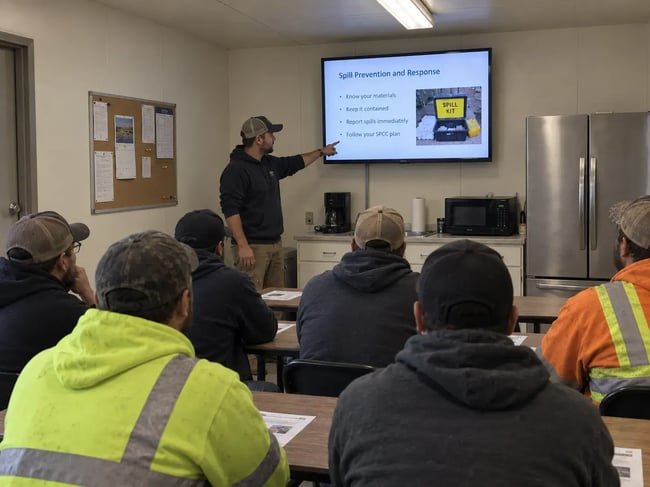
Employees who handle, transfer, store, or otherwise manage oil at a facility with an SPCC Plan need to understand the plan's spill prevention procedures, their own inspection responsibilities, reporting requirements, and what to actually do if a release occurs. This is one of the more explicitly required training areas in environmental compliance, since SPCC regulations directly call for a discharge prevention briefing at least once a year for oil-handling personnel, along with training when someone new takes on those duties.
The briefing doesn't have to be elaborate, but it does have to be specific to your facility's actual tanks, containers, and procedures rather than a generic overview of what SPCC plans are. Whether annual SPCC training applies to you and what that training should actually cover are both good next steps if you already have a plan and aren't sure your current briefings are hitting the mark.
Air Permit Compliance Training
Facilities with air permits often need to train employees on operating limits, monitoring requirements, recordkeeping responsibilities, and maintenance procedures tied to the specific permitted equipment, whether that's a generator, a boiler, a coating operation, or a dust control system. The point isn't general air quality awareness. It's making sure the people running that equipment understand which of their actions could cause the facility to exceed a permit condition, since that's usually where a small, avoidable mistake turns into a reportable exceedance.
Air permit training tends to be the most equipment-specific of everything on this list, which also makes it the easiest to get wrong by treating it as a single generic session rather than something tailored to each piece of permitted equipment on site.
Environmental Reporting and Recordkeeping Training
Regardless of which environmental programs apply to your facility, whoever is responsible for inspections, reporting, and recordkeeping needs to actually understand what's expected of them. A permit or plan doesn't do much good if the person carrying it out doesn't know what's in it. That includes people responsible for Tier II reporting, TRI reporting, waste records, inspection forms, monitoring data, and general permit recordkeeping.
This is often the training small businesses skip entirely, because it doesn't feel like "training" in the traditional sense. It's usually closer to a documented walkthrough of a specific deadline, a specific form, and a specific set of records than anything resembling a class. But when the person who used to own that responsibility leaves and nobody trained a replacement, the gap tends to surface at the worst possible time, usually right around a filing deadline.
Who at a Small Business Actually Needs Environmental Training?
Usually it isn't everyone, but it can be more people than owners initially expect. Employees who handle regulated materials, hazardous waste, oil, or other environmentally regulated activities generally need the most direct, hands-on training, since they're doing the work every day. Employees responsible for inspections, monitoring, or recordkeeping need training focused specifically on those tasks. Supervisors and managers typically need a broader understanding of the environmental program so they can oversee compliance, allocate resources, review documentation, and confirm responsibilities are actually being completed rather than assumed.
The training should match the person's actual job, not their job title. Two employees with the same title at two different facilities can have completely different environmental responsibilities depending on what each facility does, which means the training that fits one may be entirely wrong for the other.
When Should Environmental Training Occur?
There isn't one universal schedule, and "annual training" isn't a safe assumption across every program even though it's common in several. New employees typically need training before taking on environmental responsibilities, not sometime after the fact. Existing employees generally need additional training when permits, plans, equipment, or procedures change, since training tied to an outdated procedure isn't much better than no training at all. Many programs call for periodic refresher training on their own schedule, and inspections, audits, or environmental incidents can surface knowledge gaps that warrant training outside any regular cycle.
The honest answer to "how often" is that it depends on the specific regulation, permit condition, and role. Building your training calendar around your actual obligations, rather than a single blanket annual date for everything, is what keeps the schedule accurate as those obligations change.
What Should You Document?
Documentation should be detailed enough to show what employees were actually trained on, not just that a meeting happened. That generally means recording the training date, the topics covered, who delivered it, which employees participated, and copies of any presentation materials, handouts, quizzes, or acknowledgments used. Any follow-up or facility-specific instruction given afterward is worth capturing too.
A sign-in sheet with no other detail tells an inspector almost nothing about what was covered or whether it was adequate. A record that ties specific content to specific employees on a specific date is what actually demonstrates compliance when someone asks.
Common Environmental Training Mistakes at Small Businesses
The mistakes we see most often are fairly simple ones. Businesses use generic training that doesn't reflect what employees actually do at that facility. They train the wrong people, covering roles that don't carry environmental responsibilities while overlooking the ones who handle regulated materials every day. They fail to train new employees who inherit a responsibility from someone who left. They forget to update training after operational or permit changes, so the content quietly goes stale. And a lot of businesses provide the training but keep records too thin to prove what happened, which can create just as much trouble during an inspection as never training at all.
One assumption worth retiring specifically: a single general environmental awareness course doesn't satisfy every program's training requirement. Hazardous waste training, SPCC briefings, and stormwater training are each their own obligation with their own expected content, even when one employee needs all three.
How to Build a Practical Small Business Training Program
A practical program starts with identifying which permits, plans, and environmental programs actually apply to your facility, then determining which employees have real responsibilities under each one. From there, separate what's specifically required from what's voluntary program-strengthening training, and build short, role-specific sessions rather than one long course meant to cover everyone at once.
Set a realistic schedule for both initial training and any required refreshers, keep training records centralized somewhere they can actually be found later, and revisit the whole program whenever operations or requirements change rather than waiting for the next annual cycle to notice. Training tied directly to people's actual responsibilities is both easier to manage and more effective than trying to teach everyone everything. If you'd rather build on an existing structure than start from scratch, our guide to building an effective training program walks through the process in more depth, and our online training library covers a lot of the required topics without needing to schedule everyone in a room at once.
How RMA Helps With Environmental Training
We help businesses identify which environmental training requirements actually apply to them, develop training materials specific to their facility rather than generic content, deliver that training, maintain the documentation that proves it happened, and support the broader environmental compliance programs that training is meant to reinforce. We also offer custom training development for facilities whose operations don't fit a generic course, and full environmental training services for everything in between.
Small businesses don't need a complicated corporate training system. They need training tied to their actual environmental obligations and the procedures their facility actually runs. If you're not sure what your business needs, or you have a program in place that hasn't been looked at in a while, call us, email us, or fill out the form on our contact page. There's no pressure and no obligation. We'll help you figure out where you stand, and you can decide what to do from there.