What Environmental Inspectors Look For, Which Records You Need on Hand, and How to Get Your Team Ready Before Someone Shows Up Unannounced
Most small businesses don't think much about environmental inspections until one is already happening. Then it's a scramble. Someone's digging through a filing cabinet looking for a stormwater plan nobody's touched in three years, an employee is trying to answer a question they've never been asked before, and the owner is quietly hoping the inspector doesn't walk behind the building. It's a stressful hour or two, and it's almost entirely avoidable.
The businesses that handle environmental inspections well aren't lucky, and they aren't necessarily bigger or better funded. They just did the work ahead of time. In this article we'll walk through who actually conducts environmental inspections, why they happen, which records you need to be able to produce quickly, how to walk your own facility the way an inspector would, what your employees should and shouldn't say, and what happens after the inspector leaves. If you'd rather have someone else pressure test your site before a regulator does, reach out to RMA and we'll help you figure out where you stand.
Table of Contents
TL;DR
Preparing for an environmental inspection comes down to four things: records you can produce in minutes, a site that matches what your plans and permits say, employees who know their own responsibilities and won't guess, and a written protocol for what happens the moment an inspector walks in. Inspectors can arrive unannounced, and most findings come from obvious stuff like open containers, missing labels, gaps in inspection logs, and outdated plans. The single best way to get ready is to run a mock inspection, because finding twelve problems yourself gives you a to-do list, while finding those same twelve during a real inspection can mean penalties and years of extra attention.
Who Actually Conducts Environmental Inspections at Small Businesses?
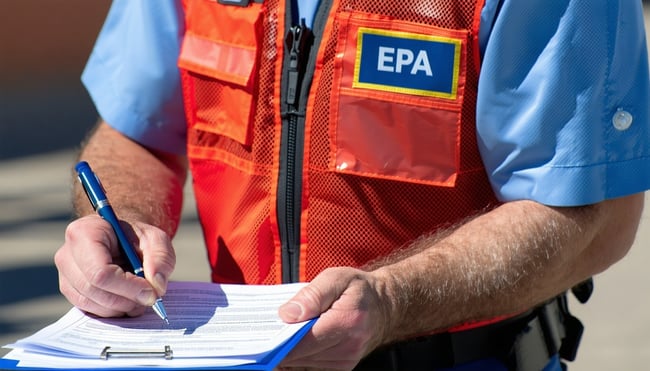
People tend to picture EPA when they think about environmental inspections, and that's usually not who shows up. Most environmental programs are delegated to states, so the person walking through your gate is far more likely to work for your state environmental agency than for the federal government. In New Jersey it's NJDEP. In New York it's DEC. In North Carolina it's DEQ. Each of those agencies runs its own inspection programs, its own checklists, and its own enforcement approach.
Below the state level, you may also see county health departments, local sewer or utility authorities checking industrial pretreatment discharges, fire officials reviewing chemical storage and Tier II information, and municipal stormwater program staff. And yes, EPA regional offices do conduct their own inspections, especially for facilities in programs they've retained or as part of a national enforcement initiative.
The practical takeaway is that "environmental inspection" isn't one thing with one script. A stormwater inspector may only care about your outfalls, your sampling records, and whether your site matches your plan. A hazardous waste inspector will head straight for your accumulation area. An air inspector wants permits, records, and emission unit details. Some inspections are multi-media, meaning one inspector looks at everything at once. If you only prepared for the program you think about most, the other three can catch you flat footed. That's part of why understanding what environmental compliance actually covers at your facility matters more than memorizing any single rule.
Do Inspectors Have the Right to Enter Your Property?
Generally, yes. Federal environmental statutes give regulators authority to enter regulated facilities at reasonable times, inspect equipment and operations, review and copy records, and take samples. The Clean Water Act, the Resource Conservation and Recovery Act, and the Clean Air Act all include inspection and information gathering authority, and state programs carry parallel authority under state law. Permits themselves usually include a right of entry condition you agreed to when you accepted coverage.
That doesn't mean you have zero say in how an inspection runs. You can verify credentials, require the same safety and PPE rules you'd apply to any visitor, escort the inspector, and ask what programs the inspection covers. What you shouldn't do is stall, refuse entry, or get combative. Being difficult is one of the fastest ways to turn a routine visit into something much less routine.
Why Environmental Inspections Happen (and Why You Might Not Get a Warning)
There are really only a handful of reasons an inspector ends up at your facility. Some inspections are routine, driven by an agency's inspection frequency goals for a given program or industry sector. Some are required by permit or by a program's own rules. Some are triggered by a complaint, and complaints come from neighbors, former employees, and passing drivers more often than people expect. Some are follow-ups tied to a previous violation or a compliance schedule. And some come from data, like a discharge monitoring report showing exceedances, a late Tier II submission, or a hazardous waste manifest that doesn't reconcile.
Announced inspections do happen, particularly when the inspector needs specific staff available or wants a lot of records pulled in advance. But plenty of environmental inspections are unannounced by design, because agencies want to see how the facility actually operates on a normal Tuesday rather than on the day you cleaned up for company. If your compliance program only works when you know someone's coming, it isn't really a compliance program.
Small businesses are not exempt from any of this. There's a common assumption that regulators only chase big industrial sites, and it just isn't true. Small facilities get inspected constantly, and in some ways they're more exposed, because they rarely have a dedicated environmental manager and their programs tend to drift when the one person who understood them leaves. If you're not sure which programs even apply to you, our article on the five key questions that determine your compliance needs is a decent place to start.
Which Records Do You Need Ready for an Environmental Inspection?
Records are where most inspections are won or lost. An inspector can only see so much on a walkthrough, but paperwork tells the whole story of whether your program has been running or sitting on a shelf. The specific list depends on what applies to your site, but the usual requests include environmental permits and permit applications, your SPCC Plan, your stormwater plan and sampling results, hazardous waste manifests and determinations, inspection logs, training records, monitoring data, chemical inventories and Tier II submissions, and spill or release documentation.
Here's the part people underestimate: it's not enough to have the records. You need to produce them quickly. An inspector asking for your last twelve monthly SPCC inspections and getting them within a few minutes sees a facility that runs its program. An inspector waiting forty minutes while someone searches an old computer sees something else entirely, and that impression colors everything else in the visit.
How Long Do You Have to Keep Environmental Records?
Retention periods vary by program, and it's worth knowing yours rather than guessing. Under the SPCC rule, signed inspection and test records are kept with the SPCC Plan for at least three years, and the plan itself gets a full review at least once every five years. Under RCRA, generators keep manifests and waste determination records for at least three years. Industrial stormwater permits typically require you to keep sampling data, visual assessments, and inspection reports for at least three years after permit coverage. Many state permits go further, and a few programs require longer retention.
Our advice, and this is what we tell clients constantly, is to keep records longer than the minimum and keep them in one organized system rather than scattered across binders, inboxes, and someone's desk drawer. There's a reason we've written about why your environmental documentation system matters so much. Documentation is the difference between "we do this" and "we can prove we do this," and only one of those holds up during an inspection.
Are Your Plans Actually Current?
One of the most common findings we see has nothing to do with housekeeping. It's a plan that no longer describes the facility. Tanks got added or removed. A new building went up. Drainage changed. Ownership changed. The emergency contact listed in the plan retired in 2019. Your SPCC Plan and your stormwater permit and plan both require amendments when the facility changes in a way that materially affects discharge or spill potential, and an inspector who notices a 5,000 gallon tank that isn't in your plan will start wondering what else is out of date.
How to Walk Your Facility Like an Environmental Inspector
The best preparation habit you can build is walking your own site with an inspector's eyes. Not a friendly walk. A skeptical one. Start where the materials are and follow them: where chemicals arrive, where they're stored, where they're used, where the waste goes, and where water leaves the property.
Look at containers first, because containers generate an enormous share of findings. Are drums closed except when adding or removing waste? Are they labeled with the words that program requires, and dated when a start date is required? Is anything stored on bare ground that shouldn't be? Then check secondary containment for cracks, standing water, drain valves left open, and capacity that's been quietly eaten up by stored equipment. Check your spill kits, and actually open one. We've seen plenty of kits with nothing in them but the wrapper from the last spill.
Then follow the water. Walk to your storm drains and outfalls and look at what's around them. Look for staining, sheen, tracked material, sediment, and any hose or pipe that discharges somewhere it shouldn't. Look at your loading areas, your outdoor storage, your dumpsters, and your equipment washing area. If you have industrial stormwater coverage, this is the same discipline as doing a stormwater visual inspection the right way, just applied to the whole property.
The Findings That Show Up Over and Over
After decades of doing this, the pattern is remarkably consistent. Open or unlabeled containers. Waste that's been accumulating past its allowable time limit. Outdated plans. Gaps in inspection logs, usually starting the month someone went on vacation. Damaged or full secondary containment. Empty spill kits. Releases that got cleaned up but never documented. Missing training records. If you want the longer version, our breakdowns of the most common audit findings and how to fix them and the hazardous waste problems that turn into facility violations cover the same ground in more detail.
Notice that almost none of these are exotic. They're not the result of one catastrophic decision. They're the result of a routine slipping a little at a time until nobody remembers it was a routine. Labeling is a good example, and if your team is fuzzy on which label goes on which container, our guide to hazardous waste, used oil, and universal waste labels is worth ten minutes of a staff meeting.
What Should Employees Say During an Environmental Inspection?
Inspectors talk to people. Not just the manager, either. They'll ask the forklift driver where the spill kit is, ask the shop tech what he does with used oil, ask the yard guy who handles the waste drums. Those conversations are part of the inspection whether you planned for them or not.
Employees should never lie or guess. That's the whole rule, and it's more useful than any script. If someone doesn't know an answer, the right response is a simple "I'm not sure, let me get the person who handles that." Guessing produces wrong answers that end up in an inspection report, and an inspector who catches one wrong answer will start testing others. What employees do need to know is their own piece: what they're responsible for, where the equipment they'd need in an emergency is located, and who the facility's designated inspection contact is.
That's a training issue, not a personality issue. Most of the awkward inspection moments we've watched happen weren't because an employee was careless. They happened because nobody ever told that person what their environmental responsibilities were. Annual training is required under several programs anyway, including SPCC and hazardous waste, and it's an easy gap for an inspector to find because training records either exist or they don't. If yours are thin, our online environmental training library covers the common topics, and our full guide to environmental training explains what's required and how often.
What to Do When an Environmental Inspector Arrives at Your Door
Write this part down and post it somewhere people can find it, because the first ten minutes set the tone for everything that follows.
Everyone at the facility should know where visitors check in and who gets called when a regulator shows up. Whoever greets the inspector should politely verify identity and agency, ask what the inspection covers, and then notify the designated contact immediately. Name a backup contact too. Inspectors don't reschedule because your environmental person is on a job site or out sick, and a facility that can't produce anyone who understands its permits doesn't inspect well.
Your representative should escort the inspector for the entire visit, apply your normal site safety and PPE requirements, and take their own notes. Write down what areas were visited, what questions were asked, and what records were requested. Photograph what the inspector photographs, and note anything they point out or sample. If the inspector takes samples, you can ask for split samples. If they ask for records you don't have on hand, say so plainly and commit to a date you can actually meet.
Be cooperative and be brief. Answer what's asked. Don't volunteer tours of areas nobody asked about, don't speculate about causes, and don't make promises about corrective actions you haven't scoped yet. "We'll look into that and get back to you" is a complete and perfectly acceptable answer. Before the inspector leaves, ask for an exit conference or at least a verbal summary: did they see anything of concern, do they need additional records, and what happens next?
What Happens After an Environmental Inspection?
Outcomes generally fall into four buckets. You may hear nothing at all, which usually means no findings. You may get informal observations or recommendations that aren't violations but are worth fixing. You may get a written information request for records that weren't available during the visit. Or you may get a formal notice of violation with corrective action requirements and deadlines, and potentially a penalty.
Whatever arrives, respond on time. Missed response deadlines make a manageable situation worse faster than almost anything else. And when you fix the problem, fix the actual problem. If the finding was an unlabeled drum, the fix isn't labeling that drum. It's figuring out why labeling stopped happening, who's responsible for it going forward, and how you'll verify it's still happening six months from now. Inspectors return, and a repeat finding on the same issue reads very differently than a first-time one.
What Do Environmental Violations Actually Cost?
The honest answer is that it varies enormously, and most small business findings resolve with corrective action rather than a big check. But the statutory ceilings are real. Under EPA's inflation-adjusted penalty table at 40 CFR Part 19, Class II administrative penalties under Clean Water Act Section 309(g) currently run up to $27,378 per day of violation, capped at $342,218, based on the adjustment rule EPA published in January 2025. Judicial penalties under the same statute run higher. Agencies calculate actual penalties case by case, weighing the seriousness of the violation, any economic benefit you gained by not complying, your compliance history, and your good faith efforts.
The direct penalty is also rarely the expensive part. Legal time, consultant time, expedited equipment purchases, downtime, and the years of elevated scrutiny that follow a violation usually add up to more. We wrote about that in more detail in the hidden costs of environmental non-compliance and in our overview of what actually happens if you're not in compliance.
Why a Mock Environmental Inspection Is the Best Preparation You Can Do
If you take one thing from this article, take this one. The single most effective way to prepare for an environmental inspection is to have someone run one on you first.
A mock inspection means someone reviews your permits and records the way a regulator would, walks the site with fresh eyes, and asks your employees the questions an inspector would ask. Done properly, it produces a written list of gaps with priorities attached, and that list is the whole point. Finding twelve problems during a mock inspection gives you a to-do list you can work through on your own schedule and budget. Finding those same twelve problems during a real inspection can mean penalties, mandated corrective actions on someone else's timeline, and years of being the facility that gets looked at closely.
This is essentially what an environmental audit does, and it's one of the most useful things a small business can buy. Our complete guide to environmental audits covers the process end to end, what to expect when a consultant conducts one walks through the day itself, and our pricing article gives you real numbers rather than a runaround. For most small facilities, an audit lands somewhere in the $3,000 to $7,500 range depending on size, complexity, and how many programs apply.
We'll also say the honest thing here: not everyone needs to hire someone for this. If you're a small facility with one permit, a handful of drums, and a manager who knows the rules, you can absolutely run your own internal walkthrough with a checklist and get most of the value. Our quick compliance check article and the free tools in the RMA Learning Center will get you started without spending a dollar. Outside help earns its keep when multiple programs overlap, when nobody on staff owns the environmental side, or when you've already had a finding and can't afford another one.
How RMA Helps Small Businesses Prepare for Environmental Inspections
We've been doing this since 1992, and a good chunk of our work is exactly this: getting facilities ready before a regulator arrives. That includes mock inspections, permit and record reviews, facility walkthroughs to find compliance gaps, updating plans that no longer match the site, building document systems that hold up under questioning, and training employees on what to do and say when an inspector shows up. We also help facilities respond after an inspection when there are findings to correct and deadlines to meet.
A good environmental inspection is boring. The right person greets the inspector. The records appear in minutes. The site matches the plans. Employees know their roles and answer honestly. The inspector leaves without much to say. That doesn't happen by luck, it happens because someone built systems that run whether anyone's watching or not.
If you're not sure where your facility stands, or you just want a second set of eyes before someone official shows up, we're glad to talk it through. You can call us, email us, or fill out the form on our site, and there's no pressure and no obligation. Tell us what you've got going on and we'll give you a straight answer about whether you need help and what it would cost. Reach out to RMA and we'll help you figure out where you stand.