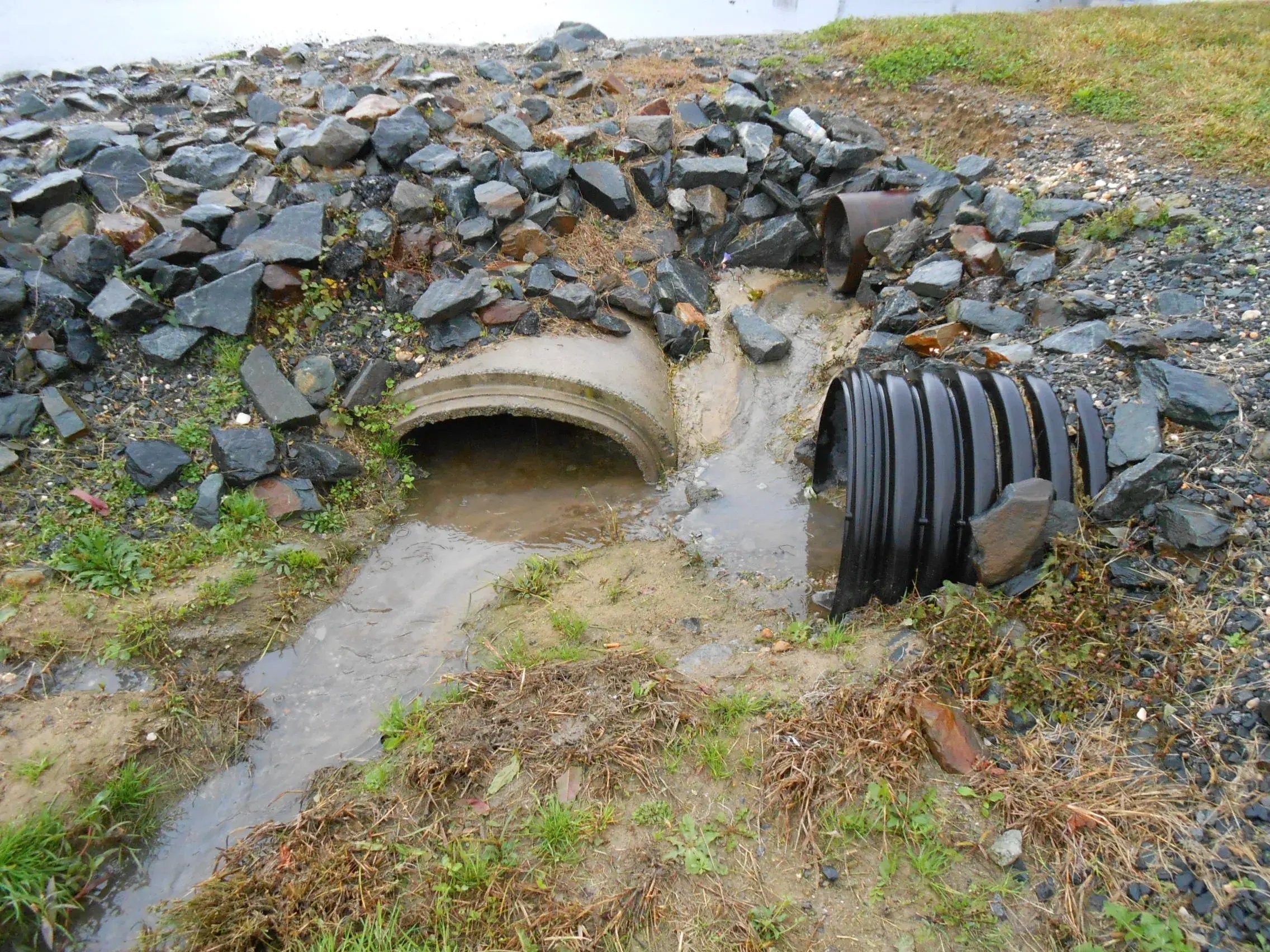
Washout, Cement Dust, and Wet Product Push Runoff pH Up. Here's How to Find the Source, Fix It, and Document It Under NJDEP's Concrete Products Manufacturing (CPM) Permit
If you run a ready-mix, block, or brick plant in New Jersey, the rain that lands on your yard doesn't stay clean for long. Cement is strongly alkaline, and anything it touches, from dried dust on the pavement to slurry left behind after a truck rinse, can turn runoff caustic within minutes. A pH meter held in a puddle near the washout pit can read 12 or higher, and a number like that showing up on a lab report or a discharge monitoring report is how many concrete producers first learn that high pH is a problem they own.
This article covers what pushes pH up at a concrete plant, how to track the source down on your own site, the fixes that work (containment, recycling, pH adjustment, and housekeeping), and the records to keep under the CPM general permit. If you'd rather talk it through with people who know concrete plants, reach out to RMA and we'll tell you whether you need our help.
Table of Contents
TL;DR
High pH at a concrete plant almost always traces back to cement-laden water or dust meeting rain: truck washout, slurry, returned or wet product, and settled cement dust. In New Jersey, concrete plants fall under NJDEP's Concrete Products Manufacturing (CPM) general permit, which requires a written stormwater pollution prevention plan and includes stormwater sampling that covers pH. The fixes start with keeping process water away from rain and recycling it on site, then sweeping and covering to keep dust out of runoff, and treating water with CO2 or acid only where the rest isn't enough. Write down what you find, what you change, and every sample you take, because that paper trail is what an inspector asks to see.
Why Does Concrete Plant Stormwater Have a High pH?
pH is the scale, from 0 to 14, that measures how acidic or alkaline water is. A reading of 7 is neutral, and most natural streams sit somewhere near it. Portland cement is mostly calcium compounds that react with water to form calcium hydroxide, also called free lime, which is the same chemistry that makes concrete harden. That lime dissolves into any water that touches fresh concrete, cement, or slurry, and water that has been in contact with it can reach a pH of 12 or higher.
The scale is logarithmic, so each whole number is a tenfold change. Water at pH 12 is about a thousand times more alkaline than water at pH 9. That's why a little washout water can push a sample over the line, and why dilution doesn't rescue you: on paper you'd need about a thousand parts of clean water for every part of pH 12 water, and the lime keeps dissolving as you add it. Fixing high pH means keeping cement water out of the runoff.
Which New Jersey Permit Covers pH at a Concrete Plant, and What Does the CPM Require?
New Jersey's Department of Environmental Protection (NJDEP) treats rain and snowmelt that runs off industrial work areas as a discharge that needs permit coverage under NJPDES, the New Jersey Pollutant Discharge Elimination System. For concrete, NJDEP wrote an industry-specific general permit, the Concrete Products Manufacturing (CPM) permit. A general permit is one permit written for a whole category of facilities, and you apply for coverage by submitting a Request for Authorization (RFA). NJDEP describes CPM as covering stormwater discharges to surface and ground waters from facilities that manufacture concrete or concrete products, meaning ready-mixed concrete, block, and brick, or facilities NJDEP classifies as concrete manufacturers.
Concrete plants usually don't qualify for the basic industrial permit, the 5G2, because it's meant for facilities that have eliminated or can eliminate exposure to rain, and a plant with aggregate piles, mixer trucks, and washout areas outdoors rarely can. Our guide to stormwater permits for concrete plants covers the broader picture.
Under NJDEP's industrial stormwater permits, you need a written stormwater pollution prevention plan with best management practices (BMPs) that eliminate or minimize exposure of source materials to stormwater. NJDEP's forms call that plan an SPPP, and you'll also hear it called an SP3 or just a stormwater plan, but we'll use SWPPP, the term most of the industry uses. Our article on what a SWPPP is goes through what belongs in one. Unlike the 5G2, the CPM permit includes stormwater sampling, and NJDEP's permit information sheet lists pH among the sampled parameters. The permit and your authorization set the pH range that applies to you, how often you sample, how the sample is collected, and how results get reported to NJDEP, so read the monitoring section of your own documents. Many industrial permits around the country use a pH range of roughly 6.0 to 9.0, but go by your permit and not by that general figure.
Two more points. First, washout and slurry are process water, not stormwater, and NJDEP regulates them differently. NJDEP's information sheet describes options for concrete facilities that involve recycling unused concrete materials, eliminating industrial discharges to groundwater, and, where authorized, discharging process wastewater to surface water, so find out which option your authorization uses. Our explainer on the difference between stormwater and process water helps here. Second, the CPM permit has been around for years and its original expiration date has long passed, so check NJDEP's industrial stormwater general permits page to confirm which version governs your site, and keep following your permit's conditions in the meantime.
What Causes High pH in Concrete Plant Stormwater?
The cause is almost always cement or concrete water that reached a surface rain can wash. The usual suspects are below, roughly in the order we find them at plants.
| Source |
How It Raises pH |
Where It Shows Up |
| Truck and mixer washout |
Rinse water carries dissolved lime and cement fines |
Washout pits that overflow, rinse done outside the designated area, water running off the pad |
| Slurry from hoppers, chutes, and pump lines |
Concentrated cement paste dries and rewets in the next rain |
Loading areas, batching platform, pump cleanout spots |
| Settled cement dust |
Dust dries on pavement and dissolves when it rains |
Silo fill areas, batching, loading lanes, around dust collectors |
| Wet or returned concrete |
Fresh concrete leaches lime into any water it sits in |
Return piles, dumped loads, spills left uncleaned |
| Fresh product curing in the yard |
Water drains off curing block, brick, or precast pieces |
Curing areas and stacking yards with open drainage |
| Crushed or recycled concrete stockpiles |
Exposed concrete surfaces leach alkaline water |
Stockpiles with no cover and no controlled drainage |
| Overflowing basins and reclaimer pits |
Process water spills into stormwater when capacity runs out |
Heavy rain, blocked outlets, pits that were never sized for storm volume |
| Truck tracking |
Slurry on tires and chassis gets carried off the process area |
Exit lanes, paved roads leaving the plant |
Washout gets the attention, but dust is the source plants miss, because nothing looks wrong on a dry day. A thin film of cement dust on a loading lane can sit for weeks and then dissolve all at once in the first storm. Returned concrete piles and block yards with open drainage keep feeding lime into runoff long after the product left the mixer.
How Do You Find the Source of High pH at Your Concrete Plant?
Walk the plant during a real rain, with a drainage map in hand and a pH meter in your pocket. Start at the outfall and work upstream. Check pH at the discharge point, at each inlet and trench drain, and in the low spots where water collects near washout, the silos, and the loading lanes. Take a reading from a clean area, such as a roof downspout or a landscaped corner, so you have something to compare against. The spot where pH jumps from normal to high is where your problem starts, and it's often not where you expected.
On a dry day, run a hose across the suspect area and watch where the water goes. You'll see which drains it finds, where it pools, and whether it ends up in a stormwater inlet or back in your process water system.
Take your own samples and readings if you can. Your staff know the site and can sample when the storm arrives, and we explain why that matters in why you should take your own stormwater samples. pH also changes quickly after collection, and the standard holding time for a pH sample is 15 minutes, so a reading taken back at the office or from a lab days later won't match what the water was doing at the outfall. Our articles on why 15 minutes matters for stormwater pH and how to measure pH in a stormwater sample walk through the details.
How Does Containment of Concrete Washout Cut High pH?
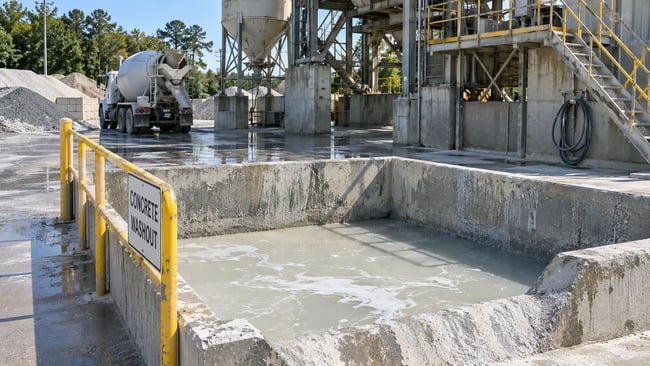
Containment is the cheapest fix and the one that does the most. If washout water and slurry never touch a surface that drains to the storm system, they can't raise your stormwater pH. The goal is a closed process area where cement water goes in and stays in, and rain stays out.
That starts with a designated washout area that every driver and loader operator uses, and nowhere else. The area should be lined or paved with a curb or berm around it, sized for the volume it really receives plus the rain that falls on it, and covered or drained so a storm doesn't push it over the edge. Chute rinsing, hopper cleanout, and pump line flushing should all happen over that same containment, not on the open pavement next to it. Check the berms and liners for cracks, because a washout pit that leaks is a stormwater discharge you can't see.
Training is half of this fix. A perfectly built washout pad does nothing if a driver rinses a chute at the exit gate because the pit was full and he was running late. Put the washout area on the route trucks already take. Our online training library is one way to cover the basics, and whether stormwater training is required depends on your permit.
Can Recycling Concrete Process Water Fix High pH?
Recycling can take high pH water out of the discharge equation entirely, which is why it's often the next move after containment. If your plant has a reclaimer, a closed-loop wash system, or a settling basin that feeds water back into the process, the high pH water goes back to work instead of leaving the site. Reusing recovered wash water for tanker and conveyor washout, or as batch water where quality allows, is common practice in the industry, and it saves you from treating and disposing of that water at all.
A settling basin removes solids, but it doesn't fix pH by itself, because the dissolved lime stays in the water after the solids drop out. Plants with a basin full of clear water can still read high at the outfall. Our article on settling basin design at concrete plants covers sizing and layout. Where water can't be reused, a hauler can take it off site to a facility permitted to accept it, though that gets costly at volume.
Solids need a plan too. Hardened washout solids and returned concrete can often be recycled or crushed for reuse, and what you can do with them is covered in what to do with concrete waste. Crushing concrete on site can trigger New Jersey recycling approvals that are separate from your stormwater permit, so check before you start a crusher. Whether you can discharge treated process water at all depends on your permit authorization, so confirm that before you build anything.
When Does Concrete Plant Water Need pH Adjustment?
pH adjustment, also called neutralization, is for water you can't contain, recycle, or haul away economically and that your permit allows you to discharge after treatment. It's usually the last step, because treatment equipment costs money to buy, run, and maintain.
The common approaches use carbon dioxide (CO2), a mineral acid such as sulfuric or hydrochloric, or citric acid. CO2 is popular at concrete plants because it forms a very weak acid in water, which makes it forgiving and hard to overshoot. Acids work, but they need more careful handling and control, and driving pH too low creates its own violation. A working system generally includes a way to settle out solids, mixing and contact time, and a pH probe that checks the result before anything leaves. The sludge it produces is concrete waste and needs disposal like any other.
Sizing and installing a treatment system is engineering work, and it belongs with an engineer or an equipment supplier. We don't design or build treatment systems. What we can do is help you work out whether you need one at all, make sure it fits your permit and your SWPPP, and train your team to operate and document it. Here's how the main fixes compare.
| Fix |
What It Does |
Works Best For |
Limits |
| Containment |
Keeps washout and slurry away from stormwater |
Washout, rinse water, slurry |
Needs sizing for storms and crew discipline |
| Recycling and reuse |
Returns process water to production |
Plants with a reclaimer or closed-loop system |
Needs enough demand for the water, and a plan for solids |
| Housekeeping |
Keeps dust and spilled product off the rain |
Cement dust, tracked slurry, small spills |
Only works if it's done on a schedule, especially before storms |
| pH adjustment |
Brings high pH water into range before discharge |
Water that can't be contained or reused |
Costs money and attention, and needs permit coverage for the discharge |
| Haul-off |
Moves water to a permitted receiving facility |
Occasional or low-volume water |
Expensive at volume |
How Does Housekeeping Keep Cement Dust From Raising Stormwater pH?
Housekeeping handles the sources containment can't, mainly dust and small spills. Fix leaking silo fittings and keep dust collectors maintained so less cement ends up on the ground in the first place. Sweep loading lanes, batching areas, and silo fill points on a schedule, and sweep or vacuum them before a forecast storm. Dry sweeping or vacuuming beats hosing the pavement down, because hosing just moves the cement into the nearest drain. Collect the dust and dispose of it with your other concrete waste.
Clean up spilled concrete and slurry right away, before it dries and sets up for the next storm. Keep returned concrete and wet product on a pad that drains to your process water system instead of the storm drains, and cover crushed concrete stockpiles or give them controlled drainage. Route roof drainage and clean yard runoff around the process area so less water touches cement.
Build all of this into the SWPPP as scheduled tasks with named responsibilities. A sweeping log that shows when each area was last cleaned says more to an inspector than a policy that says the plant sweeps regularly. Our guides on stormwater BMPs and on what inspectors look for at a concrete plant show what these items look like in practice.
What pH Records Should You Keep Under the CPM Permit?
If a pH reading goes wrong and you can show what you found, what you changed, and when, you're in a far better spot than if you can only say you fixed it. The goal is a record someone else can follow without you in the room. The permit and your authorization spell out exactly what's required, including annual inspection and certification requirements, so use the list below as a working checklist and confirm the details in your own documents.
| Record |
What to Capture |
| SWPPP |
Where cement, slurry, and dust meet rain, the BMPs for each, who's responsible, and updates whenever the plant's layout or practices change |
| Inspection logs |
Date, inspector, areas checked, washout levels, housekeeping condition, and anything that needs fixing |
| Sampling records |
Location, date and time, rainfall, who sampled, meter calibration, the reading, and the time between collection and measurement |
| Lab reports and DMRs |
Results from any lab analysis and what you submitted to NJDEP, along with the dates |
| Corrective actions |
What caused a high reading, what you changed, who did it, and the follow-up sample |
| Training records |
Who was trained, on what, and when |
| Sweeping and cleanup logs |
Which areas were swept or cleaned, when, and by whom |
When a result comes back high, don't wait for the next scheduled sample to start fixing it. Investigate right away, make the change, and sample again so the record shows the problem and the fix. Our articles on what to do when sampling results are high and whether you have to report bad results go through that decision, and what DMRs are covers the reporting form. Missed or late monitoring reports can carry penalties of their own under New Jersey's Water Pollution Control Act, separate from whether the water met the limit, so keep your reporting calendar current.
How Does RMA Help With High pH at New Jersey Concrete Plants?
We've worked with concrete producers since 1992, and we're based in New Jersey, so NJDEP's permit categories and the CPM permit are familiar ground. We can review your SWPPP and recent results against how your plant really runs, help you narrow down where the high pH is coming from, update the plan and procedures, and train your people to inspect and sample correctly. If you want ongoing help after you're permitted, we offer annual support too, from reminders and result reviews to inspection prep. Our concrete industry page shows our work across the industry.
There are things we don't do. We don't take your samples ourselves, because storms don't wait for a consultant's calendar and your own staff know the site, so we teach them to do it right. We don't do lab work, and we don't design or build treatment systems, so if you need one, you'll work with an engineer or an equipment supplier. If you've already received a notice of violation, an environmental attorney may be appropriate alongside any permit help. And if your plant has a simple fix, like moving where trucks rinse their chutes, we'll tell you that and save you the consulting bill.
If you'd like to talk it through, call us at 888-RMA-0230, email info@rmagreen.com, or fill out the form on our website. You can also contact RMA directly. No pressure and no obligation.