How to pick workable stormwater controls based on your actual site conditions instead of copying a generic list
Open any sample PPC Plan (the Preparedness, Prevention, and Contingency Plan that DEP asks many industrial stormwater permit applicants to submit) and you'll find a long list of best management practices, or BMPs, which are the physical controls and routines that keep pollutants out of stormwater. Sweep the yard, cover the piles, keep dumpster lids closed, install inlet protection. It's tempting to copy the list, check every box, and call it done. The trouble starts when the plan promises something your site can't deliver, like a weekly sweep with no sweeper, or a berm on a slope where it washes out in the first heavy rain. An inspector who reads your plan and then walks your property will see the gap.
The short answer is to choose BMPs one pollutant source at a time. Start with the sources and pathways you've identified on your site, remove the exposure first if you can, contain what's left, then control the flow of water, and match every choice to your slope, surfaces, space, climate, and the people who'll maintain it. Then check the result against what your permit requires. This article walks through that process step by step, and if you'd like a second set of eyes on your plan, you can reach out to RMA at any time.
Table of Contents
TL;DR
To choose BMPs for a Pennsylvania PPC Plan, work through each pollutant source on your site in order: remove the exposure if you can, contain what's left, control where the water goes, and treat it only as a last step. Match each control to your real slope, surfaces, space, weather, and staff, then check your choices against the BMPs your permit requires. Write down who maintains each one and how often, and revisit the list after spills, high sample results, or changes to your operations. A generic list copied from another site usually won't hold up to that test.
What Are BMPs and Why Don't Generic BMP Lists Work for a PPC Plan?
A BMP is anything you put in place or do on a routine basis to keep pollutants out of your stormwater. The category is broad. It covers structures like roofs over storage areas, secondary containment, berms, and inlet protection, and it covers habits like sweeping, inspecting, and cleaning up drips right away. Our guide to stormwater BMPs covers the basics if the term is new to you.
Under Pennsylvania's PAG-03 general permit, some BMPs apply to every facility. Those include good housekeeping, erosion and sediment controls, spill prevention and response, pollution prevention contingency planning, routine inspections, and a monitoring program. On top of those, the permit has sector-specific BMPs in appendices tied to your industry, and your facility's industrial activity determines which appendix applies. DEP does allow alternatives to the sector-specific BMPs in appropriate circumstances, but you need DEP's authorization before you swap one out.
The required list is a floor. It doesn't tell you how to apply those practices to your yard, your equipment, or your drainage, and that's where generic lists fall down. A sample plan written for a concrete plant won't fit a machine shop, and a plan written for a flat paved site won't fit a hillside yard with a gravel lot. A BMP that isn't matched to a real source and a real pathway is a promise in writing that you may not be able to keep. Not every facility needs PAG-03 coverage, and some need no permit at all, but any site with materials or activities outdoors gets better results by choosing controls this way.
You can't choose controls without knowing what you're controlling. Start with your source inventory, the list of outdoor materials, equipment, waste areas, and past spill locations on your site, along with the pathway each one takes to where water leaves your property. If you haven't built that list yet, do it first, because every BMP decision below starts from it.
Then add the site conditions that decide whether a control will work in your yard.
| Site condition |
How it changes your BMP choices |
| Slope |
Steeper ground moves water and sediment faster, so low berms and loose barriers may fail while stabilized surfaces, diversions, and covers hold up better |
| Surface type |
Pavement sheds water and carries spills quickly, while gravel and soil soak up some liquid but hold contamination and shed sediment |
| Available space |
Tight sites lean on covers, containment, and housekeeping, while roomier sites can add vegetated buffers or basins |
| Climate and winter |
Freeze-thaw cycles, snow storage, and road salt affect what survives the season and where meltwater goes |
| Traffic and activity |
Heavy truck traffic tears up barriers and tracks out sediment, so choose controls that tolerate it |
| Staff and schedule |
A BMP that needs weekly attention needs a named person to do it, while a cover that stays put needs far less |
| Sample and inspection history |
Past high results or inspector comments point to the sources already causing trouble |
Pay close attention to the last two rows. The best-designed control fails when the person responsible for it changes jobs, or when it depends on a routine nobody has time for. A simple control that gets done beats a sophisticated one that doesn't.
How Do You Match Stormwater BMPs to Each Pollutant Source?
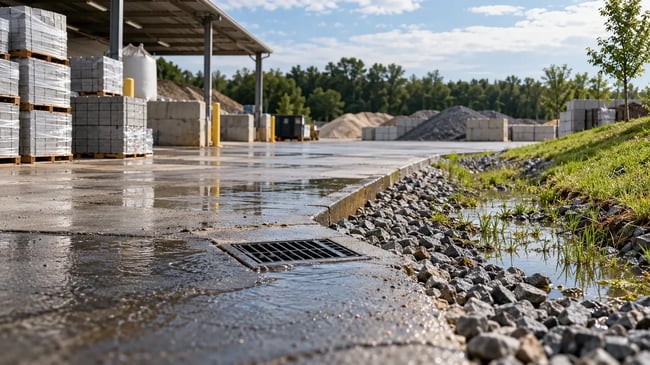
Work through your sources one at a time and ask the same four questions in the same order. Can we get rid of the exposure? If not, can we keep the material from escaping? If it can still escape, can we control where the water goes? And only after all that, can we capture or treat what's left? Stopping a pollutant at the source usually costs less and tends to hold up better than catching it at the end of a pipe, which is why treatment comes last.
| Pollutant source |
First choice: remove the exposure |
Next choices: contain, redirect, clean up |
| Open stockpiles of aggregate, sand, salt, or scrap |
Move under a roof or into a roofed bin |
Tarps or covers, perimeter berms or barriers, keeping piles back from drains, sweeping up spillover |
| Drums, totes, and oil or fuel containers |
Store indoors or under cover |
Secondary containment, drip pans, closed lids and bungs, spill kits close by |
| Fueling and vehicle maintenance areas |
Roof the fueling pad and do maintenance on an indoor floor |
Absorbents, drain covers during transfers, routine cleanup of drips |
| Dumpsters and waste containers |
Roofed enclosures or lids that stay closed |
Pickup often enough that containers never overflow, regular checks for leaks |
| Dust and tracked-out sediment |
Stabilize bare ground and surface high-traffic spots |
Sweeping, cleaning inlets, and trackout controls at exits |
| Equipment washing |
Wash indoors or in an area that drains to an approved destination |
Capture and route washwater where local rules allow, and keep it out of storm drains |
The sector-specific BMPs in your permit's appendix often show up in a table like this one. For asphalt plants, for example, the permit's sector appendix lists practices such as sweeping roads to remove dust, wheel washing to remove sediment, berms or diversions, and cleaning inlets. Your appendix will have its own list, so read it before you finalize anything.
Our look at the best stormwater BMPs compares common controls in more detail. Treat any comparison as a starting point, then test each option against the site conditions you wrote down in the last step.
How Do You Check Your BMP Choices Against PAG-03 Requirements?
Once you've got a BMP for each source, line your list up against the permit and check three things. First, make sure every BMP required of all PAG-03 permittees is covered, even the ones that seem obvious for your site. Second, read the appendix for your industrial activity, see which sector-specific BMPs apply, and note how you're meeting each one. Third, if you'd rather meet a sector-specific requirement a different way, get DEP's authorization before you rely on the alternative.
Benchmark results add another layer. PAG-03 sets benchmark values for certain pollutants, and repeated exceedances can trigger a corrective action plan. DEP's stormwater BMPs checklist comes into play at that point, and you're expected to consider additional BMPs from the permit appendices that aren't already on your site, or to explain why they aren't feasible. Choosing well the first time keeps you out of that process. If your lab results come back high, our articles on what to do when your stormwater sampling results are high and benchmark values and effluent limits walk through what the numbers mean and what comes next.
If your facility is going the No Exposure Certification route, the BMP conversation looks different. Your main job is keeping industrial materials and activities sheltered from rain and snow, and a PPC Plan is still needed when you answer yes to any of DEP's questions about how materials, equipment, and products are stored and handled.
How Do You Keep Stormwater BMPs Working Through Maintenance, Inspections, and Training?
A BMP only helps while it's working. Berms slump, covers blow off, inlet filters clog, and drip pans fill with rainwater. For each control in your plan, write down who's responsible, what they check, how often they check it, and where they record it. Then keep the entry realistic. If the plan says daily, you need daily records. If it says monthly, you need monthly records. Reviewers look for logs that match the frequency written in your plan, and a mismatch is an easy finding.
Routine inspections are one of the BMPs PAG-03 requires of every permittee, so one checklist can cover your inspection duties and your BMP upkeep together. Our guides to stormwater visual inspections and what happens during a PA DEP stormwater inspection show what a good inspection looks like and what to expect when DEP visits.
Training closes the loop. The people who fuel trucks, load product, and empty dumpsters carry out most of your BMPs, and they need to know what each one is for. A short walkthrough of the plan with photos from your own site goes further than a binder on a shelf. If you'd like a structured option, our online environmental training library has courses your team can take on their own schedule.
When Should You Revisit the BMPs in Your PPC Plan?
Treat your BMP list as something you revise, not something you finish. DEP's PAG-03 annual report asks whether the permittee's PPC Plan has been reviewed and, if necessary, updated during the reporting period, so a yearly look is the minimum.
Several events call for a review sooner: a spill or leak, a high sample result, a comment from an inspector, new equipment or a changed layout, a new product or process, or a BMP that keeps failing. When one of those happens, go back to the source and pathway behind it and ask whether the control matched the situation. Often the fix is small, like moving a container under cover, instead of building something new.
It's also fine to find that a control isn't worth keeping. Write only what you'll do, because a plan that promises more than the site delivers creates its own problem. Cut what you won't maintain, replace it with something you will, and update the plan to match.
Can RMA Help You Choose BMPs for Your Pennsylvania PPC Plan?
Choosing BMPs gets easier with practice, and plenty of facility managers handle it themselves. If you'd like help, we work with Pennsylvania facilities all the time. A senior member of our team can walk your site, review your sources and pathways, recommend controls that fit your layout and staffing, and write them into a PPC Plan built around your facility. We can also check your plan against the permit's required and sector-specific BMPs and help you respond if sample results or DEP comments show something needs to change. If you're deciding whether to handle the permit on your own, our article on getting a PAG-03 permit yourself lays out the trade-offs.
There's no pressure and no obligation. You can call, email, or fill out the form on our website, and we'll tell you honestly whether you need us. When you're ready, reach out to RMA and tell us what's happening at your facility.