Which Emergency Contacts Belong in a New Jersey Oil Spill Plan, and How to Keep the List From Going Stale
The contact page is the part of an oil spill plan that gets used when everyone is at their worst. A tank overfills during a delivery, a hydraulic line lets go on the loading dock, or a drum tips over near a storm drain, and someone grabs the plan to find out who to call. If the first number is for a manager who left two years ago, the plan has failed at the one job it exists to do. The contacts also go out of date faster than any other part of an SPCC (Spill Prevention, Control, and Countermeasures) plan, because people change jobs, contractors change phone systems, and nobody notices until a drill or a real spill.
The short answer is that a New Jersey plan should list your response coordinator and backup, a cleanup contractor you have an agreement with, the NJDEP hotline, the National Response Center, local emergency services, and the regulators who get written reports, plus a Licensed Site Remediation Professional if you've retained one. Keeping them current takes an owner, a calendar, and a few triggers. We walk through each below, and if you'd like help checking your own plan, you can reach out to RMA at any point.
Table of Contents
TL;DR
A New Jersey SPCC plan has to list phone numbers for your facility response coordinator, the National Response Center, any cleanup contractors you have agreements with, and the agencies you must notify. In New Jersey that means the NJDEP hotline at 1-877-WARNDEP (1-877-927-6337), local emergency services, and a retained LSRP if you have one. Keep the list current by giving it an owner, checking every number on a schedule, and updating it whenever a person, contractor, or phone system changes. Changing a name or phone number is an administrative update and doesn't need a new engineer certification.
The federal rule at 40 CFR 112.7(a)(3)(vi) says the plan must include phone numbers and contacts for the facility response coordinator, the National Response Center, cleanup contractors you have response agreements with, and the federal, state, and local agencies that have to be notified of a discharge. Right alongside that, 112.7(a)(4) says the plan has to give whoever is reporting a discharge what they need to say: the facility's exact location and phone number, when it happened, what was released, how much, the source, what was affected, the cause, any injuries, what's being done, and who else has been told. In New Jersey, EPA Region 2 enforces the SPCC rule, and NJDEP adds its own reporting requirements on top of it.
Notice what the rule doesn't say. It doesn't set a schedule for checking the list. The only built-in review is the five-year plan review, which is far too slow for a document with phone numbers in it. That gap is why contact pages fall out of date, and why we treat the schedule as something you build yourself. Our post on writing spill response procedures covers the reporting form and the procedures that sit behind the list.
The table below puts the contacts in the order most facilities use them, with what each one is for. The public numbers are ones you can copy as written. The facility-specific rows are the ones that go stale, which is why they get the most attention in the rest of this article.
| Contact |
Number |
What it's for |
| Emergency services |
911 |
Injuries, fire, or a release that threatens people |
| NJDEP hotline |
1-877-WARNDEP (1-877-927-6337) |
Immediate notice of most discharges under New Jersey law |
| NJ State Police (backup) |
(609) 882-2000 |
The alternate number N.J.A.C. 7:1E gives for when the hotline is inoperable |
| National Response Center |
1-800-424-8802 |
Federal notice when oil reaches or threatens navigable waters, including a sheen |
| Facility response coordinator and backup |
Direct and mobile numbers, entered in your plan |
Runs the response and makes the calls |
| Cleanup contractor |
The 24-hour number from your agreement, entered in your plan |
Containment and cleanup beyond what staff can handle |
| Local fire and emergency officials |
Their direct non-emergency numbers, entered in your plan |
Local response and awareness of what's stored on site |
| Facility LSRP, if retained |
Their direct and after-hours numbers, entered in your plan |
Soil and groundwater cleanup after a release |
How Do You List Internal Responders and Cleanup Contractors?
For internal responders, list a response coordinator and at least one backup, each with a desk number and a mobile number, and say what they're authorized to do. A coordinator who has to ask permission to call a contractor isn't much help at 2 a.m. Add the shift supervisors who are likely to be first on scene, because they make the first call before the coordinator is reached. If your facility is a New Jersey major facility with a DPCC or DCR plan, the state rules also call for a response coordinator, a chain of command, and annual drills that are varied and critiqued in writing, so the contact list and the drill record should match. We explain that threshold in our post on whether you need both an SPCC plan and a DPCC plan.
For the cleanup contractor, the rule's wording matters: it asks for contractors you have response agreements with, not a name from an online search. That means a real agreement, signed, with a number that reaches a person after hours. Confirm that the contractor serves your address, can reach you within a time you can live with, and carries what a spill at your site needs. A contractor that handles oil spills in the northern part of the state may not cover a facility in the south, and a vacuum truck outfit that does tank cleaning may not do emergency spill response at all. Put the agreement date next to the contractor's name so the next reviewer knows when it was last confirmed.
What About Local Emergency Services, EPA Region 2, and an LSRP?
For local services, 911 covers emergencies, but the plan should also list your local fire department's direct number and the fire official who enforces the Uniform Fire Code in your town. It's also worth a walkthrough with them once, so they know what oil, where, and in what quantities before they respond to an alarm at your site.
For regulators, the plan should show where written reports go, because federal rules require them after certain discharges. Under 40 CFR 112.4, a single discharge of more than 1,000 gallons, or two discharges of more than 42 gallons each within any twelve-month period, requires information to be submitted to the EPA Regional Administrator within 60 days, with a copy to the state agency. EPA Region 2 serves New Jersey, and its SPCC contacts change from time to time, so list the office and check EPA's regional contacts page for the current coordinator instead of copying a name from an old plan. Our post on the sheen rule and oil spill reporting explains which discharges trigger the federal call.
If you've retained an LSRP, list them too. In New Jersey, cleanup of contaminated soil or groundwater generally involves a Licensed Site Remediation Professional, and an LSRP who already knows your site can move faster than one you have to find during a release. The LSRP is a separate licensed professional, and their own rules of conduct include notifying NJDEP of a discharge they learn about, so make sure they have your coordinator's number and know who calls the hotline. If your spill might involve liability questions, an environmental attorney may also belong on the list.
Start by giving the list an owner, one named person with a named backup, whose job includes checking it. A contact page that belongs to "the team" belongs to no one. Then set a schedule. We suggest a full check every quarter, which fits easily into your regular inspection routine, and a recheck whenever one of these things happens: a listed person changes jobs or leaves, a contractor agreement is renewed or ends, a phone system or number changes, a new tenant or operator takes over part of the site, or a drill shows a problem.
A check means calling the numbers on your own list, not reading them. Call each person and each contractor, and confirm the number still reaches someone who knows they're on your plan. Don't call the NJDEP hotline or the National Response Center to test them. Those are public lines for real incidents, so confirm their numbers against NJDEP and the National Response Center's own sites. An annual tabletop drill is the second check, and it finds problems a phone call won't, such as a mobile number nobody answers, or a coordinator who doesn't know they were named. Our annual discharge prevention briefing agenda is a convenient place to fold the drill in.
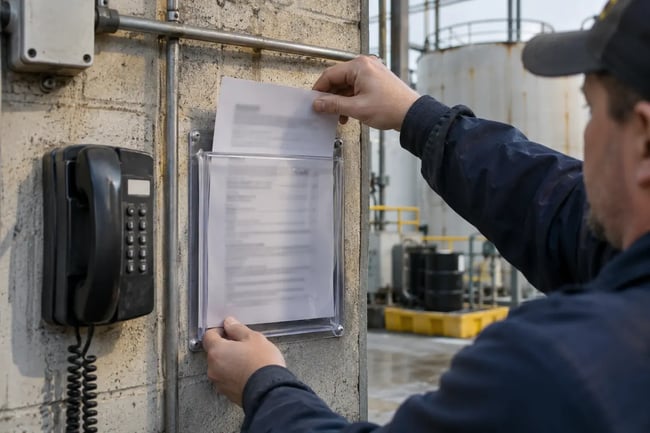
Changing a name or a phone number is an administrative update, not a technical amendment, so it doesn't need a Professional Engineer's certification. EPA treats non-technical changes, meaning ones that don't require good engineering practice, as outside the PE requirement. Make the change, date it, and record it in the revision log at the front of the plan. The five-year review is still required, but it's the wrong tool for contact updates. Then replace every copy. Plans tend to live in a binder, a shared drive, a laptop, and a copy taped up near the tank farm, and the one on the wall is usually the oldest. Our post on inherited SPCC plans covers the first-week checklist when the plan's author has left, and our New Jersey SPCC compliance calendar shows where a quarterly contact check fits.
Most problems we see on contact pages are small and avoidable. The table pairs each with its fix.
| Mistake |
Fix |
| Response coordinator who left the company |
Name a new coordinator and a backup, and note the date |
| Cleanup contractor with no current agreement, or a number that only works in business hours |
Confirm the agreement and the 24-hour number every quarter |
| Only desk phones listed |
List a mobile number for every person, since landlines can be down |
| NJDEP hotline missing, or only the federal number listed |
Add 1-877-WARNDEP alongside the National Response Center |
| Several copies of the plan, with different contact pages |
Replace every copy at the same time and log the revision |
The staff who'll make the first call need to know where the list is and what's on it, which is a training item as much as a plan item. Our post on annual SPCC training for oil-handling employees covers what to include, and our online environmental training library is one way to get new hires up to speed.
A contact list is one of the easier parts of a plan to maintain on your own. If you have an owner, a schedule, and a habit of calling the numbers, you don't need us for it. Where we help is when the contact page is one symptom of a plan nobody has looked at in years. We review New Jersey plans against what's on site, rebuild the ones that have drifted too far to patch, and set up the inspection, drill, and training routines so the contact page stays current. We're based in New Jersey, and senior staff do the work.
If you'd like a second set of eyes on your plan, you can call us, email us, or fill out the form on our website. There's no obligation and no pressure. You can also reach out to RMA directly, and we'll tell you plainly whether your plan needs work or just a phone check.