Pennsylvania's DEP Plan vs. EPA's Oil Spill Plan: What Each One Covers, Who Needs Both, and When One Document Can Do Double Duty
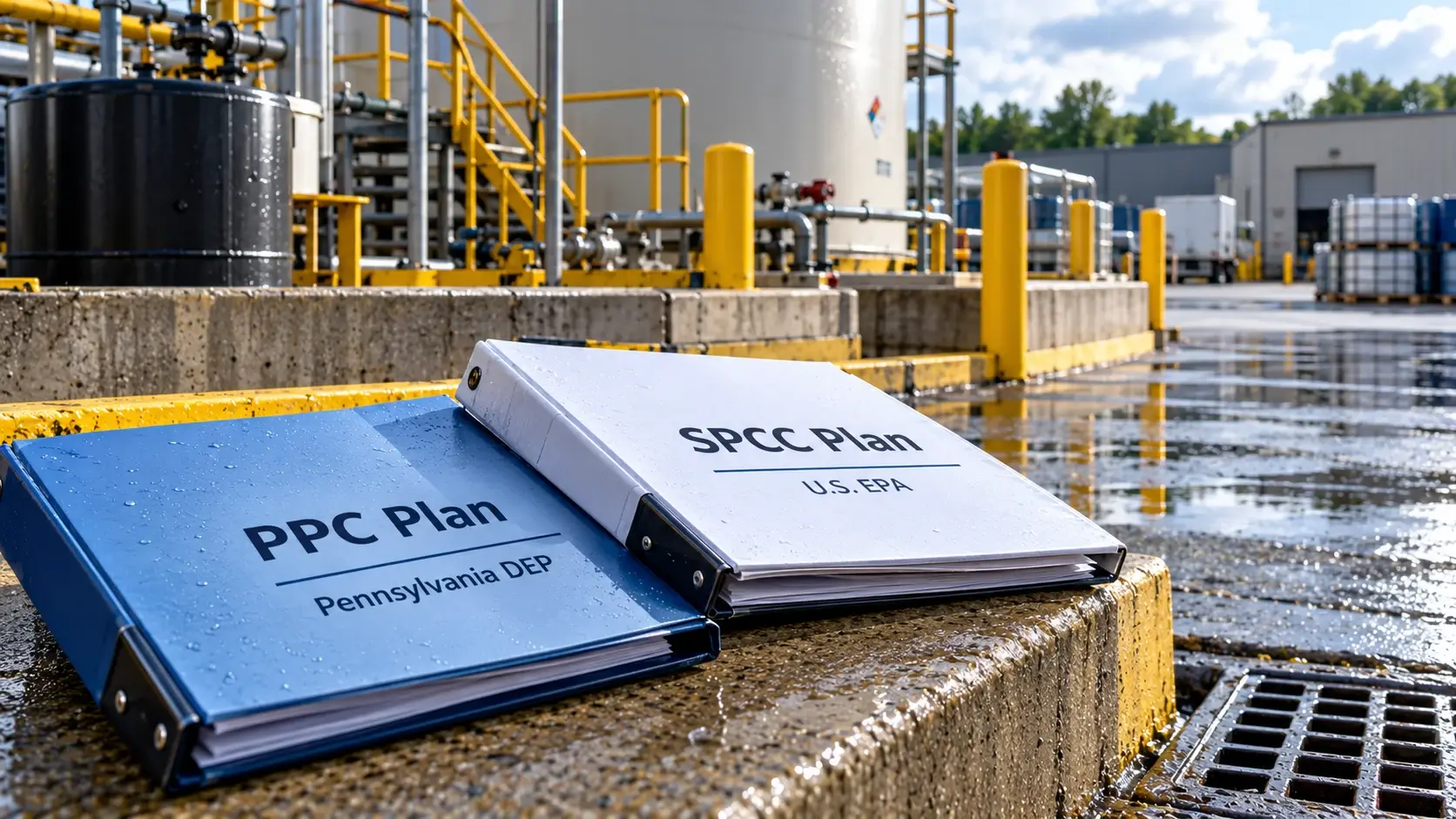
If your Pennsylvania facility stores oil and has a stormwater permit, you've probably been told you need a PPC Plan and an SPCC Plan. Both deal with spills, both sit in a binder in the office, and both get asked about during inspections, so it's easy to assume they're two names for the same document. They aren't. An SPCC Plan is a federal EPA requirement that only deals with oil, and it kicks in when a facility stores more than 1,320 gallons of oil aboveground (or a large amount underground). A PPC Plan is Pennsylvania DEP's broader spill prevention and emergency plan, covering oil plus chemicals, raw materials, wastes, and anything else that could pollute a stream, and it's required under the PAG-03 stormwater permit and other DEP programs. Plenty of facilities need both, and the two can often be coordinated or combined, as long as each one still meets its own rules.
Below, we'll walk through what each plan is, where the requirements come from, and how they compare side by side. We'll also cover which facilities need one, the other, or both, how to combine them without falling short on either, and what each typically costs. If you'd rather talk through your own facility's situation, you can always reach out to RMA and we'll help you sort out what applies.
Table of Contents
TL;DR
An SPCC Plan is EPA's federal plan for preventing oil spills, and it applies when a facility has more than 1,320 gallons of aboveground oil storage capacity (or more than 42,000 gallons completely buried) and could spill oil into a waterway. A PPC Plan is Pennsylvania DEP's plan for preventing and responding to releases of any pollutant, not just oil, and it's required for PAG-03 stormwater permit coverage and several other DEP programs. Many Pennsylvania facilities need both. You can combine them into one document if every SPCC requirement, including PE certification when it applies, and every PPC requirement is still met and kept on its own review schedule.
What Is an SPCC Plan? EPA's Federal Oil Spill Plan
SPCC stands for Spill Prevention, Control, and Countermeasure. It comes from EPA's oil pollution prevention rule at 40 CFR Part 112, which is part of the federal Clean Water Act program. The rule applies to facilities that store, use, process, or transfer oil and could reasonably be expected to spill it into navigable waters or adjoining shorelines. In practice, that includes a lot of sites whose storm drains, ditches, or swales eventually reach a creek or river.
The trigger is storage capacity, not how full your tanks are today. A facility needs an SPCC Plan if it has more than 1,320 gallons of aggregate aboveground oil storage capacity, counting only containers of 55 gallons or larger, or more than 42,000 gallons of completely buried storage capacity. Underground tanks already regulated under federal or state UST rules don't count toward that buried total. "Oil" is broad here. Diesel, gasoline, hydraulic oil, lube oil, used oil, and transformer oil all count, and so do vegetable and animal oils. A handful of drums plus one diesel tank can push a facility over the line, which is why we wrote a separate piece on whether 55-gallon drums are included in SPCC plans.
The plan itself is very prescriptive. It has to include a facility diagram, an inventory of oil containers, secondary containment for those containers, inspection and testing procedures, spill response steps, and training. Bulk storage containers need containment sized for the largest single container plus room for rainwater. Oil-handling employees need a discharge prevention briefing at least once a year, and the plan has to be reviewed at least every five years and amended when something changes that affects spill risk.
Most SPCC Plans must be certified by a licensed Professional Engineer. The exception is a "qualified facility" with 10,000 gallons or less of aboveground oil storage and a clean spill history, which can self-certify. Within that group, Tier I facilities (no single aboveground container over 5,000 gallons) can use EPA's simplified template. Our guide to the different types of SPCC plans walks through each option. You also don't submit an SPCC Plan to EPA. You keep it on site and have it ready when an EPA Region 3 inspector shows up.
What Is a Pennsylvania PPC Plan? DEP's Broader Spill and Emergency Plan
PPC stands for Preparedness, Prevention and Contingency. It's a Pennsylvania requirement rooted in the Clean Streams Law and 25 Pa. Code § 91.34, which says anyone who stores, uses, processes, transports, or disposes of pollutants has to take the steps needed to keep them out of the Commonwealth's waters, and lets DEP require a written plan showing how. DEP's guidance document, Guidelines for the Development and Implementation of Environmental Emergency Response Plans (No. 400-2200-001), lays out what a PPC Plan should contain.
Where most facilities run into the PPC requirement is PAG-03, Pennsylvania's general NPDES permit for stormwater from industrial activity. NPDES is the federal Clean Water Act permit program that DEP runs in Pennsylvania, and PAG-03 is the standard version of that permit most industrial sites use. Part C of PAG-03 requires every covered facility to develop and implement a PPC Plan, and the plan goes in with the Notice of Intent when you apply. Individual industrial stormwater permits carry similar requirements, and DEP also requires PPC Plans in several waste facility permits, such as transfer stations and certain processing facilities.
The biggest difference from SPCC is scope. A PPC Plan covers every material that could pollute water, not just oil. Under PAG-03, the plan has to identify all potential sources of pollutants that could reasonably be expected to affect stormwater, describe the preventive measures and best management practices (BMPs) used to control them, and lay out how the facility will respond to a spill or other emergency. That means fuel tanks, yes, but also chemical totes, outdoor raw material piles, dumpsters, washout areas, waste storage, and loading docks.
PAG-03 requires the plan to be reviewed at least once a year and updated as needed, including after the plan fails during an emergency. You keep the updates on site and make them available to DEP on request, and the annual report asks whether that review happened. Unlike larger SPCC Plans, a PAG-03 PPC Plan doesn't need a Professional Engineer's certification. For more on how PPC Plans fit into PAG-03 specifically, see our comparison of SWPPPs vs. PPC Plans for PAG-03.
PPC Plan vs. SPCC Plan: Side-by-Side Comparison
The easiest way to see how these two plans differ is to line them up. The table below compares the requirements that matter most when you're deciding what your facility needs and how to manage it.
| Feature |
SPCC Plan (EPA) |
PPC Plan (PA DEP) |
| Who requires it |
U.S. EPA (federal) |
Pennsylvania DEP (state) |
| Legal basis |
Clean Water Act, 40 CFR Part 112 |
Clean Streams Law, 25 Pa. Code § 91.34, permit conditions such as PAG-03 Part C, and DEP guidance 400-2200-001 |
| What triggers it |
More than 1,320 gallons aboveground oil capacity (containers 55 gallons or larger) or more than 42,000 gallons completely buried, plus a reasonable chance oil could reach a waterway |
Being covered by a DEP permit or program that requires one, such as PAG-03, an individual industrial stormwater permit, or certain waste permits, or a direct DEP request |
| Materials covered |
Oil only, in all its forms |
Any pollutant: oil, chemicals, raw materials, products, and wastes |
| Main focus |
Preventing oil discharges and containing them if they happen |
Preventing releases of any pollutant and preparing for spills and other emergencies |
| Certification |
Professional Engineer, unless a qualified facility (10,000 gallons or less) self-certifies |
No PE certification required under PAG-03 |
| Submitted to the agency? |
No, kept on site for inspectors |
Yes, submitted with the PAG-03 Notice of Intent, then kept on site |
| Review schedule |
At least every five years, plus amendments after changes that affect spill risk |
At least annually under PAG-03, plus updates after changes or a plan failure |
| Containment rules |
Specific secondary containment requirements, with bulk storage sized for the largest container plus rainwater |
Preventive measures and BMPs appropriate to each material, less prescriptive on sizing |
| Training |
Oil-handling personnel trained, with discharge prevention briefings at least annually |
Employees trained on the pollution prevention practices in the plan |
| Who inspects and enforces |
EPA Region 3 |
PA DEP regional offices |
The pattern is pretty consistent. SPCC goes deep on one type of material and is very specific about how you handle it. PPC goes wide across every material on site and is more flexible about how you control each one. That's why a good SPCC Plan doesn't satisfy PPC on its own (it skips everything that isn't oil), and a good PPC Plan rarely satisfies SPCC on its own (it usually lacks the containment calculations, inspection detail, and certification SPCC demands).
Who Needs a PPC Plan, an SPCC Plan, or Both in Pennsylvania?
Because the two plans have completely different triggers, the answer depends on two separate questions. First, how much oil storage capacity do you have, and could a spill reach a waterway? Second, are you in a DEP program, like PAG-03, that requires a PPC Plan? Here's how that typically shakes out.
| Facility Situation |
SPCC Plan? |
PPC Plan? |
| PAG-03 facility with more than 1,320 gallons of aboveground oil, like a ready-mix plant with a diesel tank or a site with a fleet maintenance area |
Yes, if oil could reach a waterway |
Yes |
| PAG-03 facility with only a few drums of oil, under 1,320 gallons total |
No |
Yes |
| Large oil storage but no industrial stormwater permit, like a data center or office campus with generator fuel tanks |
Likely yes |
Usually not, unless another DEP program or a DEP request requires one |
| Facility with a No Exposure Certification and oil stored indoors |
Possibly, since being indoors doesn't remove SPCC applicability |
Possibly, depending on answers in the No Exposure application |
| Small shop with a few drums, no stormwater permit |
Probably not |
Probably not |
That No Exposure row trips people up. Under SPCC, whether a spill could reach water is judged by location, drainage, and terrain, without giving credit for walls, dikes, or other man-made features. So moving drums inside a building doesn't, by itself, take a facility out of SPCC. Meanwhile, a No Exposure Certification is a way to skip PAG-03 permit coverage when all industrial activity is sheltered from rain and snow, but DEP's application can still require a PPC Plan depending on how you answer certain questions.
There's also a third plan that shows up at bigger sites. Under Pennsylvania's Storage Tank and Spill Prevention Act, aboveground storage tank facilities with more than 21,000 gallons of total capacity for regulated substances need a Spill Prevention Response Plan. A bulk fuel or chemical terminal with PAG-03 coverage could be juggling SPCC, PPC, and an SPR Plan at the same time. On the other end, a small shop with a few drums and no stormwater permit often needs none of these plans. Keeping a spill kit and good housekeeping habits is still smart, and the general duty in § 91.34 to keep pollutants out of the water applies to everyone, but you don't need to hire anyone to write a plan you aren't required to have.
Can You Combine a PPC Plan and an SPCC Plan?
Yes, and for facilities that need both, it's often the most practical approach. DEP designed its PPC guidance as a one-stop format for meeting state and federal emergency planning requirements, and EPA allows an SPCC Plan to be written in a different format, including as part of a larger plan, as long as it's equivalent and cross-referenced back to each Part 112 requirement. Combining means one site map, one emergency contact list, one set of spill response procedures, and one binder your team knows where to find.
The catch is that combining the plans doesn't merge their rules. The SPCC portion still needs every Part 112 element, including containment calculations, inspection procedures, and PE certification when the facility isn't qualified to self-certify. The PPC portion still has to cover every pollutant on site, not just oil, and be reviewed every year. We see the same handful of problems when combined plans go wrong:
- An SPCC Plan relabeled as a PPC Plan, with nothing about chemicals, raw materials, or wastes.
- A PE certification that doesn't make clear which parts of the combined document it covers.
- Review dates that drift apart, with the annual PPC review done but the five-year SPCC review missed (or the reverse).
- Different site diagrams or contact lists in different sections, so the plan contradicts itself in an emergency.
A simple way to avoid most of this is to build a cross-reference table at the front of the plan showing where each SPCC and PPC requirement is addressed, and to use the annual PPC review as a reminder to check the SPCC sections too. If containment is a question mark at your site, our article on how big SPCC oil spill containment needs to be is a good place to start. And if you're also weighing whether to keep your stormwater and oil plans together, we cover the pros and cons in whether SWPPPs and SPCC Plans belong in one book.
How Much Do PPC Plans and SPCC Plans Cost in Pennsylvania?
An SPCC Plan has no filing fee, because it isn't submitted to EPA. You're paying for the site evaluation, containment review, plan writing, and PE certification if your facility needs it. Across the facilities we work with, SPCC Plans run from about $2,500 for a simple self-certified plan to $15,000 for a large, complex PE-certified one, and most Pennsylvania projects land somewhere between $3,500 and $8,000.
A PPC Plan usually isn't priced on its own, because for most facilities it's one piece of a PAG-03 application. DEP charges a $500 application fee and a $500 annual fee for PAG-03 coverage. For a fairly straightforward facility, professional help with the full application, including the site evaluation, mapping, and PPC Plan, typically runs around $5,000 to $10,000, with ongoing compliance support at roughly $3,000 to $6,000 a year. Our breakdown of how much a PAG-03 permit costs in Pennsylvania goes through those numbers in more detail.
If you need both plans, doing them together can trim some cost, since one site visit and one set of maps serve both documents. It won't cut the work in half, though, because each plan still has requirements the other doesn't. For a quick estimate of what RMA's help would cost for your facility, use the pricing calculator below. There's no email required and no sales call.
How RMA Helps With PPC Plans and SPCC Plans in Pennsylvania
We're based in New Jersey and work with facilities across Pennsylvania on both sides of this question. We can start by figuring out what applies to you: whether you're over the SPCC threshold, whether you need PAG-03 coverage or might qualify for No Exposure, and whether a Spill Prevention Response Plan is also in play. From there we can write or update your PPC Plan as part of your Pennsylvania stormwater permitting, prepare or update your Pennsylvania SPCC Plan and coordinate PE certification when it's required, or build a combined plan that keeps both sets of requirements straight. Senior staff do the work, and many SPCC projects can be handled remotely.
Plans only work if your team knows how to use them, so we also help with annual reviews, inspections, and employee training, including courses in our online environmental training library. And if it turns out you don't need one of these plans, we'll tell you. Give us a call, send us an email, or fill out the form on our website, and you can contact RMA with no pressure and no obligation. We're happy to talk through your facility and point you in the right direction.


