A Breakdown of Compostable Organic Materials, Source Separation Rules, and How Class C Differs From Class B
If you're trying to figure out where food waste, yard trimmings, or other organic material fits into New Jersey's recycling classification system, you've probably run into Class C recyclables and wondered how they're different from Class B, which also deals with organic material. The short answer is that Class C is all about compost, but the actual rules around source separation, handling, and when an NJDEP approval is required get a lot more specific than that.
In this article, we'll cover what qualifies as a Class C recyclable material under New Jersey's recycling program, why the distinction between composting and processing matters, what "source separated" actually requires, and who needs an approval versus who just needs to manage the material correctly on site. If you're not sure where your business or facility falls, reach out to RMA and we can help you sort it out.
Table of Contents
TL;DR
Class C recyclables in New Jersey are source-separated compostable organic materials like food waste, yard trimmings, and grass clippings that are intended to break down into compost rather than being processed into another product. That's the key difference from Class B, where similar organic material (like a whole tree run through a chipper) is processed into mulch or wood chips instead of composted. Materials only count as Class C if they're kept separate from regular trash at the point they're generated. Most businesses just need to source separate correctly and send the material to an approved facility. It's the recycling center or composting facility itself that generally needs the Class C Recycling Center Approval from NJDEP to receive, store, process, or transfer the material.
What Are Class C Recyclables in New Jersey?
Under NJDEP's recycling classification system, Class C recyclable materials are source-separated compostable organic materials. In plain terms, these are materials that break down naturally and are meant to become compost, not materials that get disposed of as waste or processed into a different product entirely. The easiest way to remember it is that C stands for compost.
If you're wondering whether something on your site qualifies, the test isn't complicated. Ask whether the material is organic, whether it's been kept separate from regular trash, and whether it's headed toward composting rather than another type of processing. If the answer to all three is yes, you're likely looking at a Class C material.
Common Examples of Class C Recyclable Materials
The most common Class C materials under New Jersey's program are source-separated food waste, source-separated vegetative food waste, and source-separated yard trimmings. Think food scraps from a commercial kitchen, leaves and grass clippings from landscaping operations, and other plant-based material that's been pulled out of the regular waste stream before it ever reaches a dumpster or trash hauler.
Leaves collected specifically for composting are a good example. Because they're headed toward natural decomposition into compost, they fall squarely into Class C. The material itself matters, but as we'll get into next, how it's managed matters just as much.
Class C vs. Class B Recyclables: Why the Distinction Isn't Just About Material Type
This is where a lot of facilities get tripped up, because Class B and Class C both deal with organic material, but the classification depends on what happens to it, not just what it is. Class C isn't only about identifying the material correctly. It's also about how that material is being managed.
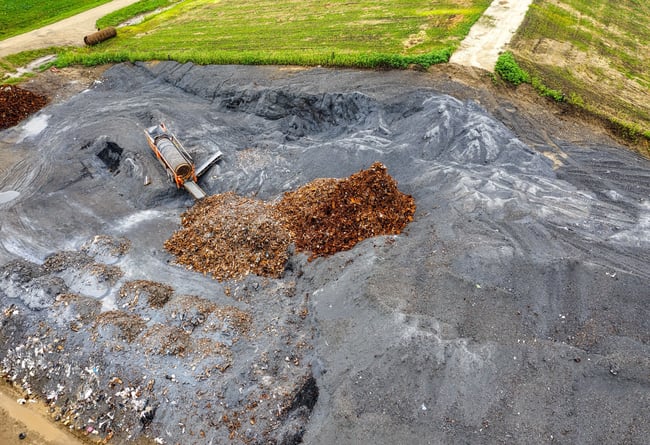
Picture two scenarios involving trees and yard waste. In the first, leaves and yard trimmings are collected and sent to a composting operation, where they naturally decompose into a soil amendment. That's Class C. In the second, an entire tree, trunk, branches, and leaves included, gets run through a wood chipper and turned into mulch or wood chips. That's generally considered Class B, because the material is being mechanically processed into a product rather than being composted.
So while both classes can involve similar organic starting material, they diverge based on end use. Class B materials typically get processed into products like mulch or wood chips. Class C materials go through natural decomposition into compost or soil amendments. If you're trying to sort out which classification applies to a specific operation, our article on Class B recyclable materials walks through that side of the comparison in more detail, and our broader guide to all four recycling classes in New Jersey covers how A, B, C, and D fit together.
What "Source Separated" Actually Means for Class C Materials
Class C materials have to be source separated, and that requirement is specific. It means the food waste, yard trimmings, or other organic material is kept separate from regular garbage at the point where it's actually generated, whether that's a kitchen, a landscaping site, or a food processing operation.
Once that material gets mixed in with municipal solid waste, it stops being considered source-separated recyclable material, even if the underlying material itself would otherwise qualify as compostable. A pile of food scraps that gets dumped into the same bin as general trash doesn't count as Class C anymore, regardless of what it's made of. The separation has to happen at the source and stay intact through collection and transport.
Who Actually Needs a Class C Recycling Approval?
For most businesses generating Class C material, like a restaurant separating food scraps or a landscaping company collecting yard waste, the responsibility usually ends at proper source separation. Once the material is correctly separated and sent to an appropriate recycling or composting facility, the generator has typically met its obligation.
The Class C Recycling Center Approval itself is generally required on the receiving end, meaning the recycling center or composting facility that wants to receive, store, process, or transfer these materials under NJDEP regulations. If you're operating or planning to operate a facility that handles Class C material in any of those ways, that's when the approval requirement applies to you directly. If your facility handles more than one class of material, it's worth reading up on multi-class recycling center approvals, since combined operations often need more than a single class approval.
How RMA Helps With Class C Recycling Center Approvals
We help clients determine whether a proposed recycling or composting operation actually requires a Class C Recycling Center Approval in the first place, prepare the full application package, and work directly with NJDEP throughout the review process until the approval is issued. A good amount of that work is simply making sure the application reflects exactly what the facility does and doesn't do, since NJDEP's review tends to move a lot faster when that's clear from the start.
If you want a sense of what a Class C approval typically costs before you talk to anyone, our New Jersey Recycling Approval pricing calculator gives you an instant estimate. No email or contact information required. And if you want to dig into related topics on your own first, our New Jersey Recycling Learning Center covers Class A, B, C, and D approvals, composting regulations, and most of the other questions that tend to come up around New Jersey recycling requirements.
If you're trying to figure out whether your operation needs a Class C approval, or you'd rather have someone handle the application and NJDEP review for you, there's no pressure and no obligation. Reach out to RMA and we'll help you figure out where you stand.