What a Pennsylvania Stormwater Permit Is, Who Needs One, and How No Exposure, PAG-03, Individual Permits, DEP, and PPC Plans Fit Together
If you run a shop, plant, or yard in Pennsylvania and you've never heard of a stormwater permit, you're in good company. You may have just seen the word "stormwater" in an email from a customer, an insurer, or DEP, with no idea whether it applied to you. Most owners run into it that way. Nobody sets out to learn about industrial stormwater permits. The rule just shows up one day, often at an awkward time, and the first few search results read like they were written for engineers.
This article is written for that person, with no assumed background. We'll walk through what a Pennsylvania stormwater permit is, who needs one, the three paths you can take (No Exposure, PAG-03, or an individual permit), what Pennsylvania DEP does, and why the PPC Plan sits at the center of the whole process. If you'd like to talk it through with someone at any point, you can reach out to RMA, and we'll tell you where you stand, including when the answer is that you don't need us.
Table of Contents
TL;DR
If industrial materials or activities at your Pennsylvania site are exposed to rain or snowmelt, you generally need stormwater permit coverage from DEP. There are three paths. A No Exposure Certification works if everything is truly under cover. PAG-03 is the general permit most industrial facilities use. An individual permit is for sites that can't use PAG-03, such as those discharging to High Quality or Exceptional Value waters. PAG-03 coverage is built around a PPC Plan, and professional help with a straightforward PAG-03 application typically runs about $5,000 to $10,000, plus DEP's fees.
What Is a Pennsylvania Stormwater Permit?
A stormwater permit is a discharge permit for rain and snowmelt that runs off an industrial site. It comes out of the federal Clean Water Act, which treats runoff from certain industrial activities the same way it treats wastewater coming out of a pipe. These permits fall under the National Pollutant Discharge Elimination System, or NPDES, which is why people use the two terms almost interchangeably. If you want the longer background, we've written up what an NPDES stormwater permit is in detail.
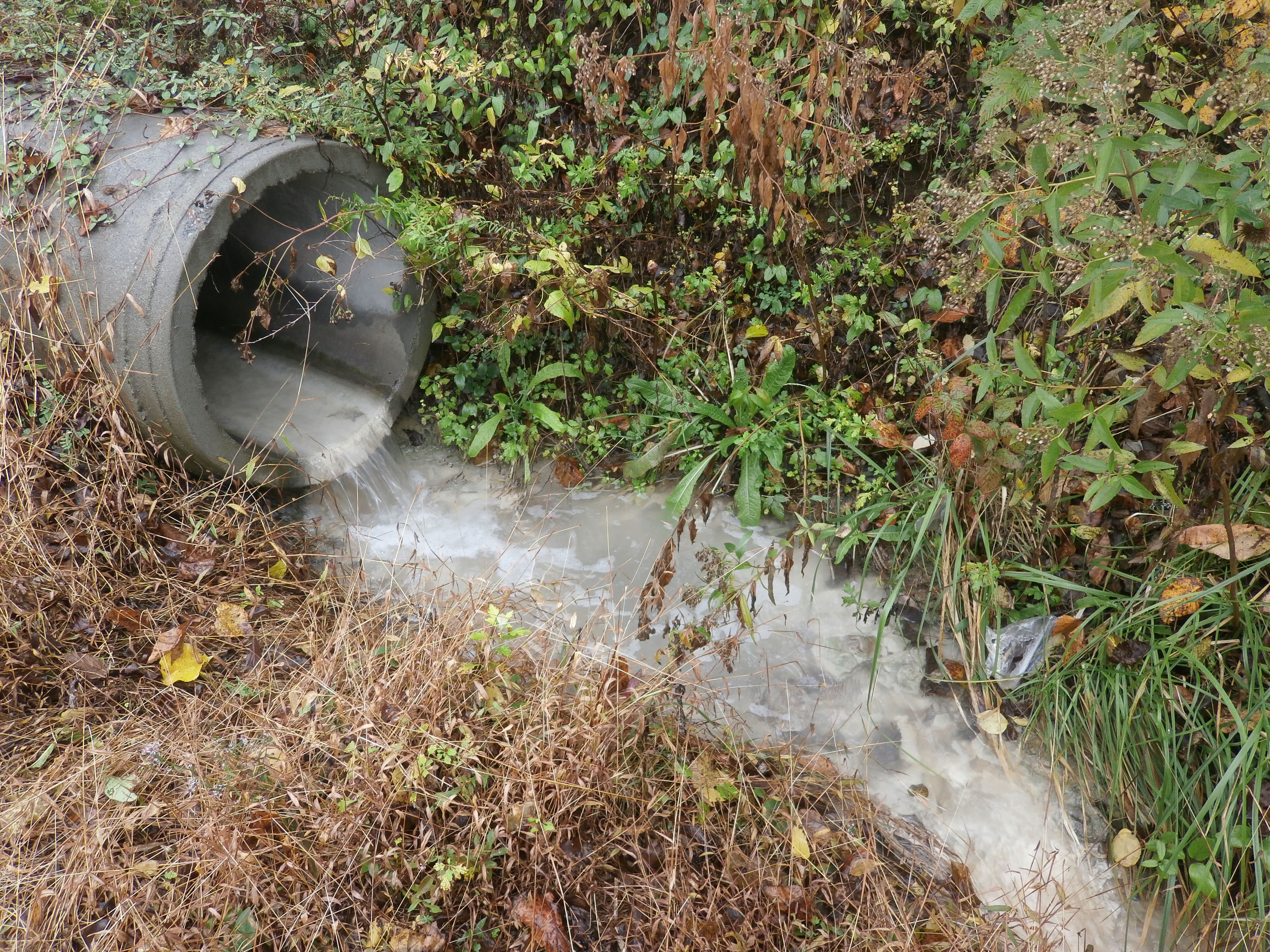
Here's how it plays out on a real site. Rain lands on your yard, your pavement, and your stockpiles. It picks up whatever it touches, like oil drips, metal dust, cement residue, or loose sediment, and then it runs to a storm drain, a ditch, or a creek. When that runoff counts as stormwater associated with industrial activity, the facility is expected to have permit coverage and a plan for keeping pollutants out of that water. Construction projects have their own stormwater permits, and those aren't what we're covering here.
Does Your Business Need a Stormwater Permit in Pennsylvania?
Whether you need coverage depends on what you do and what's sitting outside, not on how big you are. Manufacturers, concrete and asphalt plants, scrap and recycling yards, some equipment and vehicle maintenance operations, and a long list of other industrial categories can fall under the rules. The question regulators care about is whether industrial materials, equipment, or processes are exposed to rain or snowmelt at your site. We cover the longer version in our post on who needs a stormwater permit.
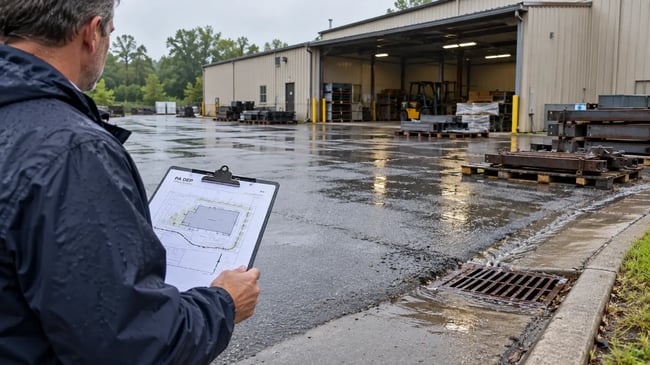
A quick way to check is to walk your property after a rain, or at least picture it. Look for outdoor storage of raw materials, products, scrap, or waste. Look for vehicles and equipment that get fueled or washed outside, loading areas, and anything that leaks, drips, or throws off dust. If you find those, there's a good chance you're in permit territory. If everything really is indoors or under a roof with walls, you may qualify for a simpler option we'll cover below. A small footprint doesn't exempt you, and neither does never having heard from DEP. Plenty of facilities find out they needed coverage during an inspection, or when a customer, lender, or buyer asks for proof of it.
What Does Pennsylvania DEP Do With Stormwater Permits?
The Pennsylvania Department of Environmental Protection, usually called DEP or PA DEP, runs the NPDES program in the state. In practice, DEP is the agency that receives your application, decides whether you qualify for a given permit path, issues or approves your coverage, collects your monitoring reports, and sends inspectors to your facility. EPA sets the federal framework, but DEP is who you deal with day to day.
It helps to know what DEP doesn't do. DEP reviews what you submit. It won't walk your site, tell you which path to pick, or write your plan for you. Staff will answer procedural questions, but an incomplete application usually comes back with more questions, and that adds time. If you're wondering how long the review takes, we've covered that in how long it takes to get PAG-03 coverage in Pennsylvania. And if an inspector does show up, our guide to what happens during a PA DEP stormwater inspection will tell you what to expect.
Which Pennsylvania Stormwater Permit Path Fits: No Exposure, PAG-03, or Individual?
Pennsylvania gives industrial facilities three routes. Which one applies depends on what's exposed at your site and where your runoff goes. Our general guide to which NPDES permit you need covers the national picture. Here's how the three look in Pennsylvania.
No Exposure Certification
A No Exposure Certification, or NEC, is for facilities that keep all industrial materials and activities indoors or under proper shelter, so nothing touches rain or snowmelt. If you qualify, you skip full permit coverage. You submit the certification to DEP, DEP has to approve it, and you renew it every five years. Our post on what no exposure means goes deeper.
No exposure has a specific meaning. It doesn't mean your yard looks tidy or that you've never seen dirty runoff. It means the qualifying materials and activities really are protected, and the option isn't available if you discharge to High Quality or Exceptional Value waters. If your operations change and something ends up outside, you may need permit coverage instead. When a facility honestly qualifies, this is usually the lightest path, and we'll tell you so even though it means less work for us.
PAG-03 General Permit
PAG-03 is Pennsylvania's general NPDES permit for stormwater from industrial activity, and it's the route most industrial facilities use. A general permit means DEP wrote one set of conditions that many facilities can sign onto, rather than writing a custom permit for each one. That doesn't make it a short form. You evaluate how stormwater moves across your site, identify your industrial activities and pollutant sources, document your outfalls and drainage areas, prepare a PPC Plan, and submit a Notice of Intent, or NOI, to DEP. The monitoring and reporting you'll owe depend in part on your industrial activity, based on the permit appendix that applies to you.
Some owners handle this themselves, and some shouldn't. If you're weighing it, read can you get a PAG-03 permit yourself for a straight look at what the do-it-yourself route involves.
Individual NPDES Permit
An individual permit is written for your facility specifically. You need one when you don't qualify for PAG-03, and the most common reason is a discharge to High Quality or Exceptional Value waters. Other site conditions can push you here too. Because the permit is custom, DEP wants a more detailed picture of your operations, discharges, drainage, pollutants, and receiving waters, so the application takes more effort and usually more time. DEP generally issues individual permit coverage for five-year terms, and you submit a renewal before it expires if you plan to keep discharging.
A simple way to sort yourself is to ask three questions in order. Is everything truly under cover? That points to No Exposure. If not, can you get PAG-03 coverage? That's the usual answer. If your runoff goes to protected waters or something else disqualifies you, you're looking at an individual permit. Have someone who's done this before check your receiving waters before you commit to a path, since a wrong guess can cost you months.
What Is a PPC Plan in Pennsylvania Stormwater Permitting?
PPC stands for Preparedness, Prevention, and Contingency. A PPC Plan is the written plan that documents how your facility keeps pollutants out of stormwater and what you'll do when something goes wrong. If you've read about stormwater permits in other states, you've probably seen the term SWPPP instead. In Pennsylvania, the PPC Plan does much of the same job, and we compare the two in SWPPPs vs. PPC Plans for PAG-03. You'll need one for PAG-03 coverage, and individual permit applications involve similar planning documentation.
A good PPC Plan is specific to your site. It includes maps showing your buildings, drainage, and outfalls, a description of your industrial activities and materials, the pollutant sources you identified, the stormwater controls (often called BMPs) you use, your inspection and housekeeping routines, your spill response steps, and who's responsible for each piece. Generic templates tend to produce plans that don't match the site and get filed away and ignored. The plan is also the document your team works from day to day, and one DEP can ask to see.
A plan only works if the people carrying it out know what's in it. That's where training comes in. Our online environmental training library gives your employees a way to learn their part, and our post on whether stormwater training is required answers a question we hear all the time.
What Happens After You Get Pennsylvania Stormwater Permit Coverage?
Getting the permit is the start of ongoing work. Once you're covered, you'll typically have routine inspections of your own site, stormwater controls to maintain, sampling during qualifying rain events, reporting, employee training, and recordkeeping. The PPC Plan needs updating whenever your operations or site layout change.
Reporting in Pennsylvania runs through DEP's electronic Discharge Monitoring Report system, called eDMR, and PAG-03 permittees are among the facilities required to use it. We walk through it step by step in our guide to Pennsylvania eDMR reporting. Sampling has its own learning curve, because how you collect a sample affects the result you end up reporting. Our post on PAG-03 stormwater samples covers how to do it properly.
None of these tasks is complicated by itself. The trouble is the number of small tasks, on a schedule, that people fall behind on. A calendar, one person who owns it, and a backup person go a long way. If that sounds like too much to carry on top of running a business, this is the stage where ongoing support helps the most.
How Much Does a Pennsylvania Stormwater Permit Cost?
For PAG-03, DEP charges a $500 application fee and a $500 annual fee. Those are the small part. The real cost is preparing everything the permit requires: the site evaluation, the mapping, the PPC Plan, and the application package. For a relatively straightforward facility, professional help with the full application typically runs about $5,000 to $10,000. Ongoing compliance support usually adds $3,000 to $6,000 a year, depending on your site and how much you want handled. An individual permit costs considerably more because the process is more involved. We break it down further in how much a PAG-03 permit costs in Pennsylvania.
We're not the cheapest option, and we don't try to be. The lowest bid tends to come with a thin PPC Plan built from a template, no real site walk, and a junior person you never speak to. That can leave you with a plan that doesn't match your site, or an application that comes back from DEP and eats the months you were trying to save. If you're comparing firms, our guide on how to choose a PAG-03 consultant lists what to ask. Senior people do the work at RMA, and we publish our pricing so you can compare.
If you want a number for your own facility, the calculator below gives you a ballpark for RMA's help, separate from DEP's fees.
How Can RMA Help With Your Pennsylvania Stormwater Permit?
RMA has helped facilities across Pennsylvania sort out their stormwater requirements for years. We start by working out which path fits your site. If that turns out to be a No Exposure Certification you can handle on your own, we'll say so. If you need PAG-03 or an individual permit, we walk your facility, build the maps and the PPC Plan, prepare the NOI and application, stay with it through DEP's review, and help with sampling, eDMR reporting, and renewals afterward.
There's no pressure and no obligation. You can call us, email us, or fill out the form on our website, and you can contact RMA about your Pennsylvania stormwater permit whenever you're ready. If you'd rather read more first, our overview of everything you need to know about NPDES stormwater permits is a good next stop.