How PAG-03, No Exposure Certifications, and DEP's SIC Code Rules Apply to Chemical Manufacturers and Chemical Wholesalers
If your Pennsylvania facility makes, blends, repackages, stores, or sells chemicals, the stormwater permit question usually comes up late, often after a DEP inspection, a customer audit, or an insurance review. Stormwater permits in Pennsylvania are part of the federal NPDES program (the National Pollutant Discharge Elimination System), which the Pennsylvania Department of Environmental Protection (DEP) runs in the state. For chemical manufacturers the answer is almost always yes. For chemical distributors it's a more careful "maybe," and the difference comes down to how DEP classifies what you do on your site.
In this article, we walk through how DEP decides which chemical facilities are covered, where chemical sites typically get exposed to rain and snowmelt, what the usual path under Pennsylvania's PAG-03 general permit looks like, and when a facility that keeps everything fully enclosed can file a No Exposure Certification instead. Southeast Pennsylvania has a large concentration of chemical manufacturing and distribution, and we work with Pennsylvania facilities all the time, so if you'd like a second set of eyes on your own site, you can reach out to RMA and we'll tell you plainly whether you need a permit.
Table of Contents
TL;DR
Chemical manufacturers in Pennsylvania are a covered industrial category, so they need either PAG-03 stormwater permit coverage or an approved No Exposure Certification, even if most of the work happens indoors. Chemical distributors may or may not be covered, depending on their primary SIC code (the code for what brings in the most revenue) and on activities like blending, repackaging, or hazardous waste storage. Tank farms, drum storage, loading and unloading, and spills are the usual exposures, and any one of them kept outdoors usually rules out No Exposure. Only a facility with everything fully enclosed and sealed is a realistic candidate for a No Exposure Certification.
Do Chemical Manufacturing Plants Need a PAG-03 Stormwater Permit?
In almost every case, yes. Federal stormwater rules, which Pennsylvania follows, list chemical and allied products manufacturing as a regulated industrial category. It covers a wide range of sites: industrial inorganic and organic chemical plants, plastics and resins, pharmaceuticals, soaps and detergents, paints and coatings, agricultural chemicals, and miscellaneous chemical products. These all sit in the 2800 range of SIC codes. SIC stands for Standard Industrial Classification, the four-digit code that describes what a facility mainly does. PAG-03 is DEP's general permit for stormwater from industrial activity, and it includes a chemicals and allied products section with requirements written for this sector.
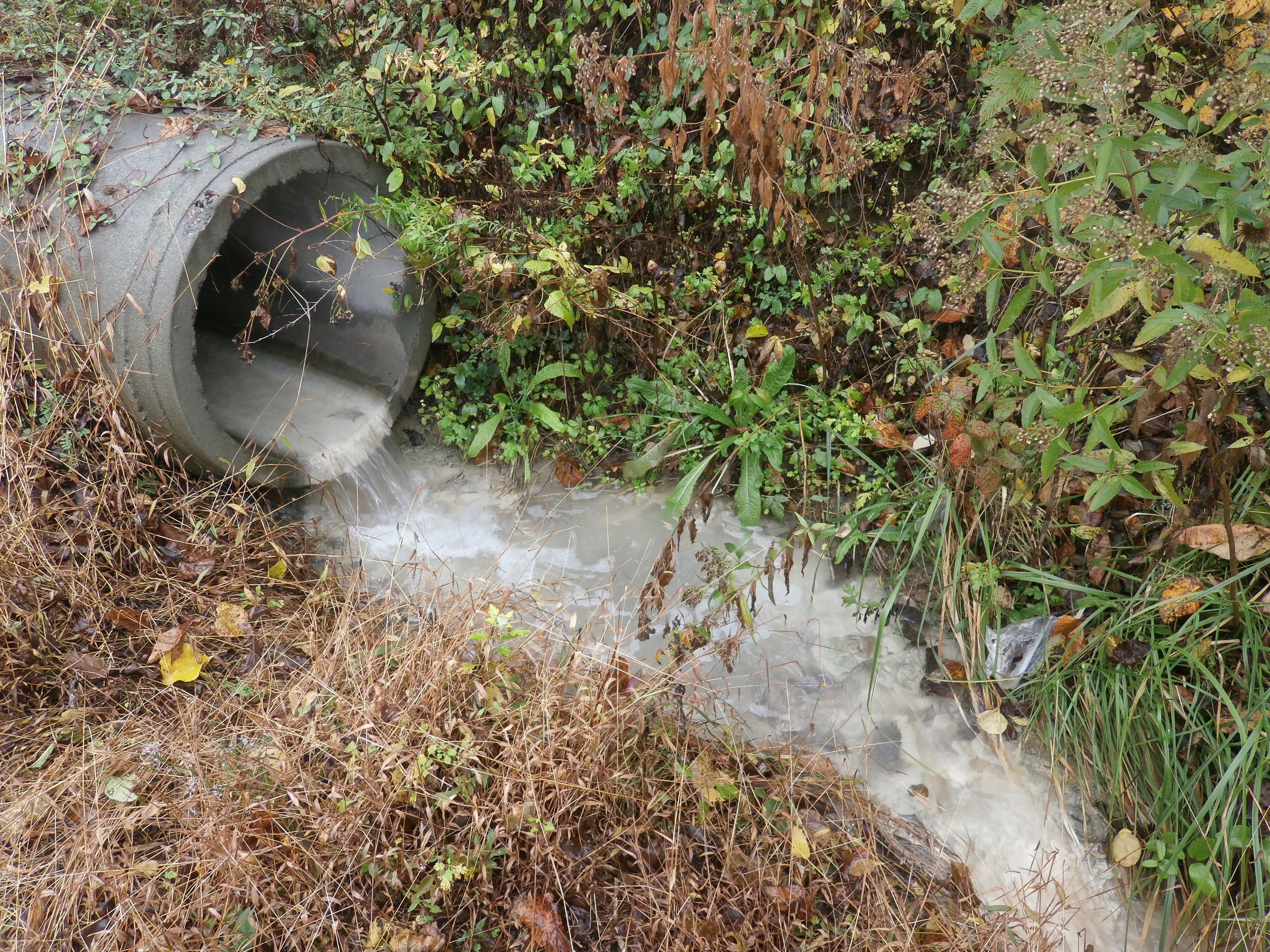
Two points trip people up. DEP determines your primary SIC code by looking at which activity brings in the most revenue at the site. And once a facility's primary activity is on the list, it needs either permit coverage or an approved No Exposure Certification, no matter how much of the work happens indoors. The lack of a discharge pipe doesn't change this either, since DEP's guidance says sheet flow across pavement counts, and so does a basin that only overflows in large storms. See our article on stormwater associated with industrial activity.
One situation can change the answer. If all of the stormwater from your industrial areas flows to a sanitary or combined sewer that's part of a publicly owned treatment works, DEP doesn't require permit coverage or a No Exposure Certification. Older cities, including Philadelphia and Pittsburgh, have combined sewers, and cities, townships, and sewer authorities can set their own rules and fees. For that reason we'd never tell a facility in a particular city that it does or doesn't need PAG-03 without first looking at where its water goes.
Do Chemical Distributors and Wholesalers Need a Pennsylvania Stormwater Permit?
It depends, and sometimes the answer is no. Chemical wholesalers usually fall under SIC code 5169, which is chemicals and allied products not elsewhere classified. Wholesale chemical distribution on its own generally isn't one of the categories the federal stormwater rules name, so a pure distributor isn't automatically required to have coverage.
Several things can pull a distributor into the program. The first is the revenue test. If a site blends, repackages, or formulates products and that work brings in more money than the wholesale side, DEP can treat the primary activity as manufacturing, which puts the site back in the chemical category. The second is hazardous waste. A site with a hazardous waste storage, treatment, or disposal unit operating under a RCRA permit or interim status is covered for that part of the site, whatever its main SIC code is. The third is DEP's authority under the Pennsylvania Clean Streams Law, which lets it require a permit from any facility whose runoff is carrying pollutants to state waters, listed code or not.
For a distributor that moves product through a warehouse with sealed containers kept under roof, there may be no permit requirement at all, and we'd tell you so rather than sell you a permit you don't need. Outdoor tanks, open loading areas, or any blending or repackaging call for a closer look before you assume you're out.
Where Do Chemical Facilities Get Stormwater Exposure?
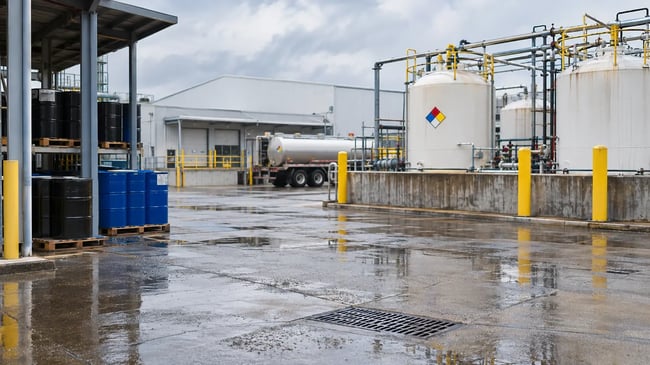
Exposure is the word regulators use for industrial materials or activities that rain and snowmelt can touch. At a chemical facility the exposure usually shows up in the same handful of places, and which ones you have decides whether you're looking at a full PAG-03 permit or a possible No Exposure Certification. The table below lays out the common ones.
| Exposure Area |
How Stormwater Gets Involved |
What It Means for Your Permit |
| Tank farms and bulk storage |
Rain collects inside diked areas, and drips from valves, pumps, and fittings mix with it. |
Water held in containment still has to be dealt with before it leaves, and containment open to the weather can rule out No Exposure. |
| Drum, tote, and container storage |
Containers staged outdoors can leak, corrode, or sit open, and spilled product sits on the pavement around them. |
Tightly sealed containers in good shape don't need a shelter for No Exposure. Deteriorated, leaking, or open ones do. |
| Loading and unloading |
Hose and coupling drips, overfills, and residue from tank trucks, rail cars, and totes land on outdoor pavement. |
Outdoor transfer areas are a common reason chemical sites can't qualify for No Exposure, and they're usually where the runoff gets sampled. |
| Spills and leaks |
Small drips and large releases both end up on pavement, and rain carries them toward storm drains. |
Spill response and housekeeping practices are central to your PPC Plan, and leftover residue shows up in sample results. |
| Tanker and equipment washing |
Wash water from rinsing trucks, totes, and equipment can run across the yard. |
Vehicle wash water isn't an authorized discharge under PAG-03. It has to be kept separate, and wash areas must be indoors for No Exposure. |
Knowing where your stormwater picks up chemicals is the first step in separating it from process water, which falls under different rules and can't simply be mixed into a stormwater discharge.
What Does the PAG-03 Permit Path Look Like for a Chemical Facility?
Most chemical manufacturers end up with PAG-03 coverage. The work starts with a walk of the site to find where stormwater touches industrial activity, where it flows, and where it leaves. From that you build a site map and a PPC Plan, which stands for Preparedness, Prevention, and Contingency Plan. Existing facilities also provide stormwater sampling results from the past two years, and everything goes to DEP in a Notice of Intent (NOI), the application for general permit coverage. We compare it with a SWPPP in our article on SWPPPs and PPC Plans for PAG-03.
Not every chemical site can use the general permit. Discharges to waters designated High Quality or Exceptional Value aren't covered by PAG-03, and those facilities apply for an individual NPDES permit instead. A facility that already has, or needs, an individual NPDES permit for process wastewater also can't put its stormwater under PAG-03, because the stormwater gets folded into the individual permit. That second situation is common at chemical plants with a wastewater discharge, so it's worth sorting out early. Our article on which Pennsylvania stormwater permit you need walks through the three options side by side.
Once you're covered, the work continues. PAG-03 requires stormwater sampling at least once every six months, with results reported through eDMR, DEP's online system for discharge monitoring reports. Results get compared against benchmark values in the chemicals appendix, which are targets rather than hard limits. Two consecutive benchmark exceedances for the same pollutant at the same outfall require a Corrective Action Plan submitted to DEP within 90 days of the end of the monitoring period. You'll also file an annual report each March 23. The current PAG-03 runs through March 23, 2028, so a renewal cycle is coming. Our guides to PAG-03 sampling, eDMR reporting, and high sample results cover each of those steps in more detail.
Can a Chemical Plant or Distributor Qualify for a No Exposure Certification?
Some can, but it's a narrow door for chemical sites. A No Exposure Certification is DEP's alternative to permit coverage for covered facilities that keep every industrial material and activity protected from rain and snow. Protected means indoors or under a storm-resistant shelter. DEP defines that as a fully roofed and walled building, or a roofed structure where stormwater can't flow through and blown-in water can't run out, usually thanks to a curb or berm. Tarps work as a temporary measure but generally can't be used over a permanent installation. Tightly sealed drums, barrels, and tanks in good condition don't need a shelter, as long as they aren't leaking or deteriorated and have no operational taps or valves.
That definition rules out most chemical manufacturers. An outdoor tank farm, an open loading rack, or drums staged in the yard each end the conversation, and DEP won't approve No Exposure for only part of a site. The realistic candidates are fully enclosed specialty blenders, small formulators working indoors, and distributors that keep sealed product inside a building and do all their transfers under roof. For those facilities, the paperwork is lighter than a full permit, with no annual fee, and a $500 fee due every five years with the NOI and certification application.
No Exposure isn't a one-time fix. DEP approves it for up to five years, renewal applications are due at least 180 days before expiration, and DEP can inspect to confirm that conditions on site match what you certified. If your operations change so that materials or activities become exposed, you have to notify DEP right away and apply for permit coverage. Our overview of what No Exposure means explains the concept in plain terms, and NPDES permit types shows how it compares with the other options.
What Other Environmental Programs Do Chemical Facilities Deal With?
Stormwater is one program among several for a facility handling chemicals, and the same inventory that drives your stormwater exposure tends to trigger other requirements. Facilities storing hazardous chemicals above threshold amounts file annual Tier II reports, larger manufacturers may owe Toxic Release Inventory reports, and any oil stored on site can bring in an SPCC Plan. Hazardous waste, air permits, tank registrations, and sewer pretreatment approvals can all apply as well, depending on what you make and store. A facility environmental audit is a practical way to find out which of these apply to you before an inspector does.
If you're building or expanding a plant or distribution site, the construction phase brings its own stormwater and erosion control requirements, along with local approvals. We don't prepare those, and your engineer or contractor typically handles them. Once the new area is running, though, it has to be reflected in your operational stormwater permit or certification, PPC Plan, inspections, and sampling, and that's where we can help. If you need to know what the construction phase requires, we can point you to the right construction professionals.
What Does a Stormwater Permit Cost for a Chemical Facility in Pennsylvania?
Agency fees are the small part. For PAG-03 coverage, DEP charges a $500 application fee and a $500 annual fee, and a No Exposure Certification is a $500 fee every five years with no annual charge. The larger cost is preparing what the permit requires: the site evaluation, mapping, PPC Plan, and application package. For a relatively straightforward facility, professional help with the full application typically runs around $5,000 to $10,000, with ongoing compliance support of roughly $3,000 to $6,000 per year depending on how much help you want. If you're thinking about doing it yourself, we lay out the trade-offs in our DIY versus consultant guide, and our article on PAG-03 permit costs goes into what drives the price up or down. For a number built around your own site, use our NPDES pricing calculator below.
How Can RMA Help With Chemical Facility Stormwater Permits in Pennsylvania?
We help chemical manufacturers and distributors work out which path applies to them, whether that's PAG-03, an individual permit, a No Exposure Certification, or no permit at all. From there we can walk the site, prepare the maps and PPC Plan, put together the application, handle DEP questions during review, and support the sampling, eDMR reporting, annual reports, and plan updates that follow. Senior staff do the work, and we explain what we're doing and why, so your team understands the program as well as having the paperwork. We also help with the Tier II, SPCC, and other programs that tend to sit alongside stormwater at chemical sites, and if your team needs training, our online training library is a good place to start.
If you're not sure whether your facility needs a permit, there's no pressure and no obligation. You can call us, send an email, or fill out the form on our website, and tell us a little about your site. If we can help, we'll explain the next steps. If you don't need us, we'll say so and point you in the right direction. You can contact RMA here whenever you're ready.