Wood Shops Mostly Work Indoors, So Many Pennsylvania Furniture and Cabinet Makers Can File a No Exposure Certification With DEP Instead of Carrying a Full Industrial Stormwater Permit
If you run a furniture or cabinet shop in Pennsylvania, you've probably heard that industrial stormwater permits are for quarries, steel mills, and scrapyards, not a woodworking shop with a showroom and a dust collector. The picture is more mixed than that. Pennsylvania DEP regulates stormwater from a long list of industries under the federal Clean Water Act, and furniture and wood cabinet manufacturing are on it. The rules are built around what happens outside your walls, though, and most woodworking happens inside. For many shops, the answer is a No Exposure Certification instead of a full permit, as long as nothing industrial sits out in the rain.
In this article, we'll explain what a stormwater permit means for a wood shop, what a No Exposure Certification is, and the everyday things that quietly create exposure: outdoor lumber, sawdust collectors, finishing materials, waste, and dumpsters. We'll give you a practical checklist for staying eligible and walk through what filing involves, because being indoors doesn't mean doing nothing. If you'd rather have someone look at your shop with you at any point, you can reach out to RMA.
Table of Contents
TL;DR
Furniture and cabinet makers are on the list of industries Pennsylvania DEP regulates for stormwater, so most need either PAG-03 permit coverage or an approved No Exposure Certification. Because woodworking mostly happens indoors, many shops can qualify for No Exposure, but only if lumber, sawdust, finishing materials, waste, and dumpsters are all under a roof or properly sealed and covered. Indoors doesn't mean doing nothing: the certification generally still has to be filed with DEP, backed by site maps, a sample result for existing sites, and sometimes a PPC Plan, and then renewed every five years.
Do Furniture and Cabinet Makers Fall Under Pennsylvania's Industrial Stormwater Rules?
A stormwater permit here is an NPDES permit, short for National Pollutant Discharge Elimination System, the Clean Water Act program that regulates what leaves a site and ends up in streams and storm drains. DEP runs that program in Pennsylvania, and its general permit for industrial facilities is called PAG-03. Facilities that don't need the full permit because nothing industrial is exposed to weather can file a No Exposure Certification instead, which we'll call an NEC.
Who has to do one or the other depends on a four-digit Standard Industrial Classification (SIC) code that describes what your business mainly does. The federal stormwater rule at 40 CFR 122.26 names SIC major group 25, furniture and fixtures, and SIC 2434, wood kitchen cabinets, among the covered categories. Sawmills, planing mills, and hardwood flooring mills are on the list too. DEP's industrial stormwater FAQ says your primary code follows revenue, meaning the activity that earns the most at the site, and a listed secondary code generally doesn't trigger the requirement. A shop that mostly sells and installs finished cabinets may be classified differently than one that builds them, so check your code instead of assuming. DEP can also require a permit from any facility whose runoff carries pollutants to a stream under the Clean Streams Law. For the broader picture, see who needs an NPDES stormwater permit and what counts as stormwater associated with industrial activity.
What Is a No Exposure Certification for a Furniture or Cabinet Shop?
An NEC is a conditional exclusion from the permit requirement. Under the federal rule and DEP's guidance, a facility can skip PAG-03 coverage if all of its industrial materials and activities are stored and carried out indoors or under roof, so rain, snow, and snowmelt never touch them. For a wood shop, that covers raw lumber and sheet goods, scrap, sawdust, finishing materials, waste, and the loading and unloading of all of it. Our article on what No Exposure means under an NPDES stormwater permit covers the concept nationally.
DEP calls the protection a storm-resistant shelter. That can be a fully walled and roofed building, or a roofed structure with a curb or berm so water can't run through it. Tarps count only as a temporary measure. A few things don't need a shelter: tightly sealed drums and tanks that aren't leaking or deteriorated, covered dumpsters in good condition, adequately maintained vehicles used to move material, and final products that stormwater wouldn't wash pollutants from. DEP's FAQ also says wooden pallets in good condition that don't contaminate stormwater can sit outside without costing you eligibility.
Two limits apply no matter how tidy your shop is. First, NEC covers the whole facility, so DEP won't certify one building as no exposure while another has a lumber rack standing in the weather. Second, it isn't available to facilities that discharge to High Quality or Exceptional Value streams under 25 Pa. Code Chapter 93. Those facilities need an individual NPDES permit, which DEP says would include limited or no stormwater monitoring.
What Can Create Stormwater Exposure at a Wood Furniture or Cabinet Shop?
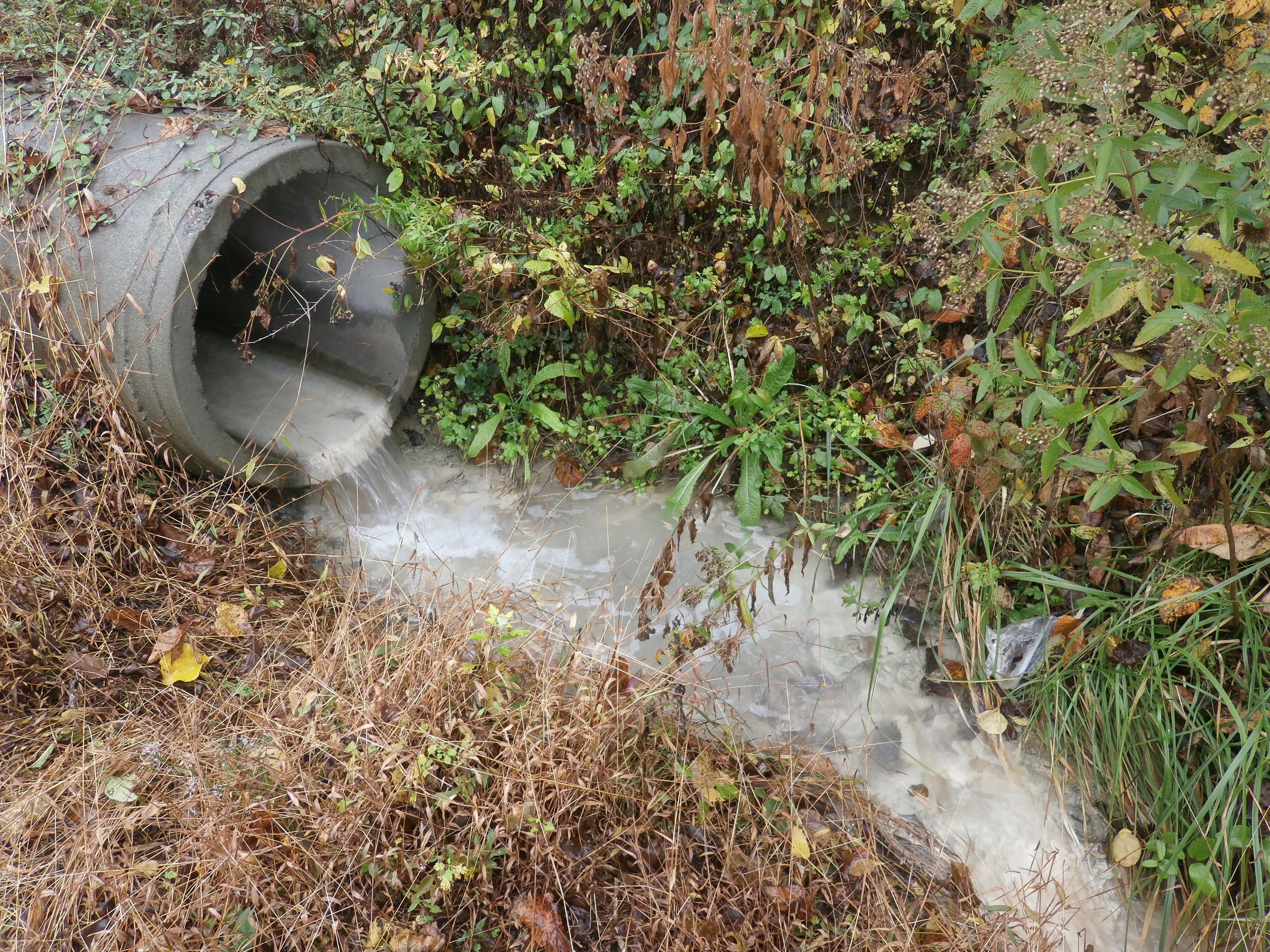
Shops usually lose NEC eligibility through small, ordinary things, not a big outdoor operation. DEP's No Exposure form asks about a specific list of exposures, and several describe a typical woodworking site almost line for line. Lumber and sheet goods stored outside are the most common: a rack along the side of the building or a tarped stack of plywood counts as materials stored outdoors, even if it's only there for a week.
Sawdust Collectors and Dust on Roofs
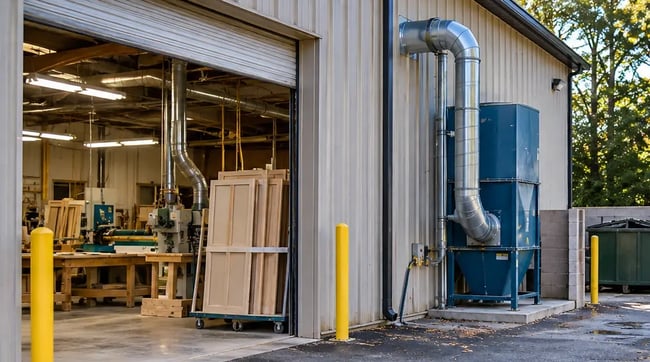
Dust catches people off guard, because the shop can be spotless inside and still have an exposure problem on the roof. The form asks whether visible particulate or residue from roof stacks and vents, not covered by an air quality control permit, shows up in the stormwater outflow. In a wood shop, that points at dust collector exhaust, cyclones, and roof vents that let fine sawdust settle on the roof and wash into the downspouts. Look at the downspout outlets after a rain and you'll usually know which situation you're in. Where sawdust bins or roll-offs get filled and emptied, spilled sawdust that sits in the rain counts too, so empty under cover or sweep up promptly.
Finishing materials are the other common trip. Stains, lacquers, solvents, and adhesives in sealed, undamaged containers don't need a shelter, but open or leaking containers do, and so does spill residue on the ground or in storm inlets. The form also asks whether you store or handle liquids containing toxic or hazardous pollutants, indoors or out, and a yes means you attach a PPC Plan. PPC stands for Preparedness, Prevention, and Contingency, and the plan lays out how you'll prevent spills and respond to one. A shop with a finishing room may answer yes even when everything is indoors, so be ready to include one.
Waste is allowed outside only in covered, non-leaking containers like lidded dumpsters. An open dumpster in the weather doesn't qualify, though an open one under a storm-resistant shelter can, and it helps to ask your hauler to close lids after each pickup. Open loading docks matter as well, since materials are exposed while being unloaded, and DEP's FAQ says any wash area has to be indoors to stay eligible. The table pulls the common sources together.
| Source at the shop |
Why it counts as exposure |
What usually fixes it |
| Lumber, plywood, and sheet goods stored outside |
Materials stored outdoors are on DEP's exposure list |
Store inside or under a roofed, bermed shelter |
| Dust collector exhaust and roof vents |
Visible deposits on roofs and in runoff can disqualify you |
Maintain collectors, clean roofs, check downspouts after rain |
| Sawdust bins and the spots where they're emptied |
Spilled sawdust at loading points sits in the rain |
Empty under cover and sweep spills promptly |
| Finishing materials and chemical drums |
Open or leaking containers and spill residue count |
Keep containers sealed, clean up spills, include a PPC Plan |
| Scrap, waste, and dumpsters |
Waste is allowed outside only in covered, non-leaking containers |
Use lids or put dumpsters under a roof |
| Open loading docks and outdoor staging |
Materials are exposed while being loaded, unloaded, or staged |
Canopies, covered bays, and indoor staging |
What Is a Practical Checklist for Staying No Exposure Eligible at a Furniture or Cabinet Shop?
Eligibility isn't something you earn once. It's a condition you maintain, and DEP can inspect to confirm it. Walking the property after a rain with this list in hand catches most problems.
- Keep lumber, sheet goods, hardware, finishing supplies, and scrap inside or under a roofed, bermed shelter, and treat tarps as a short-term fix.
- Check roofs, vents, and dust collector exhaust for visible sawdust, and look at the ground near docks and dumpsters for residue rain would carry away.
- Keep finishing containers sealed and in good shape, and clean up spills right away.
- Keep dumpsters closed and not leaking, or put them under a roof, and do equipment cleaning and washing indoors.
- Re-check the list before adding outdoor storage, new equipment, or a building addition, since one change can end eligibility for the whole facility.
Keep dated notes of each walk-through, because a record showing you check on a schedule is a stronger answer to an inspector than memory. The people who stack pallets, empty dust bins, and close dumpster lids are the ones who keep you eligible day to day, so a short talk with your crew helps, and our online environmental training library can support formal training. For what an inspector looks for, see what happens during a PA DEP stormwater inspection.
Does No Exposure Mean You Don't Have to File Anything With DEP?
No. If your primary SIC code is on the list, DEP expects either permit coverage or an approved NEC, and an NEC is something you apply for. You don't grant it to yourself. DEP's instructions say that submitting an application doesn't guarantee approval. Our overview of PAG-03, individual permits, and No Exposure in Pennsylvania shows how the options fit together.
According to DEP's FAQ, the package includes the No Exposure Certification form (3800-PM-BCW0083e) and the PAG-03 Notice of Intent form (3800-PM-BCW0083b), a topographic map, a site map or sketch showing buildings, discharge points, and drainage, and a PPC Plan when the form's questions call for one. New applicants also file a General Information Form, and if your runoff enters a municipal storm sewer, you show you notified the municipality. The filing fee is $500, due every five years with the application. DEP revises forms from time to time, so use the current versions on its industrial stormwater page.
Existing facilities also include lab results. The form asks for at least one grab sample result from a representative discharge point for eight parameters: oil and grease, BOD5, COD, total suspended solids, total nitrogen, total phosphorus, pH, and total iron. Many shops assume no exposure means no sampling, but existing facilities submit one round with the application and again at renewal. DEP's FAQ says there's no annual NEC fee, and the semiannual monitoring it describes applies to facilities covered under PAG-03.
Whoever signs the certification does so under penalty of law, citing Pennsylvania's unsworn falsification statute, 18 Pa. C.S. 4904, so that person should have walked the site. An NEC lasts about five years, and a renewal application is due no later than 180 days before the expiration date on your approval. If something changes that ends your eligibility, notify DEP right away and apply for permit coverage, since under the federal rule a discharge that becomes exposed without coverage is subject to enforcement as an unpermitted discharge. If you're already operating and never filed anything, DEP's FAQ says an existing facility without prior coverage can still apply, and an environmental attorney may be the right person to talk to if you're worried about how a past gap looks.
When Does a Furniture or Cabinet Shop Need PAG-03 or an Individual Permit Instead?
If something industrial has to stay outdoors and you can't move it, NEC isn't an option and the shop needs permit coverage. That's common when a shop has outdoor lumber storage it has no room to relocate or a loading area it can't cover. Shops that discharge to High Quality or Exceptional Value streams need an individual NPDES permit regardless of how tidy the site is.
PAG-03 coverage is a heavier lift. It involves a Notice of Intent, a PPC Plan, best management practices (the housekeeping and control measures that keep pollutants out of runoff), semiannual sampling, electronic Discharge Monitoring Reports through DEP's eDMR system, annual reports, and annual fee installments. DEP's current PAG-03 runs through March 23, 2028. We cover the details in our guides to PAG-03 and stormwater sampling, Pennsylvania eDMR reporting, and PPC Plans for PAG-03. A shop that starts with PAG-03 can sometimes move to NEC later after fixing its exposure issues, and DEP's FAQ describes how.
A few shops fall outside both. If your primary SIC code isn't on the federal list, you generally have no PAG-03 or NEC requirement unless DEP decides otherwise. If your site's stormwater flows to a sanitary or combined sewer that's part of a publicly owned treatment works, DEP's FAQ says permit coverage or NEC isn't required, though the sewer authority will have its own rules. Townships, cities, and sewer authorities can also have stormwater rules and fees of their own, so confirm yours.
How Can RMA Help Furniture and Cabinet Shops With Pennsylvania Stormwater?
We work with Pennsylvania facilities on industrial stormwater all the time, and a wood shop is a good candidate for a quick, low-pressure look at whether No Exposure is realistic. We can walk through your site with you, point out what would count as exposure, prepare the NEC package and PPC Plan, or handle PAG-03 coverage if that's where your shop lands. If your shop is fully indoors and the paperwork looks manageable, you may be able to file it yourself, and we'll tell you so.
You can call, email, or fill out the form on our website, with no obligation. To get started, contact RMA and tell us a little about your shop. If you'd like a price first, our NPDES permitting pricing calculator gives you an estimate, and our Pennsylvania NPDES and stormwater page collects more guides on PAG-03, No Exposure, and PPC Plans.