Pennsylvania Foundry Stormwater Permits: Sand, Slag, Scrap, and Dust Under PAG-03
If you run a foundry in Pennsylvania, there's a good chance DEP expects your site to have stormwater permit coverage. Foundries sit in the primary metals category, and nearly every one has sand piles, slag, scrap, or raw materials outside, plus dust that settles on yards and roofs and gets washed off when it rains. In most cases that means coverage under PAG-03, Pennsylvania's general NPDES permit for industrial stormwater. NPDES is the federal program that permits discharges to streams and rivers, and a general permit is one standard permit that many facilities sign onto by filing a Notice of Intent (NOI) instead of getting a custom permit written for each site. The main exception is a foundry that keeps every material and activity indoors, which may qualify for a No Exposure Certification instead.
Pennsylvania has a long foundry history, from the Lehigh Valley to western Pennsylvania, and many of the plants still running have yards that grew in layers over decades. That history shapes the stormwater picture, because older sites tend to have sand and scrap stored wherever there was room. We'll walk through why foundries fall under PAG-03, where stormwater pollution comes from at a casting plant, how used foundry sand ties into the state's residual waste rules, what dust from stacks and roofs does after a storm, and what the monitoring looks like. If you'd rather talk through your own site, you can reach out to RMA at any point.
Table of Contents
TL;DR
Most Pennsylvania foundries need PAG-03 stormwater coverage because they store sand, slag, scrap, and raw materials outdoors and have dust settling on yards and roofs. Iron and steel foundries fall under the Primary Metals appendix, which means sampling twice a year for pollutants like iron, suspended solids, and oil and grease. A foundry with everything under roof may qualify for a No Exposure Certification instead, and one discharging to a High Quality or Exceptional Value stream needs an individual permit. Used foundry sand also falls under Pennsylvania's residual waste rules, so the same pile can fall under both programs.
Why Do Most Pennsylvania Foundries Need PAG-03 Stormwater Coverage?
The federal stormwater rule picks out industries by SIC code, which stands for Standard Industrial Classification, the four-digit system the government uses to sort businesses by what they do. PAG-03 follows that list. Iron and steel foundries carry SIC codes 3321 through 3325, and they land in Appendix B, Primary Metals, the same sector-specific section that covers steel mills and other metal producers. Nonferrous foundries that pour brass, bronze, or aluminum generally fall in the same appendix through their own codes, but you should check your exact four-digit code against Table 1 in DEP's NOI instructions rather than assuming. If you're not sure what DEP means by industrial stormwater in the first place, our article on stormwater associated with industrial activity covers the definition.
Coverage turns on exposure. The permit is aimed at rain and snowmelt that runs across areas where industrial materials or activities are exposed, and a typical foundry yard checks that box several times over. The current PAG-03 took effect on March 24, 2023 and runs through March 23, 2028. A new discharger files an NOI at least 60 days before the discharge starts and can't begin discharging under the permit until DEP signs off on coverage. Our guide on whether you need a stormwater permit in Pennsylvania walks through the general decision, and the table below shows how it usually plays out for a foundry.
| Your foundry's situation |
What usually applies |
| Sand, slag, scrap, or raw materials are stored outdoors, or dust settles on yards and roofs, and runoff leaves through an outfall to a stream, ditch, or storm sewer system |
PAG-03 coverage under Appendix B |
| Every industrial material and activity is indoors or under roof and nothing is exposed to rain or snowmelt |
A No Exposure Certification, which DEP has to approve and which must be renewed every five years |
| The site discharges to a High Quality or Exceptional Value stream |
An individual NPDES permit, since neither PAG-03 nor No Exposure is available there |
| The plant already has, or is required to get, an individual NPDES permit for process water |
Stormwater is generally handled inside that individual permit, not under PAG-03 |
| All site runoff goes to a sanitary or combined sewer that feeds a treatment plant |
The sewer authority's rules may apply instead, and the answer depends on where your drains go |
That last row is where older cities and boroughs can surprise people, because some Pennsylvania municipalities have combined sewers and local rules and fees of their own. We wouldn't tell a foundry in any specific city that it does or doesn't need PAG-03 without looking at where its drains discharge. Our article on general, individual, and No Exposure permits lays out how the three paths compare.
What Stormwater Pollution Sources Show Up at a Foundry?
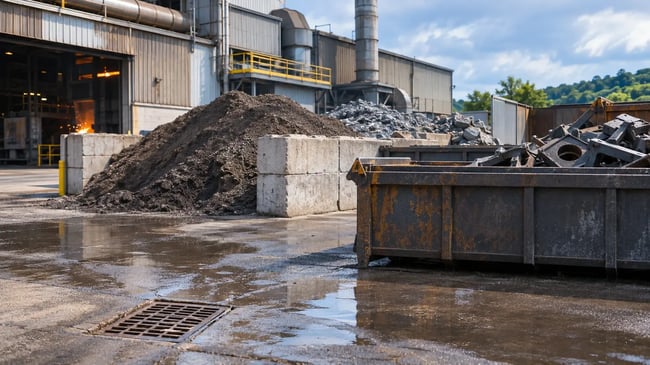
Casting is a dirty business in the plain sense of the word. Sand gets mixed, poured, shaken out, and recycled, metal gets melted from scrap and pig iron, and slag and spent refractory come off the furnaces. Most of that material starts life outside or passes through the yard on its way somewhere, and rain doesn't care whether a pile is a product, a byproduct, or a waste. The table below shows the usual suspects and what tends to work for each. These are common practices, not permit text, and your own PPC Plan should be built around what you have on site.
| Foundry source |
What runoff can carry |
What tends to work |
| New and used sand piles |
Fine solids, clay, and binder residue |
Covered bins or storage under roof, berms around the pile, and a clean pad |
| Slag and refractory |
Solids and metals, including iron |
Contained roll-offs or bays, and prompt removal |
| Scrap, returns, and alloy storage |
Rust, iron, oils from coatings or cutting fluids, and alloy metals |
Keeping scrap off bare ground, covering the most oily material, and drip pans where needed |
| Yards, roofs, and truck routes |
Settled dust and tracked material |
A sweeping schedule and inlet protection where drains pick up the load |
| Fueling, maintenance, and equipment areas |
Oil and grease |
Cover, curbing, spill kits, and dry cleanup |
Which metals show up depends heavily on what you pour. An iron foundry's runoff is mostly an iron and suspended solids story. A brass or bronze foundry can add copper, zinc, and lead to the mix, and PAG-03 lets DEP require monitoring for additional pollutants beyond the appendix list if it says so in the letter that authorizes your coverage. Our article on iron in stormwater monitoring explains why iron results can look high even when a site is run well, and our overview of stormwater best management practices covers the controls in the right-hand column in more depth.
How Does Used Foundry Sand Connect Stormwater and Pennsylvania Residual Waste Rules?
Molding sand gets reused many times, but eventually it breaks down and has to leave the system. In Pennsylvania, that used sand is generally managed as residual waste, which is DEP's term for non-hazardous industrial waste, under 25 Pa. Code Chapters 287 through 299, unless an approved beneficial use applies. Chapter 299 covers storage and transportation of residual waste, so how long a pile sits and where it sits can be a waste question as well as a stormwater question. DEP also publishes residual waste beneficial use general permits for foundry materials. WMGR019 covers waste foundry sand, system dust, and some slag and refractory for uses such as roadway construction material and as an ingredient in concrete or asphalt products, and WMGR098 covers waste foundry sand and sand system dusts with its own conditions. Both come with chemical concentration limits and testing requirements, so sand has to be sampled and shown to qualify before it goes out the gate.
The stormwater side is simpler to state. Whatever route your sand takes, the pile sitting at your site is an exposed material under PAG-03, and rain running over it can carry fine solids to your outfall. PAG-03 also speaks to the waste side directly: solids you collect while controlling stormwater, such as yard sweepings, basin sediment, and inlet filter material, have to be handled under the state's residual waste and other waste rules, and you're responsible for making sure any contractor hauling them has the permits to do it. Put another way, the waste rules govern where sand goes and how it's stored, and the stormwater permit governs what leaves your pad with the rain. A covered, contained sand pile helps with both.
If you clean out a settling basin or catch basin at a foundry, find out how that material is classified before it goes on a truck. Sediment from a foundry yard can carry the same metals and binder residue as the sand and dust that created it, and the answer isn't always the same as it would be for a basin at a warehouse.
How Does Dust From Foundry Stacks and Roofs End Up in Stormwater?
Melting, pouring, shakeout, and sand handling all throw off fine particulate. Dust collectors and baghouses catch most of it, but whatever escapes through stacks, roof vents, and open doors settles on the nearest surfaces, which are usually roofs, parking areas, and the yard. The next storm washes that film into inlets and downspouts, where it shows up as suspended solids and metals in your discharge. Roof runoff is easy to overlook because nobody stores anything up there, yet the roof of an older foundry can be a meaningful source of solids and metals in your discharge. Controlling the stack itself is an air quality question, and this article stays with what happens after the dust lands.
PAG-03 gives you a few places to deal with it. Its good housekeeping section requires a routine cleaning and maintenance program for impervious areas where particulate matter, dust, or debris can accumulate, which for a foundry means a real sweeping schedule and not a once-a-year cleanup. The annual report has to evaluate whether materials are being tracked or blown from areas of no exposure into exposed areas, which is exactly what stack and roof-vent dust does. That second point comes into play if you're hoping to designate an outfall as a no exposure outfall, because dust settling outdoors can undercut the claim. A walk through the site during a storm tells you more than any drawing, and our guide to the stormwater visual inspection covers what to look for at downspouts, inlets, and outfalls.
What Does PAG-03 Appendix B Require for Foundry Stormwater Monitoring?
Appendix B calls for sampling at your representative outfalls once every six months, in the January through June and July through December periods. A representative outfall is one that you or DEP select to stand for other outfalls whose drainage areas are substantially the same. The parameters under Appendix B include the ones in the table below. Read the appendix in your own coverage for the full list, because DEP can add parameters for a specific site and permit editions change.
| Parameter |
How often |
Benchmark value |
| Total nitrogen (TKN plus nitrate-nitrite, calculated) |
Every 6 months |
None |
| Total phosphorus |
Every 6 months |
None |
| Total suspended solids (TSS) |
Every 6 months |
100 mg/L |
| Total iron |
Every 6 months |
None |
| Oil and grease |
Every 6 months |
30 mg/L |
Samples are grabs, taken during a storm of more than 0.1 inch that follows at least 72 hours after the last measurable storm, and collected within the first 30 minutes of the discharge when possible. Results go to DEP through the eDMR system within 28 days after each period ends, and our guide to Pennsylvania eDMR reporting walks through the system. Our article on PAG-03 sampling covers the collection side. The permit also bars sheen, floating solids, and foam in your discharge no matter what your lab results say.
What Happens If a Foundry Exceeds a Benchmark Value?
Benchmark values aren't effluent limits, so a high result by itself isn't a permit violation. They're the yardstick DEP uses to judge whether your controls are working. If a pollutant exceeds its benchmark at the same outfall for two consecutive monitoring periods, you owe DEP a corrective action plan within 90 days of the end of the period that triggered it. After four consecutive exceedances, the plan has to come with DEP's Stormwater BMPs Checklist, showing which additional controls you've put in place or why a given control doesn't fit your site. Continued exceedances can lead DEP to require an individual permit. Our articles on benchmark values versus effluent limits and what to do when sampling results are high go deeper on both.
Sampling is only part of the work. PAG-03 also requires visual inspections of exposed areas, outfalls, and controls at least twice a year, with one of them during a qualifying storm each calendar year. You'll need a PPC Plan, which stands for Preparedness, Prevention, and Contingency Plan and is DEP's version of a site-specific stormwater and spill plan, reviewed at least annually. Employees have to be trained on it at least once a year, an annual report is due each March 23, and DEP's annual permit fee is $500. We compare the plan formats in our article on PPC Plans versus SWPPPs, and our online training library is one way to handle the annual training requirement. If you're wondering what an inspector looks for, see what happens during a PA DEP stormwater inspection.
How Much Does PAG-03 Coverage Cost for a Foundry?
DEP's own fees are modest. PAG-03 coverage carries a $500 application fee and a $500 annual fee. The real cost is the work behind the application, which means a site evaluation, drainage and outfall mapping, a PPC Plan, and the NOI package, and then the sampling, reporting, and upkeep that follow. For a relatively straightforward facility, we typically see professional help with the full application run about $5,000 to $10,000, with ongoing compliance support of roughly $3,000 to $6,000 per year. A foundry usually isn't the straightforward case. Multiple drainage areas, sand and slag yards, older infrastructure, and process water questions all add time, so expect to land above the low end.
Several things move the number: how many outfalls you have, how much of the yard is exposed, whether a stormwater or PPC plan already exists, how much help you want with sampling and eDMR, and whether a process water permit complicates the picture. We break down the pieces in our article on PAG-03 permit costs, and if you have the in-house staff to take on some of the work, getting a PAG-03 permit yourself explains which parts most facilities can handle on their own. For a number tied to your own site, the pricing calculator below gives an instant estimate for RMA's help, with no email and no sales call.
How Can RMA Help Pennsylvania Foundries With Stormwater Permits?
We work with Pennsylvania facilities all the time, and foundries are the kind of site where a walk-through pays off. We start by figuring out which path fits: PAG-03, a No Exposure Certification, or an individual permit. From there we can help map your drainage areas and outfalls, sort out where the sand, slag, scrap, and dust are in relation to them, build the PPC Plan, prepare the NOI, and set up your sampling and eDMR reporting. If you're already covered and getting benchmark exceedances, we can help you work out a corrective action plan that fits how your plant runs.
We'll also tell you when you don't need us. If everything at your plant really is under roof, a No Exposure Certification may be all you need, and you may be able to handle that yourself. If your site drains entirely to a sewer authority, we'll say that too. One more boundary: if you're expanding with a new building, pad, or paving, the construction-phase stormwater and erosion control approvals are a separate set of requirements, and those are not something RMA prepares. Your engineer or contractor handles that piece. Once the new area is running, the operating permits and plans are where we help, and we can point you toward the right construction people if you need a referral.
There's no pressure and no obligation. You can call us, email us, or fill out the form on our website and tell us a little about your plant. If you want a second set of eyes on your foundry's stormwater situation, contact RMA and we'll help you figure out the right next step.