How PAG-03, Appendix L, and No Exposure Certification Apply to Bus Yards Run by School Districts, Municipalities, and Private Contractors
If you run student transportation for a Pennsylvania school district, or you hold the contract that does, an industrial stormwater permit probably isn't something you've ever had to think about. Buses go out in the morning, come back in the afternoon, and the garage keeps them running. Then a contract renewal, a letter from DEP, or a question from the district's solicitor asks whether the bus yard has stormwater coverage, and nobody on the team knows the answer. The short version is that it depends on what happens in the yard. A lot that only holds parked buses usually doesn't need a permit, while a garage that repairs, fuels, or washes buses outdoors usually does.
This article walks through which parts of a bus yard Pennsylvania treats as industrial, when a garage can skip the permit or file a lighter-weight certification instead, what coverage asks of you, and how things work when a school district or municipality owns the building. If you'd rather talk through your own yard, you're welcome to reach out to RMA any time, and we'll tell you plainly if you don't need us.
Table of Contents
TL;DR
Pennsylvania doesn't require a stormwater permit just because a property holds school buses. A garage usually needs one when buses are repaired, fueled, or washed outdoors, or when oil and parts sit outside in the rain, and most of those garages get coverage through DEP's standard industrial stormwater permit. A garage that does all of that work indoors may qualify for a No Exposure Certification, which is a filing that says rain never touches the industrial activity, and a yard that only parks buses often needs nothing at all. Public ownership doesn't change the rules, and discharging to a high-quality stream can rule out both the standard permit and the certification.
Does a Pennsylvania School Bus Garage Need a Stormwater Permit?
Stormwater is the rain and snowmelt that runs across your property. Under the federal Clean Water Act, runoff from certain industrial areas counts as a discharge to nearby waters, and discharges need a permit under the National Pollutant Discharge Elimination System, or NPDES. In Pennsylvania, the Department of Environmental Protection (DEP) runs that program. Most industrial sites that need coverage get it through PAG-03, DEP's general permit for stormwater associated with industrial activity. A general permit is a standard permit that covers a whole category of facilities, so you apply for coverage under it instead of getting a custom permit written for your site.
School bus service falls under SIC code 4151. A SIC code (Standard Industrial Classification code) is the four-digit number that sorts businesses by what they do, and DEP uses it to decide which section of PAG-03 applies to you. The federal rule for transportation facilities is narrow. It reaches only the parts of a facility used for vehicle maintenance, which the rule defines to include mechanical repairs, painting, fueling, and lubrication, and for equipment cleaning. DEP's own permit fact sheets show school bus garages placed under Appendix L of PAG-03, the section for land transportation, so this isn't a hypothetical. For the broader picture across all industries, our guide on who needs a stormwater permit covers the basics.
Which Parts of a Bus Yard Trigger Stormwater Permit Coverage?
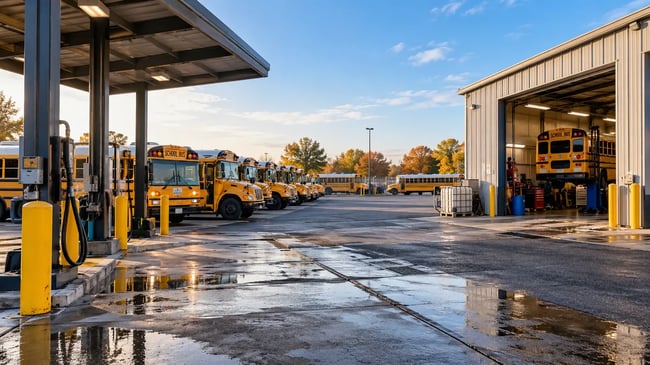
Think of a bus yard as a set of separate areas. The question for each one is whether oil, fuel, solvents, or wash water can touch the ground outdoors and then meet rain or snowmelt on the way to a storm drain or stream.
| Area of the bus yard |
What can reach the runoff |
Does it usually count as industrial? |
| Outdoor oil changes, fluid top-offs, and repairs |
Oil, coolant, grease, and solvents |
Yes |
| Fueling island or mobile fueling truck |
Drips, spills, and overfills |
Yes |
| Outdoor bus washing |
Soap, road grime, oil and grease |
Yes, and the wash water raises its own issues (see below) |
| Used oil, batteries, tires, filters, and parts stored outside |
Leaks and residue washed off by rain |
Yes |
| Lot where buses wait for repairs |
Drips from buses with active leaks |
Often treated as part of the maintenance area |
| Buses parked overnight with no maintenance on site |
Minor drips from well-maintained vehicles |
Usually not |
| Office, driver parking, and landscaping |
Ordinary parking lot runoff |
No, as long as it doesn't mix with runoff from the areas above |
Two details trip people up. A lot where buses wait for repairs can count as part of the maintenance activity, so a bus with a steady oil leak in the back corner isn't automatically outside the rule. And mobile fueling counts the same as a fixed fueling island. If a truck pulls up to the line of buses each afternoon and tops them off outdoors, the ground under those buses is a fueling area.
When Can a School Bus Garage Skip a Pennsylvania Stormwater Permit?
Plenty of bus yards don't need coverage. If a contractor parks buses on a lot with no maintenance bay, no fueling, no washing, and no outdoor storage of fluids or parts, nothing in that yard counts as industrial under the transportation rule. The same goes for a yard where all repairs happen at a separate shop across town. In that case the shop carries the permit question, and the parking lot doesn't.
A few cautions apply even when the answer looks like no. DEP keeps the authority to require a permit for a discharge that's contributing to a water quality problem. The answer can also change quietly, because a district that starts topping off fluids in the yard, or adds an outdoor wash pad, has changed it without filing anything. And townships, boroughs, and sewer authorities can have their own stormwater rules and fees on top of DEP's, so confirm locally before you assume you're done. If you can't tell which side of the line your yard sits on, a short review of the work done outdoors usually settles it, and we'd rather tell you that you don't need a permit than sell you one.
How Does a No Exposure Certification Work for a School Bus Garage?
A No Exposure Certification is DEP's option for facilities in a regulated category that keep every industrial material and activity under a storm-resistant shelter. Instead of getting permit coverage, you certify that rain, snow, and runoff never touch the industrial activity, and DEP approves the certification. For a bus garage, the candidate is a facility where oil changes, repairs, parts storage, used oil and battery storage, and washing all happen inside, and nothing leaks onto the outdoor pavement. Our guide on what No Exposure means under an NPDES stormwater permit covers the general idea.
In Pennsylvania, you request the certification by submitting the PAG-03 Notice of Intent (the application form for coverage), checking the No Exposure Certification box, and attaching DEP's separate certification form. Existing facilities are also asked to collect at least one stormwater sample to back up the claim. The certification renews every five years, you agree to let DEP inspect, and you sign under penalty of law. DEP's instructions note that submitting the paperwork doesn't guarantee approval. If operations change so that materials or activities become exposed, the certification no longer protects you, and you need permit coverage before the change happens.
Buses themselves are the gray area. Federal rules let certain adequately maintained vehicles used in material handling stay outdoors, but buses parked in a yard aren't mentioned directly. Whether outdoor-parked buses fit depends on how DEP reads your site and how well those buses are maintained, and a leaking bus parked outside can defeat the certification. Talk it through with DEP or someone who knows the program before you sign, because the signature is a legal statement about your site. The certification also isn't available to a property that discharges directly to High Quality or Exceptional Value waters, which we cover below. For a side-by-side look at the options, see our guide to which NPDES permit you need.
What Does PAG-03 Appendix L Require at a School Bus Garage?
If your garage does outdoor maintenance, fueling, or washing and discharges to ordinary waters, PAG-03 is the usual path. The permit has general sections that apply to every facility, plus sector appendices, and school bus operations land in Appendix L, which covers land transportation and petroleum stations and terminals. The current PAG-03 took effect March 24, 2023, and runs through March 23, 2028, and DEP can change requirements each time it reissues the permit.
PPC Plan and Best Management Practices for Bus Garages
Coverage starts with a Notice of Intent filed with DEP, and for most facilities it includes a PPC Plan. PPC stands for Preparedness, Prevention and Contingency, and the plan is a written document that maps your site, lists the activities and materials that could reach stormwater, and lays out how you'll prevent spills and respond to one. Our comparison of SWPPPs and PPC Plans under PAG-03 explains how Pennsylvania's version differs from what other states call a stormwater plan.
Appendix L also sets out best management practices, usually shortened to BMPs, which are the physical and procedural controls that keep pollutants out of runoff. For a bus garage, the permit language points to doing vehicle cleaning indoors, under cover, or in bermed areas, storing leaky vehicles indoors or using drip pans and absorbents, and keeping oils, hydraulic fluids, and lubricants indoors or under a storm-resistant structure. For fueling, it points to covering the area, using spill and overflow protection, and using dry cleanup methods. Our overview of stormwater BMPs shows how these controls work on the ground.
Sampling, Benchmarks, and Reporting Under PAG-03
Once you're covered, you collect stormwater samples, usually twice a year, and send them to a lab. DEP's fact sheets for bus facilities describe semiannual monitoring for total nitrogen, total phosphorus, total suspended solids (the dirt and fine particles carried in runoff), and oil and grease. Appendix L has carried a benchmark value of 30 mg/L for oil and grease. A benchmark isn't a legal limit, and going over it isn't a violation by itself, but the permit expects you to respond. After two consecutive benchmark exceedances, you have to develop a Corrective Action Plan and submit it to DEP within 90 days of the end of the monitoring period that triggered it. Our guide on benchmark values versus effluent limits explains the difference, and our PAG-03 sampling guide covers how to collect samples correctly.
Results go to DEP through its electronic Discharge Monitoring Report system, called eDMR. You'll also file an annual report, pay an annual fee, run routine inspections, train the staff who do the work, and keep records. Our guide to Pennsylvania eDMR reporting walks through the system, and our article on what happens during a PA DEP stormwater inspection helps your team know what to expect.
Do Wash Bays, Sewers, and Special Waters Change the Stormwater Permit Answer?
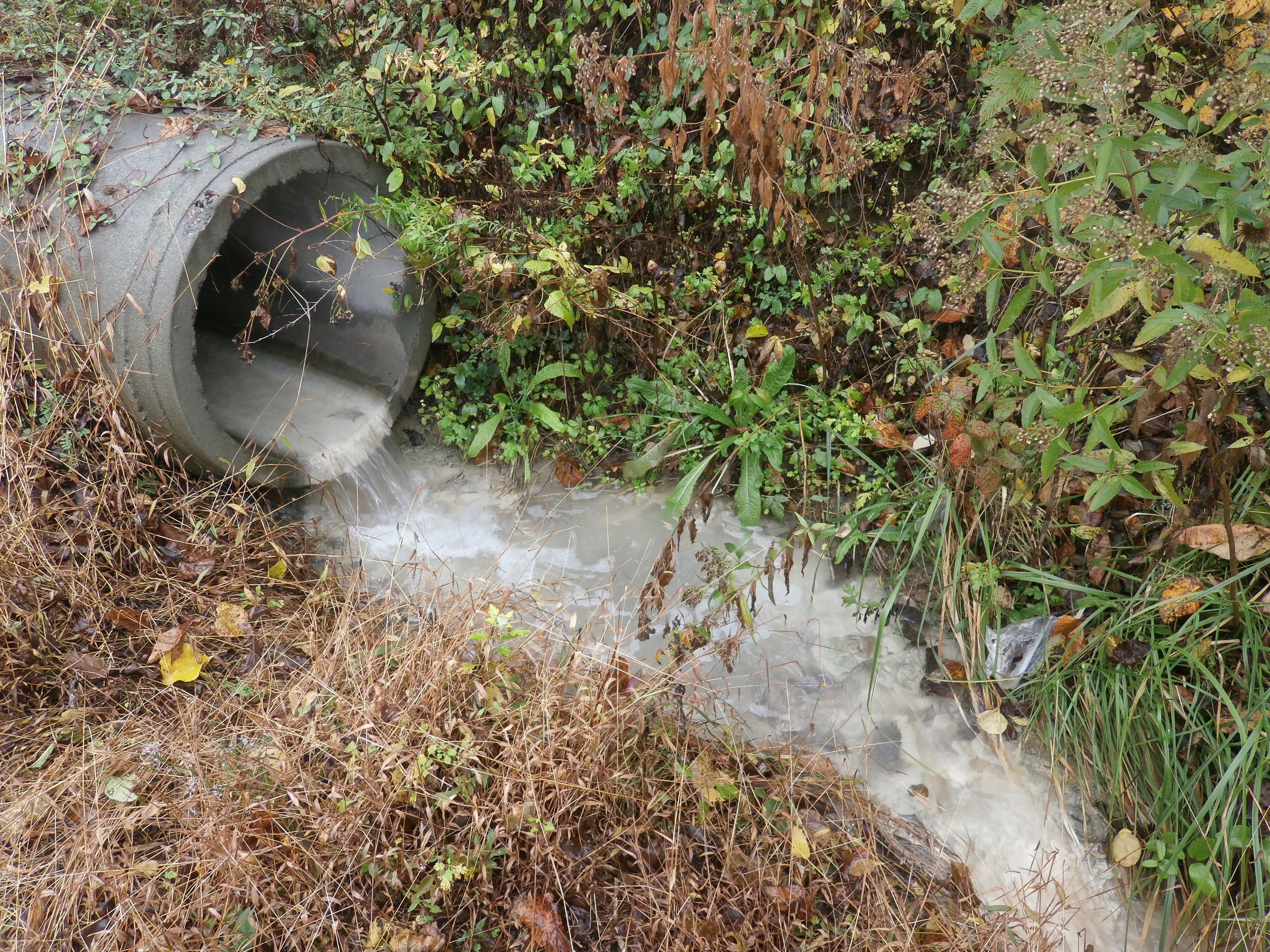
Three site conditions can change which path you're on. The first is wash water, which isn't stormwater and is regulated differently. If a wash bay or outdoor wash pad drains to a storm drain, that's an unauthorized non-stormwater discharge, and a stormwater permit doesn't fix it. Wash water usually has to go to a sanitary sewer with the sewer authority's approval, or be collected, treated, and recycled. In one DEP fact sheet we reviewed, a charter bus operation's wash water led DEP to cover both the wash water and the stormwater in a single individual industrial permit. Our article on the difference between stormwater and process water explains the line.
The second is where your runoff goes. PAG-03 is built for discharges to streams and to storm sewers that lead to them. If your site drains to a combined sewer, which carries stormwater and sanitary sewage together to a treatment plant, the sewer authority's rules may govern instead of a DEP stormwater permit. Local rules and fees differ from place to place, so we'd never say flatly that a garage in a given city does or doesn't need PAG-03 without looking at its drainage.
The third is the stream itself. Pennsylvania classifies some waters as High Quality (HQ) or Exceptional Value (EV) under 25 Pa. Code Chapter 93, and DEP generally can't approve PAG-03 coverage or a No Exposure Certification for a facility that discharges directly to them. Those facilities need an individual NPDES permit, which is written for one site and takes more work to prepare and review. DEP's fact sheets include a school bus maintenance facility sent down the individual permit path for exactly this reason, so we check the receiving stream at the start of every Pennsylvania job.
Do School District and Municipal Bus Garages Follow the Same Stormwater Rules?
Generally, yes. The federal definition of industrial activity explicitly includes facilities owned or operated by federal, state, or municipal entities, so a bus garage doesn't get a pass because a public body runs it. The activity on the ground decides the question, and a district garage that changes oil and fuels buses outdoors raises the same issues as a contractor's.
Classification can look different for public garages. Under the federal SIC manual, school bus operations run by educational institutions are treated as auxiliaries of the school rather than a standalone bus business, which could put a district garage under a different code than a contractor's yard. DEP's PAG-03 materials say the department can require a facility to follow an appendix when the activities are similar, so a different code on paper isn't a reason to assume you're exempt.
Ownership gets more tangled when a district owns the land and building and a private contractor runs the buses. Sort out responsibility in writing before you file anything. The contract should say who applies for coverage, who samples and files the reports, who pays the annual fee, who answers DEP, and what happens to the permit when the contract ends. Coverage doesn't move automatically with the operator, since DEP handles a change of operator through a transfer. Districts and municipalities may also hold a Municipal Separate Storm Sewer System (MS4) permit, a separate DEP program covering the storm sewer system itself. It doesn't by itself settle whether a bus garage needs industrial coverage, so raise it with DEP early.
How Much Does Stormwater Permit Coverage Cost for a Pennsylvania Bus Garage?
The state fees are small next to the work behind them. DEP charges a $500 application fee for PAG-03 coverage and a $500 annual fee after that. The larger cost is preparing what the permit requires, including the site evaluation, the drainage map, the PPC Plan, the sampling, and the application package. For a relatively straightforward facility, professional help with the full PAG-03 application typically runs about $5,000 to $10,000, and ongoing compliance support often runs about $3,000 to $6,000 per year. An individual permit costs considerably more because the application is more involved. A No Exposure Certification usually asks for less ongoing work, since there's no twice-a-year sampling and reporting cycle, though we'd price it from your site rather than quote a number sight unseen.
The number of outfalls (the pipes or ditches where runoff leaves your property), the size of the site, how much outdoor work happens, and whether you already have a maintained plan all move the price. Our articles on how much a PAG-03 permit costs in Pennsylvania and how long PAG-03 coverage takes go through the factors. The pricing calculator below gives you an estimate of what RMA's help would cost for your facility, with no email and no sales call required.
How Does RMA Help Pennsylvania School Bus Garages With Stormwater Permits?
We work with Pennsylvania facilities all the time, and the first thing we do with a bus garage is figure out which path you're on: PAG-03 coverage, an individual permit, a No Exposure Certification, or nothing at all. If your yard only parks buses, we'll tell you that. If you do need coverage, we walk the site, map the drainage, check the receiving stream, write the PPC Plan, coordinate the sampling, prepare the Notice of Intent, and stay with the application through DEP's review. After that, we can handle sampling, eDMR reporting, annual reports, and plan updates, and we can train your drivers and mechanics through our online environmental training library. If you're weighing whether to try the application yourself, our article on getting a PAG-03 permit yourself lays out what that involves.
There's no pressure and no obligation. You can call us at 888-RMA-0230, send an email, or fill out the form on our website, and tell us what's happening at your garage. If it looks like we're a good fit, we'll explain the next steps. If you're ready to talk, contact RMA and we'll point you in the right direction either way.