How PA DEP Treats Bakeries and Snack Plants Under Its Industrial Stormwater Rules, and When No Exposure Can Replace a PAG-03 Permit
If you run a bakery or a snack food plant in Pennsylvania, you've probably spent more time worrying about food safety audits than runoff. The ovens, fryers, mixers, and packaging lines are all indoors, so a stormwater permit can feel like something meant for quarries and scrapyards. The Pennsylvania Department of Environmental Protection (PA DEP) sees it differently. Food manufacturing is one of the industrial categories on its list, which means a plant like yours generally has to do one of two things: take coverage under a general stormwater permit called PAG-03, or file a No Exposure Certification showing that nothing industrial is exposed to rain or snowmelt. Plants that keep their work inside can usually aim for the second option, and the ones that struggle with it tend to trip over the same handful of outdoor items.
This article walks through how to tell whether your plant is covered, what No Exposure means in practice, the spots where bakeries and snack plants usually have exposure (frying oil, waste grease, dumpsters, flour dust, and loading docks), the fixes that tend to work, and what PAG-03 looks like if you can't get there. We're keeping it to stormwater, since that's where this question lives. If you'd like someone to walk your plant with you, you can reach out to RMA any time, and if you'd rather work through it yourself, everything below should give you a solid start.
Table of Contents
TL;DR
Yes, in most cases. Snack food and bakery plants are a covered category in Pennsylvania, so each one needs either coverage under a general industrial stormwater permit called PAG-03 or a No Exposure Certification from PA DEP. Plants that keep everything indoors or under roof, with sealed oil storage, covered dumpsters, controlled flour dust, and roofed loading docks, can often qualify for No Exposure, and DEP's fee for it is $500 every five years. Plants that can't qualify go on PAG-03, which adds twice-a-year sampling, a written plan, annual reporting, and yearly fees. Which path fits depends on what's sitting outside your building and which stream your runoff reaches.
What Does Pennsylvania Require From Snack Food and Bakery Plants for Stormwater?
Pennsylvania runs the federal stormwater program, called NPDES (the National Pollutant Discharge Elimination System), through PA DEP. Under that program, facilities in a list of industrial categories have to deal with the rain and snowmelt that runs off their property. A facility on the list has two main routes. It can take coverage under PAG-03, the general permit DEP wrote for industrial stormwater, or it can file a No Exposure Certification, which is DEP's way of confirming that your industrial materials and activities are protected from rain and snow, so there's nothing for stormwater to pick up. A third route, an individual NPDES permit, applies to plants that can't use PAG-03, and the most common reason is the stream the water ends up in.
Bakeries and snack plants sit in the food and kindred products category, which PAG-03 handles in its Appendix I. The practical result is that a plant doesn't get to skip the question just because the ovens, fryers, and packaging lines are indoors. If your main business is on DEP's list, you file for one route or the other. A plant that keeps everything under roof can file for No Exposure and skip most of the ongoing sampling and reporting that come with PAG-03. A plant with a few outdoor pieces either fixes them first or takes PAG-03 coverage. All of that assumes your stormwater runs to a stream or a storm sewer rather than a sewage treatment plant, which we cover in a later section. Our broader guide on which Pennsylvania stormwater permit you need covers the decision for any industry, and this article stays focused on food plants.
Which SIC Codes Put Bakery and Snack Plants Under Pennsylvania Stormwater Rules?
DEP decides who's covered using SIC codes. A Standard Industrial Classification (SIC) code is a four-digit number describing a facility's main line of business, and DEP's list of covered activities comes straight from the federal stormwater rules. For food plants, Appendix I of PAG-03 covers bakery products (2051 through 2053) and a miscellaneous food category (2091 through 2099) that includes potato chips and similar snacks. These are the codes most bakery and snack plants carry.
| SIC Code |
What the Code Covers |
| 2051 |
Bread, cake, and related products |
| 2052 |
Cookies and crackers |
| 2053 |
Frozen bakery products, except bread |
| 2096 |
Potato chips and similar snacks |
Other codes in the 2091 through 2099 range cover related food preparations, so check yours if you make something that doesn't fit neatly into one of those four. If you only know your NAICS code (the newer classification system most businesses use today), DEP's FAQ points to the Census Bureau's crosswalk between NAICS and SIC codes.
If your plant does more than one thing, DEP says the primary code is the one tied to the activity that brings in the most revenue on site. A plant that makes snacks and also runs a large on-site warehouse usually carries the manufacturing code as its primary, and the warehouse is treated as a secondary activity. One more point on coverage: Pennsylvania's Clean Streams Law lets DEP require permit coverage from a facility that isn't on the list if it finds pollutants in that facility's stormwater, so being off the list isn't a guarantee. Our explainer on stormwater associated with industrial activity covers how regulators decide which parts of a site count.
What Does No Exposure Certification Mean for a Food Manufacturing Plant?
No Exposure doesn't mean your site looks clean or that you've never seen dirty runoff. It means every industrial material and activity is stored or carried out indoors or under a storm-resistant shelter. DEP describes a shelter as a fully roofed and walled building, or a roof with open sides as long as stormwater can't flow through it and wind-blown rain can't run out from under it (a curb or berm usually handles that). Tarps are accepted only as a temporary measure, so a tarp over a permanent installation won't get you there.
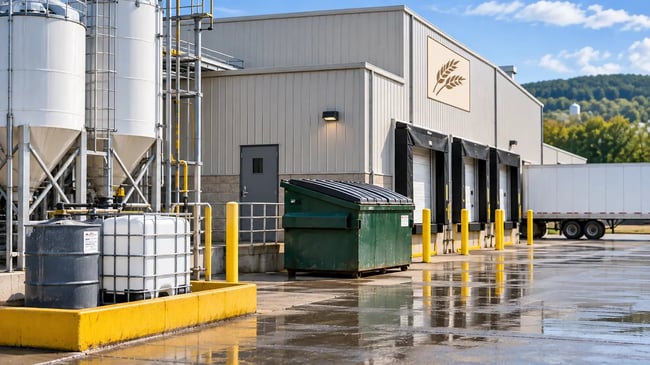
A few things can stay outside without a shelter. Tightly sealed drums, barrels, and tanks qualify if they aren't deteriorated and don't leak, and "sealed" means banded or otherwise secured, with no operational taps or valves. Dumpsters and roll-off boxes qualify if they're covered, in good condition, and not allowed to drain or leak. Well-maintained vehicles used for material handling are fine, and so are final products that wouldn't wash away in stormwater. Wooden pallets in good condition are generally fine too. The test applies to the whole facility, because DEP won't approve No Exposure for only part of a site, so one uncovered area can sink the certification for the entire plant.
No Exposure isn't available if your plant discharges to a stream DEP classifies as High Quality or Exceptional Value under Chapter 93 of the Pennsylvania Code. Those plants need an individual permit instead, and DEP says individual permits for them carry limited or no stormwater monitoring. The application package includes the No Exposure form, the PAG-03 Notice of Intent form, maps of the site and its drainage, a General Information Form for new applicants, a PPC Plan (Preparedness, Prevention, and Contingency Plan) where it applies, proof that you've notified your municipality if you discharge to its storm sewer system, and lab results if you're an existing facility. DEP's fee is $500 every five years, with no annual fee, and you renew at least 180 days before the certification expires.
Approval isn't automatic, and DEP can inspect your plant to confirm the conditions and make those inspection reports available to the public. If something changes and exposure shows up, you have to tell DEP right away and apply for permit coverage. Our article on what No Exposure means under an NPDES stormwater permit goes further into the general rules.
Where Do Snack Food and Bakery Plants Usually Have Stormwater Exposure?
The same handful of outdoor items come up again and again at bakeries and snack plants. The easiest way to find yours is to walk the outside of the plant during or right after a rain and ask three questions: what's out here, what's touching it, and where does the water go? This table covers the usual suspects.
| Spot on the Property |
Why It Counts as Exposure |
What Usually Fixes It |
| Frying oil and waste grease storage |
Outdoor tanks, totes, and used oil bins can leak, drip at the fill point, or overflow while being pumped. A tote with a working spigot isn't sealed. |
Sealed containers with no operational taps or valves, or moving storage and fill points indoors or under roof. |
| Dumpsters and compactors for food waste |
Wet food waste produces liquid that drains out, and open lids let rain in. |
Covered dumpsters in good condition that don't drain, or placing dumpsters and compactors under roof. |
| Flour, sugar, and ingredient dust |
Dust from silo fills, dust collectors, and roof vents can settle on pavement or the roof and wash into storm inlets. |
Sealed fill connections, maintained dust collectors, dry sweeping, and clean roofs. |
| Loading docks and trailer staging |
Ingredients, totes, and product handled in the open can spill or sit in the rain. |
Roofed docks or dock seals, staging inside the building, and quick spill cleanup. |
| Fryer exhaust and rooftop vents |
Visible grease or crumb deposits from stacks and vents count when they show up in the runoff and the vent isn't covered by an air permit. |
Maintained hoods and filters, and a clean roof. |
| Washing areas for racks, totes, and trucks |
Rinse water carrying food residue or grease to a storm drain is process wastewater, not stormwater. |
Washing indoors and sending the water to the sanitary sewer under local pretreatment rules. DEP says vehicle wash areas must be indoors. |
| Outdoor staging of ingredients, returns, or waste product |
Pallets of bagged ingredients, rejected product, and waste ingredients left outside are industrial materials. |
Moving them inside or under roof. Wooden pallets in good condition are generally fine. |
Washing deserves a careful look because stormwater and process water get treated very differently. Our explainer on the difference between stormwater and process water walks through it. Housekeeping belongs on this list too. Spilled material left on the ground or in a storm inlet counts as exposure even when the spill came from something that's otherwise indoors or sealed, so a plant with spotless oil storage and a greasy dock apron can still fail.
Which Fixes Can Get a Snack or Bakery Plant to No Exposure?
The cheapest fix is usually the one that removes the outdoor activity instead of building something over it. Here's how we'd think about the three biggest problem areas.
How Do You Handle Frying Oil and Waste Grease Storage?
Outdoor oil storage can qualify if the tank or tote is sealed, in good condition, and has no operational tap or valve. That rules out many of the totes and used oil bins plants use day to day, since most are built to be tapped. A plant that wants to keep oil outside can switch to sealed containers, and one that wants a cleaner answer can move storage indoors. The transfer deserves as much attention as the container. Pumping used oil from the fryer to an outdoor bin, or from a delivery truck into a tank, is material handling, and any drips at the connection are exposure. Putting the fill point under roof, or moving the transfer indoors, takes care of it, and keeping absorbent and a spill routine at that spot protects you from residue reaching a storm inlet.
How Should Dumpsters and Compactors for Food Waste Be Handled?
For dumpsters, DEP's standard is covered, in good condition, and not allowed to drain or leak. A dumpster without a lid doesn't qualify unless it sits under a storm-resistant shelter, and a flexible cover like a tarp is acceptable only on temporary installations such as a dumpster. Compactors are the harder call because they're built to squeeze liquid out of wet waste. If one weeps liquid onto the pad, it fails the "not allowed to drain or leak" test, so the usual fixes are putting the compactor under roof or indoors, or switching to a design that holds its liquid.
What About Flour Dust and Loading Docks?
Dust gets missed because flour doesn't look like a pollutant. DEP's No Exposure program rests on the federal rule at 40 CFR 122.26(g), and EPA's No Exposure checklist under that rule lists particulate matter and visible deposits from roof stacks and vents that show up in stormwater runoff, unless they're regulated under an air permit. The fix starts at the source: sealed silo fill connections, dust collectors that are maintained, dry sweeping instead of hosing down the pad, and clean roofs. Loading docks follow the same logic. A roofed dock, dock seals, and staging inside the building keep ingredients and product out of the rain, and well-maintained trailers and vehicles don't count against you. Outdoor ingredient staging that has crept out over the years is worth a second look, since it's often the easiest thing to move inside.
Some of these fixes are building projects, like roofing a dock, enclosing a compactor pad, or moving a tank indoors. Those can bring township approvals and, depending on how much ground gets disturbed, construction stormwater and erosion control requirements. RMA doesn't prepare construction-phase permits or approvals, so that piece usually runs through your engineer or contractor. What we do is help you decide which fixes get you to No Exposure, so the construction budget goes to the right things, and point you toward the right construction-phase professionals. Once the plant is running, we help with the operational side: the certification or PAG-03 coverage, the plans, and the sampling and reporting that follow.
What Does PAG-03 Coverage Look Like if a Snack or Bakery Plant Can't Get No Exposure?
If the outdoor pieces can't be fixed at a reasonable cost, PAG-03 is the next stop for most plants. A plant on a High Quality or Exceptional Value stream is the exception, since PAG-03 isn't available there either and an individual permit applies. You submit a Notice of Intent (NOI) to DEP along with a site map, a PPC Plan that covers your outdoor materials and the controls you use, and the sampling information DEP asks for. DEP charges a $500 filing fee and a $500 annual fee after that. Once you're covered, the permit sets ongoing duties: best management practices (BMPs, the housekeeping and control measures that keep pollutants out of runoff), inspections, sampling, electronic reporting through DEP's eDMR system, and an annual report. The annual report and the annual fee are both due March 23 each year, starting after your first full year of coverage. The current PAG-03 runs through March 23, 2028.
The two paths differ in more than paperwork, so here's a side-by-side look.
| |
No Exposure Certification |
PAG-03 Coverage |
| What it requires |
All industrial materials and activities indoors or under shelter |
Outdoor activity allowed, with controls in place |
| Available on High Quality or Exceptional Value streams |
No |
No |
| DEP fees |
$500 every five years, no annual fee |
$500 to file, plus a $500 annual fee |
| Plan |
PPC Plan where it applies |
PPC Plan |
| Sampling |
Lab results with the application for existing facilities, with no Appendix I monitoring schedule |
Twice a year under Appendix I |
| Ongoing reporting |
Renewal every five years |
eDMR reports and an annual report |
Appendix I is the food and kindred products appendix, and it requires a grab sample (a single sample collected at one moment, rather than over time) from each outfall twice a year. An outfall is the pipe or ditch where stormwater leaves your property, although DEP also treats sheet flow across the ground as a discharge, so having no pipe doesn't excuse you. BOD5 and COD measure how much oxygen the organic material in your runoff would use up, and TSS is total suspended solids, basically the soil and particles in the water. Food residue, sugars, and fryer oil can push all of them up.
| Parameter |
Benchmark Value |
Frequency and Sample Type |
| pH |
9.0 |
Once every six months, grab |
| BOD5 |
30 mg/L |
Once every six months, grab |
| COD |
120 mg/L |
Once every six months, grab |
| TSS |
100 mg/L |
Once every six months, grab |
| Oil and grease |
30 mg/L |
Once every six months, grab |
| Total nitrogen, total phosphorus, and nitrate plus nitrite nitrogen |
None, monitor and report only |
Once every six months, grab |
A storm counts as a sampling event if it drops more than 0.1 inch of rain and comes at least 72 hours after the previous storm. DEP wants the grab sample within the first 30 minutes of the discharge when that's possible, and you report the highest result for each six-month period (January through June and July through December) through eDMR. Our guides on PAG-03 sampling and eDMR reporting walk through both steps.
Benchmarks aren't effluent limits, so a single high result isn't a permit violation. The trigger is a streak. If the same pollutant exceeds its benchmark at the same outfall for two consecutive monitoring periods, you submit a corrective action plan to DEP within 90 days of the end of the period that triggered it, laying out what you'll change to bring the numbers down. After four in a row, you have to consider every additional BMP on DEP's sector checklist, and consistent failure can lead DEP to revoke PAG-03 coverage and require an individual permit. Our articles on benchmark values versus effluent limits and what to do when sampling results are high cover the next steps.
Another path is to take PAG-03 coverage first, fix the outdoor items over the following months, and then request No Exposure. DEP's FAQ allows the annual fee you've already paid to cover the No Exposure fee if you submit the request along with an annual report asking to end PAG-03 coverage and a Notice of Termination form. If DEP denies the No Exposure request, you stay on PAG-03.
Beyond DEP's fees, the real cost is the work: the site evaluation, mapping, PPC Plan, and application package. For a relatively straightforward facility, professional help with the full PAG-03 application typically runs about $5,000 to $10,000, and ongoing compliance support often runs $3,000 to $6,000 per year, depending on the site and how much help you want. For No Exposure, the cost depends on how much needs fixing first and what the lab results show, and we're happy to quote either path. Our guides on what a PAG-03 permit costs and how long coverage takes go deeper. For a quick estimate of what it would cost for RMA to help with your plant, use the pricing calculator below. It's free, with no email, sales call, or obligation.
How Do York, Hanover, and Lancaster Locations Change the Stormwater Answer?
Three local factors tend to decide the answer for plants around York, Hanover, and Lancaster, which all fall under PA DEP's Southcentral Regional Office. The first is the receiving stream. Both No Exposure and PAG-03 are off the table if you discharge to water DEP classifies as High Quality or Exceptional Value, and the classification can come from either the designated use or the existing use DEP determines. Check your stream's designation under Chapter 93 before you plan anything, because the designation follows the specific stream your runoff reaches, not the county you're in.
The second is where the water goes. If your stormwater enters a municipal storm sewer system (called an MS4), you still need coverage or No Exposure, and a No Exposure application includes evidence that you've notified the municipality. Many municipalities in the York and Lancaster areas run MS4 programs, and your township may have its own ordinances or fees on top of DEP's. If your plant's stormwater instead flows into a sanitary or combined sewer that's part of a public sewage treatment plant, DEP's FAQ says permit coverage or No Exposure isn't required, though pretreatment rules apply and the sewer authority needs to know. Local rules differ, so confirm your situation with the municipality or sewer authority before you rely on that.
The third is who else is on the site. Industrial parks house several tenants, and DEP treats each operator's primary activity separately, so a food plant sharing a site may end up as a co-applicant on a shared permit or file its own.
If you've been operating without either No Exposure or PAG-03 coverage, you're far from the only plant in that spot, and the fix is the same paperwork, and DEP's FAQ explains how an existing facility without prior coverage applies. If you've already heard from DEP about a violation or you're facing a penalty, an environmental attorney is worth talking to before you respond. Our walkthrough of what happens during a PA DEP stormwater inspection shows what inspectors look at, which is a good guide for your own walk-through.
How Does RMA Help Snack Food and Bakery Plants With Stormwater Permits?
We work with Pennsylvania facilities all the time, and we're happy to talk through a food plant's situation whether or not it ends in a project. We start by figuring out which route fits, No Exposure, PAG-03, or an individual permit, and we'll tell you straight if the answer is that you can handle the paperwork yourself. If it's PAG-03, we help with the site evaluation, PPC Plan, application, sampling, eDMR reporting, and annual compliance. If No Exposure is within reach, we help you spot what's in the way and prepare the certification when you qualify. Senior staff do the actual work.
If you'd like to try it yourself first, our article on whether you can get a PAG-03 permit yourself lays out what's involved, and our online training library can help your team learn inspections and sampling. When you'd like a second set of eyes, you can call, email, or fill out the form on our website, and we'll look at your plant with no pressure or obligation. Just contact RMA and tell us a little about your operation.