PAG-03, No Exposure Certification, and the Outdoor Exposures at a Food Plant That Decide Which One Applies
If you run a food processing plant in Pennsylvania, you may have assumed stormwater permits are for quarries, scrapyards, and chemical plants. Your production happens indoors, the floors get washed down every shift, and the rain never touches the product. The Pennsylvania Department of Environmental Protection (DEP) looks at it differently. Food and kindred products manufacturing is on the federal list of industries that need either a stormwater discharge permit or a formal exemption called a No Exposure Certification, so most food plants need one or the other, and which one depends on what sits outside the building.
In this article we'll explain how Pennsylvania's industrial stormwater permit, called PAG-03, differs from a No Exposure Certification, walk through the things that typically create outdoor exposure at a food plant, and give you a checklist for a walk around your own site. We'll also cover what sampling looks like if you do need PAG-03 coverage, why plants in the Chesapeake Bay watershed get extra attention on nutrients and organic material, and when it makes sense to reach out to RMA.
Table of Contents
TL;DR
Most Pennsylvania food processing plants need either coverage under PAG-03, the state's industrial stormwater general permit, or a DEP-approved No Exposure Certification. A plant that keeps everything industrial indoors or under a storm-resistant shelter can usually qualify for No Exposure, while uncovered dumpsters, outdoor ingredient or grease storage, dock spills, and outdoor wash areas push it toward PAG-03. PAG-03 for a food plant means semiannual sampling that includes nitrogen and phosphorus, which draw extra attention in the Chesapeake Bay watershed. Where your runoff goes, including sewers and special-protection streams, can change the answer.
Does a Food Processing Plant Need a Stormwater Permit in Pennsylvania?
The short answer is yes, in most cases. Federal stormwater rules list manufacturing categories by Standard Industrial Classification (SIC) code, a four-digit number describing what a facility mainly does. Food and kindred products falls under SIC 20, and DEP says a facility whose primary SIC code is on the list must either get permit coverage or qualify for a No Exposure Certification. Your primary code comes from whichever activity earns the most revenue at the site.
Two terms will come up throughout. NPDES stands for National Pollutant Discharge Elimination System, the federal permit program for discharges to streams and rivers, which DEP runs in Pennsylvania. "Exposure" means industrial materials or activities are out where rain and snowmelt can reach them. A food plant has three paths: coverage under PAG-03, Pennsylvania's general permit for industrial stormwater; an individual NPDES permit if it can't use the general permit; or a No Exposure Certification (NEC) if nothing is exposed. Our guide to whether you need a stormwater permit in Pennsylvania and which one covers all three across industries.
Not every business that handles food falls under SIC 20. A cold storage warehouse or distributor may be classified elsewhere, and DEP says a facility is generally not required to apply when only a secondary SIC code is on the list, though DEP can still require a permit if the runoff carries pollutants.
What's the Difference Between PAG-03 Coverage and a No Exposure Certification for a Food Plant?
PAG-03 is a general permit, so DEP wrote one set of rules for a category of facilities and you sign up by filing a Notice of Intent (NOI). The NOI includes your outfalls (the points where stormwater leaves the site) and a Preparedness, Prevention, and Contingency (PPC) Plan, the written plan DEP uses to see how you prevent and respond to pollution, including spills. Our comparison of SWPPPs and PPC Plans shows how it differs from what other states ask for. An NEC isn't a permit at all.
| |
PAG-03 coverage |
No Exposure Certification |
| What it is |
An NPDES permit with sampling and reporting built in |
DEP's approval that nothing industrial is exposed, so no permit is needed |
| DEP fees |
$500 application fee and a $500 annual fee |
$500 every five years, no annual fee |
| Term |
Five years. The current PAG-03 expires March 23, 2028 |
Generally five years, with renewal due 180 days before expiration |
| Sampling |
Semiannual sampling, eDMR reporting, and an annual report |
Results submitted with the application for existing facilities, with no semiannual program |
| Not available when |
Runoff reaches High Quality or Exceptional Value streams |
Runoff reaches those streams, or any industrial area is exposed |
Existing plants have to collect stormwater samples for either path, since the NEC application asks for analytical results. After that the paths split, though DEP can still inspect an NEC facility and make its reports public. NEC costs less and asks less, but DEP won't approve it for part of a site. Every industrial area has to qualify, so one uncovered dumpster can keep the whole facility out, and if conditions change later the plant must notify DEP and apply for coverage. See what No Exposure means under an NPDES permit for more.
What Creates Stormwater Exposure at a Food Processing Plant?
Food plants are mostly indoor operations, which is why many are NEC candidates. Exposure usually shows up at the edges, where product, waste, and wash water move in and out of the building. Federal rules treat storing, loading, and moving raw materials, products, and waste as material handling, and they name raw materials used in food processing as significant materials.
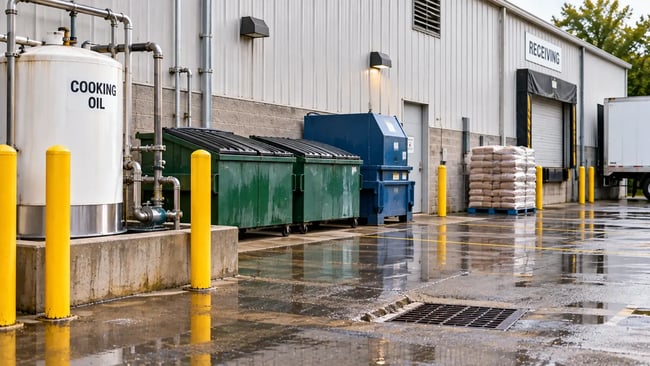
Dumpsters, Compactors, and Roll-Offs
These are among the most common exposures at food plants. DEP says dumpsters and roll-off boxes don't need a shelter if they're covered, in good condition, and not allowed to drain or leak. One without a lid that isn't under a shelter doesn't qualify for NEC. A tarp works as a temporary cover, but DEP generally doesn't accept flexible covers on permanent installations. The same logic applies to compactors: food waste is wet, so a seam, port, or ram that lets liquid reach pavement is exposure.
Ingredient, Grease, and Byproduct Storage
DEP says drums, barrels, and tanks don't need a shelter if they're tightly sealed and not leaking, and it defines sealed as banded or otherwise secured with no operational taps or valves. That catches grease: a used cooking oil tote with a working spigot doesn't count as sealed, even if it's never leaked. Wooden pallets in good condition may be eligible, but outdoor silos, bulk bins, spoiled product, trim, and wastewater sludge or skimmings left uncovered let rain carry material off the site.
Loading and unloading is material handling by definition, so docks deserve a close look. A roofed dock with the trailer sealed to the building differs from an open apron where pallets sit and product spills during transfers. DEP says adequately maintained vehicles used in material handling don't need a shelter, so a parked trailer isn't the problem. The spills around it are. A fueling area without a roof or canopy also rules out NEC.
DEP says wash areas must be indoors to qualify for NEC. Vehicle wash water isn't authorized under PAG-03, so a truck wash pad draining to a storm inlet is a problem on either path. That water has to be kept separate from stormwater and recycled or sent to a sanitary sewer under pretreatment rules. Our explanation of stormwater and process water shows where the line sits.
What's on the Food Plant Stormwater Exposure Checklist?
Walk the whole site just after a rain with this table. If every row comes back covered, sealed, or indoors, you may be an NEC candidate. A row that doesn't means PAG-03 is more likely, unless you can fix it first.
| Where to look |
What creates exposure |
What usually fixes it |
| Dumpsters, roll-offs, compactors |
No lid or shelter, or liquid draining from a seam, port, or ram |
Keep lids closed and containers sound, or put them under a roof with a berm |
| Outdoor ingredient storage |
Silos, bins, totes, or bagged ingredients in the weather, and fill-point spills |
Move indoors or under a storm-resistant shelter, and clean spills right away |
| Grease, used oil, chemicals |
Containers with working taps or valves, damaged drums, open-top totes |
Use tightly sealed containers with no operational valves, or store under cover |
| Truck docks and aprons |
Open aprons where product, pallets, or waste spill or stage |
Roof the dock, seal trailers to the building, and sweep spills promptly |
| Outdoor wash areas |
Truck or equipment washing that drains to a storm inlet |
Wash indoors and route water to a sanitary sewer or recycling |
| Waste and spoiled product |
Uncovered piles of trim, spoiled product, filter media, or sludge |
Containerize and cover, or keep indoors until pickup |
| On-site fueling |
No roof, canopy, or cover, or exposed secondary containment |
Cover the fueling area or protect the containment |
| Outdoor equipment and pallets |
Dripping compressors or chillers, or pallets in poor condition |
Repair leaks, use drip pans under cover, and keep only sound pallets |
Sometimes a lid or a covered pad solves it, which can be the cheapest permit decision a plant ever makes. The same fixes double as the stormwater best management practices your PPC Plan will call for, and our post on stormwater visual inspections covers what a good walk-through looks like.
What Does PAG-03 Require From a Food Processing Plant?
A plant with PAG-03 coverage follows Appendix I, the food and kindred products appendix. Its monitoring list has included pH, biochemical oxygen demand (BOD5), total suspended solids, chemical oxygen demand (COD), and oil and grease. BOD5 and COD measure how much oxygen organic material will use up as it breaks down, which makes them natural parameters for a plant handling sugars, fats, and proteins. The PAG-03 reissued March 24, 2023 also added total nitrogen and total phosphorus to every appendix.
Sampling is semiannual, with at least one grab sample per parameter every six months, reported through Pennsylvania's eDMR system. A qualifying storm produces more than 0.1 inch of precipitation and is separated from the previous storm by 72 hours, and samples should be taken in the first 30 minutes of discharge. Our walkthrough of how PAG-03 sampling works in practice covers the details.
Benchmark values aren't discharge limits. If the same pollutant exceeds its benchmark at the same outfall in two consecutive monitoring periods, you submit a corrective action plan to DEP within 90 days. After four, the plan must consider the full list of additional practices for your appendix, and consistent failure can cost you general permit coverage. We've written about benchmark values and effluent limits and what to do when sampling results come back high. Annual reports and the annual fee are due each March 23.
How Does the Chesapeake Bay Watershed Change Food Plant Stormwater Permitting?
Much of central Pennsylvania drains to the Susquehanna River and from there to the Chesapeake Bay, and Pennsylvania has long-running commitments to reduce the nitrogen and phosphorus reaching the Bay. Food plants sit close to that conversation because organic material uses up oxygen as it breaks down and nutrients feed algae, the two kinds of pollution a food plant's runoff is most likely to carry.
Here's what DEP's documents support. Nitrogen and phosphorus monitoring was added to every PAG-03 appendix statewide in 2023, so a food plant anywhere in Pennsylvania reports them alongside BOD5, COD, and the rest. The PAG-03 application also asks for results for any pollutant considered a cause of impairment in the receiving stream, so a nutrient-impaired stream can put those numbers under a brighter light. We can't point to separate PAG-03 requirements for plants inside the Bay watershed. What changes is the context: which stream receives your runoff and how it's classified. See our article on impaired waters and TMDLs.
What Else Can Change a Food Plant's Stormwater Permit Answer?
Where your stormwater goes can change the answer. If runoff from industrial areas flows to a sanitary or combined sewer that's part of a publicly owned treatment works, DEP says neither coverage nor NEC is required, though pretreatment rules apply and the treatment plant should be told. If it goes to a storm sewer or a basin that rarely overflows, you still need one or the other, and sheet flow counts too. Cities, townships, and sewer authorities can have their own rules and fees, so confirm your situation locally. That's why we don't tell anyone flatly they need PAG-03 until we know where their water goes.
If your runoff reaches a High Quality or Exceptional Value stream under 25 Pa. Code Chapter 93, PAG-03 and NEC are both unavailable and the plant needs an individual NPDES permit, which is a more involved application.
If you're building or expanding a plant, the construction phase has its own stormwater approvals, such as erosion and sediment control plans and PAG-02 coverage. We don't prepare those. Your engineer, contractor, or an erosion and sediment control specialist does, and we're glad to point you to the right people. We help with what the plant needs once it's running: PAG-03 or NEC, the PPC Plan, sampling, and reporting. Our article on how long PAG-03 coverage takes gives a sense of the timeline.
How Much Does Stormwater Permit Coverage Cost for a Food Plant?
Agency fees are the small part: $500 to apply for PAG-03 plus $500 a year, or $500 every five years for NEC. The rest depends on your plant, including which path fits, how many outfalls and drainage areas it has, its size and complexity, how much sampling has to be arranged, and whether a PPC Plan already exists. Our PAG-03 cost article goes through what drives the price. The pricing calculator below estimates RMA's help with your facility, and you can run it without talking to anyone.
How Can RMA Help a Pennsylvania Food Plant With Stormwater?
We work with Pennsylvania facilities all the time, and a food plant usually starts with one question: can we get to No Exposure, or do we need PAG-03? We can walk the site with you and tell you what it would take to qualify for NEC. If PAG-03 is the answer, we prepare the PPC Plan and maps, coordinate sampling, put together the NOI, work with DEP during review, and help with eDMR and annual reports. See our page on Pennsylvania NPDES and stormwater services.
If your plant is fully indoors and tidy, you may not need us. Our article on doing PAG-03 yourself lays out the work so you can decide, and our online environmental training library can help your team keep lids closed and spills swept. There's no pressure or obligation. You can call, email, or fill out the form on our website, and if we aren't the right fit we'll say so. When you're ready, get in touch with our team.