Indoor Machine Shops Usually File a No Exposure Certification, but a Few Outdoor Habits Can Push You Into PAG-03 Permit Coverage
If you run a machine shop in Pennsylvania, a stormwater permit probably sounds like something for quarries and steel mills, not a shop full of CNC mills and lathes. The reality is more mixed. Pennsylvania DEP regulates industrial stormwater through the NPDES program (the National Pollutant Discharge Elimination System, the federal permit program for discharges to streams and storm sewers), and most machine shops sit in a category that program covers. What decides your path is exposure. A shop that keeps its materials and work indoors usually files a No Exposure Certification with DEP, while a shop with open chip bins, used coolant drums, or a leaking dumpster outside usually needs coverage under PAG-03, the state's general permit for industrial stormwater.
Below, we cover how DEP sorts machine shops, what counts as exposure, the outdoor habits that most often tip a shop into PAG-03, and a checklist for staying No Exposure eligible. If you'd rather have someone look at your shop with you, you can reach out to RMA, and we'll tell you plainly whether you need our help at all.
Table of Contents
TL;DR
Most Pennsylvania machine shops fall in a manufacturing category DEP regulates, but the rule only bites when industrial materials or activities are exposed to rain and snow. If everything stays indoors or under roof, a shop files a No Exposure Certification ($500 every five years) instead of getting PAG-03 coverage, and it shouldn't skip the filing. Metal chips in open bins, open or leaking oil and coolant drums, outdoor equipment cleaning, and leaking dumpsters are the usual reasons a shop ends up needing PAG-03.
Does a Pennsylvania Machine Shop Need PAG-03 or a No Exposure Certification?
Federal rules sort industrial facilities by SIC code, the Standard Industrial Classification number that describes what a business mainly does. Machine shops generally land in SIC 3599, which falls in major group 35, and shops that mainly make fabricated metal parts may sit in major group 34. Both groups are on the federal list of regulated manufacturing categories in 40 CFR 122.26(b)(14)(xi) (group 34 excludes SIC 3441), and DEP follows that list. DEP's FAQ says your primary code is whichever activity brings in the most revenue. If that code is listed, you either get permit coverage or qualify for a No Exposure Certification (NEC). If only a secondary activity is listed, you generally need neither unless DEP decides your runoff calls for a permit.
That leaves three paths. PAG-03 is DEP's general permit for industrial stormwater, a standard permit many facilities join by filing a Notice of Intent (NOI). The current version expires March 23, 2028. An individual NPDES permit is written for one facility and is the route when PAG-03 isn't available. The NEC is the alternative to both for facilities that show nothing industrial is exposed to weather.
| Path |
Usually fits a shop that... |
What you file |
Ongoing work |
| No Exposure Certification |
Keeps everything indoors or under roof |
NEC form, NOI, maps, lab results for existing sites, $500 fee |
Renew every five years |
| PAG-03 general permit |
Has exposed materials or activities and discharges to waters PAG-03 allows |
NOI, PPC Plan, maps, fees |
Twice-yearly sampling, eDMR, annual report |
| Individual NPDES permit |
Can't use PAG-03, often because of the receiving stream |
Individual permit application |
Set by the permit, generally five-year terms |
Our guide on whether you need a stormwater permit in Pennsylvania covers all three paths for any industry, and our overview of NPDES stormwater permits explains the program behind them.
What Does No Exposure Mean for a Machine Shop Stormwater Permit?
DEP's rule of thumb is that all industrial materials and activities have to be stored and conducted indoors or under roof. That covers more than the machines: bar stock, cutting fluids, tooling, chips, scrap, used oil, waste, finished parts, and the loading and moving of all of it. If rain or snowmelt can touch it, DEP can treat it as exposed.
The shelter has to be a real one. DEP accepts a fully roofed and walled building, or a roof with no walls as long as stormwater can't flow through and blown-in rain or snow can't run back out, which usually means a curb or berm. Tarps generally don't count over a permanent setup, though they work as a temporary cover over something like a dumpster.
A few things can stay outside without a shelter: tightly sealed drums (banded or secured, with no operating taps or valves) that aren't deteriorated or leaking, covered dumpsters and roll-offs in good condition that don't drain or leak, well-maintained material-handling vehicles, and final products that runoff can't wash away. Good wooden pallets stacked outside and properly stored deicing salt don't disqualify a shop either. We cover the concept in more depth in our article on what No Exposure means under an NPDES stormwater permit.
Why Do Indoor-Only Machine Shops Still File a No Exposure Certification?
Many owners assume that if everything is indoors, there's nothing to file. DEP's FAQ says facilities in the regulated categories must either obtain permit coverage or, if eligible, apply for an NEC. The NEC is what gets an indoor shop out of the permit requirement. Without it, you've skipped the paperwork, not earned the exclusion.
It's also the lightest path by a wide margin. You skip the twice-yearly sampling and eDMR reporting that come with PAG-03, and there's no annual fee, just $500 every five years with the application.
Two cautions go with it. You sign the certification under penalty of law, and it covers the whole facility, so one outdoor problem on one side of the lot can undo it. DEP also says submitting an application doesn't guarantee approval, since it can decline if it finds your runoff likely carries pollutants to surface waters. Walk the property with the checklist below before you sign. A couple of situations where a shop files neither one come up near the end.
What Tips a Machine Shop Into Needing PAG-03 Stormwater Permit Coverage?
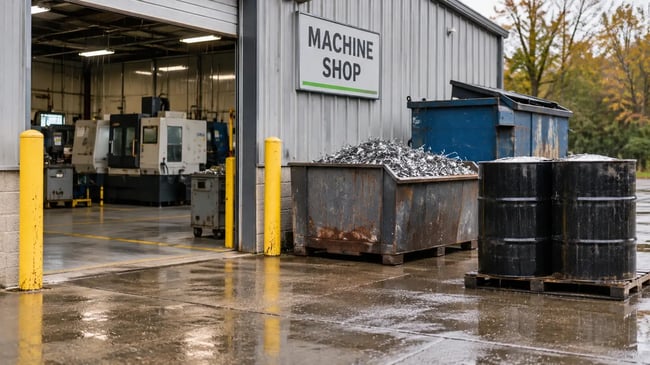
DEP won't approve no exposure for only part of a site, so every industrial area has to qualify, and one outdoor habit can push a shop toward PAG-03. These come up most for machine shops.
| Outdoor habit |
Why it counts as exposure |
Typical fix |
| Chips, swarf, and scrap in open bins or piles outside |
Chips coated in cutting fluid are waste, and an open bin lets rain run through |
Move bins under roof, or use covered roll-offs that don't drain or leak |
| Used coolant and oil drums outside |
Open, deteriorated, leaking, or tapped drums count as exposed |
Store indoors, or keep outdoor drums sealed, banded, and intact |
| Cleaning machinery or parts outdoors |
Wash water and residue reach the ground, and DEP requires wash areas to be indoors for an NEC |
Wash indoors and keep wash water out of storm drains |
| Uncovered, damaged, or leaking dumpsters |
Without a lid or shelter, an outdoor dumpster doesn't qualify |
Keep lids closed, repair holes and drains, and ask haulers to close lids after pickup |
| Oil or coolant stains and spill residue on pavement or in inlets |
Residue left from past spills and leaks counts as exposure |
Clean up fully, then fix the leak at its source |
| Roof vent or stack residue in runoff |
Deposits that show up in the stormwater outflow count |
Maintain exhaust filters and mist collectors, and check roof drains |
Raw bar stock racked outside belongs on the list too, since raw materials are protected materials. Finished parts are treated differently, because DEP doesn't require a shelter for final products that runoff can't wash away. Whether a given container or stockpile passes can come down to its condition, so confirm anything borderline before you certify. Our explainer on stormwater associated with industrial activity shows how regulators see these areas, and our article on the difference between stormwater and process water helps with the washing question.
Machine Shop No Exposure Checklist: How to Stay Eligible
Take this walk through your yard slowly, and on a wet day if you can, since rain shows leaks, staining, and drainage paths a dry afternoon hides.
- Walk the whole property, including the dock, yard, and lot edges, not just the shop floor.
- Keep chip and scrap containers indoors, or covered, intact, and not draining.
- Keep used oil and coolant inside, or sealed, banded, and tap-free if they must be outdoors.
- Clean and wash machinery, tooling, and parts indoors, with wash water kept out of storm drains.
- Check every dumpster and roll-off for lids, holes, and drain plugs.
- Look for oil stains, coolant residue, and metal fines on pavement and in inlets. Clean them up and fix the source.
- Check roof vents, stacks, and roof drains for residue.
- Keep raw stock and in-process work under roof.
- Use a real shelter for anything outdoors, such as a roof with a curb or berm, not a loose tarp over a permanent setup.
- Know where each discharge goes: a stream, a storm drain, or a sewer.
- Tell your crew and haulers what can stay outside, because one barrel left on the dock can end eligibility. Our online environmental training library is a good start.
If you find outdoor items you can't realistically move, PAG-03 usually comes into play. For what a DEP visit looks like once you're in the program, see what happens during a PA DEP stormwater inspection.
What Does Filing a Pennsylvania No Exposure Certification Involve?
DEP's FAQ lists what goes into an NEC application: the NEC form and PAG-03 NOI, a General Information Form for new NECs, a topographic map and a site sketch showing structures, discharge points, and drainage, the fee, and proof you notified your municipal storm sewer operator if one applies. A PPC Plan (Preparedness, Prevention, and Contingency Plan, DEP's spill and release prevention plan) is required in some cases, depending on how you answer certain questions on the form.
If your shop already operates, you also submit lab results for the parameters on the NEC form, which the FAQ puts at eight. That means collecting stormwater samples first, so read our piece on taking your own stormwater samples. The fee is $500 every five years, with no annual fee. A certification is generally valid for five years, with renewal due no later than 180 days before it expires, and if your shop stops qualifying, DEP expects immediate notice and an NOI for permit coverage. A simple, clean indoor shop can often handle the paperwork itself. The maps and sampling are where most people want a second set of eyes.
What Does PAG-03 Cost and Require for a Machine Shop?
If your shop can't reach no exposure and discharges to waters PAG-03 allows, PAG-03 is usually the path. You file an NOI with a PPC Plan, site maps, and sampling information tied to the PAG-03 appendix for your industry. Once covered, you sample at least once every six months, report through DEP's electronic discharge monitoring report system (eDMR), file an annual report by March 23, and follow the permit's best management practices (BMPs, the housekeeping and control measures). If the same pollutant exceeds its benchmark value (a target concentration in your appendix) at the same outfall in two consecutive monitoring periods, you submit a corrective action plan. Our guides to PPC Plans for PAG-03, eDMR reporting, and PAG-03 sampling cover each piece.
DEP charges a $500 application fee and a $500 annual fee. The bigger expense is the application work: site evaluation, mapping, the PPC Plan, and the package itself. For a relatively straightforward facility, RMA's published range for full application help is about $5,000 to $10,000, with ongoing support around $3,000 to $6,000 per year. That gap is why many shops find it cheaper to fix a few outdoor habits and file an NEC. We break it down in how much a PAG-03 permit costs in Pennsylvania, and our DIY versus consultant comparison covers doing it yourself. Our pricing calculator is below. It estimates what RMA's help would cost, not DEP's fees, and it doesn't ask for your email.
How Do Your Watershed and Sewer Connection Change a Machine Shop's Stormwater Permit Answer?
Where your runoff goes can change the answer. If stormwater flows to a sanitary or combined sewer that's part of a publicly owned treatment works (POTW, a municipal wastewater system), DEP's FAQ says you don't need PAG-03 or an NEC, though pretreatment rules still apply and the POTW should know. Many older Pennsylvania cities have combined sewers, and the details vary by sewer authority, so confirm with yours. Discharges to a municipal storm drain system (an MS4) still need coverage or an NEC.
The stream matters too. If you discharge to a water with a High Quality or Exceptional Value use under 25 Pa. Code Chapter 93, you can't use PAG-03 or an NEC and would apply for an individual NPDES permit, which DEP says would carry limited or no stormwater monitoring but a heavier application. Boroughs and townships can add their own stormwater rules and fees, so ask your municipality what applies.
How Does RMA Help Pennsylvania Machine Shops With Stormwater Permits?
We work with Pennsylvania facilities all the time, and for a machine shop the first step is usually a walk of the yard. We can look at your SIC code, drainage, and outdoor storage and tell you whether No Exposure is realistic. From there we can prepare the certification, build a full PAG-03 package, or tell you which two or three fixes would get you eligible so you can do them yourself. If your shop is simple enough that you don't need us, we'll say so.
There's no pressure and no obligation. You can call us, email us, or fill out the form on our website, or you can contact our team directly and tell us what's going on at your shop.