A Step-by-Step Guide to Getting the Right Bottles, Hitting the Sampling Window, Handling the Sample, and Avoiding the Mistakes That Throw Out Your Results
A stormwater grab sample looks simple. You fill a bottle with runoff and send it to a lab. The trouble is that the whole thing runs on a clock and a checklist, and a sample that misses either one can end up useless. Rain doesn't wait for a convenient hour, the sampling window is short, and the lab will analyze whatever shows up, whether or not it was collected properly.
This guide walks through the full process for a New Jersey facility whose NJPDES permit requires grab samples: getting the right bottles from a lab certified under New Jersey's laboratory certification program, recognizing a qualifying storm, collecting at the right outfall, labeling and chain of custody, holding times, recording conditions, and the mistakes we see most often. Your permit controls the details, so treat this as a working routine you can compare against your permit language, and if you'd like help doing that, you can reach out to RMA at any point.
Table of Contents
TL;DR
Order bottles from a New Jersey certified lab before storm season, watch for a storm that meets your permit's definition, and collect the grab sample at the permitted outfall as soon as runoff starts, usually within 30 minutes or as soon after as you can safely manage. Fill the lab's bottles directly from the discharge without contaminating them, label them fully, keep them cold, document every handoff, and deliver them before the holding times run out. Write down the rainfall and conditions while you're there. Your permit sets the exact timing, so check it first.
What Is a Stormwater Grab Sample, and Does Your NJPDES Permit Require One?
A grab sample is a single sample collected all at once from a discharge, as opposed to a composite sample made from several portions collected over time. For stormwater, it's a snapshot of what's leaving your site at one moment, usually early in the runoff when the first flush carries the most pollutants. Our post on grab samples versus composite samples covers when each applies.
Whether you have to take one at all depends on your permit. Some New Jersey general permits require sampling, and some don't, so check yours before you buy a single bottle. If you're on the 5G2, start with whether the 5G2 requires stormwater sampling, and if you operate a concrete or asphalt plant, our posts on CPM sampling and reporting and R4 monitoring and reporting cover those permits. Your permit also tells you which parameters to test, how often, and how to report the results, and all of that drives what you ask the lab for.
How Do You Get the Right Bottles and Preservatives From a New Jersey Certified Lab?
Start with the lab, and do it before the season starts. Under N.J.A.C. 7:14A-6.5, the lab analyzing your samples has to be certified by NJDEP for each parameter it tests, so confirm that the lab holds certification for your exact parameters and methods, not just for stormwater work in general. Ask the lab to send you a bottle set built for your permit's parameter list. Our guide to picking a water testing lab covers what to ask.
The lab's bottles come with the right container type and, where needed, preservative already added. Plastic is typical for many parameters, while oil and grease goes in glass, because oil sticks to plastic and gives falsely low results. Because preserved bottles hold acid, don't rinse them and don't overfill them, or you'll wash the preservative out. Ask for a few spare bottles of each type, along with the labels, the chain of custody forms, and a cooler. Check the bottles for cracks and damaged caps when they arrive, and keep them in a clean spot until you need them. Bottles tossed in a truck bed for months pick up dust and grease before you ever use them.
What Counts as a Qualifying Storm Event for Stormwater Sampling?
The federal definition of a storm event, which New Jersey uses in its rule for permit applications at N.J.A.C. 7:14A-24.8, is a storm of more than 0.1 inch of rain that comes at least 72 hours after the previous measurable storm. Individual NJDEP general permits can set their own criteria, and some are looser, asking only for a storm that produces a discharge, while others spell out their own rainfall or dry-period conditions. Look at your permit's definition, and take that one if it differs from what you've heard.
Practically, that means watching the forecast in your monitoring period, knowing when it last rained and how much, and keeping your sampling gear ready to go. The 72-hour clock catches people off guard in wet stretches, when it rains every other day for a week and nothing qualifies. If it snows, check how your permit treats snowmelt, since many don't count it the same way as rain. Our snowmelt post explains how that tends to play out. And if you can't get a sample because water never leaves your site, see how to handle sites where the water doesn't leave and what reporting no discharge involves.
How Do You Collect a Stormwater Grab Sample Safely Within the Required Window?
The timing is where most samples go wrong. New Jersey's rule for permit applications asks for a grab sample during the first 30 minutes of the stormwater discharge, or as soon thereafter as practicable. A general permit we reviewed, the wood waste recycling and leaf composting permit, uses the same 30-minute language and asks you to explain on the monitoring report form if you sample later. Other permits word the window differently, so read yours and count from the moment runoff starts leaving the outfall, not from when it started raining. Our post on when the 30-minute window starts goes through that distinction.
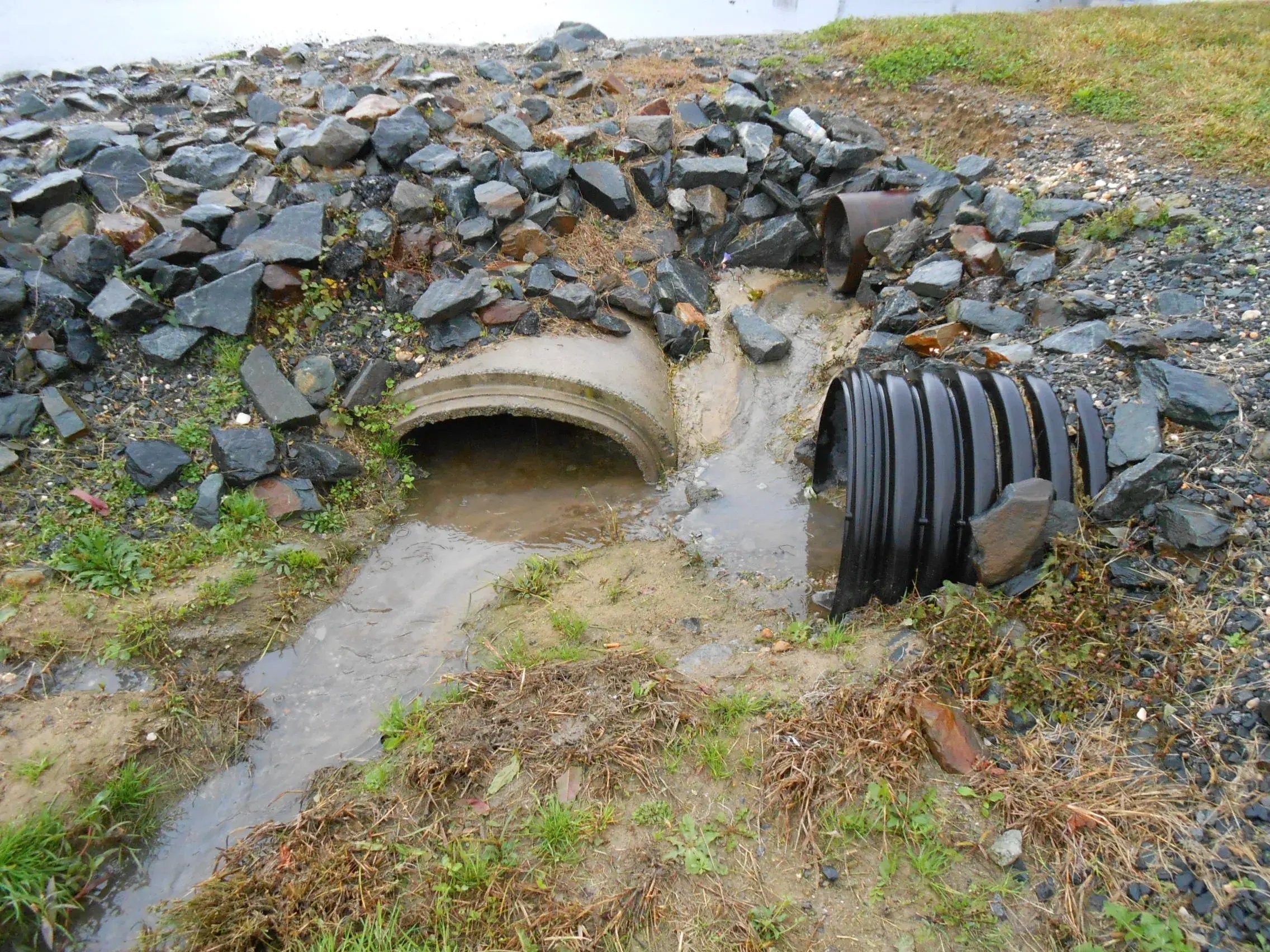
Choose the outfall named in your permit or SWPPP (the stormwater pollution prevention plan, sometimes called an SPPP or SP3). If the water leaves the site at more than one outfall, sample the ones your permit calls for. If you have to sample from a basin or another treatment device, collect at its discharge point, not out of the standing water. Walk the route ahead of time so you aren't finding a locked gate or a flooded access path while the clock runs. Safety comes first, and no sample is worth an injury. Don't sample during lightning, stay out of traffic lanes, avoid steep or slick banks, and never climb into a basin, manhole, or vault to reach the water. Bring a second person if the location is awkward.
Once you're at the outfall, the field routine looks like this:
- Put on clean gloves and have the bottles, labels, pen, cooler, and paperwork within reach before you step up to the water.
- Note the time runoff reaches the outfall, since that starts your window.
- Uncap the bottle without touching the inside of the cap or the rim, and keep the cap in your hand or pocket, not on the ground.
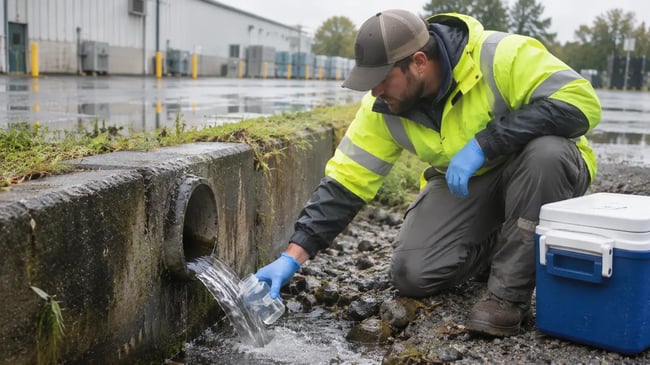
- Hold the bottle facing upstream into the flow and fill it directly from the discharge, below the surface and away from the pipe or channel bottom so you don't stir up sediment or skim the surface.
- For oil and grease, fill the glass bottle straight from the discharge and don't use another container as a go-between, because oil clings to everything it touches.
- Cap each bottle right away, label it, and put it in the cooler with ice.
If you take the sample with a pole or dipper, that tool needs to be clean and shouldn't have been used for anything else. Our tips for taking a good stormwater sample go further on technique.
How Do You Avoid Contaminating the Sample?
Contamination is easy to cause and hard to see. Keep vehicle exhaust, cigarettes, sunscreen, and dirty gloves away from the bottles, and never touch the inside of a cap. Don't sample from a pooled puddle beside the outfall, and don't scoop from a spot where you've just kicked up mud. Collect samples in the order your lab recommends if they've given you one. If a bottle touches the ground or you drop the cap, use a spare bottle. That's why you asked for extras.
How Should You Label Stormwater Samples and Handle Chain of Custody?
Label every bottle in the field, not later in the truck. Use waterproof ink and put on the label the sample ID or outfall number, date, time of collection, who collected it, and the parameters or analysis requested. If the bottle contains a preservative, note it. A bottle with a smeared or incomplete label may not be accepted by the lab, and you can't recreate that information afterward.
Chain of custody is the paper trail that shows who had the sample from the moment you collected it until the lab received it. The form lists the samples, the collection time, the analyses wanted, and each handoff, with a signature and date and time every time the samples change hands. NJDEP's Field Sampling Procedures Manual covers chain of custody procedures, and your lab will give you a form that follows its own process. Fill it out at the outfall or right after, keep it with the cooler, and sign it over when you drop the samples off. Under N.J.A.C. 7:14A-6.5, permittees follow the Manual's procedures or an approved alternative, so it's worth knowing what's in it.
What Are Stormwater Sample Holding Times, and How Do You Get Samples to the Lab on Time?
A holding time is the maximum time between collection and analysis, and it starts when you fill the bottle. Federal rules at 40 CFR 136.3 (Table II) list the container, preservation, and maximum holding time for each parameter. The lab will give you its own list, which is the one to follow, but this table shows how widely the times vary for common stormwater parameters.
| Parameter |
Typical Container and Preservation |
Maximum Holding Time |
| pH |
Plastic or glass, no preservative |
Analyze immediately, which in practice means within 15 minutes |
| Oil and grease |
Glass, cooled, acid to pH below 2 |
28 days |
| Total suspended solids |
Plastic or glass, cooled |
7 days |
| Biochemical oxygen demand |
Plastic or glass, cooled |
48 hours |
| Most metals |
Plastic, acid-preserved |
Generally 6 months, with shorter times for a few such as mercury, and dissolved metals have to be filtered within 15 minutes of collection |
pH is where permits and the federal table can seem to disagree. The federal table treats pH as an immediate analysis, while the wood waste recycling and leaf composting general permit we reviewed allows stormwater pH to be analyzed within 24 hours of collection. Follow your own permit, and if you read pH on site, use the meter correctly, because the number drifts as the sample sits. Our posts on pH changing after 15 minutes and a DIY pH kit explain how people handle this.
Getting samples to the lab on time takes planning. Keep the samples cold, around 4 degrees Celsius with ice or ice packs but not frozen, and out of the sun. Call the lab ahead of the season to learn their drop-off hours, whether they take samples on weekends, and who to contact after hours. A storm that arrives Friday afternoon is the classic problem, so know what you'll do with it before it happens. Our quick guide on what to do with samples after collecting them has more.
What Rainfall and Site Conditions Should You Record During Stormwater Sampling?
Write down the details while they're fresh. At minimum, record the date, the time the sample was collected, the time runoff began if you saw it, the rainfall amount, the hours since the last storm, and the outfall you sampled. The monitoring report forms in at least one NJDEP general permit we looked at ask for the hours since the last storm event, the rainfall amount at the time of sampling, and the date and time of collection, so it's smart to gather those every time. Add the weather, anything unusual you noticed such as a sheen, color, odor, or active work in the drainage area, and the name of everyone who handled the sample.
A rain gauge on site is the most direct source for rainfall, and a nearby weather station is the fallback. Our post on where to get rainfall data goes through the options. Keep these notes with the chain of custody form and your other monitoring records, because you'll need them when you fill out the report. The same applies to results that come back bad: the field notes are often what lets you explain them. If you're dealing with that, read what to do when your results are high and how discharge monitoring reports work.
What Common Mistakes Invalidate a Stormwater Grab Sample?
The same handful of problems cause most of the lost samples we see, and nearly all of them are preventable.
| Mistake |
Why It Causes Trouble |
| Sampling after the window closes with no explanation |
The sample may not meet the permit's timing, and the first flush has already passed |
| Sampling a storm that doesn't qualify |
The result may not count toward your monitoring requirement |
| Using the wrong bottle or rinsing a preserved one |
Plastic for oil and grease, or a washed-out preservative, changes the result |
| Transferring oil and grease through another container |
Oil sticks to the surface, so the result reads low |
| Touching the bottle rim or cap, or scooping stirred-up sediment |
Contamination and unrepresentative solids and metals |
| Skipping the cooler |
Warm samples can fail preservation requirements |
| Missing a holding time |
The lab may flag or reject the analysis |
| Incomplete labels or chain of custody |
The lab can't tie the sample to your site and event |
| Using a lab not certified for your parameters |
The results may not satisfy your permit's laboratory certification requirement |
| Forgetting the rainfall and condition notes |
You can't document the event or explain a surprising result |
Our list of the top reasons stormwater samples go bad covers many of these in more detail. If a sample does get compromised, say so to your lab and think through what your permit allows before you try to cover for it. Quietly submitting a questionable result is a worse position than documenting what happened, particularly because the person who signs your reports certifies they're accurate. And if you're ever worried about your legal exposure over a result, an environmental attorney is the right person to ask.
How Can RMA Help With Stormwater Sampling in New Jersey?
We're a family-run firm based in New Jersey, and we believe your own team should take your samples. They know the site, and storm windows are too short for us to be there in time, so we don't do the sampling ourselves. We train your people to do it correctly instead. We can also read your permit with you, set up a sampling routine and kit list, and help with annual support after you're permitted, from reminders to interpreting results and SWPPP updates. If you'd like your staff to build skills on their own, our online training library is another option, and our post on why you should take your own samples explains the thinking.
There's no pressure and no obligation. You can call, email, or fill out the form on our website, and we'll talk through your permit and your site. If you'd like a hand getting your sampling routine in order before the next storm, contact RMA whenever it suits you.