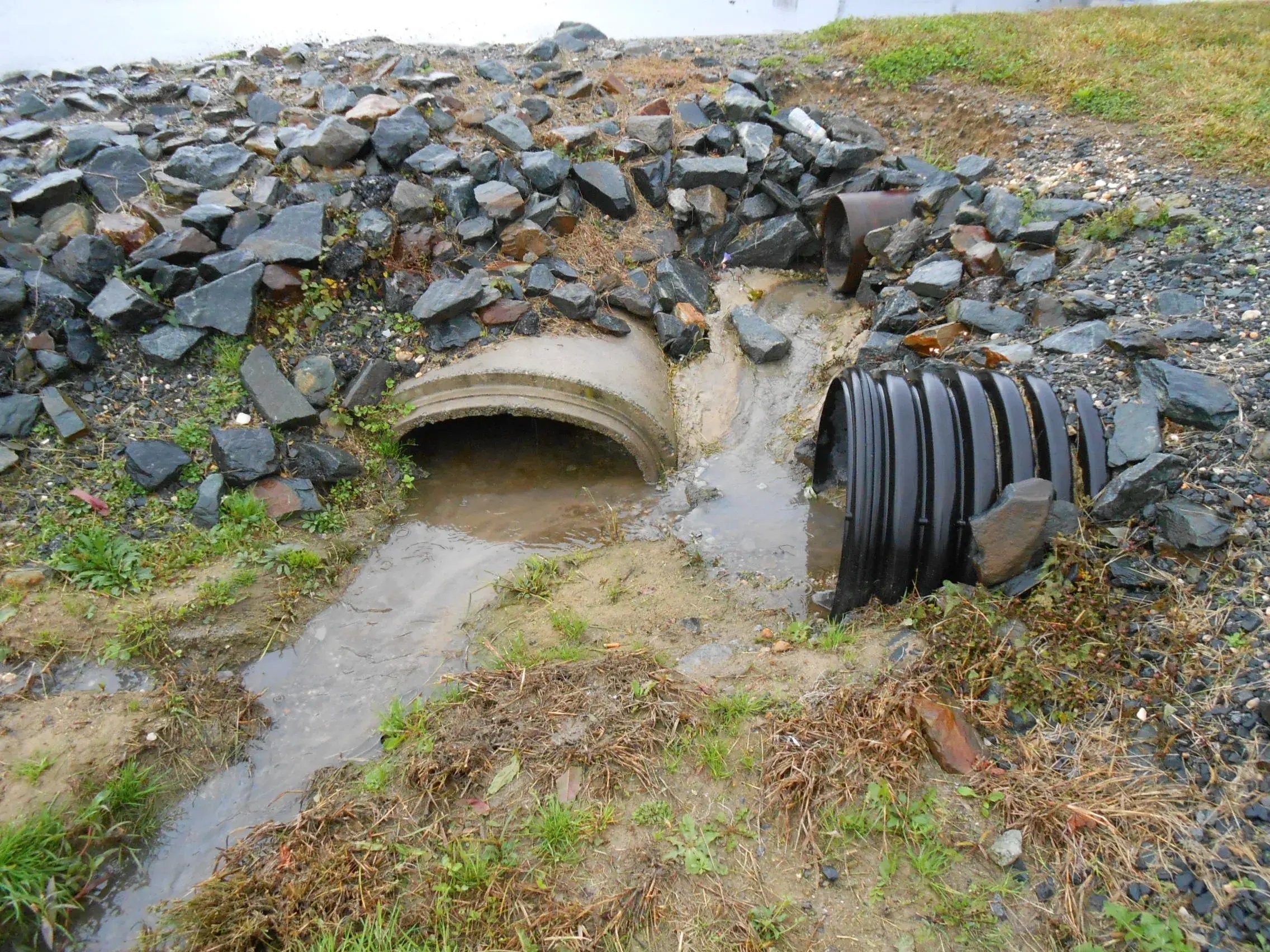
A Walkthrough of Sample IDs, Dates, Units, Detection Limits, Qualifiers, and Holding Times, Plus How to Compare Results to Your NJPDES Permit and Enter Them Online
The lab report lands in your inbox as a PDF with a page or two of tiny columns, a few cryptic letters next to some of the numbers, and a footnote that mentions something called a holding time. Somewhere in there is the answer to the only question you care about, which is whether the water leaving your facility met your permit. Most facility managers never had anyone sit down and show them how to find it.
This article goes through a stormwater lab report one piece at a time, using an annotated sample report so you can see where everything sits. We'll cover sample IDs and outfalls, dates and times, parameters and units (including the mg/L versus µg/L mix-up that trips up almost everyone), detection and reporting limits, qualifiers, and holding times. Then we'll show you how to compare results to the numbers in your NJPDES permit and enter them into New Jersey's online monitoring report system. If you get stuck on a report you're holding right now, you can reach out to RMA and we'll look at it with you.
Table of Contents
TL;DR
Read a stormwater lab report in this order: confirm the sample ID matches your outfall, check the collection and analysis dates, then look at each parameter's result, units, reporting limit, and any qualifier letter. Make sure the units match your permit (1 mg/L equals 1,000 µg/L), remember that "not detected" isn't zero, and check whether the lab hit the holding time. Then compare each result to the right number in your permit, noting whether it's a limit, a benchmark, or monitor-only, and enter it into NJDEP's online monitoring report system with the lab's detection symbol where it applies.
What Does a Stormwater Lab Report Look Like? An Annotated Sample
Every lab formats its reports a little differently, but the same pieces show up on all of them. Below is a fictional sample report with numbered markers on each piece. The facility, the lab, and every number are made up for teaching purposes, so don't compare them to anything in your own permit. Each marker gets explained in the sections that follow.
Sample Report (Fictional Example)
Example Environmental Laboratory | Certificate of Analysis
| 1 Sample ID |
26-10-0457-01 |
Client |
Sample Aggregate Co., Anytown, NJ |
| 1 Client sample name |
Outfall 001, Q4 storm sample |
2 Collected |
10/14/2026 08:20 |
| Matrix |
Stormwater (grab) |
3 Received at lab |
10/14/2026 11:05 (cooler at 3.8 °C) |
| 4 Parameter |
Method |
5 Result |
6 Units |
7 RL |
7 MDL |
8 Qualifier |
2 Analyzed |
| pH |
SM 4500-H+ B |
8.4 |
SU |
n/a |
n/a |
H |
10/14/2026 14:50 |
| Total suspended solids |
SM 2540 D |
38 |
mg/L |
5.0 |
1.2 |
|
10/16/2026 09:30 |
| Oil and grease (HEM) |
EPA 1664B |
<5.0 |
mg/L |
5.0 |
1.4 |
U |
10/19/2026 13:10 |
| Chemical oxygen demand |
SM 5220 D |
62 |
mg/L |
10 |
4.0 |
|
10/20/2026 10:45 |
| Iron, total |
EPA 200.7 |
1.9 |
mg/L |
0.050 |
0.015 |
|
10/21/2026 15:20 |
| Zinc, total |
EPA 200.8 |
32 |
µg/L |
50 |
10 |
J |
10/22/2026 11:05 |
9 Lab notes: H = analyzed outside the method holding time (pH is to be analyzed within 15 minutes of collection). J = estimated value, detected above the MDL but below the reporting limit. U = analyzed for but not detected at or above the reporting limit. RL = reporting limit. MDL = method detection limit. SU = standard units.
You'll notice this one report mixes units, because iron came back in mg/L and zinc came back in µg/L. That's normal when two different methods are used, and it's one of the easiest ways to misread a result.
How Do You Read the Sample ID, Outfall, and Collection and Analysis Dates?
Start at the top, with marker 1. The lab assigns its own sample ID (26-10-0457-01 in our sample), and the report usually also shows the name you wrote on the bottle or the chain of custody form, like "Outfall 001, Q4 storm sample." That name is how you connect the result to a specific discharge point, so check it against the outfall names in your SWPPP and your permit. If your site map says SW-1 and the lab says Outfall 001, or if two outfalls ended up with swapped labels, fix it with the lab before the result goes anywhere else. A perfect result assigned to the wrong outfall is still a wrong report.
Marker 2 is where dates and times cause real trouble. A report normally shows at least three timestamps: when the sample was collected, when the lab received it, and when each parameter was analyzed. The collection date and time came from you, written on the chain of custody form at the moment you filled the bottle, so the lab can't catch a mistake there. Compare it to your own sampling log. Your permit may set conditions for a qualifying storm, such as how much rain fell, how long it had been dry beforehand, and when after the discharge began you collected, and the collection time on the report is your proof. Marker 3 shows when the lab received the sample, and often the cooler temperature. A long gap between collection and receipt is the first thing to look at when a result gets flagged later. Our post on how to take a good stormwater sample covers the field side of this.
How Do You Read Stormwater Parameters, Results, and Units Like mg/L and µg/L?
Marker 4 is the parameter, meaning what the lab measured, and next to it you'll usually see a method code (SM for Standard Methods, EPA followed by a number). Lab names for parameters don't always match your permit's wording. "Residue, non-filterable" is total suspended solids. "HEM" or "n-hexane extractable material" is oil and grease. If a metal appears as "total" in your permit, make sure the report says total and not dissolved. Those are different analyses with different numbers, and a dissolved result will usually come in lower than a total one on the same sample. If a parameter your permit requires is missing from the report entirely, we cover what to do in what happens if the lab forgets a parameter.
Marker 5 is the result and marker 6 is the units, and they only mean something together. The two units you'll see most are mg/L (milligrams per liter, roughly parts per million) and µg/L (micrograms per liter, roughly parts per billion). One milligram is 1,000 micrograms, so 1 mg/L equals 1,000 µg/L. To go from µg/L to mg/L, move the decimal three places to the left. The zinc in our sample reads 32 µg/L, which is 0.032 mg/L. If your permit lists a zinc number in mg/L and you read "32" as if it were also in mg/L, you'd think you were hundreds of times over when you were well under. The mistake runs the other way too, and it's a bad one when it hides a real exceedance.
A few results don't use concentration units at all. pH is reported in standard units (SU), and it has no mg/L. If you ever see a flow value, it'll be in a volume per time like gallons per minute, and the form you report on will tell you which unit it wants.
What Are Detection Limits and Reporting Limits on a Stormwater Lab Report?
Marker 7 is where the lab tells you how low it can see. Two numbers matter. The method detection limit (MDL) is the lowest concentration the lab can distinguish from zero with confidence. The reporting limit (RL, which some labs call the PQL or LOQ) is the lowest concentration the lab can measure with confidence in the number itself, and it's always higher than the MDL. A result sitting between the two means the lab saw something but can't say exactly how much, so it reports an estimate and flags it, like the zinc in our sample.
When a parameter comes back "ND," "U," or with a less-than sign, as the oil and grease did at <5.0 mg/L, that doesn't mean the water had none. It means whatever was there was below the reporting limit. This is where a quiet problem can hide. If your permit threshold is lower than the lab's reporting limit, a non-detect can't prove you're under it. Our post on why NPDES lab results confuse people gives an example of exactly that. The fix happens before you sample: send the lab your permit's numbers and ask for reporting limits low enough to compare against them.
What Do Lab Qualifiers and Flags Like J, U, B, and H Mean?
Marker 8 is the qualifier column, the little letters beside some results. They're short notes from the lab about how much to trust a number. The exact codes differ from lab to lab, so always read the key at the bottom of your own report (marker 9), but these show up on most of them.
| Qualifier |
What It Usually Means |
What to Do With It |
| U or ND |
Not detected at or above the limit shown |
Treat it as "less than" the reporting limit, never as zero, and check that limit against your permit number |
| J |
Estimated value, found between the MDL and the reporting limit |
Use it as an estimate, and ask the lab how it wants the value reported if your permit form has a place for it |
| B |
The substance also showed up in the lab's blank, so contamination may have added to the result |
Ask the lab how much of the result may come from the blank before you rely on it |
| H |
Analyzed after the holding time ran out |
Ask the lab and your NJDEP contact whether the result can be used for compliance, and don't pass it along quietly |
| E or D |
Above the instrument's calibrated range (E), or the sample was diluted to get a reading (D) |
Check whether dilution raised the reporting limit above your permit number |
The rule of thumb is that any qualifier you don't understand is a reason to call the lab before you use the number. A flagged result isn't automatically a bad one, but a result with an unexplained flag is not one you want to certify.
What Are Holding Times and Why Do They Matter for Stormwater Samples?
A holding time is the maximum time allowed between collecting a sample and analyzing it. Chemistry keeps changing after the sample is in the bottle, so the clock starts at collection and each parameter gets its own limit. You'll find the dates and times at marker 2 and the lab's notes at marker 9. Subtract collection from analysis for each parameter and compare it to the limit. The federal limits in the Clean Water Act testing rules at 40 CFR 136.3 are listed below. Your permit or the specific method can set a different one, so use these as a guide.
| Parameter |
Maximum Holding Time |
Preservation |
| pH |
Analyze within 15 minutes |
None required |
| Total suspended solids |
7 days |
Cool, 6 °C or below |
| Total dissolved solids |
7 days |
Cool, 6 °C or below |
| Oil and grease |
28 days |
Cool, 6 °C or below, acid to pH below 2 |
| Chemical oxygen demand |
28 days |
Cool, 6 °C or below, acid to pH below 2 |
| Metals (iron, zinc, copper, lead) |
6 months |
Nitric acid to pH below 2, or acidified at least 24 hours before analysis |
Look at the pH row, because it explains the H on our sample. Fifteen minutes is tighter than any lab can meet when the sample has to travel, so pH is measured on site, right at the outfall, with a meter you've calibrated. The lab's pH result, run more than six hours after collection in our sample, comes back flagged. New Jersey also treats pH as its own certification category for labs. If you rely on a lab pH that's flagged H and your permit requires pH, that's a gap you need to close. Our guide on taking your own stormwater samples goes into the field side of it.
The other holding times mostly cause trouble through delays: a sample that sits over a weekend, a courier that misses a pickup, or a lab that's backed up. For solids that's a 7-day clock, which is shorter than it sounds. Ship the same day when you can, keep the cooler cold, and check the dates when the report comes in rather than after you've already submitted it. Also check that the lab is certified for what it ran. Under N.J.A.C. 7:18, labs that analyze samples for compliance have to be certified by NJDEP, and certification is listed parameter by parameter, so the certificate's parameter list should include everything on your report. Our guide on picking a water testing lab covers what to ask before you hire one.
How Do You Compare Lab Results to Your NJPDES Stormwater Permit Benchmarks?
First, find out whether your permit asks for sampling at all. The 5G2 Basic Industrial Stormwater General Permit is built around best management practices and doesn't require it, as we explain in our post on 5G2 sampling. Sampling shows up in other permits, including the scrap metal SM2 permit and individual NJPDES permits, and the industry-specific permits can include monitoring, benchmarks, or limits. Each one has its own terms, which you can see in posts like CPM sampling and reporting for concrete plants and R4 monitoring for asphalt plants. Never assume which parameters or numbers apply to you. Read the current version of your own permit and authorization.
Once you have the permit open, go through each result in four steps.
Step 1: Identify What Kind of Number You're Comparing To
Your permit might call the number a limit, a benchmark, or monitor-and-report-only. A limit is an enforceable cap, and an exceedance is generally treated as a permit violation. A benchmark is a reference level that tells you whether your best management practices are working, and an exceedance usually calls for investigation and fixes, with trouble coming from repeated exceedances that nobody acts on. Monitor-and-report-only means you record the value and have no number to meet. A result can look identical on the lab report in all three cases, which is the point we make in benchmark values versus effluent limits.
Step 2: Match the Parameter, Form, and Units
Confirm that the parameter matches (total versus dissolved), and convert the units to what the permit uses. The table below shows how it works with the sample results, using made-up thresholds. These numbers are for illustration only, so use the values in your own permit.
| Parameter |
Lab Result |
In Permit Units |
Illustrative Threshold |
Comparison |
| Total iron |
1.9 mg/L |
1.9 mg/L |
1.0 mg/L |
Over the threshold |
| Total zinc |
32 µg/L (J) |
0.032 mg/L |
0.12 mg/L |
Under the threshold, as an estimate |
| Oil and grease |
<5.0 mg/L (U) |
<5.0 mg/L |
15 mg/L |
Under the threshold, since the reporting limit sits below it |
| pH |
8.4 SU (H) |
8.4 SU |
6.0 to 9.0 SU |
In range, but flagged, so use your field reading |
Step 3: Handle Non-Detects With Care
Compare a non-detect using its reporting limit, and only call it "under" the threshold if the reporting limit itself is under the threshold. If the lab's reporting limit is higher than your permit number, you can't show compliance from that result and you should talk to the lab about a lower limit for the next sample.
Step 4: Decide What an Over-the-Number Result Means
If a result is over, the type of number drives what comes next. Over a benchmark, you look for the cause, whether it's housekeeping, erosion, a failing best management practice, or a sampling error, and you fix it and document it. Over a limit, you're likely looking at a reportable violation that goes on your next monitoring report, and the sooner you respond the better it looks. In either case you can't throw the result away, which we cover in whether you have to report bad stormwater results, and our post on what to do when sampling results are high walks through the response.
How Do You Enter Stormwater Results Into New Jersey's eDMR System?
Most people call it eDMR, but New Jersey's term is the NJPDES Monitoring Report Form, or MRF. A Discharge Monitoring Report (DMR) is one type of MRF, and permit holders complete and submit them online through NJDEP Online. If you want the background on the form itself, start with what a DMR is. You'll need a MyNewJersey account linked to NJDEP Online, and the right access for your role.
The basic path through NJDEP's online system looks like this.
- Log in to NJDEP Online, open My Workspace, and select the NJPDES Monitoring Reports link.
- Choose your facility and permit number. NJPDES numbers start with NJ or NJG, so don't confuse them with the Program Interest ID.
- Open the Available grid and pick the form for the monitoring period you're reporting. Forms past their due date show up in red text.
- Enter your results for each parameter, in the units your permit and the form use for that parameter.
- Add any comments, then have a Responsible Official or Facility Administrator certify and submit the form.
A few details trip people up. When a result is a non-detect, type the less-than symbol directly before the value in the quantity box, such as <5.0, and don't add other special characters. The entry can be up to 12 characters including the decimal point and symbol. The "No. Ex." column is for the number of excursions, so fill it in only when a result doesn't meet a permit requirement and leave it blank otherwise. If you had no discharge to sample during the period, check the "No Discharge for Monitoring Period" box and the system fills in the right codes, which we explain in our post on reporting no discharge (NODI). The form may also ask for details about the storm that triggered the sample, so keep your rain data and sampling log handy.
On roles, General Users can enter and review data but can't certify or submit, while Responsible Officials and Facility Administrators can do both. Certification takes the user's challenge question answer and PIN, so a staff member can key in the data and then notify the Responsible Official by email that the form is ready. Before anyone certifies, read it line by line against the lab report, since NJDEP's DataMiner makes submitted data public. Check units, check decimal points, and check that every flagged result was handled the way you decided it would be.
How Does RMA Help With Stormwater Lab Reports?
We don't do the sampling or the lab work for our clients. Storm events don't wait for anyone's schedule, and nobody knows your site like your own team, so we train you to sample correctly instead. What we do is help you make sense of what comes back: reading the report with you, checking that the units, limits, and qualifiers line up with your permit, deciding what an exceedance means, and getting the right numbers into your monitoring report. We also offer annual support after you're permitted, with reminders, interpreting results, SWPPP and annual reporting updates, and inspection prep, as hands-on or hands-off as you like.
There's no pressure and no obligation. You can call us, email us, or fill out the form on our website, and send along a lab report that's got you stumped. When you're ready, contact RMA and we'll walk through it together. If you want to build your own team's skills first, our online environmental training library is a good place to start.