Practical Fixes for After-Hours Storms, Frozen Outfalls, Snowmelt, and Long Dry Spells Under New Jersey's Stormwater Sampling Permits
Storms don't check your shift schedule. The rain that finally gives you a sampling opportunity tends to start at 2 a.m. on a Saturday, right after the one person who knows how to sample went home for the weekend. Add a New Jersey winter, with frozen outfalls, snowmelt that trickles instead of flowing, and weeks where nothing falls at all, and a sampling requirement that looked simple on paper turns into a logistics problem.
This article walks through the practical problems facilities run into and the fixes that tend to hold up: training several people, setting up an on-call rotation, keeping sampling kits ready, using automatic samplers where they fit, and documenting attempts when sampling isn't possible. If you'd like help building a sampling plan that matches your permit, you can reach out to RMA any time.
Table of Contents
TL;DR
Only some New Jersey stormwater permits require sampling, and the ones that do set their own rules for what counts as a valid storm. If yours does, the fixes for after-hours storms and winter conditions are mostly about preparation: train several people, set up an on-call rotation, keep a stocked kit by the outfall, line up your lab ahead of time, and start your sampling window early so a dry spell doesn't catch you at the end of the quarter. Automatic samplers can help but only if they match your permit's method. When you can't sample, write down what happened right away, and check your permit for how to report it.
Which New Jersey Stormwater Permits Require Sampling?
Before building any after-hours system, confirm that you need one. New Jersey's Basic Industrial Stormwater General Permit, the 5G2, doesn't require stormwater sampling. It's built around a stormwater pollution prevention plan (a SWPPP, sometimes called an SPPP, an SP3, or just a stormwater plan), inspections, and keeping materials out of the rain. A facility with a no exposure exclusion has no permit and therefore no sampling either.
The industry-specific general permits are where sampling shows up. NJDEP's list includes Concrete Products Manufacturing (CPM), Hot Mix Asphalt (R4), Mining and Quarrying (R13), Sand and Gravel (RSG), Scrap Metal (SM2), Vehicle Recycling (RVR), and Wood Waste Recycling and Leaf Composting (WRC), and each one sets its own monitoring terms. The SM2 calls for quarterly sampling, and CPM plants generally sample quarterly too. Individual NJPDES permits typically carry site-specific monitoring that can be more extensive. We cover why the state has so many permit types in Why Does New Jersey Have More Than One Industrial Stormwater Permit?, and the specifics for two of the sampling permits in our CPM sampling guide and our R4 monitoring guide.
One caution before the fixes. What counts as a sampleable storm, how long you have after discharge begins, how a quarter is counted, and how a quarter with no qualifying discharge gets reported all come from your own permit and authorization. The permit language can also change at renewal. Everything below is built to work with whatever your permit says, so pull up the current text and write the criteria down before you start.
How Do You Cover Stormwater Sampling at Night and on Weekends?
The core problem is that sampling often depends on one person. That person goes on vacation, gets sick, or leaves the company, and the sampling program goes with them. A rain event at midnight on a holiday weekend then has no one to answer it. The fix is to treat sampling like any other coverage duty at the facility, with backups and a schedule.
Train Several People, Not Just One
Aim for at least three or four trained samplers across different shifts, including someone who lives close to the site. Training doesn't take long, and it's the cheapest insurance you can buy. We explain why facilities should take their own samples, and our tips for taking a good stormwater sample make a useful starting handout. Put the steps for your site on one page, with the permit's storm criteria and the outfall locations on it, so a person sampling for the first time at night isn't guessing. Our online environmental training library is another place to look for team training.
Set Up an On-Call Rotation Before You Need It
A rotation works when it's boring. Publish a schedule for the sampling window, give each person a backup, keep a call tree with phone numbers, and settle the overtime or comp-time question in advance so nobody has to negotiate at 2 a.m. Watch the forecast, and when a qualifying storm looks likely, tell the person on call the day before. Two people on every sampling run is better than one for safety reasons too. No sample is worth someone slipping on ice or getting hit by a truck in a dark lot.
Sort Out the Lab Before the Storm
Getting a sample is only half the job, because it has to reach a New Jersey certified lab within the time limits for each parameter. Some have short holding times, and a Friday night sample can run into trouble if the lab isn't open on Saturday. Ask your lab ahead of time about weekend and holiday receiving, courier pickup, bottle orders, and how it wants samples kept. Our guide on picking a water testing lab covers what to ask, and what to do with samples after collecting them walks through the handoff.
What Should Be in a Stormwater Sampling Kit?
A kit that's always ready removes most of the scramble. Keep it in a labeled tote or cooler at a spot everyone knows, and assign someone to check it monthly, because the bottles, ice packs, and batteries are what go missing. The table shows what we'd put in it and why.
| Kit item |
Why it's there |
| Lab-supplied bottles, labeled and with any preservatives the lab provides |
Wrong or unpreserved containers can spoil a sample, so use only what the lab sends, plus spares |
| Chain of custody forms and a pen that writes on wet paper |
The lab needs them, and filling them out at 2 a.m. is easier when they're already in the kit |
| Card with your permit's storm criteria and sampling steps |
Lets a backup sampler decide whether the storm qualifies without calling anyone |
| Cooler and ice packs |
Samples need to stay cold on the way to the lab. In winter, keep them from freezing as well |
| Nitrile gloves, headlamp, hi-vis vest, and rain gear |
Clean hands, light, and visibility for a person working alone in the dark at an outfall |
| Sampling pole or dipper, if your outfall is hard to reach |
Keeps people out of ditches and off slick banks |
| Field meter or test strips, only if your permit calls for field readings |
Check the meter's operating temperature range, since cold can throw readings off |
| Phone or camera, plus a field log |
Photos and notes of the outfall, flow, and conditions support your records whether or not you get a sample |
| Lab contact numbers and the on-call list |
Saves time if a bottle breaks or a question comes up after hours |
What Do You Do About Frozen Outfalls and Snowmelt When Sampling Stormwater?
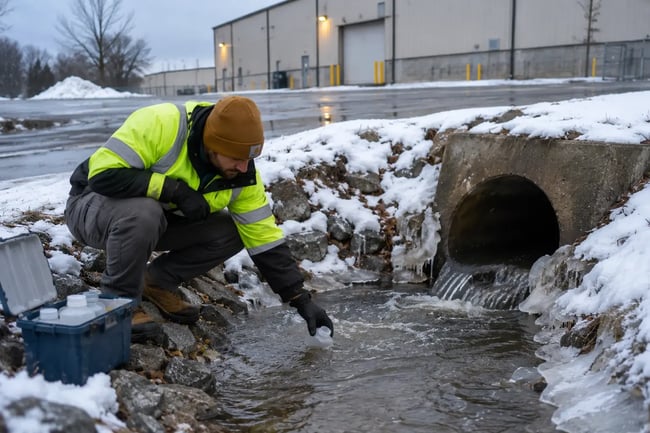
Winter creates problems rain doesn't. An outfall can be frozen shut or buried in snow, a thaw can produce a slow trickle across a lot for days, and the water that does come off the site is full of salt, sand, and whatever else the plows pushed around. None of that makes sampling impossible, but you need a plan for it before January.
Start with the permit. NJDEP's rules let a permit spell out the form of precipitation that counts, snowmelt or rainfall, along with the season and the minimum conditions for a valid storm, so whether a snowmelt discharge qualifies for your facility depends on your own permit's wording. Our article on snowmelt and stormwater samples goes into the details, and the question about when a sampling window starts is worth reading before your first winter event.
For the practical side, a few habits help. Walk your outfalls after a freeze and clear access routes and ice so you know in advance where you can safely reach water. If the discharge point is frozen or unsafe, don't chip at ice on a slope to get a sample. Photograph the conditions, write down the time and temperature, and treat it as an attempt you'll document. Keep sample bottles in the cooler, away from the cold truck bed, since a frozen bottle can crack or change the sample. Expect higher salt readings during deicing season and talk with your lab about how that may show up in your results. And if your plow crews or yard staff can see outfalls from their routes, ask them to flag blocked ones so you aren't discovering it mid-storm.
How Do You Handle a Long Dry Spell When a Stormwater Sample Is Due?
The opposite problem is a quarter where no qualifying storm arrives until the last few days, or at all. The most reliable fix is to treat the first week of the quarter as the start of your sampling window and stay ready the whole time. A plant that waits until the final month has a lot less room if the weather doesn't cooperate. That also keeps you from sampling a marginal event just to get something on paper, which can leave you with a result that doesn't meet your permit's criteria.
Keep the kit stocked, keep the on-call list current, and check the forecast weekly. Know where your water goes too. Some sites have outfalls that rarely flow or drainage that never leaves the property, and our article on sampling when water doesn't leave your site covers that situation. If the quarter ends without a qualifying discharge, don't assume you can skip the paperwork. Skipping a report because nothing happened can still lead to a missing-report problem, and how a no-discharge period gets reported depends on the monitoring report form and your permit, which we explain in reporting no discharge when you can't get a sample.
Do Automatic Stormwater Samplers Make Sense for a New Jersey Facility?
Sometimes. An automatic sampler sits at the outfall and collects a sample when it senses flow, so it can catch the 3 a.m. storm without anyone on site. That's appealing for remote locations, outfalls that are dangerous to reach, and facilities with thin staffing. But the trade-offs are real. Samplers cost money to buy and maintain, they need to be installed and programmed correctly, and in winter they can freeze, jam, or fail without a heated enclosure. A sampler that works in July can sit useless in January.
The bigger question is whether it matches your permit. Permits can call for specific sample types, such as grab samples or composites, and some parameters need to be collected by hand in a particular way, so a machine that collects a sample the permit doesn't allow doesn't help you. Our guide on grab samples versus composite samples explains the difference. Before you buy anything, read the monitoring section of your permit and ask your certified lab whether the sampler's method and sample handling fit. For many small sites, a well-trained crew and a ready kit are a simpler answer than hardware.
How Should You Document a Stormwater Sample You Couldn't Collect?
Sometimes you'll do everything right and still miss. The storm came and went before anyone could get there, the outfall was frozen, or conditions weren't safe. What you can control is the record. Write it down while it's fresh, and keep it with your SWPPP records so it's there if NJDEP asks.
A useful attempt log captures the date and time, the weather and a source for it, who was on call and who responded, what the outfall looked like, and the specific reason a sample wasn't collected. Add photos with timestamps, and note any steps you took, like calling the backup or driving to the site. If you were prevented because it wasn't safe, say so plainly. Reading it later, a reviewer should be able to tell the difference between a facility that tried and one that didn't.
Be realistic about what the log does. It shows good faith and gives you something concrete to point to, but it doesn't change what your permit requires, and it can't promise how a missed sample will be treated. How a missed event is reported depends on your permit and the reporting form, so check that language and ask us if it's unclear. If you're missing samples regularly, treat that as a sign your coverage plan needs work, whatever your logs say.
How Can RMA Help With Stormwater Sampling Plans?
We don't collect your samples. Storm events don't wait for a consultant to arrive, and nobody knows your outfalls like your own team, so we train you and your staff to sample correctly instead. We can help you read your permit, write down the storm criteria and reporting steps, build a one-page sampling procedure and kit list, set up a backup rotation, and interpret your results once they come back. If you have a SWPPP or annual reporting to update, we can help with that too.
There's no pressure and no obligation. You can call us, email us, or fill out the form on our website, and you can contact RMA about your sampling program whenever you're ready. If your permit doesn't require sampling, we'll tell you that too. You can also browse our NPDES and stormwater resources to keep reading.