The Permits and Plans Nobody Mentions at Business Registration, From Industrial Stormwater to Air, Waste, Oil Storage, and ISRA
You registered the business, signed the lease, and ordered equipment, and nobody along the way mentioned the environmental side. In New Jersey that's easy to miss, because business registration isn't connected to environmental permitting, and the New Jersey Department of Environmental Protection (NJDEP) doesn't send a welcome letter. Rain running off your yard, water going down your floor drains, a generator out back, a fuel tank, and the chemicals on your shelves can each come with their own permit, plan, or annual report. Which ones apply depends on what you do on site.
The short answer is that many new businesses need very little, and some need several things at once. This article walks through each program a new New Jersey business should check, starting with industrial stormwater permits, where we spend the most time, and then covering sewer approvals, air permits, waste rules, oil storage, Community Right to Know reporting, construction-phase requirements, and the Industrial Site Recovery Act (ISRA) that shows up later. If you'd like a second opinion on your own situation, you can reach out to RMA, and we'll tell you plainly if you don't need us.
Table of Contents
TL;DR
Registering a business in New Jersey doesn't trigger any environmental review, so spotting the permits is up to you. Which ones apply depends on what you do on site. Industrial stormwater coverage is the one most owners miss, while offices, retail, and many warehouses often don't need it. Sewer discharges, air-emitting equipment, hazardous waste, oil storage, and chemical inventories each have their own rules, construction brings separate approvals, and ISRA applies if you ever sell or close an industrial operation.
Which Environmental Permits Might Apply to a New Jersey Business?
Environmental rules attach to activities, not to business types or registration paperwork. A machine shop and a consulting office both have an address and an EIN, but only one is likely to store scrap outside, run a boiler, and generate waste solvents. The table below matches what you do to the programs that might apply, so you can see which sections of this article are worth your time. "Might" is the right word, because thresholds, exemptions, and exact scope vary, and we've called out where to verify.
| What you do |
What might apply |
Who regulates it |
| Operate an industrial, manufacturing, recycling, or similar facility with materials or activities outdoors |
NJPDES industrial stormwater permit, or a no exposure exclusion, plus a stormwater plan |
NJDEP |
| Send wash water, process water, or floor drain water anywhere |
Sewerage authority approval, possibly an SIU permit, or an NJPDES discharge permit |
Local sewerage authority, NJDEP |
| Run boilers, generators, spray booths, woodworking, or dust-producing equipment |
Air permit, either a general permit or a preconstruction permit |
NJDEP |
| Generate paints, solvents, aerosols, batteries, or other hazardous waste |
Generator status, storage, labeling, manifests, training |
NJDEP, EPA |
| Take in material to sort, crush, or recycle |
New Jersey recycling approval, plus stormwater |
NJDEP |
| Store fuel, oil, or hydraulic fluid |
Federal SPCC plan, Spill Act reporting, larger plans at very large storage volumes |
EPA, NJDEP |
| Keep hazardous chemicals on site |
Community Right to Know Survey, federal Tier II reporting |
NJDEP, EPA |
| Build, expand, or disturb land |
Soil erosion certification, construction stormwater coverage, site plan approvals (RMA doesn't handle these) |
Soil Conservation District, NJDEP, municipality |
| Later sell, close, or transfer an industrial business |
ISRA |
NJDEP |
| Run an office, retail shop, or warehouse with nothing industrial outdoors |
Often none of the above, though a few can still apply |
Varies |
Does Your New Jersey Business Need an NJPDES Industrial Stormwater Permit?
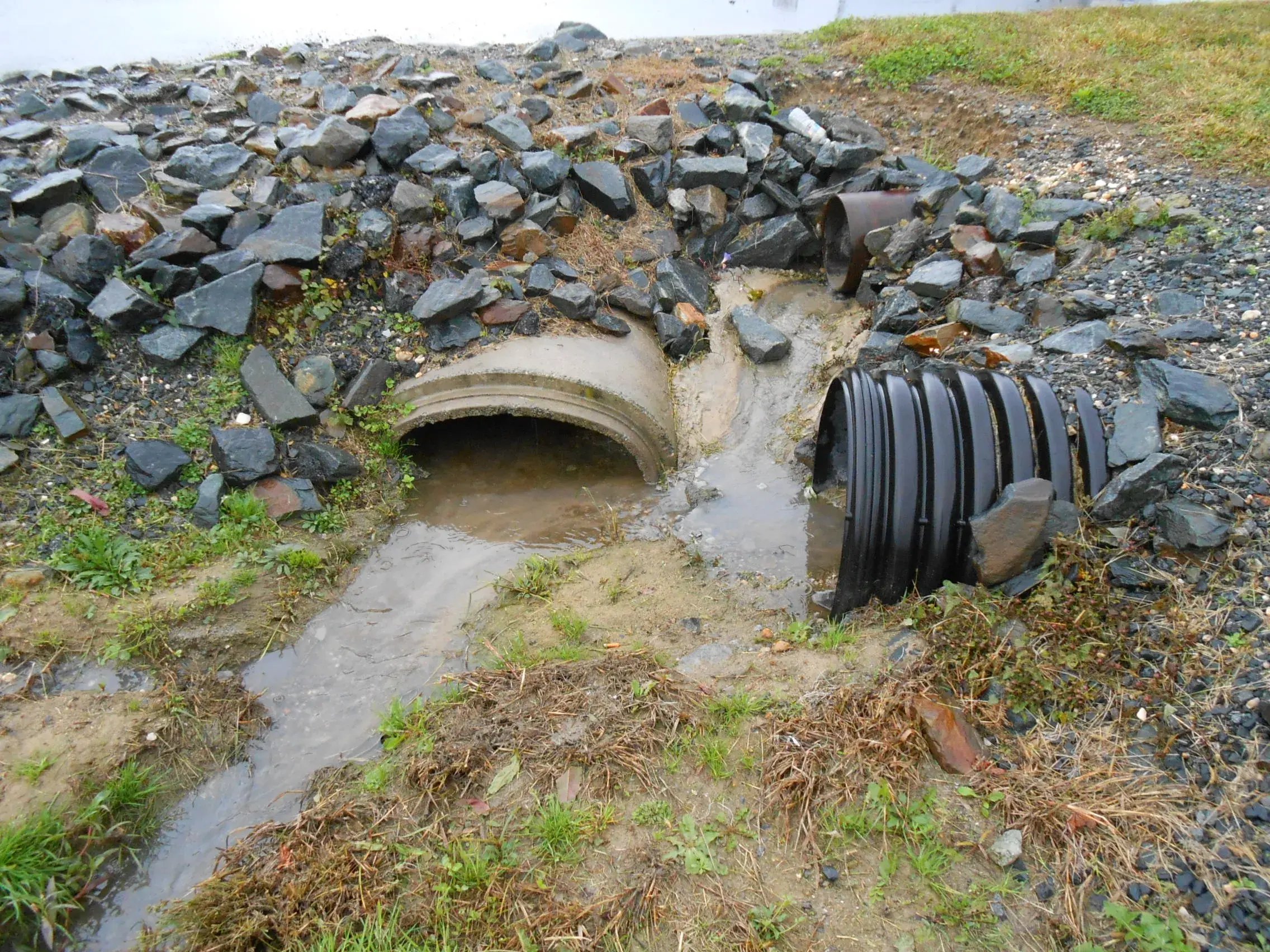
Start with a plain picture: rain falls on your yard, runs across pavement and past stored materials, and ends up in a storm drain or a stream. NJDEP regulates that runoff at certain businesses through the New Jersey Pollutant Discharge Elimination System (NJPDES), the state's version of the federal NPDES program, under the Water Pollution Control Act. Federal rules describe eleven categories of "stormwater associated with industrial activity," and whether you're covered depends on what your facility does, whether industrial materials or activities are exposed to rain and snowmelt, and where the water goes. Our article on stormwater associated with industrial activity covers the definition in more detail.
Which New Jersey Industrial Stormwater Permit Fits Your Business?
New Jersey doesn't use one general permit for everyone. It uses a basic permit plus several industry-specific ones, and picking the wrong one is a common and avoidable mistake. The Basic Industrial Stormwater General Permit (5G2) is available to regulated facilities that have eliminated all exposure of industrial materials and activities to stormwater, or can do so within six months of authorization. Facilities that can't get there, usually because the work happens outdoors, generally need an industry-specific permit or an individual one.
| NJPDES stormwater permit |
Built for |
| Basic Industrial Stormwater (5G2) |
Regulated facilities with no exposure, or that can eliminate it within six months |
| Concrete Products Manufacturing (CPM) |
Concrete products plants |
| Hot Mix Asphalt (R4) |
Asphalt production |
| Mining and Quarrying (R13) |
Mines and quarries |
| Sand and Gravel (RSG) |
Sand and gravel operations |
| Scrap Metal (SM and SM2) |
Scrap metal recycling |
| Vehicle Recycling (RVR) |
Vehicle recyclers |
| Wood Waste Recycling and Leaf Composting (WRC) |
Wood waste recyclers and leaf composters |
| Individual NJPDES permit |
Facilities that don't fit a general permit |
There's also an exclusion for facilities with no exposure at all. NJDEP's current guidance spells out who qualifies and what the filing involves, so check it or talk with us before assuming your site qualifies. Our guides on choosing between general, individual, and no exposure options, the 5G2 basic permit, and when an individual permit is needed go deeper on each path.
What Does Industrial Stormwater Coverage Involve After You Apply?
You apply by submitting a Request for Authorization (RFA) to NJDEP for the permit that fits your facility. Coverage generally comes with a written stormwater pollution prevention plan, sometimes called an SPPP, an SP3, or just a stormwater plan, which we'll call a SWPPP here. It also comes with regular inspections, employee training, and an annual certification. Sampling depends on the permit category, and some permits require none, so confirm it against the current permit for your category rather than assuming. Timelines and fees also change, which is why we'd point you to our article on how long a New Jersey stormwater permit takes and to our SWPPP explainer.
Which New Jersey Businesses Probably Don't Need Industrial Stormwater Coverage?
Offices, retail stores, and restaurants generally aren't in a regulated industrial category. Warehouses, data centers, body shops, dealerships, and quick-lube shops also often fall outside, though the answer turns on the specific activities on your site. A fleet or delivery business is regulated only for vehicle maintenance, equipment cleaning, fueling-related, and deicing areas, not for parked trucks. If you lease, ask your landlord whether the property already has coverage, and remember that a new tenant's activities can change the answer.
Do You Need Sewerage Authority Approval for Wastewater?
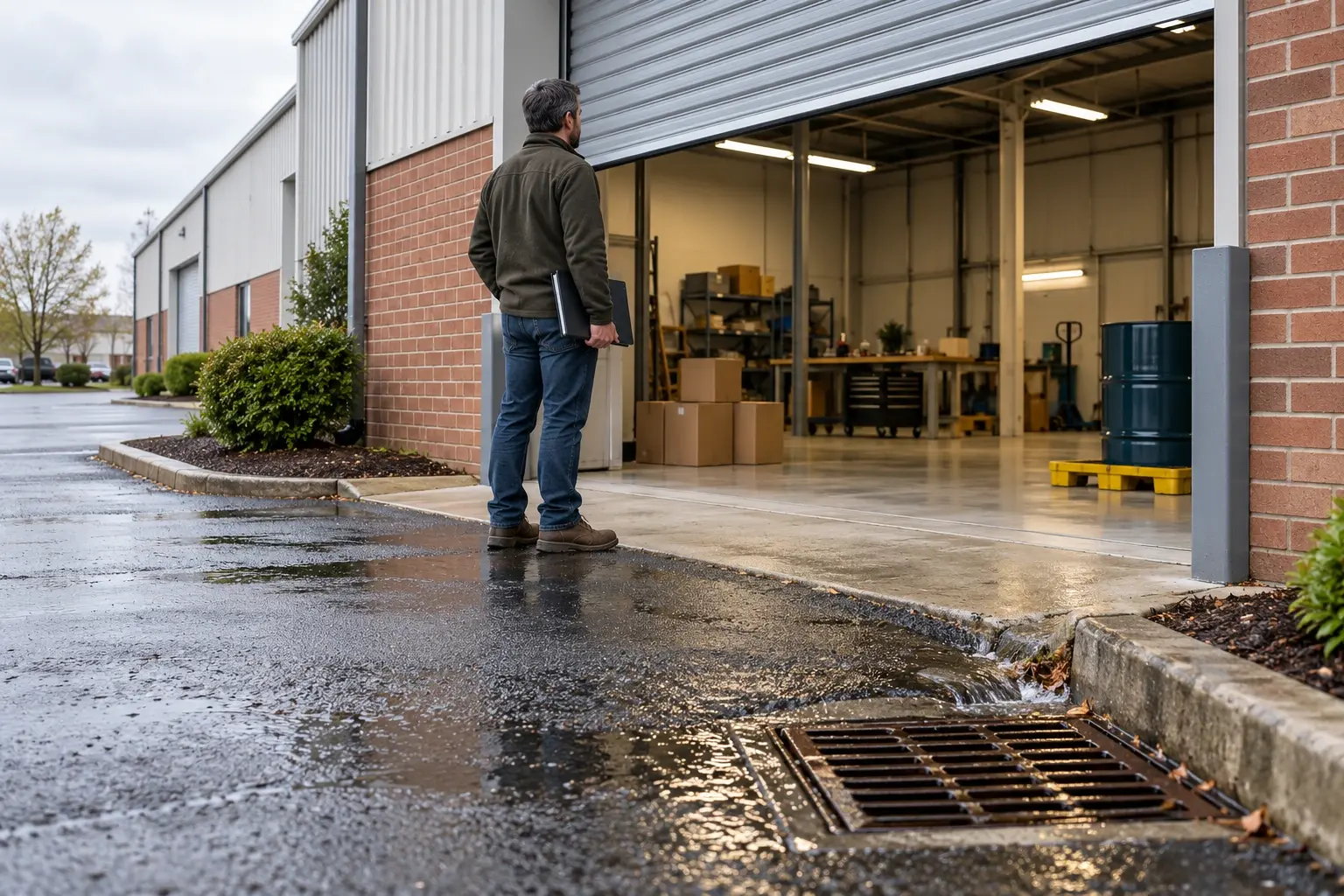
Rain isn't the only water leaving your building. Wash water, process water, and floor drain water can trigger separate requirements, and where it goes decides which ones. If it goes to a sanitary sewer, you're an "indirect user" of the local sewerage authority's treatment plant. NJDEP says not every indirect user needs an individual NJPDES permit, but all must meet minimum requirements, and a significant indirect user (SIU) needs an NJPDES SIU permit. Depending on your area, SIUs are regulated by a delegated local agency or by NJDEP directly, and the authority may add its own conditions. Discharging process water to a storm drain, stream, or the ground is a different matter and generally needs its own NJPDES permit, which is why the difference between stormwater and process water is worth understanding before you plumb anything.
Several older New Jersey cities have combined sewers, where stormwater and wastewater share pipes. At those sites the sewerage authority's rules may apply instead of, or alongside, an NJPDES stormwater permit. We'd never tell you flatly that a site in a particular city does or doesn't need a stormwater permit, because it depends on where your site drains. Confirm that with the sewerage authority and NJDEP.
Does Your New Jersey Business Need an Air Permit for Equipment?
New Jersey requires NJDEP approval, usually a preconstruction permit under N.J.A.C. 7:27-8, before you install or modify equipment that emits air contaminants. Many small sources qualify for a general permit, which is a pre-approved permit with set conditions, instead of a full case-by-case permit. Equipment that commonly triggers a look includes generators, boilers and other fuel burning equipment, spray booths and coating operations, woodworking equipment, and dust-producing operations. The rule also contains catch-all provisions, so equipment that isn't on an obvious list can still need approval.
Timing is where new businesses get hurt. Installing a generator or spray booth first and asking questions later can put you out of compliance on day one, and NJDEP can take enforcement action for equipment running without a permit. Check applicability before you buy, not after. Our guide on whether you need an air permit is a good place to start, and we prepare air permit applications for clients when one is needed.
What Hazardous Waste and Recycling Rules Apply to a New Jersey Business?
Almost every business generates some waste, and some of it is regulated. Paints, solvents, aerosols, batteries, and contaminated materials can all be hazardous waste under federal RCRA rules and New Jersey's hazardous waste program. Your generator status, which is based on how much hazardous waste you produce in a month, determines storage time limits, labeling, training, manifests, and reporting. Even a small shop needs to identify its waste streams before it can know which category it's in. Our waste and hazardous waste management page explains how we help with that.
Recycling is its own track. If your business takes in material from others to sort, crush, or process, such as concrete, asphalt, wood, or scrap, New Jersey has a recycling approval process separate from stormwater and waste generation rules. We handle New Jersey recycling approvals, and it's far easier to plan for one before you sign a lease than after.
Do You Need an SPCC Plan for Oil Storage in New Jersey?
Federal Spill Prevention, Control, and Countermeasure (SPCC) rules apply to facilities that store more than 1,320 gallons of oil in total above ground and have a reasonable expectation of a discharge reaching navigable waters or adjoining shorelines. Oil includes diesel, gasoline, hydraulic oil, lubricants, heating oil, and used oil, and the capacity counts across every container on site, so several small drums and a fuel tank can add up. A required plan describes your containers, containment, inspections, and spill response. Underground tanks add their own rules, so mention them to whoever prepares your plan.
New Jersey layers its own rules on top under the Spill Compensation and Control Act. Everyone in the state, including homeowners, must report a discharge of a hazardous substance under N.J.A.C. 7:1E-5, and facilities storing 200,000 gallons or more of regulated hazardous substances including petroleum, or 20,000 gallons or more excluding petroleum, face additional planning requirements. If a spill happens, stop the source if it's safe to do so, call emergency services for any danger to people, and report it to NJDEP. Our comparison of SPCC plans and SWPPPs and our SPCC plan process cover the details.
Do You Have to File Community Right to Know Reports in New Jersey?
Under the New Jersey Worker and Community Right to Know Act, private employers in covered NAICS codes file an annual Community Right to Know Survey with NJDEP, due March 1. The survey lists environmental hazardous substances present at the facility at or above the reporting threshold, and thresholds vary by substance. NJDEP has also asked covered facilities with no reportable substances to file an exemption or non-user form instead of ignoring the survey.
Federal reporting under EPCRA sits alongside this. Facilities that store hazardous chemicals above federal thresholds file Tier II inventories, and certain manufacturers also face Toxic Release Inventory (TRI) reporting. How the state and federal filings fit together depends on what you store, so build a chemical list from your Safety Data Sheets first. Our Tier II reporting service starts with exactly that question.
What Construction Permits Apply When Building a New Jersey Facility?
If you're building or expanding, a separate set of construction-phase requirements applies. The Soil Erosion and Sediment Control Act requires a plan certified by your local Soil Conservation District for most non-agricultural projects that disturb more than 5,000 square feet of land. Larger land disturbances also bring construction stormwater coverage under NJPDES, known as the 5G3 general permit, which is handled through the Soil Conservation Districts. Major developments face stormwater management design rules under N.J.A.C. 7:8, and your municipality will have its own site plan approvals.
We don't prepare any of those construction-phase permits or approvals. Your engineer, contractor, or a soil erosion specialist handles them, and we're glad to help you work out what your project needs and point you to the right people. Where we come in is the other half: once the facility is running, it almost always needs operational permits and plans, such as the right NJPDES industrial permit or a no exposure exclusion, a SWPPP, inspections and annual certification, sampling where the permit requires it, and often SPCC and Community Right to Know filings. Our article on environmental consultants on construction projects draws the line between the two.
What Is ISRA and When Does It Apply to a New Jersey Business?
The Industrial Site Recovery Act (ISRA) isn't a day-one permit. It applies to "industrial establishments," meaning businesses whose NAICS code is listed in Appendix C of the ISRA rule, N.J.A.C. 7:26B. It kicks in when a triggering event occurs, such as closing or ending operations or transferring ownership or operations, including a sale of the business or of a controlling interest in it. The duty falls on the owner of the establishment, the owner of the real property, or the operator, and it generally involves notifying NJDEP and, depending on the facts, investigating and cleaning up the site, with some submissions due before a sale closes.
For a new business, ISRA matters most in two ways. First, if you're buying or leasing an existing industrial property, a Phase I Environmental Site Assessment before you commit shows what you're stepping into. Second, the records you keep about what you store and generate today will shape how smoothly a sale or closure goes later. ISRA carries real legal and financial exposure, so involve an environmental attorney whenever a transaction is on the table.
How Can RMA Help Sort Out Your New Jersey Environmental Permits?
Where do you start? Write down what you do on site, where your water goes, what equipment you'll run, what you'll store, and what you plan to build, then check each against the table above. We're a family-run firm based in New Jersey and have been at this since 1992, so we know NJDEP's categories well, and senior staff do the work. If your business is small, our page on environmental help for small businesses explains how we approach it, and our online environmental assessment is a free way to get oriented. Our staff training is also available through the online environmental training library.
If you'd like to talk it through, you can call us, email, or fill out the form on our website, and there's no obligation. Tell us what you're starting, and we'll tell you what applies, what doesn't, and whether you need us at all, since plenty of new businesses can handle a few items themselves. Whenever you're ready, contact RMA and we'll point you in the right direction. Growth changes the answers too, which is why we wrote about how business growth triggers new environmental requirements.