An Honest Walkthrough of Delaware Stormwater Inspections, What Inspectors Actually Look At, and How to Leave Them Satisfied
If you just got notified about a DNREC stormwater inspection, there's a good chance your stomach dropped a little. That's a completely normal reaction, and it's usually more anxiety than the situation warrants. A Delaware stormwater inspection is serious, but it's rarely the disaster people picture in their heads before it happens.
DNREC inspectors are there to evaluate compliance, identify problems, and gauge whether your facility is making a real effort to follow its permit. They aren't expecting perfection from every site they walk onto. What they're actually looking for is whether you're organized, cooperative, informed, and actively trying. Below we'll walk through what triggers an inspection, what happens during one, what tends to catch an inspector's attention, and what to do afterward. If you'd rather talk through your specific situation, you can reach out to RMA directly.
Table of Contents
TL;DR
Most DNREC stormwater inspections aren't about catching a facility doing something wrong. Inspectors review your records, walk the site, and check sampling history to see whether you understand your permit and are actively managing it. Inspections typically move from a documentation review into a site walkthrough covering material storage, drainage, outfalls, and housekeeping. Disorganization causes more trouble than honest deficiencies do, and a facility that stays cooperative and shows it's engaged with compliance generally comes out of an inspection in far better shape than one that gets defensive.
Why DNREC Stormwater Inspections Happen
A lot of facilities assume an inspection only happens because they did something wrong. Usually that's not the case. Some inspections are routine, tied simply to how long it's been since the last one. Some are triggered by a specific permit condition. Some happen because a facility falls into a category DNREC prioritizes for review. And yes, some inspectors show up unannounced.
That last part surprises people, but it's normal, and it isn't automatically a bad sign. Many stormwater inspections are intentionally unannounced because DNREC wants to see the facility as it actually operates day to day, not the version that gets cleaned up in the thirty minutes after a phone call. An unannounced visit means the inspector is there. It doesn't by itself mean you're in trouble.
One clarification worth making here: Delaware runs its own industrial stormwater program under state regulations rather than under EPA's federal Multi-Sector General Permit, so if you've read that a facility's inspection frequency depends on its MSGP sector, that's describing a different state's system, not Delaware's. DNREC still prioritizes inspections by risk and industry type, the mechanics are just built around Delaware's own regulations rather than the federal permit.
The Mindset That Actually Matters
The biggest shift we try to help facilities make is realizing the inspection itself isn't the enemy. Disorganization is. Facilities that understand their permit, know where their records are, and cooperate generally come out of an inspection in far better shape than facilities that get defensive, evasive, or chaotic, even when the underlying compliance issues are similar.
One way to think about it: what do you want the inspector to do at the end of the visit? Leave. And how do you want them to leave? Satisfied. That doesn't mean leaving without any findings, and it doesn't mean automatically passing with no follow-up. It means the facility demonstrated professionalism, preparedness, and a real willingness to address whatever comes up. Inspectors do this for a living. They can tell the difference between a facility genuinely trying to comply and one trying to avoid responsibility, usually within the first few minutes.
The Records Review
Most DNREC stormwater inspections start with a documentation review before the inspector ever walks the site. Records they typically ask for include:
- The current SWPPP
- Inspection logs and records
- Sampling and monitoring data
- Employee training records
- Corrective actions completed since the last review
This is where a lot of facilities run into trouble, not because the records don't exist, but because nobody can find them in the moment. Documentation scattered across emails, filing cabinets, desktops, and a folder named something like "Stormwater FINAL FINAL 3" causes more stress on inspection day than any actual deficiency usually does. Reviewing your records system periodically, rather than only when a notice arrives, is one of the simplest ways to lower that stress before it starts, and it's worth checking your retention practices at the same time, since some of what an inspector asks for has its own minimum retention period under your permit.
If an inspector asks for something you genuinely can't locate on the spot, the better move is calmly saying you'll find it and follow up, rather than guessing or handing over something that might be wrong. An inspector would rather wait a day for the right document than receive an incorrect one immediately.
The Site Walkthrough
After the records review comes the part most people picture when they imagine an inspection: the walk around the facility. Inspectors typically look at material storage areas, dumpsters, loading zones, drainage paths, outfalls, and whatever stormwater controls the facility has in place.
This usually isn't a dramatic search for a single catastrophic problem. Inspectors are evaluating whether your stormwater controls appear functional and whether pollutant exposure risks actually exist, and they're also picking up on operational culture along the way. Does the facility look maintained? Do employees seem to understand what's expected of them? Do the BMPs look intentional, or does everything look like it was addressed the day before the inspection and forgotten since? That impression shapes the rest of the visit more than people expect.
Practically, that means walking the same ground your own SWPPP describes: where materials are stored outdoors, where equipment gets fueled or maintained, where waste containers sit, and where water actually leaves the property. An inspector who finds a drum sitting in the open next to a storm drain doesn't need to find much else to start asking harder questions.
Sampling Records and Benchmark Results
Sampling history is another major focus, and it's often where facilities get nervous, because stormwater sampling genuinely can be technical. It's common for facilities managing compliance internally, without a dedicated environmental team, to misunderstand sampling frequencies, timing windows, or what a benchmark exceedance actually requires them to do next.
One exceeded benchmark usually isn't what creates a real problem. Ignoring a pattern of them is. Inspectors want to see engagement with the process: did the facility investigate, document what it found, and take a corrective action, or did it note the number and move on? "We identified elevated results, looked into potential sources, and documented what we did about it" lands very differently than silence on the same data. Benchmarks versus limits is worth understanding if you're not sure what your own results actually mean.
Inspectors will often cross-check your sampling records against what was actually submitted in your Discharge Monitoring Reports, and gaps between the two are an easy thing to get caught on. A missing sample that never got reported as a no-discharge event, or a benchmark exceedance that shows up in a lab report but never made it into a DMR, reads as a records problem even when the underlying cause was innocent. What a DMR actually needs to contain and reporting no discharge when you can't collect a sample are both worth reviewing if your reporting history has any gaps you haven't accounted for.
Why Housekeeping Matters More Than People Think
This might sound too simple to matter, but housekeeping is one of the biggest factors in how an inspection actually goes. Organized storage, labeled containers, clean drainage areas, and maintained BMPs immediately signal that someone is paying attention. Trash buildup, leaking drums, outdoor debris piles, and neglected containment systems tend to invite deeper scrutiny very quickly, whether or not they reflect an actual permit violation.
A lot of stormwater problems are, at their core, housekeeping problems. Compliance rarely fails because of one catastrophic issue. It usually fails because a hundred small preventable things quietly added up, which is exactly why regular site walkthroughs on your own schedule matter as much as the ones DNREC eventually shows up for.
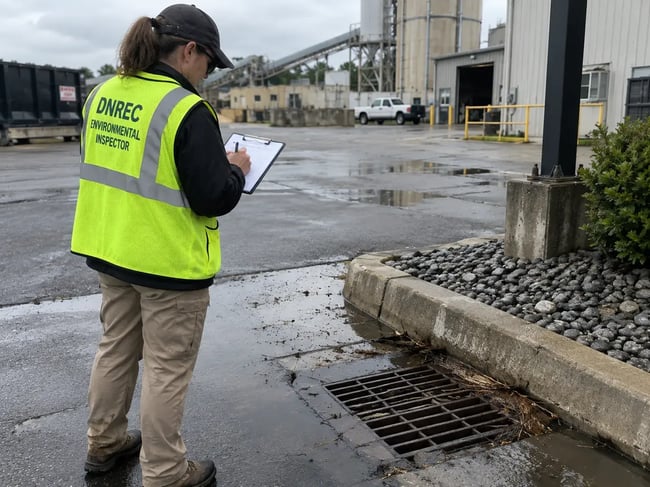
Outfalls and Whether Your SWPPP Still Matches Reality
Outfalls get particular attention. Inspectors commonly compare your SWPPP's drainage maps against what's actually on the ground, and if the two don't match, that becomes a problem quickly. This happens constantly after facilities expand, move materials, modify drainage, install new equipment, or shift process areas without updating their plan. The documented conditions no longer describe the real ones, and an inspector notices the gap immediately.
That's one of the better reasons to review your program periodically rather than only after a change feels significant enough to warrant it. Five signs it's time to update your program is a useful check if it's been a while since anyone looked at your SWPPP against the current site.
Common Findings in Delaware Stormwater Inspections
Most of what turns up in these inspections falls into a predictable range:
- Missing or disorganized records
- Drainage or outfall conditions that no longer match the SWPPP
- Exposed materials or leaking containers
- Poor housekeeping around storage and drainage areas
- Unaddressed benchmark exceedances or missing corrective action documentation
Notice what's not on that list. Most of these are operational management issues rather than catastrophic environmental events, which is actually reassuring, since it means most inspection risk is preventable with better organization and periodic maintenance rather than a major capital project.
What Not to Do During an Inspection
Most inspections go sideways for the same handful of reasons:
- Guessing at answers instead of saying you'll check and follow up
- Minimizing or hiding information the inspector is likely to find anyway
- Arguing with observations rather than acknowledging what's actually there
- Treating the visit as adversarial from the moment the inspector arrives
None of that changes the underlying compliance picture, and all of it makes the inspector's job, and yours, harder. You don't have to act like the inspection is no big deal, because it is one. But professionalism, cooperation, and transparency go a long way, even when real findings exist. A facility that leaves an inspector with the impression that it's cooperative, informed, and willing to fix what needs fixing is in a stronger position than one that leaves them with the opposite impression, regardless of how the underlying numbers looked going in.
What Happens After the Inspection
After the visit, DNREC typically issues some form of follow-up communication, which can range from informal notes to a formal notice of violation depending on what was found. Most inspections don't end in immediate, severe enforcement. In many cases, facilities are given a real opportunity to correct deficiencies and document the improvement.
What tends to matter most after that point is timing and follow-through. Findings that get addressed promptly and documented clearly usually stay minor. Findings that get set aside for six months are where situations tend to escalate, sometimes into a formal notice of violation and a compliance schedule rather than the informal correspondence that a quicker response would have produced. This is also where experienced environmental support tends to earn its keep, since compliance can get technical fast once corrective action documentation, benchmark exceedances, or SWPPP updates are all on the table at once.
How RMA Helps Facilities Prepare for Inspections
We help Delaware facilities prepare for DNREC stormwater inspections, maintain SWPPPs that actually reflect current site conditions, manage sampling requirements, and respond to inspection findings once they arrive. A lot of our work is identifying compliance gaps before an inspector does, which is a much less stressful way to find them.
The facilities that handle inspections best usually aren't the ones with zero issues. They're the ones that stay organized, cooperate professionally, and can show they're making a genuine effort to comply with their permit. If you want help getting there, call us, email us, or fill out the form on our contact page. There's no pressure and no obligation. We'll help you figure out where you stand, and you can decide what to do from there.