Hiring an SPCC Plan Consultant Outside Pennsylvania: What Stays the Same, What Doesn't, and How Far Is Too Far
If you store oil at a Pennsylvania facility, there's a good chance a federal rule applies to you. An SPCC Plan (short for Spill Prevention, Control, and Countermeasure Plan) is the written oil spill plan EPA requires when a facility stores more than 1,320 gallons of oil aboveground, counting only containers of 55 gallons or more, or more than 42,000 gallons buried. If your tanks put you over that line, you'll need one. If you already have one, it needs a review every five years and an update when your tanks or layout change. Either way, you'll end up calling consultants, and some of them won't have a Pennsylvania address. That raises a fair question about whether the location of the firm matters.
It does, but less than most people expect and in a different way than they expect. The rule itself doesn't change at the state line. What changes is the Pennsylvania layer around it, the travel involved, and the engineer's license if your plan needs a stamp. We'll walk through each of those, give you our view on which distances make sense, and show you what to ask before you sign anything. If you'd rather talk through your own site, you can reach out to RMA at any point.
Table of Contents
TL;DR
Yes, a firm outside Pennsylvania can prepare your SPCC Plan. SPCC is a federal rule, so the requirements are the same nationwide, and what matters is real SPCC experience plus working knowledge of Pennsylvania's tank program and state spill plans. If your plan needs a Professional Engineer's stamp, ask where that engineer is licensed. A firm from a neighboring state that travels Pennsylvania regularly is a fine choice. A firm from across the country usually means paying for travel and getting less local knowledge for it.
Is the SPCC Rule the Same in Every State?
Yes. SPCC lives in 40 CFR Part 112, a federal regulation, and EPA applies it the same way in Pennsylvania as it does in Ohio or Oregon. The capacity threshold, the inspection and testing requirements, the containment sizing, the annual training, and the five-year review are identical everywhere. In Pennsylvania, EPA Region 3 is the agency that enforces it (our post on who enforces SPCC plans covers how inspections work). Any consultant who writes SPCC Plans for a living can produce a plan that meets the federal rule, no matter where their office is.
What changes from state to state is the layer wrapped around the federal rule. Pennsylvania has its own storage tank program run by DEP under the Storage Tank and Spill Prevention Act and 25 Pa. Code Chapter 245. Depending on the tank, that program can bring registration, DEP-certified installers and inspectors, and integrity testing requirements that have nothing to do with EPA. Pennsylvania also has state-level plans such as the PPC Plan and, for larger aboveground storage tank facilities, the Spill Prevention Response Plan (SPRP). Whether any of them apply depends on your tanks, and our post on the difference between SPCC, PPC, and SPRP plans sorts them out. A plan can be perfectly valid under the federal rule and still leave you exposed on the Pennsylvania side if the person who wrote it never looked at that layer.
What Pennsylvania Experience Should an SPCC Plan Consultant Have?
Think of it as three things in order of weight: SPCC experience first, Pennsylvania familiarity second, and the firm's address a distant third. A consultant who has written hundreds of SPCC Plans and knows the Pennsylvania tank program will serve you better than a Pennsylvania firm that writes two plans a year. The table below shows what to look for and why each item matters on a Pennsylvania site.
| What to look for |
Why it matters at a Pennsylvania facility |
| A track record of SPCC Plans, not just general environmental work |
Container counting, secondary containment sizing, and the Tier I, Tier II, and PE-certified decision all take judgment that comes from repetition. |
| Working knowledge of DEP's storage tank program |
Tank registration, certified inspectors, and testing schedules sit on top of the federal plan, and a gap there is a separate violation. |
| Familiarity with the PPC Plan and SPRP |
Some facilities need a state plan in addition to the SPCC Plan, and a good consultant checks before assuming one document covers everything. |
| A feel for Pennsylvania sites |
Creeks, storm drains, and slopes shape where a spill would go, and the federal rule asks you to judge that realistically for your own property. |
Ask any firm you're considering for a few examples of Pennsylvania plans they've done, and ask how they handle the DEP side. If the answer is vague, that tells you something regardless of where the office sits. For a deeper look at how the process works, our post on what it's like to hire an SPCC plan consultant walks through a typical engagement.
Does a Pennsylvania SPCC Plan Need a Pennsylvania-Licensed Engineer?
Many plans don't need an engineer at all. A facility that qualifies as a Tier I qualified facility, generally one with 10,000 gallons or less of aboveground oil storage and a clean recent spill history, can self-certify its plan. Larger or more complex facilities need a licensed Professional Engineer (PE) to review and certify the plan under 40 CFR 112.3(d), and technical amendments need the same treatment. Our post on the different types of SPCC plans shows which category tends to fit which facility.
When a PE is required, the federal rule asks for a licensed engineer without naming a state. EPA has said the federal rule doesn't require the PE to be licensed in the same state as the facility, but it has also noted that state rules can keep an engineer from applying a seal where they aren't licensed. Pennsylvania's State Registration Board for Professional Engineers, Land Surveyors and Geologists regulates engineering practice in the state, and Pennsylvania has a licensure path for engineers already licensed elsewhere. Whether signing an SPCC certification counts as practicing engineering in Pennsylvania can turn on specific facts, so the board is the place for a final answer. In practice, the safe move is to ask your consultant who the engineer is and where they're licensed. Our post on whether an SPCC plan needs a Pennsylvania-licensed engineer goes further on this question.
Here's how it works at RMA. We don't have a PE on staff. When a plan needs one, we work with an outside professional engineer for the state the plan is in. Our staff usually do the site visit and develop the plan, and then the engineer reviews it, stamps it, and seals it. That review is paid work and it adds time, which is one reason PE-certified plans cost more, as we explain in why PE-certified SPCC plans cost more in Pennsylvania. EPA allows the engineer's agent to do the site examination as long as it fits good engineering practice, so the person walking your site isn't always the engineer.
How Do SPCC Site Visits Work With a Firm Outside Pennsylvania?
A lot of the work happens before anyone drives anywhere. We start with a call, email, or Teams meeting to learn where your facility stands, then gather your tank inventory, photos, existing paperwork, and a rough site layout remotely. Some facilities are a good fit for doing nearly everything that way, and we cover that in how remote SPCC development works and whether your facility is a good fit for it. A site visit is only needed when the consultant has to see the facility, and a PE-certified plan raises that likelihood because of the examination requirement.
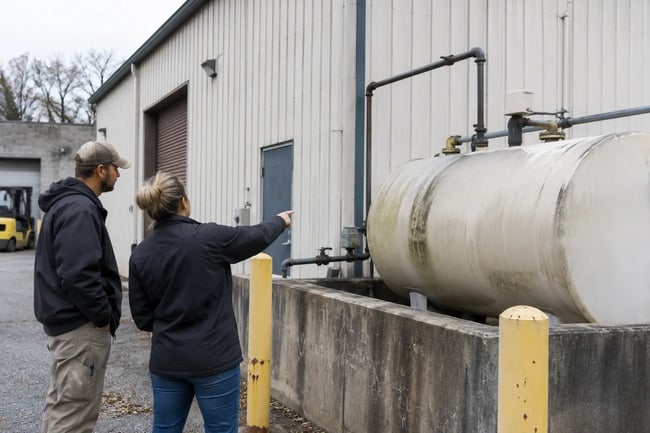
When a visit is needed, it's usually short. At RMA, one lead consultant comes to the site for roughly one to four hours, photographing and measuring tanks, containment, drains, and the surrounding ground. We schedule around your operations, and you can escort us or let us work independently depending on your safety rules. For a firm in a neighboring state, that's a day trip. A consultant from Ohio, New York, Maryland, or Delaware can reach most Pennsylvania facilities by car without a hotel stay, and travel barely changes the price. A firm that needs a flight, a rental car, and a night in a hotel to look at one diesel tank will pass those costs along somehow.
How Far Is Too Far to Hire an SPCC Consultant for a Pennsylvania Facility?
Our opinion is that a neighboring state is totally fine. We work from outside Pennsylvania, we have no problem traveling throughout the state, and we do it all the time. Where it stops making sense is a firm from the West Coast. You're paying for their travel, and they may not understand the Pennsylvania landscape, from the DEP program to the way creeks and storm drains run through industrial areas. You'd be paying more for less local knowledge. The table lays out how we'd think about it.
| Where the firm is based |
Travel to your site |
Pennsylvania familiarity |
Our take |
| Pennsylvania |
Shortest drive |
Built in, if they do SPCC regularly |
A strong choice when SPCC is a real part of their work |
| Neighboring state |
Usually a day trip by car |
Good if they regularly work in Pennsylvania |
Perfectly fine |
| A few states away |
Long drive or a short flight |
Varies a lot, so ask for Pennsylvania examples |
Reasonable if the plan can be done mostly remotely |
| Across the country |
Flights, lodging, rental car |
Often limited |
Rarely worth it for a single site |
One more point in fairness to Pennsylvania firms. If a local firm with solid SPCC experience is nearby and priced reasonably, hire them. We'd rather you get a good plan than a plan from us. And if your facility is small enough to self-certify, you may not need a consultant at all, which we cover in how to write your own SPCC plan for a Pennsylvania facility.
Does an Out-of-State SPCC Firm Cost More?
Not by much when the firm is close, and sometimes by quite a bit when it isn't. RMA's SPCC plans run roughly $1,500 to $15,000 overall, and a simple Tier I plan typically falls between about $1,500 and $4,000. Those numbers move with the facility, not with the state line. Travel only shows up as its own cost driver when the trip gets long, and it matters most when a site visit is needed. For a full look at pricing, see our posts on SPCC plan costs and Tier I plan costs in Pennsylvania.
| What drives the price |
Pushes it up when |
Keeps it down when |
| Plan type |
A PE has to review and certify |
The facility qualifies for a Tier I self-certified plan |
| Number of containers |
Many tanks, drums, totes, and oil-filled equipment |
A few tanks in one area |
| Secondary containment |
Containment has to be evaluated or sized |
Existing containment is clearly adequate |
| Site visit and travel |
The consultant has to fly or stay overnight |
Information can be gathered remotely or the trip is a drive |
If you'd like a ballpark for RMA's help with your own facility, the pricing calculator below takes a couple of minutes and doesn't require a call. It's also available on its own page as the SPCC plan pricing calculator.
What Questions Should You Ask Any SPCC Plan Consultant Before Hiring?
Whether the firm is in Harrisburg or three states away, the same questions sort the good ones from the rest. Here are the ones we'd ask if we were in your seat:
- How many SPCC Plans have you written for Pennsylvania facilities, and can you describe one similar to mine?
- How do you handle DEP tank registration, certified inspections, and the PPC Plan or SPRP if they apply to me?
- If my plan needs a PE, who is the engineer, where are they licensed, and can I verify the license?
- Who will visit my site, and will it be the person who writes the plan?
- What does the quote include, and what happens to the price if you have to travel?
- Who handles the five-year review and later amendments, and what will that cost?
A consultant who answers these plainly is worth considering. One who dodges them is telling you how the engagement will go. Our guide on the Pennsylvania SPCC compliance calendar also helps you see what ongoing work comes after the plan is written, so you can ask about it before you sign.
How Does RMA Help Pennsylvania Facilities With SPCC Plans?
RMA is a family-run firm, and our senior staff do the actual SPCC work rather than handing it to someone junior. We work with Pennsylvania facilities regularly and travel across the state for site visits when they're needed. When a facility is a good fit, we handle most of the information gathering remotely so you're not paying for a trip you don't need. If your plan needs a Professional Engineer, we bring in an outside engineer and tell you who it is and where they're licensed before the work begins. We'll also tell you straight if you can self-certify and don't need us. Our online environmental training library is there too if your team needs SPCC training after the plan is in place.
There's no pressure and no obligation in a first conversation. You can call, email, or fill out the form on our website, tell us what you store and where, and we'll give you a straight read on what you need. If that sounds useful, contact RMA whenever you're ready.