How PAG-03, No Exposure Certification, and Loading Rack Spill Controls Apply to Petroleum Bulk Plants, Heating Oil Dealers, and Fuel Terminals
A fuel distribution yard looks like a stormwater problem before anyone explains a single rule. There are diked tanks, a truck loading rack, tanker trucks parked on gravel, and thousands of gallons of petroleum moving through a few acres that drain somewhere when it rains. The short answer is that most Pennsylvania fuel distributors and bulk plants that run their own trucks need coverage under PAG-03, which is DEP's general permit for stormwater from industrial sites, or a No Exposure Certification, which is a DEP-approved exemption for sites that keep everything under cover. PAG-03 is one of the NPDES (National Pollutant Discharge Elimination System) permits that Pennsylvania's Department of Environmental Protection, or DEP, issues for water leaving a site. The trigger is specific, though, and a few operations don't meet it.
Below, we walk through which parts of a bulk plant DEP treats as covered, where the water goes, why loading rack spill controls matter so much, and what permit coverage involves day to day. We also cover the other plans and tank registrations that come with this business, briefly. Every site is laid out differently, so if you'd like a second set of eyes on yours, feel free to reach out to RMA.
Table of Contents
TL;DR
Most Pennsylvania fuel distributors and bulk plants with their own trucks need PAG-03 stormwater coverage, because DEP counts vehicle maintenance, equipment cleaning, and fueling of the plant's own tanker trucks as industrial activity. Moving product from a storage tank into a tanker truck isn't a trigger by itself, and a distributor with no bulk storage, no truck maintenance, and no equipment cleaning on site may not need a permit at all. Outdoor tanks with exposed containment make a No Exposure Certification hard to get, so most plants end up with PAG-03 and a PPC Plan. Loading rack spill controls drive most of the real stormwater risk, and these sites almost always need an SPCC Plan and DEP storage tank registration too.
Do Fuel Distributors and Bulk Plants in Pennsylvania Need PAG-03 Stormwater Coverage?
DEP decides who needs a stormwater permit by looking at what a business does, using a four-digit Standard Industrial Classification (SIC) code. Petroleum bulk stations and terminals carry SIC 5171, and that code is listed in Appendix L of PAG-03, the section for land transportation and petroleum stations and terminals. A fuel distributor with bulk storage tanks is generally classified under 5171, and a wholesaler without bulk storage generally falls under 5172, which isn't on the Appendix L list. DEP's industrial stormwater FAQ says a facility's primary activity is set by revenue.
Being under 5171 doesn't put the whole property under the permit. For transportation-type facilities, the rule reaches the areas involved in vehicle maintenance and equipment cleaning, and DEP treats fueling as part of vehicle maintenance. Most distributors fuel their own tanker trucks at the yard, so most land inside the permit. The picture changes if the trucks are serviced and fueled somewhere else, the site only does retail fueling, and nothing else on the property counts as vehicle maintenance or equipment cleaning. In that case a permit may not apply, and we'd tell you so.
Two limits apply. PAG-03 isn't available for direct discharges to waters DEP classifies as High Quality or Exceptional Value, so a plant draining straight to one of those streams may need an individual NPDES permit instead. And local rules can add requirements on top of DEP's, especially where a sewer authority or municipality controls the drainage. Our guide on which Pennsylvania stormwater permit a facility needs covers the decision for every industry.
Which Parts of a Fuel Bulk Plant Does Pennsylvania DEP Treat as Covered?
Federal stormwater rules, which Pennsylvania's permit follows, define industrial activity at transportation facilities as the vehicle maintenance, equipment cleaning, and fueling areas, so two plants with the same SIC code can have very different exposure. The table below summarizes how DEP's FAQ treats common bulk plant activities. For background on the term itself, see our explainer on stormwater associated with industrial activity.
| Activity at a Bulk Plant |
How DEP's FAQ Treats It |
| Fueling your own tanker trucks at the plant |
Treated as vehicle maintenance, so it needs PAG-03 coverage or a No Exposure Certification. |
| Maintenance shop, or trucks parked outside waiting for repair |
Covered, and outdoor storage of vehicles awaiting maintenance rules out a No Exposure Certification. |
| Washing trucks or cleaning equipment |
Covered as equipment cleaning, and vehicle wash water isn't an authorized discharge under PAG-03. |
| Moving product from storage tanks into a tanker truck |
Not considered fueling, so it isn't a trigger by itself. |
| Retail fueling of vehicles at the site |
Not considered vehicle maintenance. |
| Tank farm and diked tank areas |
Not addressed in the FAQ, so it depends on the site and how DEP reads it. |
Runoff from a tank dike or the loading rack apron often crosses the same yard as runoff from the covered areas, and both can end up at the same outfall, the point where water leaves your property. Even where a tank area isn't covered on its own terms, DEP can specify that facilities with similar activities follow an appendix, and any discharge that pollutes a stream is a problem under the Clean Streams Law regardless of the permit paperwork. We'd rather look at a site plan than guess, because the line between covered and uncovered areas is rarely as clean as a table makes it look.
Where Does Stormwater Go at a Petroleum Bulk Plant?
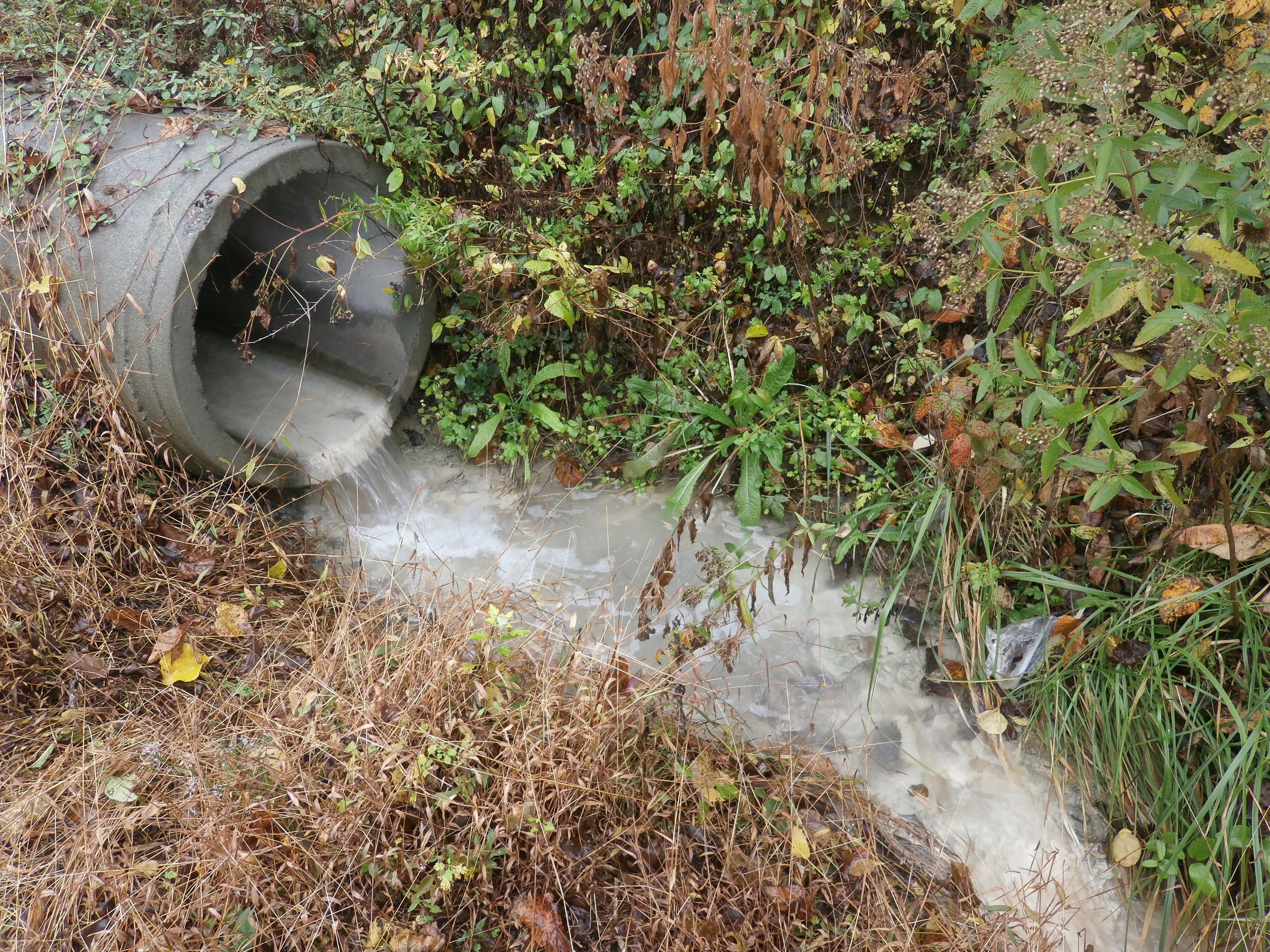
Following the water is the first thing we do at a fuel site. Rain landing on the loading rack apron usually drains to a trench, sump, or oil/water separator. Rain inside a tank dike is typically held behind a valved drain, and what happens when someone opens that valve is a stormwater question. Rain on the truck parking area and yard runs across gravel or pavement to catch basins, swales, or the property edge. Truck wash water, where a plant has a wash bay, belongs in a holding tank or the sanitary sewer under the sewer authority's rules, never at the stormwater outfall.
From there, the water leaves the site one of a few ways, and the destination decides which rules sit on top of PAG-03. It may go to a municipal separate storm sewer system, or MS4, which is the storm drain network a township or borough runs. It may go to a roadside ditch, an unnamed tributary, or a creek. In some older cities with combined sewers, including Philadelphia and Pittsburgh, runoff can go to a treatment plant, and the local sewer authority may govern it in place of a DEP stormwater permit. Local requirements and fees differ, so confirm your situation before relying on any general answer, ours included.
The practical step is to walk the yard during a real rain with a site plan in hand and mark where each roof drain, rack trench, dike valve, and catch basin sends water, plus every spot where water leaves the property. That map becomes the outfall list on a PAG-03 application, and it often turns up a drain nobody remembered was connected.
Why Do Loading Rack Spill Controls Matter for Bulk Plant Stormwater?
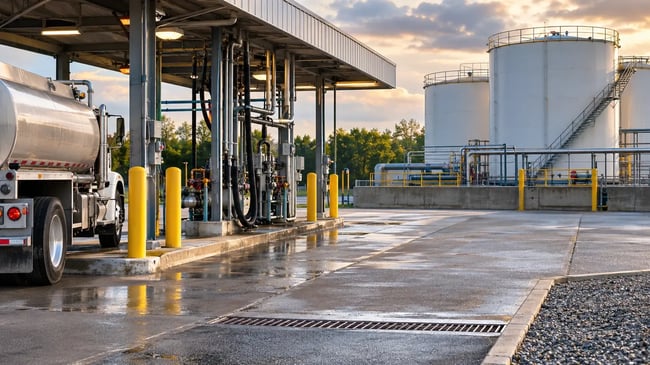
The loading rack is where product, trucks, and open air meet, and it's where most petroleum gets onto a pad that rain can reach. Overfilled compartments, drips from hoses at disconnect, a rack drain left open, and a separator nobody has cleaned all send product toward the outfall. A small drip at every disconnect adds up across hundreds of loads, and the first sign is often a sheen on the water leaving the site or a high oil and grease result.
The federal SPCC rule, 40 CFR 112.7(h), sets specific expectations for tank truck loading racks, and they double as stormwater protection. Where rack drainage doesn't flow to a catchment basin or treatment system built for spills, the rule calls for a quick drainage system. Containment has to hold at least the maximum capacity of any single compartment of a truck loaded or unloaded at the facility. Near the rack, the plant needs an interlocked warning light or physical barrier, warning signs, and wheel chocks or a brake interlock so a truck can't pull away while a hose is still connected. Before filling and before any truck leaves, someone has to inspect the lowermost drain and all outlets for leaks.
Rainwater that collects inside rack containment has to be checked before it's released, and a sheen means it stays put until it's dealt with. Petroleum that does reach a waterway and leaves a sheen carries its own reporting duty, which we cover in our guide to the sheen rule. Under PAG-03, facilities also sample their stormwater, and oil and grease is the kind of result a leaky rack produces. Fixing the rack costs less than explaining a string of high results to DEP.
Can a Pennsylvania Bulk Plant Get a No Exposure Certification?
A No Exposure Certification, or NEC, tells DEP that none of your industrial activities or materials are exposed to rain, snow, or runoff, so you don't need to hold a PAG-03 permit. DEP's FAQ says an indoor-only transportation site may qualify, but outdoor storage of materials, or of vehicles awaiting maintenance, rules it out. It also lists fueling stations without a roof or cover, and aboveground tanks with exposed secondary containment, as ineligible. Most bulk plants have outdoor tanks, an open loading rack, and trucks parked in the yard, so a No Exposure Certification is rarely realistic for them.
The exception is a small operation with an enclosed garage, covered fueling, and no outdoor tank exposure. For that site, DEP's FAQ puts the fee at $500 every five years, and certifications are generally valid for five years. DEP can inspect to confirm the conditions, and if anything changes, the operator has to notify DEP and seek PAG-03 coverage. Our article on what non-exposure means covers the conditions.
What Does PAG-03 Coverage Involve for a Fuel Distributor?
Coverage starts with a Notice of Intent, or NOI, filed with the DEP regional office for your county. The package includes a site plan, a topographic map, outfall information, and a Preparedness, Prevention, and Contingency Plan, known as a PPC Plan, which is DEP's emergency and spill response plan for a site. DEP's NOI instructions say a stormwater or SPCC plan prepared for another program is acceptable if it's consistent with DEP's PPC guidance, which helps a plant that already has an SPCC Plan. Agency filing and annual fees apply and change over time, so check DEP's current fee schedule when you apply. Our comparison of PPC Plans and SWPPPs for PAG-03 explains the difference, and the plan has to be kept current, as we explain in when to update your PPC Plan.
After approval, the work is ongoing. PAG-03 was reissued on December 24, 2022, took effect March 24, 2023, and runs through March 23, 2028. Appendix L sets the sampling parameters and benchmark values for your sector, and DEP added nitrogen and phosphorus monitoring to the sector appendices in the 2022 reissue, so confirm the current list in the appendix itself. Two consecutive monitoring periods over a benchmark value trigger a corrective action plan, more controls, or an individual permit if DEP asks for one. Results are reported through DEP's electronic system, and we've written a walkthrough of eDMR reporting and a guide to taking PAG-03 stormwater samples. Expect an annual report and possible DEP inspections too.
Cost depends on the number of outfalls, the size and layout of the site, how many sampling points you have, and whether a usable SPCC Plan or PPC Plan already exists. Our pricing calculator below shows a ballpark for RMA's help with PAG-03 and PPC Plan work at a site like yours. For the agency side, see how much a PAG-03 permit costs in Pennsylvania and how long coverage takes.
What Other Plans and Registrations Do Bulk Plants Need Besides a Stormwater Permit?
Three pieces of paperwork travel with a bulk plant, and each one should describe the same tanks, containment, and procedures as the others. The first is a Spill Prevention, Control, and Countermeasure Plan, or SPCC Plan. The federal rule applies to facilities with more than 1,320 gallons of aggregate aboveground oil storage in containers of 55 gallons or larger, or more than 42,000 gallons of buried oil storage, and a bulk plant clears that threshold by a wide margin. Our Pennsylvania SPCC plan services page covers it, and the difference between an SPCC Plan and a SWPPP is worth reading if you're sorting out which plan does what.
The second is the PPC Plan already mentioned, which goes with the PAG-03 application. The third is storage tank registration with DEP's storage tank program under the Storage Tank and Spill Prevention Act. Regulated aboveground tanks holding more than 250 gallons of regulated substances, and regulated underground tanks over 110 gallons, must be registered, and DEP invoices registered tank owners every year. Tank owners submit DEP's registration and permitting application form for each regulated tank, and underground tanks carry their own technical rules.
How Does RMA Help Fuel Distributors With Pennsylvania Stormwater Permits?
We work with Pennsylvania facilities all the time. We can help you work out whether your plant needs PAG-03 coverage, a No Exposure Certification, or neither, and then guide you through the application, the PPC Plan, sampling, and DEP reporting if you do need coverage. A senior team member does the work, and we'll tell you plainly if your situation is simple enough to handle without us. If your site plan raises questions about a particular drain, dike, or rack, we're happy to talk it through.
There's no obligation in starting a conversation. You can call us, email, or fill out the form on our website, and we'll take it from there. If you'd like to contact RMA about your bulk plant, send a site plan if you have one and we'll start with where your water goes.