Why an Empty Tank Still Counts Toward Your Oil Spill Plan Threshold Until It's Permanently Closed
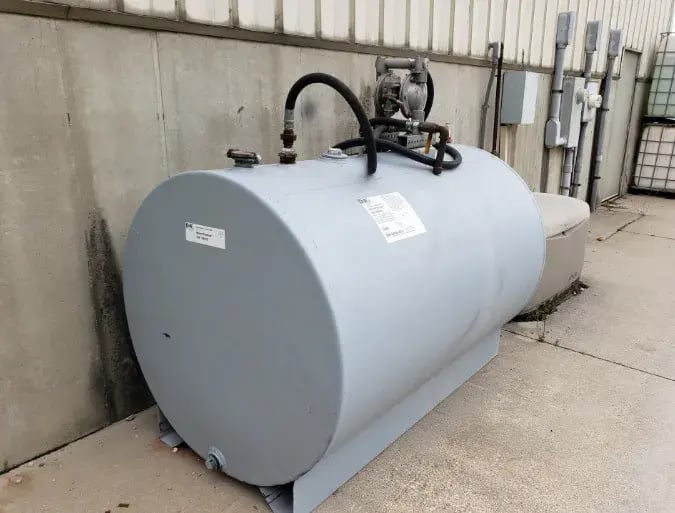
The tank has been dry since the old boiler came out, or since you switched fuel suppliers, or since someone drained it last spring. It's empty, so it can't spill, and it seems obvious that it shouldn't count when you add up your oil storage. That assumption is the reason empty tanks get left off the math. Under the federal Spill Prevention, Control, and Countermeasure (SPCC) rule, an empty tank still counts unless it's been permanently closed, and "permanently closed" has a specific definition.
This article explains why capacity, not contents, drives the count, what a tank has to go through to be permanently closed, and what New Jersey facilities should check before they close one. If you'd rather have someone look over your tank list with you, you're welcome to reach out to RMA at any point.
Table of Contents
TL;DR
Yes, an empty tank counts. SPCC measures a container's capacity, not what's in it, so an empty tank of 55 gallons or more still counts toward the 1,320-gallon threshold. It stops counting only when it's permanently closed, which means all liquid and sludge are out of the tank and its lines, the piping is disconnected and blanked off, the valves are closed and locked, and a sign with the closure date is posted. In New Jersey, closing a tank can also set off state steps, so check before you assume the job ends with the sign.
Why Does an Empty Oil Tank Still Count Toward the SPCC Threshold?
The federal rule applies to a facility that stores more than 1,320 gallons of oil in aboveground containers, adding up only the containers that hold 55 gallons or more. EPA measures each container by its shell capacity, which is the volume the container can hold, not the volume in it today. A 1,000-gallon tank with 20 gallons in the bottom counts as 1,000 gallons. So does one that's bone dry. EPA has said the same thing about empty tanks directly: unless the container has been permanently closed, its capacity goes into the threshold calculation.
The logic is easy to follow once you picture it. An empty tank can be refilled by a delivery truck tomorrow, and the rule treats it as storage that's available. It also covers containers used for standby, seasonal, or temporary storage, so a backup tank you only fill in winter counts all year. For the rest of the counting, see our guides on inventorying oil tanks, drums, and equipment and the 1,320-gallon rule.
Leaving an empty tank off the count has two kinds of consequences. A facility that believes it's under 1,320 gallons may be over it, which means it needs an SPCC plan and doesn't have one. A facility that already has a plan still has to treat the empty tank like a full one, with secondary containment, inspections, and integrity testing. EPA Region 2 enforces SPCC in New Jersey, so a tank missing from your plan is a gap an inspector can find.
What Does a Permanently Closed SPCC Tank Require?
EPA defines the term in 40 CFR 112.2, and a tank has to meet every part of the definition. There's no partial credit for getting two out of three.
| Requirement |
What it looks like on site |
| All liquid and sludge removed |
The tank and every connecting line are free of product and bottom sludge, not just pumped down. |
| Lines disconnected, valves locked |
Piping is disconnected and blanked off, and every valve except ventilation valves is closed and locked. |
| Conspicuous signs posted |
Each container carries a sign stating it's permanently closed, along with the closure date. |
The first requirement trips people up, because draining a tank isn't the same as emptying it. Sludge on the bottom and product left in the connecting lines both count as contents under the definition. The other two requirements are physical and visible: blanked-off piping, locked valves, and a sign anyone walking by can read. We'd photograph each step and keep the disposal records for whatever came out, so you can show an inspector what you did and when.
Is a Drained or Idle Oil Tank Permanently Closed Under SPCC?
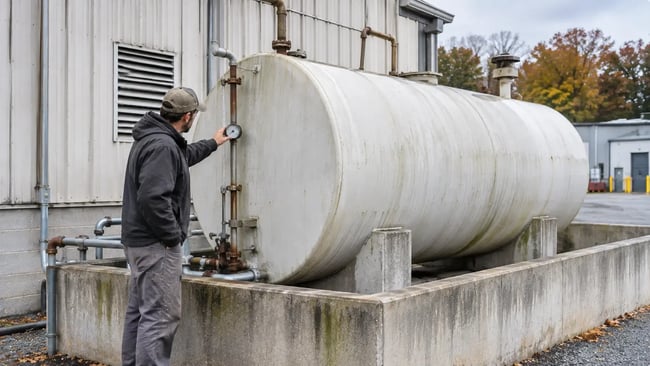
A tank that's been pumped out but still has open valves, a fill line attached, and no sign is out of service, not permanently closed. It stays in your count, and it needs the same containment, inspections, and testing as any active tank. The same goes for a tank nobody has touched in years. How long it's sat doesn't change anything under the rule. Only the closure steps do. Once a tank has been closed correctly, its capacity comes off your total, and a tank removed from the site entirely is off the count for the simpler reason that it's gone. For the wider question of what happens to your SPCC duties when a site goes idle or shuts down, see our post on going idle or closing a New Jersey facility.
What Should New Jersey Facilities Check Before Closing an Oil Tank?
The federal definition is one layer. If the tank is a regulated underground tank, NJDEP's underground storage tank program under N.J.A.C. 7:14B controls the closure, and the work has to be done by an NJDEP-certified contractor. A padlock and a sign don't substitute for that. Our post on underground tanks in New Jersey explains when buried tanks count toward SPCC at all. For aboveground tanks, local fire officials enforce the Uniform Fire Code, so ask them whether closing or removing the tank needs a permit.
If your facility is a "major facility" under N.J.A.C. 7:1E, you also carry NJDEP-approved DPCC and DCR plans, and closing or removing a tank may mean amending those as well. Contact NJDEP before assuming those duties change on their own. Our post on SPCC and DPCC plans covers how the two programs differ. Cleaning or pulling an old tank can also turn up a past discharge. If it does, New Jersey's Spill Act reporting duty comes into play, cleanup is typically led by a Licensed Site Remediation Professional (LSRP), and an environmental attorney can advise you on liability.
On the federal side, taking a closed tank out of your SPCC plan is a plan amendment, which has to be made within six months of the change. Technical changes to a plan certified by a Professional Engineer (PE) generally need a PE to review and certify them, so bring the PE in before the closure, not after. RMA doesn't do the physical closure or removal work. That belongs to a tank contractor, and to an NJDEP-certified one for regulated underground tanks. We can help you sort out what the closure means for your plan and your count.
How Can RMA Help With Empty Tanks and Your New Jersey SPCC Plan?
We're based in New Jersey and work with NJDEP's rules and EPA's SPCC rule every day. If you have tanks that are empty, idle, or half-closed, we can go through your tank list with you, tell you which ones count, and say plainly whether you need a plan at all. Sometimes a short conversation is all it takes, and you won't need us after that. If a closure changes your total or your plan, we'll help you work out what comes next. You can call us, email us, or fill out the form on our website, and there's no obligation. Whenever you're ready, contact RMA.