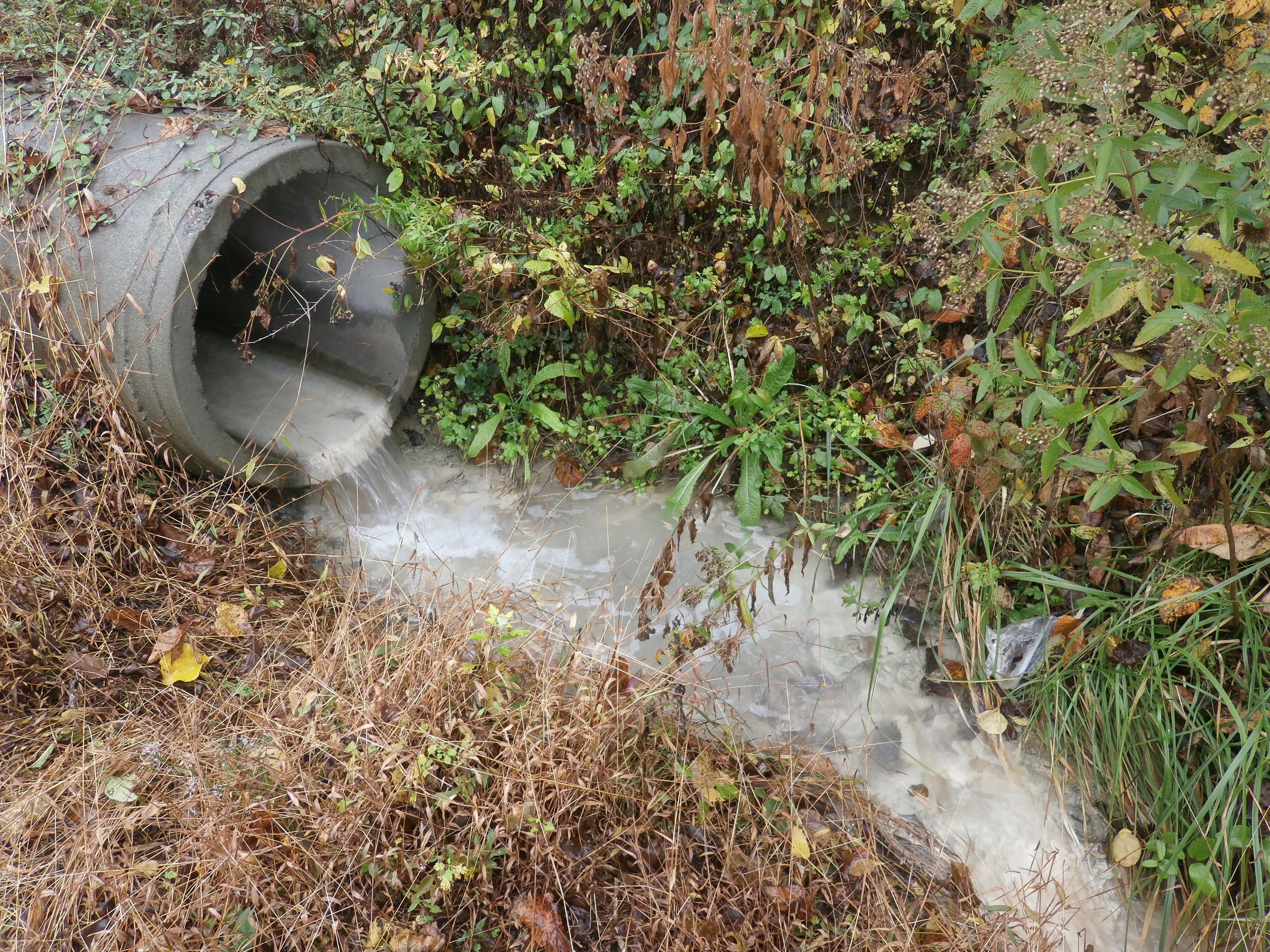
Who Collects, Who Analyzes, and Who Acts on the Results Under PAG-03
If your Pennsylvania facility has PAG-03 coverage, DEP's general permit for industrial stormwater, you've probably run into the sampling requirement and wondered who is supposed to do the work. Some facilities assume the lab handles everything. Others assume the consultant who wrote their plan will take care of it. Neither is quite right, because sampling is really three jobs: collecting the sample, analyzing it, and deciding what the results mean for your permit. Different people are good at different pieces of that.
The short answer is that most facilities do best when an accredited lab analyzes the samples, their own trained staff collect them, and a consultant helps run the program and responds when results come back high. Hiring someone else to collect the samples makes sense in some situations, and we'll cover when. If you'd like help sorting out which setup fits your site, you can reach out to RMA at any point.
Table of Contents
TL;DR
A lab analyzes your samples and must be accredited by DEP, and some labs also send someone out to collect them. A consultant interprets results, runs your sampling program, and handles corrective action when results stay high. Many facilities collect the samples themselves, with lab support and a consultant on call, because the sample has to be taken within the first 30 minutes of a qualifying storm and the pH measured on site within minutes. Outside sampling makes sense when your site is unstaffed during storms, has hard-to-reach outfalls, or has no one trained to do it. The permit holder stays responsible for the results either way.
What Does Each Role Do in Pennsylvania Stormwater Sampling?
Start with the permit itself. Under PAG-03, most facilities have to collect stormwater samples from their outfalls, which are the points where runoff leaves the site, and send them to a laboratory. The results get compared against benchmark values, which are pollutant concentrations that act as a check on whether your controls are working. Most sector appendices call for sampling twice a year, and your appendix sets the schedule and the list of parameters, so confirm yours before you plan anything. Our guide to finding your PAG-03 appendix shows how.
Three roles show up in that process. The person who collects the sample has to be at the outfall at the right time and handle the bottles correctly. The lab analyzes what's in the bottles and reports numbers. The consultant, if you use one, helps you decide what to test, whether the results mean anything, and what to change when the numbers are high. Plenty of facilities fill the first role with their own staff, the second with a lab, and the third with an outside consultant, but there's no rule that says it has to be split that way. The permittee, meaning the company or organization named on the permit, stays responsible for the sampling program and the results regardless of who does each piece.
What Does a Stormwater Testing Lab Do for a PAG-03 Facility?
A lab analyzes samples, and Pennsylvania cares a great deal about which lab you pick. Under 25 Pa. Code Chapter 252, labs that test environmental samples to comply with a DEP-administered statute have to be accredited or registered with DEP, and DEP's guidance on discharge monitoring reports says samples must be analyzed by a lab accredited by or registered with DEP. A cheap lab that isn't accredited can leave you with results DEP won't accept. Beyond accreditation, the lab has to be able to run every parameter your appendix lists, and its method has to be sensitive enough to meet the permit's target quantitation levels. A less sensitive method can produce results that don't satisfy the permit. We cover how to evaluate one in how to pick a water testing lab.
Most labs also provide the bottles, the preservatives, and a cooler, and they'll tell you the holding time for each parameter. That's the window between collecting a sample and starting the analysis, and a missed holding time can ruin a result. Some labs go further and offer field sampling, where their technician comes to your site to collect the samples. That service varies from lab to lab, so ask each one whether it's available at your location, how they handle storm callouts, and what they charge for a trip that ends with no qualifying rain. One thing labs generally don't do is decide for you what to test. If the list of parameters you give them is wrong, they'll still run it, and we explain how that goes in what happens when a parameter gets missed.
What Does a Stormwater Consultant Do That a Lab Doesn't?
A lab gives you a report full of numbers. A consultant tells you what those numbers mean for your permit. That starts before any sample is taken, with confirming your appendix, picking outfalls, and building a sampling plan and calendar. After results come in, the consultant checks them against your benchmarks and helps you report them accurately through DEP's electronic reporting system, which we describe in how to report results through eDMR. A high result isn't automatically a violation, and how PAG-03 benchmark values work explains why. The trouble starts when the same pollutant exceeds its benchmark at the same outfall in consecutive monitoring periods.
That's where corrective action comes in. After two consecutive exceedances, the permit calls for a corrective action plan submitted to DEP within 90 days after the end of the monitoring period that triggered it, and after four or more, DEP's Stormwater BMPs Checklist goes with it. The permit holder is responsible for developing and carrying out that plan. A consultant can help you work out the likely cause, choose controls, write the plan, and update your PPC Plan, but the obligation stays with you. Our article on PAG-03 corrective action goes through what DEP expects. Some consultants also collect samples in the field, so a consultant and a field sampling service aren't always separate.
What Are the Options for Collecting PAG-03 Stormwater Samples, and What Are the Trade-Offs?
There are four common ways to handle collection, and the right one depends on your site. This table compares them side by side.
| Option |
Who collects the sample |
Strengths |
Trade-offs |
| Your own staff, with lab support |
Trained employees who already work on site |
Already on site when it rains, know the outfalls, can meet the 30-minute window and measure pH right away |
Needs training, a backup person, and someone willing to work around storms |
| Lab field sampling service |
The lab's technician |
Sample handling and chain of custody stay in one place, and the lab knows its own bottles and holding times |
Not every lab offers it, travel time can eat the window, and wasted trips may cost you |
| Consultant or contract sampler |
The consultant's field staff |
Experienced eyes at the outfall, and one party sees both the sample and the paperwork |
Same timing problem as the lab option, and usually the highest cost per event |
| Hybrid |
Your staff normally, an outside sampler as backup or for hard outfalls |
Covers vacations, night storms, and difficult locations |
Two systems to coordinate, and the backup has to be arranged before the storm |
Cost is a real part of the decision, but we're not putting numbers on it here because pricing depends on how many outfalls you have, how far the sampler travels, and how a provider charges for standby and canceled trips. Ask for those terms in writing before you commit to any outside sampling arrangement.
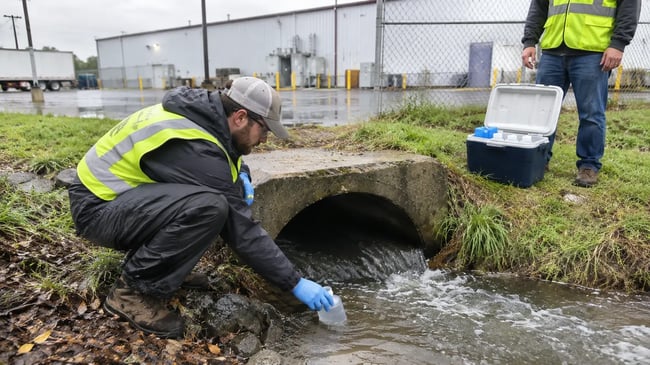
Why Do the 30-Minute Window and Unpredictable Rain Make Outside Sampling Hard?
The sampling rules are built around storms, and storms don't keep a schedule. Under PAG-03, the grab sample is collected during the first 30 minutes of the discharge, or as soon after as practicable. The storm has to produce more than 0.1 inch of rain and has to come at least 72 hours after the previous measurable storm. The 30 minutes starts when water begins leaving your outfall, not when it begins to rain, and the lag between the two depends on your site. DEP's annual report form asks whether each sample was collected within the first 30 minutes and requires an explanation when it wasn't.
Now picture the logistics for an outside sampler. Someone has to watch the forecast, decide a storm is likely to qualify, get in a vehicle, and reach your outfall before the first 30 minutes run out, possibly at night or on a weekend. A technician who has to drive an hour will often miss the window. Meanwhile, if your own employee is already standing on the site when rain starts, getting to the outfall takes minutes. The same goes for pH. It has to be measured within 15 minutes of collection, which means it's generally done on site with a calibrated meter and not back at the lab. Our article on why pH can't wait explains the chemistry.
None of this makes outside sampling a bad choice. It means the provider needs to be close, reachable, and committed to storm callouts, and you should expect some missed events. When they happen, document why. Facilities that sample themselves face the same weather, but they have the advantage of being there.
How Should a Pennsylvania Facility Choose Its Stormwater Sampling Setup?
Start by asking who is on site when it rains. If you have people on the property most hours of the week and just a few outfalls, self-sampling with an accredited lab is a common and practical setup, and it's what we generally recommend. Train at least two people so a vacation or a sick day doesn't cost you a sampling period, and have them practice on a few ordinary rain events before a qualifying storm arrives. Our articles on taking your own samples, taking a good sample, and why in-house sampling pays off go into the habits that make it work.
Outside sampling is the better call in a few situations. If your site is unstaffed nights and weekends, if outfalls sit in places that are hard or unsafe to reach, if no one on your team is comfortable doing it, or if you've missed windows more than once, bring in help. For a facility with many outfalls, a hybrid works well. Your staff handle the easy ones and an outside sampler covers the rest, and either way the same lab analyzes everything so the data stays consistent.
Whichever way you go, a few practices keep things clean. Tell the lab exactly which parameters your appendix requires, and double-check the list. Keep your chain-of-custody forms, lab reports, and field notes, since PAG-03 requires you to retain monitoring records for at least three years. Remember that a responsible official has to sign your DEP paperwork, a point we cover in who can sign DEP stormwater paperwork. A consultant can prepare results for you, but the permit holder answers for them, so read what's being submitted in your name. And whoever collects the samples, review your results early in the monitoring period, because a high result in June leaves time to fix the problem and resample, while a high result in the last week of December doesn't.
How Does RMA Help Pennsylvania Facilities With Stormwater Sampling and Results?
Our role is on the program side. We help you work out which appendix and parameters apply, build a sampling plan, train your staff to collect samples correctly, make sense of results, and work through corrective action when benchmarks are exceeded. We work with Pennsylvania facilities all the time, and senior staff handle the work directly. If you're comfortable sampling in house, we'd rather help you do that well than talk you into paying for something you don't need.
You can find more in our NPDES and stormwater resources library, on our Pennsylvania NPDES and stormwater services page, and in our full set of Pennsylvania NPDES articles. If you'd like to talk through your sampling setup, you can call, email, or fill out the form on our website, and there's no obligation. Just contact RMA whenever you're ready.