SPCC's Permanently Closed Definition, New Jersey's Underground Tank Closure Steps, and How Closure Changes Your Oil Storage Count
A tank that's empty and out of use still has a regulatory life. Facilities drain an old diesel tank, shut down a boiler room, or retire a used-oil tank and assume it's off the books. Whether it is depends on how the tank was shut down and what kind of tank it is. A drained tank with open valves still counts toward your oil spill plan, and a buried tank can't be shut down by anyone with a shovel and a weekend.
Federal oil spill rules (the SPCC rule, short for Spill Prevention, Control, and Countermeasure) define exactly what "permanently closed" means, and a container that meets the definition drops out of your capacity count. New Jersey adds its own closure process for regulated underground tanks, with certified contractors, notice to NJDEP, and a site investigation. In short, an aboveground tank closes permanently when it's emptied, disconnected, locked, and signed, and a regulated underground tank closes through a certified firm after NJDEP gets advance notice. This article walks through both, plus how closure changes the math on whether you need a plan. If you're sorting out a specific tank now, you can reach out to RMA and we'll help you work out what closing it does to your SPCC obligations.
Table of Contents
TL;DR
An aboveground tank counts as permanently closed only when all the oil and sludge is out, the lines are disconnected and blanked off, the valves are locked, and a dated sign is posted. Once that's done it stops counting toward the 1,320 gallon line that triggers an oil spill plan. A regulated underground tank in New Jersey has to be registered, closed by a state-certified firm, reported to NJDEP at least 14 days ahead, and checked with a site investigation. Update your oil spill plan afterward, and keep the paperwork.
What Does "Permanently Closed" Mean Under the SPCC Rule?
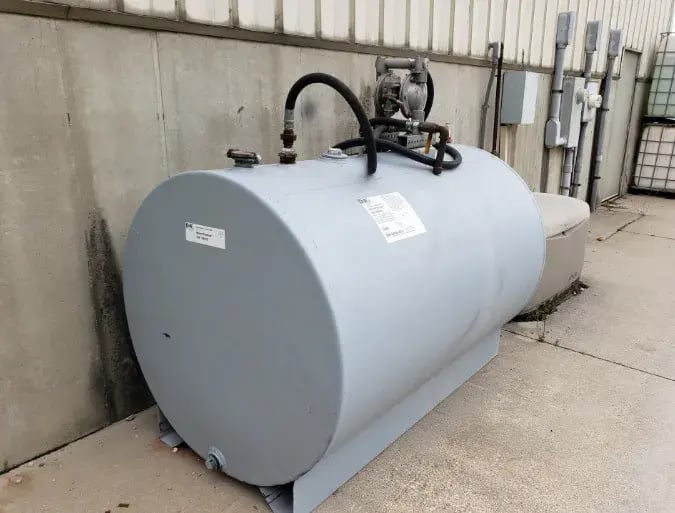
The federal rule defines it in 40 CFR 112.2, and the definition has four parts that all have to be true. All liquid and sludge has to be removed from each container and its connecting lines. All connecting lines and piping have to be disconnected from the container and blanked off. All valves, except ventilation valves, have to be closed and locked. And a conspicuous sign has to be posted on each container stating that it's permanently closed and giving the date of closure.
Draining the tank is only the first part. A tank that's empty but still piped to a fill line, with unlocked valves and no sign, doesn't qualify, and neither does one with a faded "out of service" note taped to it. EPA's inspector guidance repeats the same four-part definition, so there's no softer standard for old or rarely used tanks. Our article on what happens to SPCC obligations when a New Jersey facility goes idle or closes covers the facility-wide view, including when to keep a plan active instead of closing containers.
How Does Permanently Closing a Tank Change Your SPCC Capacity Count?
The SPCC rule applies to facilities with more than 1,320 gallons of aboveground oil storage capacity that could reasonably be expected to discharge to navigable waters or adjoining shorelines. Only containers of 55 gallons or more count, and capacity is what counts, not what's inside today. The rule specifically excludes permanently closed containers from that aboveground total, and from the completely buried total as well. Here's how that plays out: a site has a 1,000 gallon diesel tank, a 500 gallon used-oil tank, a 330 gallon generator tank, and two 55 gallon drums, which adds up to 1,940 gallons. Properly closing the 1,000 gallon tank takes the total to 940 gallons, under the line. Draining it and walking away leaves the total at 1,940.
| Tank status |
Counts toward the 1,320 gallons? |
Why |
| Drained, but lines still connected or valves unlocked |
Yes |
It doesn't meet the four-part definition, and capacity counts, not contents |
| Drained, blanked off, locked, and signed with the closure date |
No |
It meets every part of the definition in 40 CFR 112.2 |
| Removed from the site |
No |
The container is gone, so keep the removal and disposal records |
| Completely buried tank subject to all federal UST requirements (or an approved state program) |
Not counted |
It's excluded by rule, though it still goes on the facility diagram if the plan applies |
Closure also triggers a plan amendment. The rule lists decommissioning containers among the changes that call for one when they materially affect discharge potential. The amendment has to be prepared within six months and implemented within six months after that, and a Professional Engineer has to certify technical amendments to a PE-certified plan (see our article on professional engineers and SPCC plans). If closure drops you to 1,320 gallons or less, a plan may no longer be required, but recount first using our guide to inventorying oil tanks, drums, and equipment. A forgotten drum, a day tank, or oil-filled equipment can put you back over the line.
What Are New Jersey's Closure Steps for a Regulated Underground Tank?
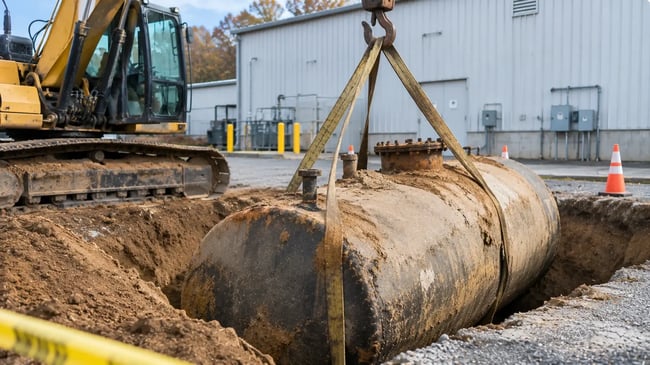
New Jersey regulates underground storage tanks under N.J.A.C. 7:14B, and closure, whether the tank is removed or abandoned in place, follows N.J.A.C. 7:14B-9.2. The table below walks through the sequence in the order it usually happens.
| Step |
What the rule requires |
| 1. Register |
The facility has to be registered with NJDEP before closure. Closure can't begin at an unregistered facility. |
| 2. Hire certified professionals |
An NJDEP-certified closure firm does the work, and a Licensed Site Remediation Professional (LSRP) is retained for the remediation side. |
| 3. Notify NJDEP |
File a notice of intent through NJDEP Online at least 14 calendar days before closure, naming the closure firm and the LSRP and stating whether the tank will be removed or abandoned in place. |
| 4. Share the approval |
Give NJDEP's approval to the municipal and county health departments at least 14 days ahead, and to the local authority with the demolition permit application. Comply with the Uniform Construction Code. |
| 5. Close the tank |
Follow API Recommended Practice 1604, examine the tank for holes, and call the NJDEP hotline, 1-877-WARNDEP, if holes or a discharge turn up. |
| 6. Investigate the site |
Carry out a closure plan that includes a site investigation under N.J.A.C. 7:26E-3.3, and keep the plan at the facility. |
| 7. Remove or abandon |
Abandonment in place is allowed only if no contamination exceeds standards or removal isn't feasible. It needs a New Jersey licensed engineer's statement, inert fill such as sand or cement, and fill pipes removed to at least one foot below ground. |
If the site investigation finds contamination above the applicable standards, remediation follows N.J.A.C. 7:26C, typically under the LSRP. The site investigation report has a due date set in N.J.A.C. 7:14B-9.5, which NJDEP has put at 270 days after closure, so your LSRP will confirm the current deadline. Tanks that sit unused are on a clock too: an out-of-service system needs an amended registration within seven days, API 1604 temporary out-of-service steps by the end of the third month, and closure after more than 12 months unless an exception applies. We don't remove tanks, file local demolition permits, or oversee cleanups. That work belongs to certified closure firms, your local officials, and your LSRP.
How Does Closure Work for Heating Oil Tanks and Aboveground Tanks in New Jersey?
Heating oil tanks sit in a separate category. New Jersey calls a heating oil tank serving a residential building, or up to 2,000 gallons combined at a non-residential property, an unregulated heating oil tank. NJDEP doesn't regulate how it's operated, but an underground one still has to be removed by a closure-certified individual working for a certified firm, and a leak goes through NJDEP's Unregulated Heating Oil Tank program, with an LSRP or certified subsurface evaluator doing the cleanup. For SPCC, a buried heating oil tank outside the UST rules generally still counts toward buried capacity until it's gone.
The 14-day notice is specific to underground tanks, but other rules still reach aboveground ones. Removal may need local demolition or fire official sign-off. At a New Jersey major facility under N.J.A.C. 7:1E, the DPCC and DCR plans have to be amended within 30 days of a modification that changes them, and some changes need advance notice to NJDEP. NJDEP's capacity counting mirrors the federal four parts: a tank is out of service only if it's emptied, disconnected and blanked off, locked, and signed with the date, and an empty tank that doesn't meet that still counts. Underground tanks generally count toward major facility capacity too, except heating oil used on site. Our article on whether you need both an SPCC Plan and a DPCC Plan explains how the two programs overlap.
How Do You Document an Oil Tank Closure So It Holds Up in an Inspection?
Photos do most of the work. Take pictures of the blanked-off lines, the locks on the valves, and the dated sign on each container, since those are the details an inspector looks for. Keep the waste manifests for the oil and sludge that came out, since residue needs a waste determination before it leaves the site (our article on used oil versus waste oil covers how that call gets made). For an underground tank, keep the NJDEP approval, the closure firm's documentation, and the LSRP's reports and any No Further Action letter.
Then fix the plan. The inventory, the facility diagram, and the capacity calculation all need to match what's now on the ground, and the old plan and closure records stay on file. We'd also note any closed containers still sitting on site in the plan, with the closure date. EPA Region 2 enforces the SPCC rule in New Jersey (see who enforces SPCC Plans), and a closed tank with nothing to prove it was closed can be treated like an open one.
How Should You Sequence Tank Closure, Permits, and the SPCC Plan Amendment?
Start with the count. Inventory every container of 55 gallons or more so you know whether closing one tank gets you under 1,320 gallons or just trims the total. Then line up the people: a certified closure firm and LSRP for an underground tank, a licensed vendor to pull the oil and sludge from an aboveground one, and your local construction and fire officials for any demolition or removal permits. Those permits are construction-phase approvals, and we don't prepare them.
For an underground tank, file the NJDEP notice at least 14 calendar days ahead and don't schedule the work inside that window. Close or remove the tank, document it, and start the SPCC amendment right away instead of waiting for the six-month limit, because the plan on the shelf is wrong the day the tank is gone. At a major facility, the DPCC and DCR amendment clock is 30 days. For the replacement side of a tank project, our post on replacing an old tank at a New Jersey facility covers what changes when a new tank goes in. If a closure turns up stained soil or a sheen, see our article on when you have to report an oil spill.
What Does Tank Closure Cost, and How Does It Affect the Cost of an SPCC Plan?
Tank cleaning, removal, and UST closure prices vary with tank size, access, contamination, and local conditions, so get written quotes from certified contractors. The SPCC side is more predictable. An SPCC Plan runs about $2,500 to $15,000, depending on total storage capacity, the number and type of containers, whether secondary containment needs evaluating, and whether a Professional Engineer has to certify it. If closure takes you under 1,320 gallons, you may not need a plan at all, which can make closing a tank cheaper than keeping it. If you stay over the line, a plan someone else wrote and left to age is usually rebuilt rather than patched, and our SPCC cost breakdown covers that. The pricing calculator below gives you a ballpark for the plan.
How Can RMA Help When You're Closing an Oil Tank?
We can look at your tanks before the work starts, tell you whether closing one gets you under the SPCC threshold, and handle the plan side afterward, whether that's an amendment, a rebuilt plan, or a clear answer that you no longer need one. For a major facility, we can flag the DPCC and DCR changes that follow. We're a family-run firm based in New Jersey, so NJDEP's rules and EPA Region 2 enforcement are familiar ground, and we can point you toward the certified closure firms, LSRPs, and local officials the tank work itself requires.
We'll also tell you when you don't need us. If you're closing a tank at a site that's well under 1,320 gallons even before you start, you may only need to keep your records. There's no pressure and no obligation. You can call, email, or fill out the form on our website, or just contact us with a quick description of the tanks.