Certified Contractors, NJDEP Notification, Sampling, and What Happens If You Find Contamination
Pulling an old tank out of the ground looks like a simple excavation job until the first shovel hits stained soil. In New Jersey, taking out a regulated underground tank is a permit-adjacent process with its own paperwork, its own certified workers, and a defined path for what happens if the tank has been leaking. Owners who skip steps tend to find out at the worst moment, usually when a buyer's lender or a neighbor asks about the hole in the parking lot.
This article walks through the removal process for regulated underground storage tanks (USTs): who's allowed to do the work, what you tell NJDEP and when, how sampling works, and what changes if contamination turns up. We also cover the follow-up most owners forget, which is updating your SPCC (oil spill prevention) plan once the tank is gone. If you'd like help with that side of it, you can reach out to RMA at any point.
Table of Contents
TL;DR
Removing a regulated underground tank in New Jersey has to be done by an NJDEP-certified closure contractor, and NJDEP needs notice at least 14 calendar days before the work. The tank is inspected, the soil around it is screened and sampled, and if contamination is found you report it to the NJDEP hotline and hire a Licensed Site Remediation Professional (LSRP) to run the cleanup. Once the tank is gone, you amend your SPCC plan within six months if the removal changes your oil storage.
Who Can Legally Remove a Regulated Tank in New Jersey?
Closing a regulated underground tank, whether you pull it out or leave it in place, has to be done by a contractor certified for UST closure under NJDEP's Underground Storage Tank rules, N.J.A.C. 7:14B. Both the business and the individual doing the work carry certification, and they're required to enter a written contract with you. NJDEP publishes lists of certified UST firms, including a version sorted by county, so you can confirm a contractor's status before you sign anything instead of taking a sales pitch at its word.
The physical work, meaning everything from breaking ground until the hole is filled, belongs to the closure-certified person. If contamination is found, a second professional enters the picture: a Licensed Site Remediation Professional, or LSRP, who determines how far the problem extends and directs the cleanup. The two roles are meant to work together, and it helps to ask a prospective contractor which LSRP they work with and how they handle it when the excavation turns up something unexpected. A bid that doesn't mention sampling or what happens if contamination turns up is worth a second look, because those are the parts of a removal that can change the price.
What Does NJDEP Notification Look Like Before Tank Removal?
Before closure starts, the facility and the tank need to be registered with NJDEP. You then submit a notice of intent to close through NJDEP Online at least 14 calendar days before the planned closure date, and the system generates an approval of the notice when you submit it. The notice names the certified closure firm and, if remediation is already involved, the LSRP, so your contractor normally handles it with you, but the legal responsibility sits with the owner or operator.
That approval then gets passed along. A copy goes to the municipal and county health departments, and the same approval goes in with your local demolition permit application, also at least 14 calendar days ahead. The work also has to comply with the New Jersey Uniform Construction Code. Local permits and construction approvals are handled between you, your tank contractor, and the municipality, and they're not something RMA prepares. We can point you toward the right people if you don't know where to start.
How Does the Tank Removal Process Work Step by Step?
The sequence below is the typical path for a regulated underground tank. Your contractor's closure plan sets the specifics, and NJDEP requires that plan to be kept on site while work is underway. The tank is closed following the American Petroleum Institute's recommended practice for closing underground tanks, which includes examining the tank for holes once it's out of the ground.
| Step |
What happens |
Who's responsible |
| 1. Confirm registration and hire a certified firm |
Facility and tank registered, written contract signed |
Owner or operator, closure firm |
| 2. File the notice of intent |
NJDEP Online filing at least 14 calendar days ahead |
Owner or operator, with the firm |
| 3. Send approval to local officials |
Health departments and demolition permit office |
Owner or operator, contractor |
| 4. Empty and clean the tank |
Product and residue removed and handled as waste |
Closure firm |
| 5. Excavate and inspect |
Tank removed and examined for holes |
Closure-certified individual |
| 6. Screen and sample soil |
Field screening, then lab samples from the excavation |
LSRP or designee, closure firm |
| 7. Backfill and close out |
Excavation filled after sampling sign-off, records kept |
Closure firm, owner |
One practical point on step 4: the leftover product and tank sludge are waste, and they need a proper determination and disposal paperwork. Our post on what happens to your SPCC obligations when a facility closes covers permanent closure options for tanks that stay on site.
What Soil Sampling Happens During a New Jersey Tank Removal?
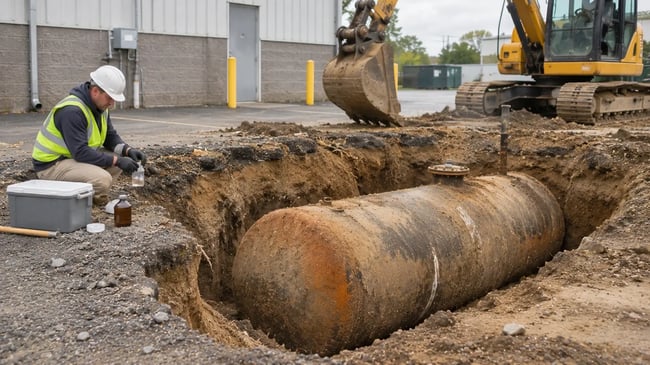
As soon as the tank is out, someone has to look at what's around it. Staining, odor, sheen, and readings from field screening instruments tell the team whether product has reached the soil, and those observations guide where samples are taken. Confirmation samples are then collected from the excavation, with the locations and number set by the closure plan and NJDEP's technical requirements for site remediation, N.J.A.C. 7:26E, and sent to a laboratory. Results are compared to New Jersey's soil remediation standards, and groundwater gets sampled if the excavation reaches it.
The practical advice here is to hold off on backfilling until the person overseeing the sampling says it's all right. Backfilling over a stained wall because the schedule is tight can turn a small, cheap problem into an expensive one, since the clean fill then has to come back out. The sampling results and the tank inspection findings also become part of your permanent closure record, which buyers, lenders, and insurers may ask to see years later.
What Happens If You Find Contamination During Tank Removal?
If the tank has holes or you confirm a discharge, it has to be reported to the NJDEP hotline at 1-877-WARNDEP (1-877-927-6337), unless that discharge was already reported. If you see product, a sheen, or a strong odor in the excavation, stop and make that call before the work moves on. The Spill Act can hold the owner responsible for cleanup regardless of who caused the leak, so an environmental attorney is a reasonable call at this stage.
When contamination exceeds an applicable remediation standard, cleanup is handled under NJDEP's Administrative Requirements for the Remediation of Contaminated Sites, N.J.A.C. 7:26C, and an LSRP is required to prepare or oversee the investigation and the remediation. The LSRP plans the additional sampling, directs any excavation or treatment, and, when the work is done, issues a Remedial Action Outcome, which is the document that says the site meets the standards. Hiring or dismissing an LSRP has to be reported to NJDEP through an online form within 15 days. The specific report deadlines come from the rules and depend on the type of case, so your LSRP will track them. What the cleanup costs depends on how far the contamination spread, whether groundwater was affected, how much soil has to go off site, and how long monitoring runs, which is why two tank removals that look identical on paper can end up very far apart.
What About Aboveground Tanks and Heating Oil Tanks?
Aboveground tanks aren't closed under the UST closure rules, but they still need to be emptied, cleaned, and disposed of properly, and any stained soil or sheen underneath them can point to a discharge that needs reporting and an LSRP. Unregulated underground heating oil tanks, which are common at older buildings, have their own path: the removal of an underground one still has to be done by a closure-certified individual working for a closure-certified firm, and NJDEP's role is limited unless a discharge is confirmed and reported to the hotline. Which tanks count as regulated depends on size, what's stored, and how the tank is used, so confirm yours against N.J.A.C. 7:14B or with your certified contractor.
If you're replacing a tank rather than just removing one, our post on replacing an old tank and the SPCC amendment covers the swap itself.
How Do You Update Your SPCC Plan After a Tank Is Removed?
An SPCC plan has to be amended when a change to the facility could materially affect its potential for a discharge, and the federal rule lists adding or removing containers among the changes that qualify. The amendment must be prepared within six months of the change and put into effect within six months after that. A Professional Engineer has to certify technical amendments unless your facility qualifies to self-certify, and our post on self-certifying versus using an engineer explains where that line falls.
What changes depends on the tank. A completely buried tank that's subject to the federal UST rules is exempt from SPCC, though it appears on the facility diagram, so removing one with nothing aboveground replacing it may only mean updating the diagram and inventory. Removing an aboveground tank is different. Your total oil storage drops, so you recount every container of 55 gallons or more, including drums and oil-filled equipment, and see where you land against the 1,320-gallon threshold and the 10,000-gallon qualified facility line. Our guide to inventorying oil tanks, drums, and equipment walks through the count. If you're left at or under 1,320 gallons aboveground, and your buried storage is also under the federal limit, the rule may no longer apply to you, but check the whole site before you say so.
If you're still covered, the plan needs more than a deleted line. The tank comes out of the inventory, the facility diagram, the containment calculations, the inspection checklist, and any integrity testing schedule, and the plan should note the date and how the tank was closed. Keep the closure paperwork with it, along with the sampling results. If your site is a major facility under N.J.A.C. 7:1E, the state discharge prevention plan may need a matching update, which our post on SPCC plans and DPCC plans explains. It's also a good moment to check where you stand on the five-year review, since an amendment can be combined with it.
How Can RMA Help After a Tank Removal?
The removal itself belongs with a certified closure contractor and, if contamination turns up, an LSRP. We don't prepare construction or demolition permits either, though we can help you work out which professionals your project needs. What we do is the plan side: recounting your oil storage, working out whether the removal changes your SPCC status, and amending the plan so the diagram, inventory, containment, and inspection records match what's actually on your site. Where a Professional Engineer needs to review and certify the amendment, we help you get that done. We're based in New Jersey and know how NJDEP's rules sit on top of the federal ones.
There's no pressure and no obligation. You can call us, email us, or fill out the form on our website, and if it turns out you don't need an amendment, we'll tell you that. When you're ready, reach out to RMA and we'll take a look at it with you.