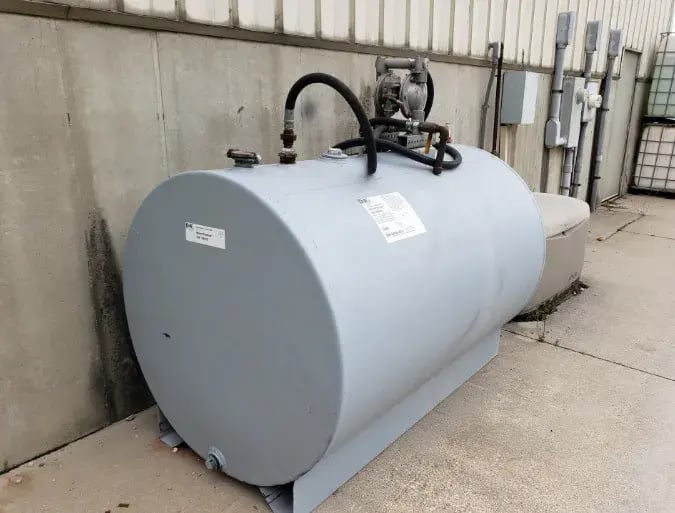
Certified Contractors, NJDEP Notice, Sampling, What Happens If You Find Contamination, and the SPCC Update Afterward
Pulling an old underground tank out of the ground looks like a one-day excavation job, and the digging is the shortest part of it. In New Jersey, a regulated tank can't come out until the facility is registered, NJDEP has been notified, and a certified contractor is lined up. Soil samples taken that same day decide whether you're done or whether you've just started a cleanup. And once the tank is gone, your oil spill plan has to match what's left on the site.
This article follows the process in the order it happens. We cover who can legally do the work, how the 14-day notice works, what gets sampled, and what to do the moment a sample or a smell says there's contamination, including the role of a Licensed Site Remediation Professional (LSRP). Then we cover the SPCC update. If you've got a tank coming out and want a second set of eyes on the paperwork around it, you can reach out to RMA at any point.
Table of Contents
TL;DR
Removing a regulated underground tank in New Jersey takes a registered facility, an online notice to NJDEP at least 14 days ahead, and a contractor certified for tank closure. Soil samples taken during the removal show whether there's a discharge. If there is one, it gets reported right away to NJDEP's hotline and the local health agency, and the cleanup runs under an LSRP. Afterward, update your SPCC Plan and facility diagram to match what's left on site, and add any replacement tank to the plan.
Which Tanks Fall Under New Jersey's Regulated Tank Closure Process?
The closure process in this article applies to regulated underground storage tanks (USTs) covered by NJDEP's UST rules, N.J.A.C. 7:14B. That mostly means tanks holding petroleum or other hazardous substances, like fleet fueling tanks, retail fuel tanks, and larger buried heating oil tanks at nonresidential buildings. Several kinds of tanks are exempt from those rules, including residential heating oil tanks and nonresidential heating oil tanks of 2,000 gallons or less used on site. Exempt doesn't mean free of requirements. Exempt heating oil tanks generally still need certified professionals for closure, and a leak from one still has to be cleaned up. Our post on heating oil tanks at New Jersey businesses covers where that line falls.
A tank that's just sitting there is still a tank. NJDEP's guidance says a regulated UST that's out of service has to be handled on a timeline: update the registration within 7 days of taking it out of service, cap the risers and product lines by the three-month mark, and by month 11 either return it to service, get a one-year extension, or get approval to remove it. A tank out of service for more than 12 months without an extension can draw a violation, an order to remove it, and a penalty, so abandoned tanks at idle sites tend to be the ones that get forced.
Who Can Legally Remove a Regulated Tank in New Jersey?
New Jersey requires certified people for this work, and the certification applies to both the company and the individual. NJDEP certifies UST contractors by category, and tank closure is its own category. Closure work has to be done by a certified individual or under that individual's on-site supervision, and the firm has to hold the matching certification. NJDEP puts the responsibility for checking on the owner or operator, so ask to see the individual's license card and confirm the firm on NJDEP's searchable list of certified UST companies. The firm's certification number goes on the notice you file with NJDEP, which means the contractor has to be chosen before the notice goes in.
A second professional enters the picture if there's any chance of contamination. For regulated USTs, an LSRP is required for remediation, and NJDEP's guidance says the LSRP or their designee takes the role the old subsurface evaluator used to have on site during closure, which is determining whether contamination is present and how far it extends. NJDEP expects the LSRP to work alongside the closure-certified contractor. If you expect to find something, say a tank that's been in the ground for decades with a history of overfills, NJDEP's notice asks you to name the LSRP up front. It makes sense to bring the LSRP in before removal day, since that's when sampling starts.
Then there are the local permits. Tank removal typically involves a demolition permit and compliance with the Uniform Construction Code, and local fire officials may be involved. RMA doesn't prepare those construction-phase permits or approvals. Your closure contractor, your engineer, or your municipality's construction office is the right place to start.
How Do You Notify NJDEP Before a Tank Removal?
Start by confirming the facility and the tank are registered with NJDEP. If the facility isn't registered, you register it first, and no tank at the facility can be closed until that's done. Then file a notice of intent to close through NJDEP Online, at least 14 calendar days before the planned closure date. The notice includes the facility registration number, whether the tank will be removed or abandoned in place, the planned date, the certification number of the closure firm, and the license number of the LSRP if one is doing remediation.
NJDEP generates an approval automatically when you submit. That approval isn't the end of the notice duty. You give a copy to the municipal and county health departments and to the local authority handling your demolition permit application, also at least 14 calendar days before closure. The UST rules also include a separate 14-day notification for installation, substantial modification, or closure work, which is sent by email to NJDEP with the site address, the UST facility ID, the dates, and the owner and contractor contact details. That one doesn't replace the notice of intent or any permit, so file both. If an emergency forces the work, notice is due as soon as practicable and no later than 14 days after the work, and it can come from the owner, the certified contractor, or an LSRP.
What Happens on Tank Removal Day?
Before anyone starts cutting, a closure plan has to exist and stay at the facility, where NJDEP, the local construction official, or local health officials can ask to see it. The plan includes the site investigation approach and a tank decommissioning plan. Closure follows the American Petroleum Institute's Recommended Practice 1604 for closing underground petroleum tanks, and the tank is emptied and cleaned using the industry safe-entry standards the rule lists. Confined space entry is dangerous work, and it's one more reason the certified contractor does it, not the facility's maintenance crew.
Once the tank is out and secured, the contractor looks it over for holes. If there are holes, or a discharge has been confirmed, the NJDEP hotline gets called unless the discharge was already reported. The residue and rinsate from cleaning count as waste, so someone has to make a hazardous waste determination and arrange disposal with the right paperwork. Keep every manifest.
When Can a Tank Stay in the Ground?
Abandoning a tank in place is the exception. It's allowed only when no contamination above the remediation standards turns up, or when removal isn't feasible, such as a tank under a building. In that case a New Jersey licensed professional engineer has to certify why removal isn't feasible. The tank gets pumped out, cleaned, inspected inside, and completely filled with sand, cement, or a similar inert material, and the fill pipes come out to at least a foot below grade. Even then, the sampling still happens, through borings drilled through the tank bottom.
How Does Soil Sampling Work During a Tank Closure?
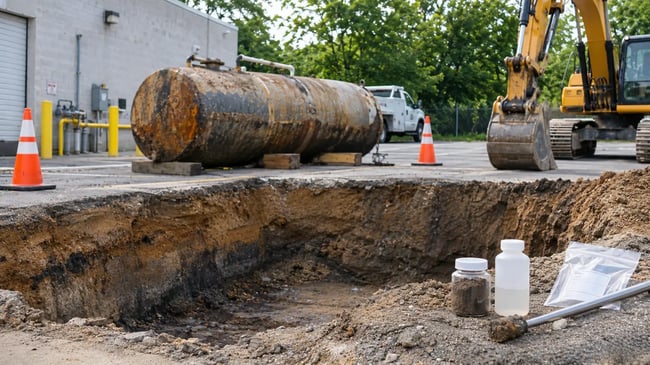
NJDEP's UST investigation guidance covers the details, and your LSRP or closure professional will follow it. Samples are collected the same day the tank comes out. As the soil is dug, it's field-screened. For products that give off vapors, like gasoline, diesel, No. 2 fuel oil, kerosene, and waste oil, that means screening the floor and sidewalls of the excavation. For heavier products like No. 4 or No. 6 fuel oil, the person on site looks for staining and odor. Samples are aimed at the spots that screen highest or look worst, and when nothing stands out, professional judgment fills the gap.
| Situation |
Where samples go |
| Dry excavation |
Along the tank centerline, one per five feet of tank length, 0 to 6 inches below the excavation bottom (or just above bedrock) |
| Groundwater in the excavation, lighter-than-water product |
0 to 6 inches above the high water table, one per 30 linear feet of sidewall, at least one per sidewall |
| Tank on a concrete pad |
One location per 30 linear feet on each side of an intact pad, or beneath the most cracked areas of a damaged pad |
| Piping, fill ports, and dispensers |
Sampled under NJDEP's Soil Sampling Technical Guidance |
| Tank abandoned in place |
Borings through the tank bottom, about one per five feet of length |
What the lab tests for depends on what was in the tank. If the contents are unknown, the guidance starts broad, with a full target compound list, metals, petroleum hydrocarbons, and pH, and then narrows once the contaminants are characterized. If groundwater could be affected, groundwater sampling comes next, typically with the first sample within about 10 feet of the tank in the expected downgradient direction. Soil dug out only to reach the tank can go back in the same hole without analysis if nothing suggests a discharge. Soil that's visibly stained or tests dirty can't just be backfilled, and its reuse or disposal follows NJDEP's fill guidance. We left the specific analytical lists out here on purpose, because they vary by product, and your LSRP should confirm them for your tank.
What Happens If You Find Contamination Under a Removed Tank?
A confirmed discharge starts a clock. Anyone involved with the tank system, including the owner or operator, the certified remover, and the LSRP, has to report it immediately to the local health agency and to the NJDEP Environmental Action Hotline, which the rule lists as 877-927-6337 (confirm the current number on NJDEP's website). Confirmation can come from lab results, a closure-sampling result showing contamination near the tank, or a site investigation, and visual or odor checks and field screening count too. The report gives the substance and estimated amount, the location, and what's being done to contain and clean it up. For hazardous substances other than petroleum, a release above the reportable quantity can also go to the National Response Center.
From there, the owner or operator has to remediate under the UST rules and New Jersey's site remediation rules, and an LSRP runs that work. The sequence goes roughly like this: a site investigation, a site investigation report filed within the deadlines in N.J.A.C. 7:26C-3.3, and then either a Response Action Outcome from the LSRP if no more cleanup is needed, or a remedial investigation and remedial action if contamination exceeds the standards. Keep in mind that NJDEP's penalty table lists a $20,000 base penalty for failing to remediate a UST discharge as the rules require. Ignoring the obligation, or hiring an LSRP late, is the expensive way to handle it.
Cost and timing vary a lot, and we won't guess at a number. A clean tank pull with passing samples can wrap up quickly. A discharge with groundwater impact can run for years. New Jersey's Spill Act can hold a responsible party liable for cleanup costs regardless of fault, so an environmental attorney is worth a call alongside the LSRP if sampling comes back bad. The property owner also has to keep the closure records permanently and make them available to NJDEP, which is one more reason to keep the closure plan, notices, approvals, manifests, and lab data together in one file.
How Does a Tank Removal Change Your SPCC Plan?
The federal SPCC rule requires an amendment whenever a change to the facility's design, construction, operation, or maintenance materially affects its potential for a discharge, and adding or removing containers is one of the listed examples. The deadline is to amend the plan within six months of the change and put the amendment into practice within six months after that, though doing it sooner is better. It helps to sort out which situation you're in, because the answer differs.
If a Regulated Buried Tank Comes Out and Nothing Replaces It
Completely buried tanks that meet all the federal UST requirements, or an approved state program, are excluded from the SPCC rule and from the 1,320-gallon aboveground count, so removing one doesn't change your capacity math. The plan's facility diagram still needs to reflect reality, since that's where the buried tank was marked as exempt. Pull it off the diagram and update the inventory. If the tank was the only oil storage you had, check whether any aboveground containers, drums, or oil-filled equipment remain. Our post on going idle or closing a New Jersey facility explains what happens to the plan once nothing is left to cover.
If an Aboveground Tank Replaces It
This is the case that catches people. A new aboveground tank counts toward your SPCC capacity, and installing one is a technical amendment. A technical amendment to a PE-certified plan has to be certified by a licensed Professional Engineer. For a self-certified plan, the owner or operator can usually certify the change, unless it touches an element that needed a PE in the first place, like an alternative to standard containment. The key is having a qualified person review and approve the change before the tank goes into service. Our posts on replacing an old tank and the SPCC amendment and what a PE does when certifying an SPCC Plan cover that side in depth.
What Else Needs Updating After a Removal?
If you're a New Jersey major facility with NJDEP-approved DPCC and DCR plans, a tank removal can trigger an amendment to those, and those amendments are generally due within 30 days of the change, so check N.J.A.C. 7:1E against your own facility. If you're reworking the plan yourself, our guide on reviewing and updating your own SPCC Plan gives you a self-audit to work from, and the tank inventory guide helps you recount what's left.
How Can RMA Help Around a Tank Removal in New Jersey?
Here's where we fit and where we don't. The removal itself belongs to a certified closure contractor, the cleanup belongs to an LSRP, and the demolition and construction permits belong to your contractor and municipality. We don't do any of those. What we can do is help you work out what the removal does to your oil spill plan, recount your storage, update the facility diagram and plan so they match the site, and coordinate with whoever certifies the amendment when a PE is needed. If you're deciding who to call first, we can also help you figure out what the project needs and point you toward the right people.
If you've got a tank coming out and you're not sure how it touches your SPCC Plan, there's no pressure and no obligation. You can call us, email us, or fill out the form on our website, and you can contact RMA whenever it's convenient. If you don't need us, we'll say so.