From Storm Drain to the Schuylkill, Susquehanna, or Allegheny: Following Your Parking Lot Runoff to Pennsylvania's Rivers
Rain hits your parking lot, runs across the pavement, and disappears into a grate. Most of us never think about where it goes after that. In most of Pennsylvania, the answer is a nearby creek, with no treatment along the way, and from that creek into one of the state's major rivers, whether that's the Schuylkill, the Susquehanna, the Allegheny, or one of the others.
This article follows that water from the drain to the river. We'll cover how storm drains work, what's in the runoff from a typical lot, which Pennsylvania river system your site drains to, and where the rules start to apply. We'll also go through simple ways to keep a lot cleaner. If you have questions about your own site, you're welcome to reach out to RMA, though plenty of what's here you can handle on your own.
Table of Contents
TL;DR
In most of Pennsylvania, a parking lot storm drain sends runoff untreated to the nearest creek, and that creek feeds one of the state's big river systems: the Delaware and Schuylkill in the southeast, the Susquehanna through the middle, the Allegheny and Ohio in the west, with smaller areas draining to Lake Erie and the Potomac. Runoff carries oil, metals, salt, sediment, and trash. A lot used only for parking usually doesn't need a stormwater permit, but a lot with industrial activity on it may, and spills and dumping into a drain are illegal everywhere. Most of the fixes that keep runoff cleaner are cheap.
Where Does a Pennsylvania Parking Lot Storm Drain Go?
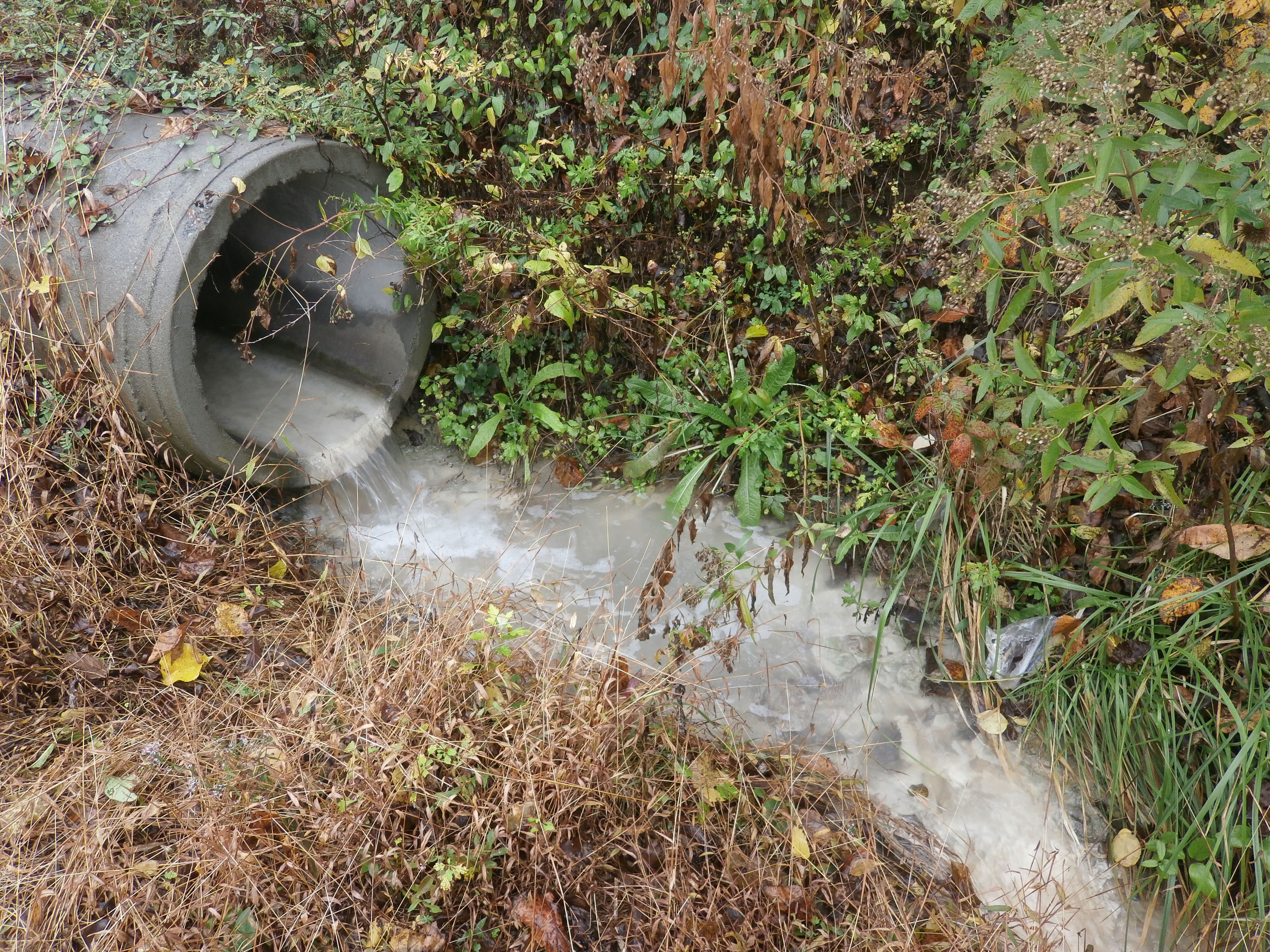
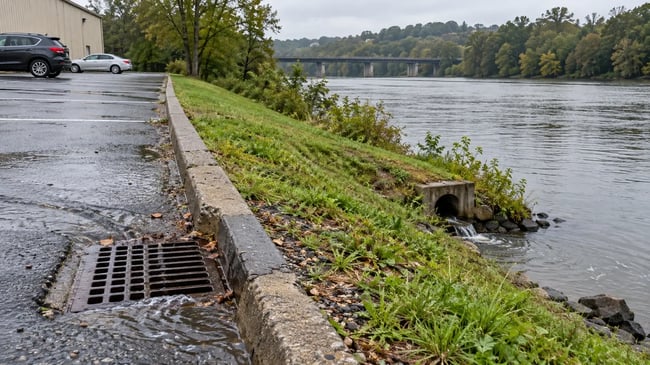
A storm drain isn't a sewer. That's the first thing to untangle. A sanitary sewer carries what goes down your sinks and toilets to a wastewater treatment plant. A storm sewer usually carries rain and snowmelt, and in most of Pennsylvania it runs to the nearest stream with nothing in between. There's no plant, no screening, and no filter unless someone built one into the system.
The path usually goes like this. Water runs across your pavement into a catch basin, drops into a pipe under the street, and joins pipes from neighboring properties and roads. Those pipes feed an outfall, which is the spot where the pipe empties into a ditch, a creek, or a basin. Your township or borough often owns the pipe under the street, but whatever you let into the drain still arrives at the outfall.
There are exceptions. Older parts of cities like Pittsburgh and Philadelphia have combined sewers, where stormwater and sewage share one pipe. In dry weather that flow goes to a treatment plant, but in a heavy storm the system can overflow into the river. Some newer sites also route runoff through a detention basin, rain garden, or filter before it leaves, which cleans up part of it.
How Can You Tell Where Your Own Storm Drain Goes?
Start with your site plans, since the engineer who designed the lot would have shown the storm system and where it discharges. If you don't have them, your township or borough public works office usually keeps a storm sewer map. You can also walk the property after a good rain and follow the water. It tends to show you the low point of the lot and the drain it heads for, and from there you can ask where that pipe comes out.
What Pollutants Are in Pennsylvania Parking Lot Runoff?
Every car and truck that crosses a lot leaves a little something behind. Oil and grease drip from engines and transmissions. Brake pads and tires wear down into fine dust that carries metals like copper and zinc. Antifreeze, hydraulic fluid, and fuel show up wherever vehicles leak or get filled. In winter, road salt and deicers add chlorides, and those don't break down or settle out. They stay in the water all the way downstream.
Then add whatever your business generates. Dumpster areas leak liquids and blow litter toward the drains. Fleet yards, loading docks, and equipment storage areas add more of the same. Sediment from bare dirt or worn paving travels along with it, and cigarette butts, plastic, and other trash end up in the creek. The first good rain after a dry stretch usually carries the heaviest load, because everything that built up on the pavement gets flushed at once.
None of this looks dramatic in a single storm. The effect comes from volume. A parking lot is mostly hard surface, so rain can't soak in, and every inch that falls becomes runoff that moves fast and picks up what it finds. Multiply that across every lot, road, and roof in a watershed, and small streams feel it. Plenty of Pennsylvania streams are already listed as impaired, and we explain how that connects to permits in our post on impaired waters and TMDLs. A visible oil sheen on a creek or a cloudy outfall after every storm usually traces back to places like yours, and the sheen rule is what decides when a spill has to be reported.
Which Pennsylvania River System Receives Your Storm Drain Runoff?
Pennsylvania drains in several directions, so where your lot sits decides where its water ends up. Your runoff goes first to a small local creek, and that creek feeds one of the river systems below. The table lays out the main ones by region.
| Region |
River System |
Where It Ends Up |
| Southeast, including Philadelphia, Bucks, Montgomery, Delaware, and most of Chester counties, the Lehigh Valley, and the Poconos |
Delaware River and its tributaries, including the Schuylkill and the Lehigh |
Delaware Bay and the Atlantic |
| Central and northeast, including Harrisburg, Lancaster, York, Scranton, Wilkes-Barre, Williamsport, and State College |
Susquehanna River and its tributaries, including the West Branch and the Juniata |
Chesapeake Bay |
| Southwest and west, including Pittsburgh, Washington, Butler, and Johnstown |
Ohio River basin, including the Allegheny, Monongahela, and Beaver rivers |
Mississippi River and the Gulf of Mexico |
| South-central border, around Chambersburg and Gettysburg |
Potomac River tributaries |
Chesapeake Bay |
| Northwest corner, around Erie |
Small creeks flowing to Lake Erie |
The Great Lakes |
In the east, the Schuylkill runs from the coal region down through Reading and Norristown and joins the Delaware at Philadelphia. In the west, the Allegheny and the Monongahela meet at Pittsburgh and form the Ohio. The Susquehanna is the largest of the state's rivers and one of the main sources of fresh water for the Chesapeake Bay, which is why Bay cleanup efforts put so much attention on Pennsylvania's central counties.
Downstream is where it gets personal. Philadelphia draws its drinking water from both the Delaware and the Schuylkill, and Pittsburgh draws from the Allegheny. Water suppliers treat what they take in, but cleaner source water costs less to treat. A lot in Reading and a lot in Allentown both look like ordinary pavement, yet one sends its runoff toward the Schuylkill and the other toward the Lehigh and the Delaware. Knowing which one you're on tells you who's downstream of you and which watershed groups, water suppliers, and regulators are paying attention to that stretch of river.
What Do Pennsylvania Stormwater Rules Say About Parking Lot Runoff?
Pennsylvania's Clean Streams Law prohibits putting pollution into the waters of the Commonwealth, and the federal Clean Water Act does the same thing at the national level. A storm drain that connects to a creek counts as a discharge to that creek. Civil penalties under the Clean Streams Law can reach $10,000 per day for each violation, so a problem that goes on for weeks adds up quickly.
Do You Need a Stormwater Permit for a Parking Lot?
Usually not for the parking itself. A lot at an office, a clinic, or a retail store, with customers' and employees' cars parked on it, generally isn't regulated as industrial activity. The permit question starts when the lot is also used for industrial work. Manufacturing, equipment and vehicle maintenance, scrap and recycling, outdoor material storage, and loading areas where materials sit exposed to rain are all examples. If rain touches those activities and then leaves the site, you may need coverage under Pennsylvania's general permit for industrial stormwater, called PAG-03. Our posts on stormwater associated with industrial activity and who needs a stormwater permit go through the triggers one by one.
Even then, a permit isn't the only path. Facilities that keep their industrial materials and activities fully sheltered from rain and snow may qualify for a No Exposure Certification instead, and others may need an individual permit. We compare the options in which NPDES permit you need. Under PAG-03, the plan DEP expects is a PPC Plan, and how it differs from a SWPPP is worth a read if you've heard both terms. DEP can also show up unannounced, and a PA DEP stormwater inspection tends to start at the outfall and the drains.
What Does Your Township Require?
Permits aside, your municipality has its own say. Many Pennsylvania townships and boroughs hold their own stormwater permits for their storm sewers, called MS4 permits, and they back them with ordinances that ban anything but stormwater from entering a storm drain. Pressure washing a dumpster pad, dumping mop water, or rinsing a concrete truck into a grate can all be violations, and fines vary by municipality. Spills are a separate matter. If a release threatens a stream or storm drain, 25 Pa. Code 91.33 requires you to notify DEP right away, by phone, and the safest course is to call when you're unsure.
Which Parking Lot Activities Send Pollution Down Pennsylvania Storm Drains?
The rule of thumb is simple: only rain should go down a storm drain. In practice, the trouble comes from routine work that happens to take place near one. Washing trucks, vans, or equipment on the lot sends soap, oil, and grime straight to the creek. Fueling and fluid transfers drip, and a few drops at every fill-up add up over a year. Vehicles that leak while they sit in the same spots every day leave a stain that rain carries away.
Dumpsters are another regular offender, especially when the lids stay open or the pad is cracked and the liquid pools. Outdoor storage causes problems too, from pallets of product to scrap, drums, and bags of bulk material. Add snow piles, which hold salt and sand until the thaw releases them all at once, and spills from deliveries that nobody notices until the next rain. If you're sorting out what counts as stormwater versus other water on your site, our post on stormwater versus process water helps draw that line.
How Can a Pennsylvania Business Keep Parking Lot Runoff Cleaner?
Most of what keeps runoff cleaner is cheap and doesn't take a consultant. The practices below are the ones we see work best on ordinary commercial and industrial lots:
- Sweep the lot regularly, and especially before the season's heavier rains, so sediment and debris go in a dumpster instead of a creek.
- Keep spill kits where fueling and fluid transfers happen, and train the people who use them.
- Use drip pans under equipment and vehicles that leak, and fix the leaks when you can.
- Keep dumpster lids closed, and put covers or roofs over outdoor storage when it's practical.
- Clean out catch basins and storm inlets on a schedule so sediment doesn't build up and wash through.
- Store salt under cover and use only what you need.
A walk through the lot after a rain tells you a lot. You can see where water collects, where stains sit, and which drains take the worst of it, and doing a stormwater visual inspection the right way gives you a checklist for it. When the fixes need to be more permanent, our explainer on stormwater BMPs covers the structural and non-structural options. And when the people on your team don't know what they're looking for, our online training library is a low-cost way to get them up to speed.
How Can RMA Help With Pennsylvania Stormwater Compliance?
RMA is a family-run firm that's been doing this since 1992. We're based in New Jersey and work with facilities across Pennsylvania and the rest of the country. Senior staff do the work themselves, and we don't use AI to produce client deliverables. For Pennsylvania stormwater, that usually means figuring out whether a site needs PAG-03 coverage, a No Exposure Certification, or nothing at all, and then handling the application and the PPC Plan through our NPDES permitting service. If you're curious about doing it yourself, we wrote up when you can get a PAG-03 permit on your own, and our online environmental assessment can point you toward the programs most likely to apply to your site.
A lot of businesses that call us turn out not to need a permit, and we'll say so. If you're not sure, that's a perfectly good reason to get in touch. You can call, send an email, or fill out the form on our website, and there's no obligation either way. Whenever you're ready, contact RMA and tell us what's going on at your site.