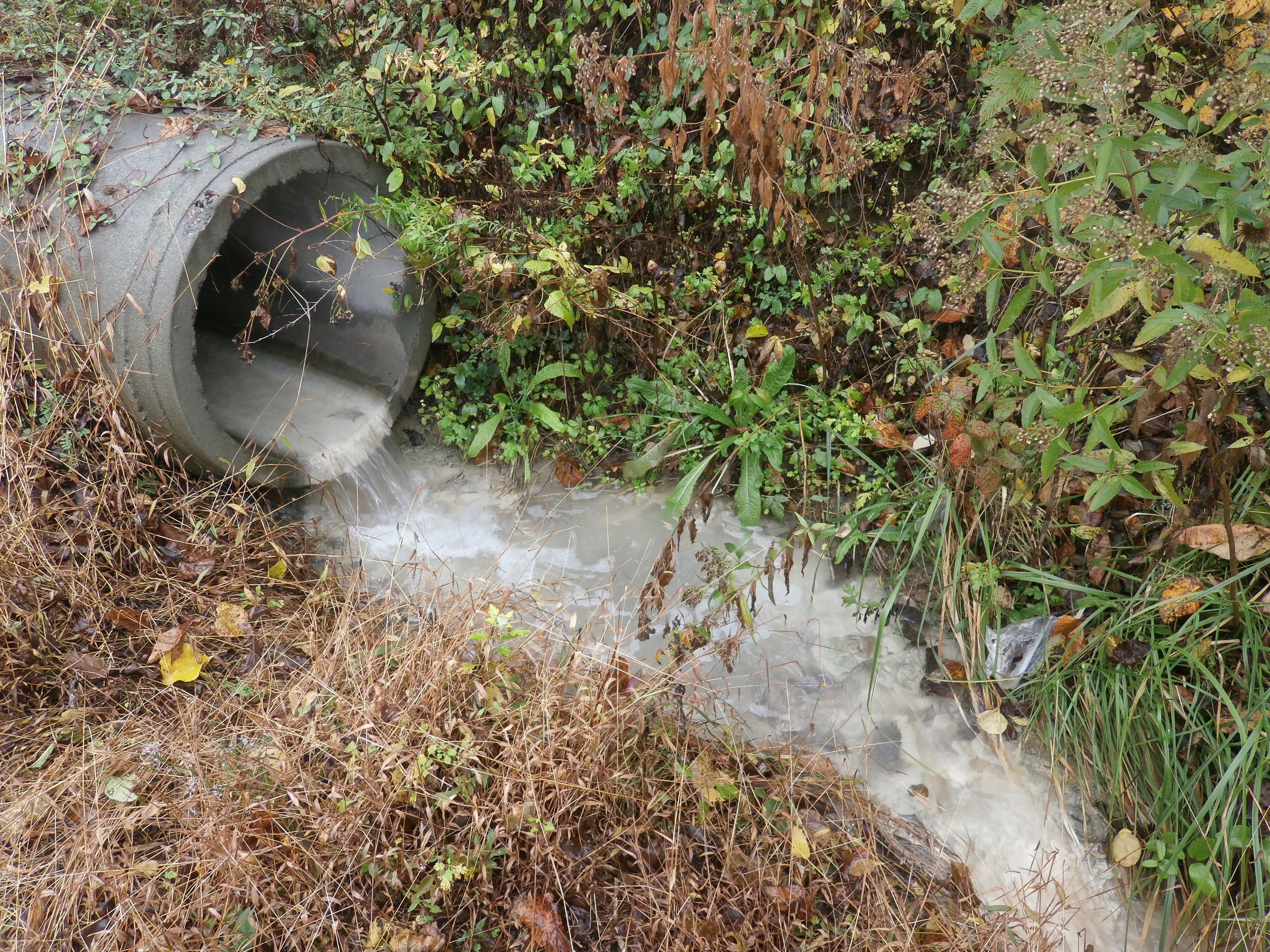
How Pennsylvania DEP's PAG-03 Industrial Stormwater Permit Applies to Outdoor Curing Yards, Form Oils, Washout, and Stockpiles at Precast Plants
Most precast concrete plants in Pennsylvania do need stormwater permit coverage, and the usual route is a general permit called PAG-03, issued by the Pennsylvania Department of Environmental Protection (DEP). The reasoning is simple. A precast plant makes its product from cement, aggregate, steel, and oil-based form release agents, and a lot of that work, along with the finished product, sits outdoors where rain and snowmelt can wash across it and into a storm drain, a ditch, or a creek. Runoff that leaves the site is regulated under the federal Clean Water Act through a program called NPDES (the National Pollutant Discharge Elimination System) and under Pennsylvania's Clean Streams Law. The exception is a plant that keeps everything under a roof, and even that plant usually has paperwork to file with DEP.
This article walks through where stormwater picks up pollution at a precast plant, what PAG-03 and its concrete-specific section require, and how pH, sediment, and oil tend to cause trouble. We also cover how precast differs from ready-mix, when a plant might qualify for something other than PAG-03, and what to expect on cost. If you'd rather talk through your own plant, you can reach out to RMA any time, and we'll tell you plainly what applies and what doesn't.
Table of Contents
TL;DR
Most Pennsylvania precast plants need coverage under DEP's PAG-03 general permit, in the section written for concrete products (Appendix N), because outdoor curing and storage yards, form oils, washout, and stockpiles all come into contact with rain and snowmelt. A plant that keeps every material and activity under cover may qualify for a No Exposure Certification instead, and a few sites need an individual permit. PAG-03 comes with a PPC Plan, twice-a-year sampling, and electronic reporting, and the trouble usually comes from high pH, sediment, and oil sheen. Construction-phase approvals and local sewer rules sit outside the permit and can change the picture for a specific site.
Why Do Precast Concrete Plants Need a Pennsylvania Stormwater Permit?
Pennsylvania DEP regulates what it calls "stormwater associated with industrial activity," which means runoff from the manufacturing, material handling, and storage areas of an industrial site. Whether your plant lands in that category starts with its SIC code, the four-digit Standard Industrial Classification number that describes what a business makes. Precast concrete products fall under SIC 3272, concrete products except block and brick, and PAG-03 groups codes 3271 through 3275 into one sector section called Appendix N, Glass, Clay, Cement, Concrete and Gypsum Products. If you'd like the full definition, our article on what stormwater associated with industrial activity means goes through it in plain language.
The right SIC code doesn't automatically mean a permit, though. Coverage turns on whether industrial materials or activities are exposed to rain and snowmelt, and on whether that water leaves your site through an outfall into a creek, a ditch, or a storm sewer. Pennsylvania's definition of exposure is broad. Raw materials, equipment, byproducts, waste, and final products all count, so a yard full of finished beams, pipe, or panels counts the same as a pile of sand. A precast plant that cures and stores product outdoors will almost always meet that test.
A plant that discharges industrial stormwater without PAG-03 coverage, an individual permit, or an approved No Exposure Certification is out of step with the permit program, and DEP inspectors do ask for it. On the other hand, a small shop that makes everything indoors and stores every product, material, and piece of equipment under a roof may need nothing more than a certification. We'll cover that option below.
Where Does Stormwater Pick Up Pollutants at a Precast Plant?
Rain doesn't pollute anything on its own. The trouble starts with what it picks up between the sky and your outfall, which is the pipe, ditch, or channel where water leaves the property. At a precast plant, that list looks a little different from a typical factory because so much of the work, and so much of the finished product, sits outside.
| Exposure at the Plant |
What It Can Add to Stormwater |
| Outdoor curing and storage yards |
Concrete dust and fines, chips and broken product, sediment from unpaved areas, drips of form oil and hydraulic fluid |
| Form release agents and oils |
Oil sheen and staining from overspray and drips around casting beds |
| Washout from forms, mixers, buckets, and tools |
Highly alkaline slurry (high pH) and suspended solids if it isn't contained |
| Aggregate and cement handling |
Sediment from sand and stone piles, cement dust, alkaline fines |
| Sawing, grinding, and finishing |
Slurry and fine particles that raise both pH and solids |
| Equipment fueling and maintenance |
Fuel and oil spills, hydraulic leaks, sheen |
The yards are usually the biggest exposure. Precast pieces are large and heavy, so they sit outside on the ground for days or months while they cure and wait for shipping, and the storage areas tend to be big, partly unpaved, and busy with forklifts, gantry cranes, and delivery trucks. Concrete dust, chips, and fines build up on that ground, and young concrete is alkaline, so runoff that crosses it can pick up a high pH along with the sediment. The form release agents add a second problem. They're sprayed or rolled onto molds before every pour, and overspray and drips collect around the casting beds, where rain turns them into a visible sheen.
Washout is the exposure most likely to turn a manageable plant into a problem plant. Rinsing forms, mixers, buckets, hoppers, and hand tools produces alkaline slurry, and that is process wastewater, not stormwater. PAG-03 covers stormwater plus a short list of clean non-stormwater discharges, such as irrigation drainage and uncontaminated groundwater, and washout isn't on that list. It has to be contained, reused where that's feasible, and disposed of properly rather than allowed to run across the yard. Our articles on the difference between stormwater and process water and settling basin design at concrete plants show how plants handle it.
Aggregate and cement round out the list. Sand and stone piles shed sediment, and cement, fly ash, and slag can blow around as dust if they aren't enclosed. Appendix N tells plants to store raw materials in permanent structures such as enclosed silos, hoppers, or buildings, but it exempts aggregate from that requirement unless DEP determines the piles are causing pollution and notifies the plant in writing. Uncovered aggregate piles aren't automatically a violation, in other words, but DEP can require cover or other controls once they become the source of a problem.
How Does PAG-03 Appendix N Apply to Precast Plants?
PAG-03 is a general permit, which means DEP wrote one set of rules for a whole category of facilities and each plant joins by submitting a Notice of Intent (NOI) instead of negotiating its own permit. The current PAG-03 runs from March 24, 2023 through March 23, 2028. Parts A, B, and C apply to everyone and cover monitoring and reporting, standard conditions, and best management practices (BMPs), which are the physical and operational controls that keep pollutants out of runoff. A precast plant follows those three parts plus Appendix N.
The NOI goes to the DEP regional office that covers the county where the plant sits, and it needs to be in at least 60 days before a new discharge starts. The application describes the industrial activities on site, the outfalls and drainage areas, and the authorized non-stormwater discharges, and it comes with the plant's Preparedness, Prevention, and Contingency (PPC) Plan. DEP reviews it before approving coverage, and it can deny general permit coverage and require an individual permit based on what it finds. Our guide to Pennsylvania's PAG-03 permit and how to take stormwater samples walks through the application side.
What Does Appendix N Require Precast Plants to Sample?
Appendix N requires a grab sample at each representative outfall once every six months, and the results go on Discharge Monitoring Reports (DMRs). Two parameters carry benchmark values. The rest are report-only, which means DEP wants the data but there's no number to meet.
| Parameter |
Benchmark Value |
Frequency |
| pH |
9.0 standard units |
Once every 6 months (grab) |
| Total suspended solids (TSS) |
100 mg/L |
Once every 6 months (grab) |
| Total nitrogen |
Report only |
Once every 6 months (calculated) |
| Total phosphorus |
Report only |
Once every 6 months (grab) |
| Total aluminum |
Report only |
Once every 6 months (grab) |
| Total iron |
Report only |
Once every 6 months (grab) |
Benchmarks aren't effluent limits, so a single high result isn't a permit violation. The trouble starts when the same outfall exceeds a benchmark for two monitoring periods in a row. At that point the plant has to submit a Corrective Action Plan within 90 days of the end of the monitoring period, and after four in a row it also has to work through DEP's Stormwater BMPs Checklist. Continued exceedances can lead DEP to require an individual permit. Our article on benchmark values versus effluent limits explains the difference in more detail.
The sampling rules are specific. Samples have to come from a storm event larger than 0.1 inch that follows at least 72 hours after the previous measurable storm, and grab samples are collected within the first 30 minutes of the discharge. Analysis has to be done by a laboratory accredited in Pennsylvania. Plants that miss the window or sample the wrong storm end up with results DEP may not accept, which is why we encourage plant staff to take their own stormwater samples instead of waiting on a lab visit.
What Else Does PAG-03 Require From a Precast Plant After Approval?
Sampling is only part of the routine. The plant has to inspect its exposed areas, PPC Plan pollutant sources, outfalls, and BMPs by eye at least twice a year, and once each year that inspection has to happen during a qualifying storm. DMRs go to DEP through its electronic eDMR system and are due January 28 for the second half of the year and July 28 for the first half. Each year the plant also files an Annual Report and pays a $500 installment of the permit fee by March 23. Our guide to Pennsylvania eDMR reporting and our walkthrough of how to do a stormwater visual inspection cover both in detail.
The PPC Plan is the document that ties it together. It identifies every source of pollutants that could reach stormwater, describes the BMPs and spill response procedures, includes a site map showing structures, drainage, and outfalls, and sets up employee training. The plant has to review it at least once a year, and train employees on it at least annually. An existing SPCC (Spill Prevention, Control, and Countermeasure) plan can serve as the PPC Plan if it covers the permit's minimum requirements, which is worth knowing because many precast plants already have one for their oil storage. Our comparison of SWPPPs and PPC Plans for PAG-03 and our article on whether a concrete plant needs an SPCC plan go further.

How Do You Manage pH, Sediment, and Oil in Precast Plant Stormwater?
These three problems account for most of what goes wrong at precast plants, and each one has a different cause and a different fix. Appendix N and the general BMPs in Part C give a starting list, but how well they work depends on how your plant is laid out.
How Do You Control High pH at a Precast Plant?
Cement is alkaline, so anything that touches fresh concrete, slurry, or fines can push runoff above the 9.0 benchmark. The usual culprits at precast plants are washout water that reaches the yard, saw and grinder slurry, a film of concrete fines on pavement, and leftover concrete dumped or washed off near a drain. DEP has denied general permit coverage to a concrete facility in part because its washout area didn't have an adequately sized, impermeable retention structure and its stormwater sample came back at a pH of 10.5.
The fixes work upstream of the outfall. Appendix N calls for an impermeable retention structure for washout water and solids, with the collected water reused where feasible and the solids removed and disposed of properly. It also calls for dust control around material handling and mixing, runoff controls around wash areas, and berms or similar controls in loading areas. Many plants add slurry collection at their saws and regular vacuum sweeping of the casting and finishing areas. Be careful about treating the water itself, because PAG-03 doesn't allow polymers or other chemicals to treat stormwater without DEP's written permission, and that would generally include chemicals used to adjust pH. Pull samples promptly and test right away, since pH in a sample can drift, and our article on whether stormwater sample pH changes after 15 minutes explains why.
How Do You Reduce Sediment in Precast Plant Runoff?
Sediment shows up in the TSS result, and the 100 mg/L benchmark is easy to miss at a plant with unpaved yard areas, aggregate piles, and constant equipment traffic. Appendix N points to routine housekeeping, dry cleanup of accumulated solids, and regular sweeping of paved surfaces, and those habits keep most of the solids from ever reaching a basin. Part C adds grading, berming, or curbing to keep clean run-on water away from dirty areas, stabilization of exposed soil, and velocity dissipation at outfalls so discharges don't scour the channel below. Appendix N also requires silt sacks or similar inlet protection as part of any Corrective Action Plan, or whenever DEP notifies the plant in writing. Our overview of stormwater BMPs covers the options.
How Do You Prevent Oil Sheen in Precast Plant Stormwater?
Oil and grease isn't one of the parameters Appendix N asks you to sample, but that doesn't make it a lower-risk issue. The permit prohibits discharges of oil and grease that cause a film or sheen on the water, and an inspector can see a sheen without any lab results. The sources at a precast plant are form release agents, hydraulic leaks from cranes and forklifts, fueling areas, and drips from parked equipment. Part C requires covering fueling areas where feasible, using berms and oil/water separators or oil and grease traps, keeping spill kits near areas where spills can happen, cleaning up with dry methods, and storing leaking equipment indoors or using drip pans and absorbents. Any incident that causes or threatens pollution has to be reported to DEP by phone as soon as possible and no later than four hours after you become aware of it, and spills above a reportable quantity also go to the National Response Center. Our article on the sheen rule for reporting oil spills explains when a small sheen becomes a reportable event.
How Is Precast Plant Stormwater Different From a Ready-Mix Plant?
Both types of plant fall under Appendix N and share the same benchmarks, the same sampling schedule, and the same PPC Plan requirement, so if you've read our producer's guide to concrete plants and stormwater permits, much of the framework will look familiar. What changes is where the trouble starts.
| Topic |
Ready-Mix Plant |
Precast Plant |
| Finished product |
Leaves as wet concrete in trucks, so there's no yard of cured product |
Cures and sits outdoors, often in large yards, until it ships |
| Truck washout |
Daily drum washout and returned concrete are the main concern, and Appendix N addresses truck barrel cleaning water directly |
Usually less truck washout, but mixers, buckets, forms, and tools still produce slurry |
| Form oils |
Rarely a factor |
Release agent overspray and drips around casting beds are a recurring source of sheen |
| Finishing |
Little beyond mixing and loading areas |
Sawing, grinding, and finishing slurry and dust |
| Where high pH usually comes from |
Often one concentrated source, the washout and returned-concrete area |
Often several scattered sources across the yard and production areas |
A ready-mix plant can often fix most of its pH trouble by fixing one washout area. A precast plant usually has to chase it across the yard, which is why housekeeping, sweeping, and slurry capture do so much of the work at precast sites. The size of the storage yard also changes the sediment picture, since a plant with several acres of product and equipment traffic has a lot more surface for runoff to pick up fines from. Truck washout isn't gone from a precast plant if it runs mixer trucks, and PAG-03 doesn't cover truck barrel cleaning water, so those plants need the same contained washout setup a ready-mix plant uses. Our article on whether precast environmental regulations match other concrete plants and our explanation of concrete plant water management cover the rest.
Can a Precast Plant Get a No Exposure Certification or Need an Individual Permit?
PAG-03 isn't the only possible outcome. Pennsylvania allows a facility to request a No Exposure Certification when every industrial material and activity is protected from rain and snowmelt by a storm-resistant shelter. That includes raw materials, equipment, byproducts, waste, and final products. DEP has to approve the certification, it has to be renewed every five years, and it isn't available to a facility discharging to High Quality or Exceptional Value waters. If operations change and something ends up outside, the plant may need permit coverage instead. Our articles on what No Exposure means and which NPDES permit you need go into the details.
For most precast plants, outdoor curing and storage yards rule this option out. A plant that does all of its casting, curing, finishing, and storage indoors might qualify, but DEP makes the call, and finished product stored outside is the part most likely to get questioned. We'd rather tell you that up front than have you spend money on a certification application that won't be approved.
An individual NPDES permit enters the picture when PAG-03 isn't available. That happens when a plant discharges directly to High Quality or Exceptional Value waters, when its stormwater could contribute to the impairment of a stream that doesn't meet its designated uses, or when it has other discharges that need their own individual permit. Appendix N lists truck barrel cleaning water as one of those discharges, and DEP can also require an individual permit after repeated benchmark exceedances. An individual permit is written for one site, so the application takes more work and more time than a PAG-03 NOI.
What Does PAG-03 Coverage Cost for a Precast Plant?
The agency side is the easy part. DEP charges $500 with the NOI and a $500 installment each year after that, due with the Annual Report each March 23. The bigger number is the work behind the application, and it varies a lot from plant to plant. The things that move it most are the size of the site and the number of outfalls, how complicated the drainage is, whether a stormwater plan or PPC Plan already exists, how much sampling has to be set up, and how much ongoing help you want with inspections, eDMR reporting, and plan updates.
A plant with one outfall, a clean site, and someone on staff who's comfortable with paperwork can sometimes handle much of this internally, and we'd tell you so. A plant with several outfalls, a history of high pH, or no existing plan usually benefits from a second set of eyes. Our articles on what a PAG-03 permit costs in Pennsylvania, doing PAG-03 yourself versus hiring a consultant, and how long PAG-03 coverage takes give more specifics. If you'd like a number for your own plant, RMA's pricing calculator for NPDES help is just below.
What About Construction, Sewer Authorities, and Local Rules at a Precast Plant?
If you're building a new precast plant or expanding a yard, the construction phase comes with its own requirements. Earth disturbance falls under 25 Pa. Code Chapter 102, which covers erosion and sediment control plans and NPDES coverage for construction activity, and projects commonly also need county conservation district review, Chapter 105 approvals for work near streams and wetlands, and township land development stormwater approvals. RMA doesn't prepare or manage any of those construction-phase permits, and most plants work with their engineer, contractor, or an erosion and sediment control specialist on them. We can help you work out what the construction phase is likely to need and point you toward the right people.
What we do help with is the part that starts when the plant is running. A new or expanded precast plant almost always needs PAG-03 coverage or a No Exposure Certification, a PPC Plan, sampling, inspections, and eDMR reporting, and the NOI has to be in at least 60 days before the first discharge, so it's worth planning alongside construction instead of after it.
Local rules can change the picture too. Townships, cities, and sewer authorities may have their own stormwater requirements and fees, and some older cities have combined sewers where runoff goes to a treatment plant. When site runoff is routed to a sanitary or combined sewer, the sewer authority may govern it instead of a DEP stormwater permit. DEP's PAG-03 materials also say that sending runoff into a municipal storm sewer doesn't by itself remove the need for coverage. Because the answer depends on where your water actually goes, confirm your situation with DEP and the local authority before assuming either way.
How Can RMA Help With Precast Plant Stormwater in Pennsylvania?
We've worked with concrete producers, including precast plants, since 1992, and we work with Pennsylvania facilities all the time. For a precast plant that usually starts with figuring out which path applies: PAG-03, a No Exposure Certification, or an individual permit. From there we can walk the site, map the drainage and outfalls, build the PPC Plan, prepare the NOI, coordinate sampling, and handle the eDMR reporting and Annual Reports that follow. If your results are creeping toward the benchmarks, we can help you find the source and put together a Corrective Action Plan before it turns into a bigger problem. We also offer online environmental training for the crew members who do the day-to-day sweeping, inspections, and spill response.
There's no pressure and no obligation. You can call or email us, or fill out the contact form on our website, and tell us a little about your plant. We'll tell you what we think applies, what it would take, and whether you need us at all.