Fluids, Batteries, and Mercury Switches: What NJDEP Expects at a Vehicle Recycling Yard
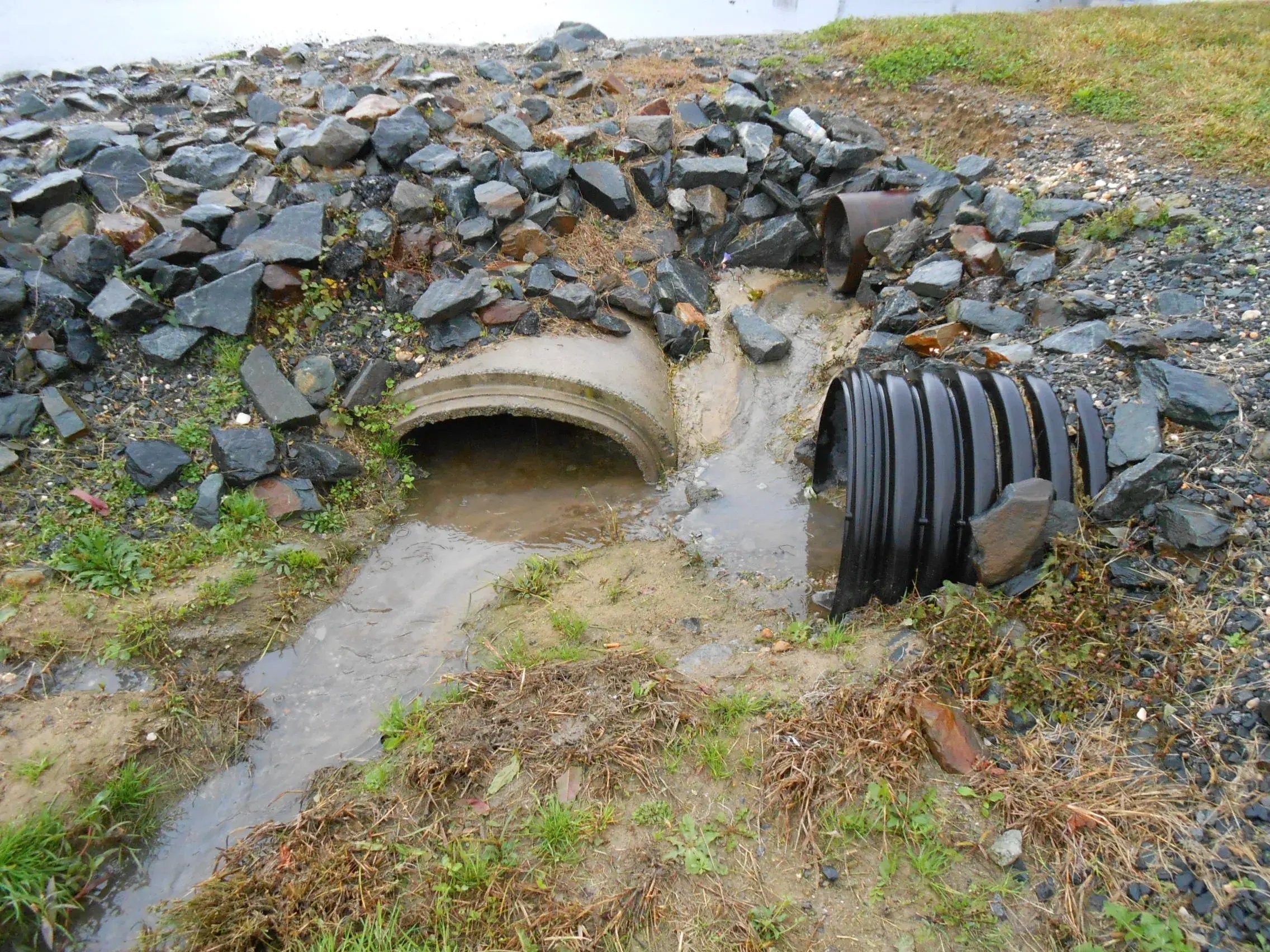
If you run an auto salvage or dismantling yard in New Jersey, how you drain vehicles is the first thing an NJDEP inspector is likely to look at. Oil, coolant, and brake fluid are what end up in rainwater when a yard handles them loosely. The Vehicle Recycling general permit, known as the RVR, is the NJPDES stormwater permit written for yards that only recycle vehicles. It spells out where draining happens, where the fluids go afterward, and what has to come off a vehicle before it moves to the next stage.
The short version is that every vehicle gets drained in a designated, contained, covered area, drained fluids go into labeled containers inside secondary containment, and batteries and mercury switches come out before the vehicle leaves the draining area. Most violations come from small shortcuts like a drum sitting a few feet off the pad or a battery tossed in a bin with no cover. Below we walk through each piece in plain terms, and if you'd like someone to look over your yard against the permit, you can reach out to RMA.
Table of Contents
TL;DR
Under New Jersey's RVR permit, you drain every vehicle in a contained, covered area, then store the drained fluids in labeled containers with secondary containment, indoors or under cover. Batteries and mercury switches come out before a vehicle leaves the draining area. Batteries go indoors or into leak-proof containers under cover, and mercury switches go into a closed, labeled, leak-proof container. Check your own permit and stormwater plan for the exact wording, because NJDEP can cite any gap between what's written and what's happening in the yard.
What Does the RVR Permit Require for Draining and Storing Vehicle Fluids?
The RVR is built around a handful of work areas, and each one has its own rules. Your stormwater plan has to describe how you'll handle an inbound vehicle inspection area, a fluid draining and dismantling area, a parts storage area, a fluid storage area, a processed vehicle storage area, an operable vehicle storage area, and spill response. Fluids, batteries, and mercury switches touch three of those areas, which is why they get so much attention from inspectors.
The flow is simple on paper. A vehicle comes in and gets looked over for leaks. It moves to the draining and dismantling area, where every fluid is drained and the battery and mercury switches are pulled. The fluids go to the fluid storage area, the battery and switches go to parts storage, and the drained vehicle moves on to wherever you keep processed vehicles. If a vehicle leaves the draining area still holding fluid, a battery, or a mercury switch, that's a gap in the process. NJDEP's October 2025 compliance advisory for vehicle recycling and scrap metal yards says inspectors are checking these basics and can issue a Notice of Violation when they find a problem.
We cover the broader question of whether your yard needs the RVR or the scrap metal permit in our post on stormwater permits for scrap yards and auto recyclers in New Jersey. This post goes deeper on the fluid, battery, and mercury switch side of the day-to-day work. If your yard also handles scrap metal beyond vehicles, you're likely looking at the SM2 scrap metal permit instead, and its conditions differ in places.
What Should Your RVR Fluid Draining and Dismantling Area Look Like?
NJDEP's guidance for the RVR describes the draining area as an impervious, contained space under cover. A bermed concrete pad under a roof is the standard example. Impervious means water and oil can't soak through it, contained means a berm, curb, or similar edge keeps a spill from running off, and under cover means rain can't fall on the work and carry anything toward a storm drain. The October 2025 advisory puts it another way: drain and dismantle fluid-containing parts indoors or under a roof on a sealed surface, unless stormwater from the area is collected and disposed of properly.
That last clause is where yards get creative, and it's also where they get into trouble. Collecting stormwater from an open draining pad sounds like a workaround, but it means you're now managing a waste stream, and you need a plan for where that water goes. For most yards the simpler path is a roof over a berm. If you're picturing a tarp on four poles, check how well it keeps rain off the pad in a windy storm, because an inspector will look at the pad on a wet day, not a dry one.
Put the draining area where vehicles can reach it without crossing the yard dripping, and keep it clear of storm drains. If a drain sits close to the pad, talk to us or your stormwater professional about how it's protected, since a drain next to a draining area is the kind of detail a stormwater plan should address directly.
Which Vehicle Fluids Must Be Drained Under the RVR Permit?
The fluids NJDEP lists for the draining area are fuel, engine oil, coolant, brake fluid, power steering fluid, transmission fluid, and wiper fluid. Wiper fluid surprises people, but it's on the list, and it was named in a 2024 State enforcement complaint against a vehicle dismantler over how drained fluids were stored. Air conditioning refrigerant isn't a stormwater fluid, but it has its own handling rules, so don't let it slide just because it isn't on this list.
There are a few exceptions. Fluids don't need to be drained from units that are part of an operable vehicle, which is why the permit treats operable vehicles as their own storage category. Sealed units that don't leak and are sold as complete units, such as differentials and transfer cases, don't need to be drained either. Brake cylinders are not considered sealed units, so those do need to be drained. The rule NJDEP puts in the permit guidance is that all fluids must be drained from a vehicle before it leaves the draining area, and that's the standard to hold your crew to.
| Work area |
What happens there |
What NJDEP guidance expects |
| Fluid draining and dismantling area |
Fluids are drained into containers. Batteries and mercury switches are removed. |
Impervious, contained, and under cover. Nothing leaves the area with fluid, a battery, or a mercury switch still in it. |
| Fluid storage area |
Drained fluids wait for pickup. |
Indoors, or on a contained impervious surface under cover. Secondary containment, and clear labels. |
| Vehicle parts storage area |
Batteries, mercury switches, engine blocks, cores, and other oily parts are held. |
Indoors, or in leak-proof containers on an impervious surface under cover. Mercury switches in a closed, labeled, leak-proof container. |
| Processed vehicle storage area |
Drained vehicles are held for removal. |
Hoods down, per NJDEP's October 2025 advisory. |
How Do You Store Drained Fluids Under the RVR Permit?
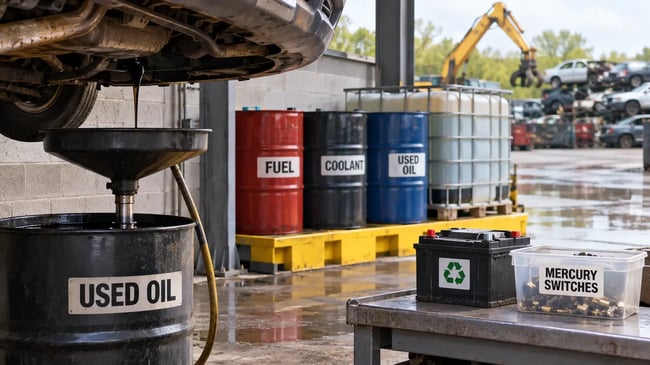
Once fluids come out of the vehicle, they move to the fluid storage area. NJDEP expects this area to be indoors, or on a contained impervious surface under cover, and expects all drained fluids to be in secondary containment with labels that make the contents obvious at a glance. Secondary containment just means a second barrier, such as a containment pallet, a berm, or a curbed pad, that holds the fluid if a drum or bucket fails. Labels let a crew member, an inspector, or a hauler should be able to tell used oil from coolant without opening anything.
Keep different fluids in separate containers, and don't mix them to save space. Mixed fluids are harder and more expensive to get rid of, and a drum of unknown liquid is a problem the moment anyone asks what's in it. Keep lids on, keep the containers in good shape, and replace anything that's rusting or bulging.
Fluids leave the yard through a licensed hauler, whether they're going for recycling or disposal. NJDEP's RVR guidance calls for keeping the receipts on site, so file them where you can hand them over during an inspection, and check your permit for how long they need to be kept. Anything that looks like a large volume of oil also raises a separate question about whether you need an SPCC plan. That plan applies to facilities with enough oil storage, and our SPCC plan resources explain how the thresholds work. Our post on the difference between an SPCC plan and a SWPPP is a good place to start if you're not sure which one you're dealing with.
How Should You Handle Vehicle Batteries Under the RVR Permit?
Batteries come out in the draining and dismantling area, and they have to be out before the vehicle leaves it. From there they go to the vehicle parts storage area. NJDEP's guidance says to store them indoors or in leak-proof containers under cover. A pile of batteries on bare ground in the rain is one of the more common problems at salvage yards, since lead and acid wash out easily and the runoff is hard to miss in a sample or an inspection.
A few habits keep this simple. Set a designated spot for batteries on an impervious surface, put them in a leak-proof tub or bin with a cover, and keep cracked or leaking batteries separate from intact ones so one bad battery doesn't contaminate the rest. The same guidance asks you to remove lead parts like battery cable ends and lead tire weights and keep them under cover too. Those small pieces are easy to forget because they look like scrap, but lead is lead once it hits a storm drain.
Used batteries are also regulated as universal waste in New Jersey, which sets its own rules for how long you can hold them and how they must be labeled and shipped. Those rules sit outside the RVR itself, so our waste and hazardous waste resources are a better starting point for that side of it.
How Do You Remove and Store Mercury Switches at an RVR Yard?
Mercury is highly toxic, and once it's released you can't get it back. Mercury switches turn up in places like under-hood and trunk lighting, certain anti-lock brake systems, and some high-intensity discharge headlights and taillights. NJDEP's RVR guidance has you remove them in the draining and dismantling area, so they're out before the vehicle goes anywhere else. Pulling them there also means a crew member is doing it over a contained surface, not in the middle of the yard.
Once removed, mercury switches go into a leak-proof, labeled, closed container kept in the vehicle parts storage area. Keep a container dedicated to them, keep the lid on, and keep it where nobody will knock it over. If one breaks or a container spills, stop and treat it as a mercury release, because ordinary cleanup methods like a shop vacuum or a broom can make it worse.
There's a second layer here that's separate from stormwater. New Jersey's Mercury Switch Removal Act puts duties on scrap recycling facilities that process end-of-life vehicles, including removing the switches before shredding, keeping records, and handling removed switches under the state's universal waste rules. If you send your drained shells to a shredder, expect them to ask whether the switches are out. Having a clear record of what you removed, and when, makes that conversation easy.
How Do Spill Response, Hauler Records, and Your SWPPP Fit With RVR Fluid Handling?
The permit expects you to have a stormwater pollution prevention plan, and it requires a copy at the facility. NJDEP's own materials call it the SPPP, and you'll hear it called an SP3 or just a stormwater plan as well. At RMA we call it a SWPPP, so that's what we'll use here. For an RVR yard, the SWPPP is where you describe each of the work areas above, show where they sit on a site map, and lay out the practices your crew follows. If you want to see how a plan reads before you write or update one, our post on New Jersey's stormwater pollution prevention plan explains the basics, and our guide to checking your own SWPPP for compliance problems helps you spot gaps before an inspector does.
Spill response ties in directly. NJDEP's advisory calls for spill kits on hand, annual training for all employees on spill response, immediate attention to spills, and proper disposal of the absorbent material you use. Quarterly facility inspections with a detailed log round out the routine, and the log is often what proves to an inspector that your practices run all year and not only on the day they arrive. Our online training library is one way to handle the annual training, and the sheen rule explains when your crew has to report one, so it's a good read for them when a spill becomes reportable.
Two more habits save headaches. Wash-down is one: rinsing a draining pad with a hose and letting the water run off is a quick way to turn a clean pad into a discharge, and our post on washing trucks and equipment outside in New Jersey covers why that's risky. The other is consequences. NJDEP has taken enforcement action against vehicle recyclers over fluid and parts storage, and our post on what happens when a New Jersey business ignores stormwater rules walks through how that tends to unfold.
How Can RMA Help With RVR Fluids and Parts Storage?
We're a family-run firm based in New Jersey, and our senior staff do the work themselves. For RVR yards, that usually means building or updating the SWPPP so it matches how your yard really runs, walking the site to check the draining area, fluid storage, and parts storage against the permit, and training your crew so the practices hold up when someone new starts. We can also help you get ready for an NJDEP inspection so you know what they'll ask for before they ask.
We'll also be direct about where we stop. We don't design or build containment structures, roofs, or berms, so if your draining area needs a new pad or a roof, that's a job for a contractor or an engineer, and we're glad to tell you what the permit calls for so the work is built to the right target. We don't haul fluids or run a lab either. And if you only need a quick answer on one condition, you may not need us at all, since NJDEP's permit pages and the permit itself are public. When you're ready to talk through your yard, you can call, email, or fill out the form on our website, and there's no obligation. To start, reach out to RMA.