What PAG-03 Takes in Time and Knowledge, Where It Breaks Down for Busy Plant Managers, and How to Make It Manageable
If you run a plant in Pennsylvania and your facility holds PAG-03 coverage, the stormwater permit probably landed on your desk next to production, safety, maintenance, and everything else. Nobody hired you to be a stormwater specialist, but DEP expects the permit's inspections, samples, reports, and paperwork to get done on schedule anyway. So can one plant manager handle it? Often yes, when the site is simple and the work is organized. The permit has a lot of moving parts, though, and most of them come with hard dates.
This article walks through what PAG-03 asks of you each year, what the PPC Plan, storm sampling, lab coordination, eDMR, training, and recordkeeping take in practice, where the work usually falls apart, and what you can do to keep it manageable. If you decide you want help with part of it or all of it, you can reach out to RMA anytime.
Table of Contents
TL;DR
A plant manager can handle PAG-03 when the site is simple, the staff is stable, and someone owns a calendar of dates. The work is mostly recurring: two inspections, two sampling rounds, and two eDMR reports a year, plus an annual report, annual training, and an annual PPC Plan review. The hours matter less than the timing, since a storm sample has to be collected within 30 minutes of a discharge starting. Most breakdowns come from storms at off-hours, missed deadlines, and a key person leaving. Backups, a shared calendar, a standing lab arrangement, and outside help for the pieces that don't fit your week keep it manageable.
Can a Plant Manager Handle PAG-03 on Top of Their Other Duties?
Nothing in the permit says otherwise. PAG-03 is a general permit, which means you operate under DEP's standard terms and do the work yourself instead of getting a custom permit. It doesn't require a professional engineer to certify the PPC Plan, and it doesn't say who has to do the inspections. A plant manager is allowed to run the program.
Whether you should comes down to your site. It's realistic when you have a few outfalls (each representative outfall gets its own samples and its own report), a stable team, a second person who knows the permit, and enough flexibility in your day to head outside when it rains. It gets hard when you have many outfalls, shifts that run at night and on weekends, one person holding all the knowledge, or sample results that start coming back high. We lay out the tradeoffs in more detail in our guide on doing PAG-03 yourself versus hiring a consultant.
What Does PAG-03 Require Every Year?
The permit's work is mostly recurring, so the easiest way to size it up is to count what lands on your calendar each year. Your sector appendix and DEP's approval letter can change some details, so treat this as the standard set.
| Task |
When It's Due |
What It Takes |
| Routine visual inspections |
Twice a year, once January through June and once July through December. At least one each year during a qualifying storm while water is discharging. |
Someone who knows the site and the PPC Plan, plus written documentation. |
| Stormwater sampling |
At least once every six months, in a storm over 0.1 inch that follows 72 hours without one. |
Staff ready to collect a grab sample within 30 minutes of the discharge starting, and an accredited lab. |
| eDMR reports |
July 28 for the January through June period, and January 28 for July through December, unless your sector appendix says otherwise. |
GreenPort accounts and a Certifier, with a separate report for each representative outfall. |
| Annual Report and annual fee |
March 23 each year. The fee is due whether or not DEP sends an invoice. |
DEP's annual report template, with inspection findings, training dates, and PPC Plan updates. |
| PPC Plan review |
At least annually, and whenever something triggers an update. |
Knowing what changed at the site since last year. |
| Employee and contractor training |
At least annually, on pollution prevention and on leak and spill response. |
A session, sign-in sheets, and a record of the topics covered. |
That's roughly a dozen dated tasks a year, spread across all four seasons. We're not going to put an hours number on it, because a one-outfall site and a ten-outfall site are very different jobs. What stays the same is that the time is rarely the problem. The timing is.
What Does the PAG-03 PPC Plan Take to Write and Keep Current?
The PPC Plan, short for Preparedness, Prevention and Contingency Plan, is the document the rest of the permit hangs on. DEP expects it to follow 25 Pa. Code Section 91.34 and DEP's environmental emergency response plan guidelines. At a minimum it covers your pollutant sources, preventive measures, spill response, erosion controls, security, employee training, and a site map.
Writing it takes site knowledge more than technical credentials. You need to be able to trace where water leaves the property, spot the outdoor materials and equipment that could put pollutants in its path, and choose controls that fit your site rather than copying a generic list. A first draft is the biggest single lift in the whole program. After that, keeping it current is a smaller job, as long as someone hears about changes. The permit calls for an update when regulations or the permit change, when the plan fails in an emergency, when facility changes materially raise the risk of a release, when your emergency coordinator or equipment list changes, or when DEP tells you in writing. A new chemical, a new tank, or a reassigned supervisor can all qualify.
If you want to try it yourself, our step-by-step guide on writing your own PPC Plan covers the walkthrough, and our article on which parts your team can write without a consultant is useful for deciding where to draw the line. Once it's written, knowing when to update it is the part that tends to slip.
What Does PAG-03 Storm Sampling and Lab Coordination Take?
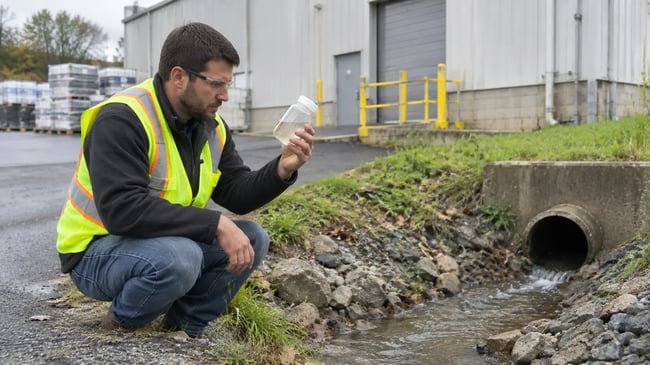
Sampling is the task that least fits a normal workday. A qualifying storm is one with more than 0.1 inch of precipitation that causes a discharge and follows at least 72 hours after the last measurable storm. Snowmelt equivalent to 0.1 inch of rain can be sampled, but DEP prefers rainfall. Once the discharge starts, you collect a grab sample within the first 30 minutes. If you can't, you collect it as soon as possible after that and document why.
In practice that means someone watching the forecast, bottles labeled and staged before the storm, and a person trained to collect from the right outfall, upstream of anything that mixes non-stormwater into the flow. Then the sample has to reach the lab in time. Some tests can be run on site if the method is approved and the holding time is under 24 hours, but most go to an accredited lab that can meet the quantification limits published in the permit. When you start with a lab, or switch labs or methods, DEP wants a Supplemental Laboratory Accreditation Form (3800-FM-BCW0189) filed. For each sample you record the exact location, date, and time, who collected it, who analyzed it and when, the methods used, and the results.
Plenty of managers collect their own samples, and there are good reasons to, which we cover in why you should take your own stormwater samples and our walkthrough of PAG-03 sampling in Pennsylvania. If you haven't chosen a lab yet, see how to pick a stormwater testing lab.
What Do eDMR, Training, and Recordkeeping Add to the PAG-03 Workload?
These three don't take long on any given day, but they're where good intentions leak out.
eDMR is DEP's electronic Discharge Monitoring Report system, and every industrial stormwater permittee has to use it. Each person who works in it needs their own Keystone GreenPort account, and the facility registers users with DEP through paperwork that can take 30 days or more to complete. You need at least two users, including at least one Certifier, and only a Certifier can submit. A Certifier has to be a responsible corporate officer, owner, or principal executive officer, or someone one of them has authorized in writing. Our guides on Pennsylvania eDMR reporting and who can sign DEP stormwater paperwork cover the setup.
Training has to happen at least once a year for employees and contractors, on pollution prevention practices from your PPC Plan and on leak and spill response. The permit doesn't set a curriculum or a number of hours, so your PPC Plan's training section becomes the standard DEP compares against what you do. Our article on PAG-03 employee training lists who needs it and what to cover.
Recordkeeping ties everything together. The permit requires keeping records for at least three years from the date of the sample, measurement, report, or application, and DEP can require longer. Many facilities keep them for the full permit term or longer. What belongs in the file is covered in what PA DEP expects to see in your PAG-03 files, and the inspection side is in our guide on PAG-03 visual inspections.
Where Does PAG-03 Compliance Typically Break Down?
The permit rarely fails on the hard technical parts. It fails on the calendar and on the people.
Storms During Off-Hours
Rain doesn't follow your shift schedule. A qualifying storm at two in the morning on a Saturday still starts a 30-minute window, and nobody is on site who knows how to sample. The same goes for the once-a-year storm-event inspection. A late sample is allowed with a documented explanation, but you don't want to be writing that explanation every period. Dry stretches cause the opposite problem: the reporting period closes without a qualifying storm, and you need to know how to report that. We explain it in reporting no discharge when you can't get a sample.
Missed Deadlines
The permit has dates that come with no reminder from DEP: July 28 and January 28 for eDMR, March 23 for the annual report and fee, and the annual training and PPC Plan review that nobody else is tracking. They're spread across the year, and they pile up on the weeks when production is busiest. A date missed in a hurry is the most common way a well-run plant ends up with a compliance problem.
Staff Changes
This is the quiet one. The only Certifier leaves, and nobody can submit the next eDMR. The one person who knew where the sample bottles and chain-of-custody forms live takes another job. The emergency coordinator named in the PPC Plan moves on, and the plan is now out of date, which is itself one of the triggers for an update. Adding or removing a Certifier takes new paperwork, so it isn't something you can fix the week it happens.
There's one more point where plant managers tend to realize the program has outgrown a side-of-the-desk job. When the same pollutant exceeds its benchmark at the same outfall in two or more consecutive monitoring periods, DEP expects a corrective action plan within 90 days after the end of that monitoring period. See what DEP expects after repeated exceedances before that happens to you.
How Can a Plant Manager Make PAG-03 Manageable?
Most of the fixes are about structure, not effort. Put every date from the table above on a shared calendar with reminders a few weeks out, and name a backup for each task so a vacation or a resignation doesn't leave a gap. Register at least two eDMR users, including a second Certifier if your company allows it, before you need one.
For sampling, stage a kit with labeled bottles and instructions near the exit, set up a standing arrangement with your lab before the first storm, and train a few shift supervisors to collect the sample so you aren't the only option at night. Try to schedule your semiannual inspections early in each window, January through March and July through September, so a missed storm still leaves you time to try again. Schedule the annual PPC Plan review and training in the first half of the year, and keep every record in one shared folder organized by year, with at least two people who know where it is. Our guide on reviewing your own PPC Plan before an inspection works as a yearly checklist.
It also helps to split the work. Many plants keep the inspections and sample collection in house, since they depend on being on site, and hand the PPC Plan, eDMR, annual report, and corrective action work to a consultant who does it every week. If you're weighing that, see how to choose a PAG-03 consultant. And if your site is simple, your team is stable, and the calendar is under control, you may not need anyone.
How Does RMA Help Plant Managers With PAG-03?
We work with Pennsylvania facilities all the time, and we can take on as much or as little of the program as you want. Some plant managers hand us the PPC Plan, its annual review, the eDMR reports, and the annual report while they keep inspections and sampling in house. Others want the whole program managed for them. If your site is simple and you have the time and the backups, we'll tell you that. Our pricing is published in what RMA charges for PAG-03 and PPC Plan services.
There's no pressure and no obligation. You can call, email, or fill out the form on our website, and we'll go through where your program stands and which pieces make sense to hand off. When you're ready, contact RMA.