How PAG-03 and No Exposure Certification Apply to Plants That Make Parts for Cars and Trucks
Most auto parts plants don't look like the kind of site a stormwater permit was written for. The machining, stamping, assembly, and packing all happen inside, the lot is mostly trucks and employee cars, and nobody has ever watched a river of runoff leave the property. Then you walk the back of the building and find a scrap hopper, a few drums of used oil, a row of returnable racks waiting for the next pickup, and a pile of rejected parts, and the answer to whether you need a permit stops being obvious.
Here's the short answer. Auto parts manufacturing sits in a category that PA DEP's industrial stormwater program covers, so most Pennsylvania plants need either coverage under PAG-03, DEP's general permit for industrial stormwater, or an approved No Exposure Certification. Which one fits depends on what sits outside in the rain. Below, we cover how DEP classifies these plants, what creates exposure, how the two paths compare, how OEM audits fit in, and a checklist for your own site. If you'd rather have someone look at your plant with you, reach out to RMA.
Table of Contents
TL;DR
Most Pennsylvania auto parts plants are in a category DEP regulates for stormwater, so they need either coverage under DEP's general industrial stormwater permit (called PAG-03) or an approved No Exposure Certification. The difference is what sits outdoors. If scrap hoppers, used oil, parts racks, or returnable containers get rained on, plan on PAG-03. If everything stays indoors or under a roof, a No Exposure Certification can replace the permit, but the whole site has to qualify. Customer audits tend to check whichever one you hold, so the paperwork has to match the yard.
How Does PA DEP Classify an Auto Parts Plant for Stormwater Permitting?
Pennsylvania runs its stormwater program through NPDES, the National Pollutant Discharge Elimination System, and DEP decides who's covered by SIC code, the Standard Industrial Classification code that describes what your plant makes. Motor vehicle parts and accessories fall under SIC 3714, part of the transportation equipment group (SIC 37). DEP's notice of intent instructions for PAG-03 list transportation equipment manufacturing, other than ship and boat building, among the facilities that may be covered under Appendix J, the "Additional Facilities" appendix. The appendix that applies to your plant determines which monitoring and best management practices come with coverage.
Two details trip up auto parts suppliers. DEP works from SIC codes, not NAICS codes, and your primary SIC code is whichever activity brings in the most revenue. A stamping or casting operation can classify differently than an assembly plant, and fabricated metal products and primary metals each have their own appendix. If you're not sure which code is yours, see our article on how to find your SIC code for a Pennsylvania stormwater permit.
Being in a covered category doesn't settle the question. PAG-03 covers stormwater associated with industrial activity, meaning runoff from areas where manufacturing, material storage, or waste handling happens. If rain never touches any of that, the No Exposure Certification is DEP's alternative to a permit, and a covered plant that keeps everything indoors generally still files it so DEP has it on record. Our guide on how to determine whether your Pennsylvania facility needs a PAG-03 permit covers the general test.
One flag before the details. If your plant discharges process wastewater or cooling water to a stream, that discharge typically needs its own individual NPDES permit. A facility that already has or needs one can't use PAG-03 for its stormwater, and a No Exposure Certification isn't available unless those discharges are authorized under the general permit. Confirm your path before filing anything.
What Creates Stormwater Exposure at an Auto Parts Plant?
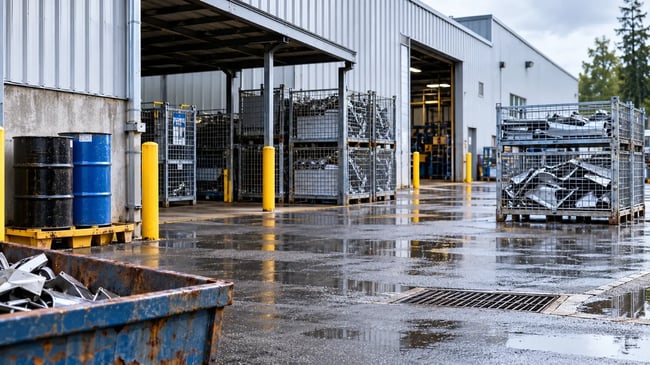
Exposure means rain, snow, or snowmelt can reach industrial materials or activities, and DEP generally expects everything covered by a No Exposure Certification to be stored and conducted indoors or under a roof. At an auto parts plant, the trouble spots sit where manufacturing hands off to shipping, waste, and maintenance: scrap and chip hoppers, drums of used oil and coolant, returnable racks and totes, rejected parts, and the loading dock where all of it moves. Our articles on everyday things DEP counts as stormwater exposure and storing materials outside cover the general rules.
| Item |
How DEP's rules generally treat it |
What usually fixes it |
| Scrap metal and chip hoppers |
Open-top bins in the rain are exposure, and oily chips make it worse |
Roof over them, use fitted lids, or move them inside |
| Used oil and coolant drums or totes |
Sealed, banded, intact containers with no operational taps or valves generally don't count. Open or leaking ones do |
Keep them sealed, add drip pans, and stage them under cover |
| Returnable racks, totes, and dunnage |
Depends on condition. Residue from oil, coolant, or metal fines makes them exposure |
Clean them before they go outside, or store them under a roof |
| Finished and rejected parts |
Final products qualify only if rain wouldn't carry material off them |
Keep them inside until they ship |
| Loading docks and trailer staging |
Parts, containers, and waste handled in the open count |
Canopies or an enclosed dock |
The standard applies to the whole site. DEP's FAQ says every industrial area subject to permit requirements has to meet it, so one open scrap hopper can disqualify the entire plant, and stained pads or metal fines around the dock can undercut a claim even after the hopper moves inside. To find these spots systematically, see our guide on how to identify stormwater pollutant sources at your Pennsylvania industrial facility.
How Does No Exposure Certification Work for an Auto Parts Manufacturer?
The No Exposure Certification, often shortened to NEC, is an exclusion from permit coverage, not a lighter permit. You complete the PAG-03 notice of intent, attach DEP's No Exposure Certification form, and certify that no stormwater from the entire facility is contaminated by industrial materials or activities. Depending on your answers on the form, DEP may also require a Preparedness, Prevention, and Contingency (PPC) Plan. DEP's filing fee is $500, and the certification lasts up to five years, with renewal due at least 180 days before the expiration date in DEP's approval letter. Once approved, there's no ongoing PAG-03 sampling, no monitoring reports, and no annual fee.
Several limits come with it. DEP can inspect, and inspection reports can be released to the public on request. The certification isn't available in High Quality or Exceptional Value watersheds, stream designations under 25 Pa. Code Chapter 93, and plants that discharge there generally apply for an individual permit instead. And if conditions change, such as a new scrap area or an outdoor storage pad, the certification stops covering you, and you have to notify DEP and seek coverage right away. See our articles on Pennsylvania's No Exposure Certification and who qualifies and what happens during a PA DEP stormwater inspection.
What Does It Take to Qualify at an Auto Parts Plant?
Most of the work is moving things under a roof: roofing over hoppers, lidding or enclosing dumpsters, canopying the dock, keeping oil and coolant sealed indoors, and staging racks and rejected parts inside. Temporary fixes don't count for much. DEP's FAQ says tarps and similar flexible covers generally can't establish no exposure over a permanent installation without DEP approval, and an unroofed fueling station for a plant's own fleet is also a disqualifier.
When Does an Auto Parts Plant Need PAG-03 Coverage Instead?
If the scrap hoppers have to stay outside, the dock can't be roofed at a reasonable cost, or the plant doesn't qualify for a certification, PAG-03 is the path. DEP's current PAG-03 took effect March 24, 2023 and expires March 23, 2028. Coverage means a notice of intent, a PPC Plan, best management practices for the areas where materials are exposed, and stormwater monitoring that depends on the appendix for your plant. The reissued permit added total nitrogen and total phosphorus monitoring to every appendix, and results go to DEP through eDMR, the electronic discharge monitoring report system. Our guide to Pennsylvania's eDMR reporting explains the mechanics, and if you've worked with SWPPPs in other states, our comparison of SWPPPs and PPC Plans shows how the PPC Plan differs.
DEP charges $500 for a new notice of intent and a $500 annual fee due each March 23, and those fees are the small part of the cost. Plan preparation, lab testing, and annual reporting add up, as our article on what a PAG-03 permit costs in Pennsylvania explains. What you'd spend with a consultant depends on the permit appendix, the number of outfalls, the size and complexity of the site, and whether a stormwater plan already exists. Neither path is automatically cheaper: roofing a scrap area costs money once, while PAG-03 costs money every year, so the right answer depends on how much has to move and how long you'll be at the site.
Plants that drain to High Quality or Exceptional Value waters are a separate case, because PAG-03 is often unavailable there and DEP generally requires an individual permit. Our article on PAG-03 vs. an individual NPDES permit covers how DEP decides. Local rules can add to all of this, too. Municipalities and sewer authorities may have their own stormwater requirements or fees, and where site runoff goes to a sewer system that reaches a treatment plant, the sewer authority may govern it instead of a DEP stormwater permit. Confirm where your drains go before you assume either way, and see our article on stormwater fees versus stormwater permits.
How Do OEM Supplier Audits Affect Stormwater Compliance at Auto Parts Plants?
Customers have started asking suppliers for proof of environmental compliance, and stormwater is an easy line item for them to check. A permit or certification either exists in DEP's records or it doesn't, and an auditor can compare the paper to what's in your yard. The requests come as supplier questionnaires and, at some customers, on-site audits. The table below shows what they tend to look like and what you can hand over.
| What a customer may ask |
What you can show |
| Do you hold the stormwater permit or exclusion your site requires? |
Your PAG-03 coverage approval or No Exposure Certification approval letter, with the DEP permit number |
| Can DEP's records confirm it? |
Your facility's record in eFACTS, DEP's public online records system |
| How do you keep stormwater clean? |
Your PPC Plan under PAG-03, or documented site walks showing everything stays covered under a certification |
| Have you had violations, notices, or spills? |
DEP inspection reports, correspondence, and your spill records |
| Are your people trained, and do you monitor discharges? |
Training records, plus eDMR submissions and lab reports if you're under PAG-03 |
Auditors can accept either path. What causes trouble is a mismatch. If your certification says nothing is exposed and the auditor photographs an open hopper behind the building, you have a customer finding and a certification that may no longer be accurate, which means notifying DEP and seeking coverage. If you're on PAG-03 and your PPC Plan describes a layout you changed two years ago, the same problem shows up in a different form. Updating the plan or certification whenever production moves is the simplest way to stay ready, and our guide to PAG-03 employee training covers the training records customers often ask about. If a customer asks for your permit number and nobody can find it, start with eFACTS. Our walkthrough on how to use eFACTS to see what PA DEP has on file for your facility shows what to look for, including whether your PAG-03 coverage or No Exposure Certification appears at all.
Which Path Fits? A Stormwater Checklist for Auto Parts Plants
Here's a short checklist you can run through at your own plant. Do the walk after a rain if you can, since wet pavement shows where water goes and what it picks up.
- Confirm your primary SIC code, based on the activity that brings in the most revenue, and note any secondary activities on the property, such as a warehouse or maintenance shop.
- Look up your facility in eFACTS to see whether DEP already shows PAG-03 coverage, a No Exposure Certification, or neither.
- Walk every outdoor area and write down what's there: scrap and chip hoppers, used oil and coolant containers, returnable racks and totes, rejected parts, dumpsters, and outdoor equipment.
- Check the ground and roofs for staining, metal fines, or residue around docks, dumpsters, drains, and exhaust points.
- Trace each storm drain and downspout to see where it goes, and find out whether the receiving stream carries a High Quality or Exceptional Value designation.
- Check for non-stormwater discharges, such as process or cooling water, that would change which permit applies.
- Decide whether everything outdoors can reasonably move indoors or under a storm-resistant shelter. If it can, a No Exposure Certification is worth pursuing. If it can't, plan for PAG-03.
- Pull together the paperwork your customers will ask for, and set a reminder to review the site after any layout or production change.
The first six steps give you the facts, and step seven is the decision. If the walk turns up something you can't classify, such as a container in a gray area or a drain nobody can trace, get a second set of eyes on it before you file anything.
How Can RMA Help Pennsylvania Auto Parts Manufacturers With Stormwater Permits?
We work with Pennsylvania facilities all the time, and auto parts plants usually come to us with the same question you started with: do we need a permit, and if so, which one? We can help you confirm your SIC code and appendix, work out what's exposed, and tell you plainly whether a No Exposure Certification is realistic or PAG-03 is the better fit. From there we can help prepare the paperwork for whichever path you choose, including the PPC Plan and notice of intent under PAG-03. Some plants can handle a No Exposure Certification on their own, and our article on whether you can get a PAG-03 permit yourself lays out where doing it in-house works and where it doesn't. If that's you, we'll say so.
There's no pressure and no obligation. You can call us, email us, or fill out the form on our website, and contact us whenever you're ready. Our Pennsylvania NPDES and stormwater services page shows the rest of what we do for PAG-03, No Exposure, and PPC Plans, and our Pennsylvania NPDES article library collects every guide in this series.