How Pennsylvania Textile Mills Can Use a No Exposure Certification Instead of PAG-03, and What Can Take That Option Away
Pennsylvania's textile industry is smaller than it used to be, but mills are still running in the eastern part of the state, from Philadelphia up through the Lehigh Valley and Reading and into the Scranton area. Many sit in older buildings, work mostly indoors, and have never given stormwater much thought. DEP has. Textile mills are on the list of industrial activities that need either a stormwater permit or a formal exemption, so the real question for a mill owner is which of the two applies.
The short answer is that many textile mills can skip the full PAG-03 permit by filing a No Exposure Certification, as long as nothing industrial ever touches rain or snow. This article covers what tends to break that eligibility, namely dye and chemical storage, outdoor equipment, and waste storage, and how to confirm where your mill lands. If you'd rather have someone walk your site with you, you can reach out to RMA at any point.
Table of Contents
TL;DR
Textile mills are covered by DEP's industrial stormwater rules, so every mill needs either PAG-03 coverage or a No Exposure Certification. A mill that keeps its materials, equipment, and waste under a roof or in sealed containers can usually file the certification instead of taking on a full permit. Dye and chemical storage, outdoor equipment, and waste storage are the usual things that break eligibility. Before you file, confirm your primary SIC code, the stream your runoff reaches, and everything sitting outside your building.
Are Textile Mills Covered by Pennsylvania's Industrial Stormwater Rules?
Yes, which surprises people who think of stormwater permits as a heavy industry problem. DEP's program is built around SIC codes, and textile mill products (SIC 2211 through 2299) are on its list of covered activities. PAG-03, DEP's general permit for industrial stormwater, has a sector section for textile mills, apparel, and other fabric products. Coverage follows your primary SIC code, meaning the activity that brings in the most revenue at the site, so a small fabric operation inside a different primary business generally isn't pulled in by that secondary code alone. Our post on finding your SIC code for a Pennsylvania stormwater permit walks through the lookup.
Being covered doesn't automatically mean you need the full permit. DEP gives facilities three paths: PAG-03 coverage, an individual NPDES permit, or a No Exposure Certification, which is a formal exemption for facilities where industrial materials and activities never meet rain. For a mill that keeps everything indoors, the exemption is usually the right fit and comes with far less ongoing work.
What Does a No Exposure Certification Mean for a Textile Mill?
The certification tells DEP that all industrial materials and activities at your site are protected by a storm-resistant shelter, so rain, snow, and snowmelt can't carry anything off. You submit the application with a PAG-03 Notice of Intent, and if DEP approves it you're excluded from permit coverage for five years. Renewal is due at least 180 days before expiration, and DEP's industrial stormwater FAQ lists a $500 fee due with each application and no annual fee in between.
Three rules catch mills off guard. The test applies to the whole site, so one uncovered dye tank can sink the certification for the rest of the property. A direct discharge to a High Quality or Exceptional Value stream rules it out entirely. And the only non-stormwater discharges allowed are the ones PAG-03 specifically authorizes. Our guide to who qualifies for Pennsylvania's No Exposure Certification goes through the full eligibility list.
What Creates Stormwater Exposure at a Textile Mill?
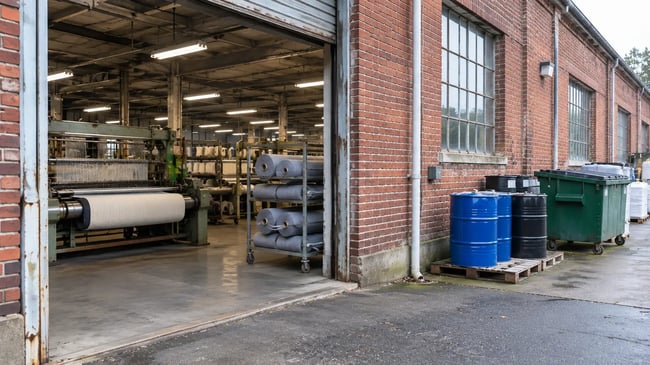
DEP's test is blunt: if rain can touch it, it's exposed. That includes raw materials, intermediate products, waste, machinery, and the loading and unloading of any of them. Older mill buildings often come with outdoor tanks, open docks, and yards that newer plants never had, so the trouble spots tend to be the same handful of places.
| Area of the mill |
Usually fine |
Usually creates exposure |
| Dye and chemical storage |
Tightly sealed drums and totes in good condition, with no taps or valves |
Bulk tanks with valves, open containers, bagged dye, salt, or soda ash stacked outside |
| Outdoor equipment |
Well-maintained forklifts and yard vehicles |
Leaking dust collectors, lint hoppers, compressors, or boiler equipment, and any fueling station without a roof |
| Waste storage |
Covered dumpsters that don't leak or drain |
Open roll-offs holding fabric scrap, fiber waste, or dye-stained rags |
| Loading and raw materials |
Covered docks, and finished goods rain won't wash away |
Raw fiber, yarn, or fabric stored or staged outside |
A tarp doesn't solve any of this for something permanent, since DEP treats tarps as a temporary measure. A fully roofed and walled structure qualifies. A roof without walls qualifies only if stormwater can't flow through it and a curb or berm keeps wind-blown rain and snow out. Our post on everyday things PA DEP counts as stormwater exposure covers the smaller items that trip facilities up.
How Do You Confirm Your Textile Mill Qualifies for No Exposure?
Start with the paperwork. Confirm your primary SIC code, then check the classification of the stream your stormwater reaches under Chapter 93 of DEP's regulations. Our post on High Quality and Exceptional Value stream classifications explains how. It also helps to search your address in eFACTS to see whether DEP already has coverage or a certification on file, which can happen when an older mill changes hands.
Then walk the whole property, ideally during a rain. Look at everything outside, trace every storm drain and downspout, and check the floor drains too. Process water from dyeing, washing, or finishing can't go anywhere near a storm drain, and where that wastewater does go, to a sewer authority or to a stream under its own permit, is a separate question from your stormwater status. Our explainer on the difference between stormwater and process water helps sort out which is which. When you're done, you have to be able to answer no to every exposure question, and DEP asks you to certify that nothing is exposed now or will be for the next five years, so a planned outdoor tank or storage pad needs to factor in before you file. Depending on your answers about storing and handling materials, DEP may also want a PPC plan, Pennsylvania's Preparedness, Prevention and Contingency plan.
What Happens If a Textile Mill Needs PAG-03 Instead?
A mill that can't reach no exposure needs PAG-03 coverage, or an individual NPDES permit if its stream classification or other circumstances rule out the general permit. PAG-03 brings the textile section of the permit, a PPC plan, inspections, and monitoring requirements that depend on the appendix and permit category that apply to you. Our post on finding the PAG-03 appendix for your industry shows how to read yours. Plenty of mills fix the exposure instead. Moving drums indoors, roofing a storage pad, or swapping an open roll-off for a lidded dumpster can cost less than years of permit obligations, and a contractor can often handle that without a consultant. Our comparison of No Exposure versus PAG-03 can help you weigh the two.
How Does RMA Help Pennsylvania Textile Mills With Stormwater Permits?
We work with Pennsylvania facilities all the time, and a textile mill walkthrough usually goes quickly. We check the SIC code, the receiving stream, the drains, and every spot where something sits outside. If your mill qualifies for No Exposure, we'll tell you so and help you file, so you don't end up with a bigger permit than you need. If the fix is just moving some drums indoors, you probably don't need us for that. If you'd like a second set of eyes, you can call, email, or fill out the form on our website, with no obligation. Just contact RMA whenever it suits you.