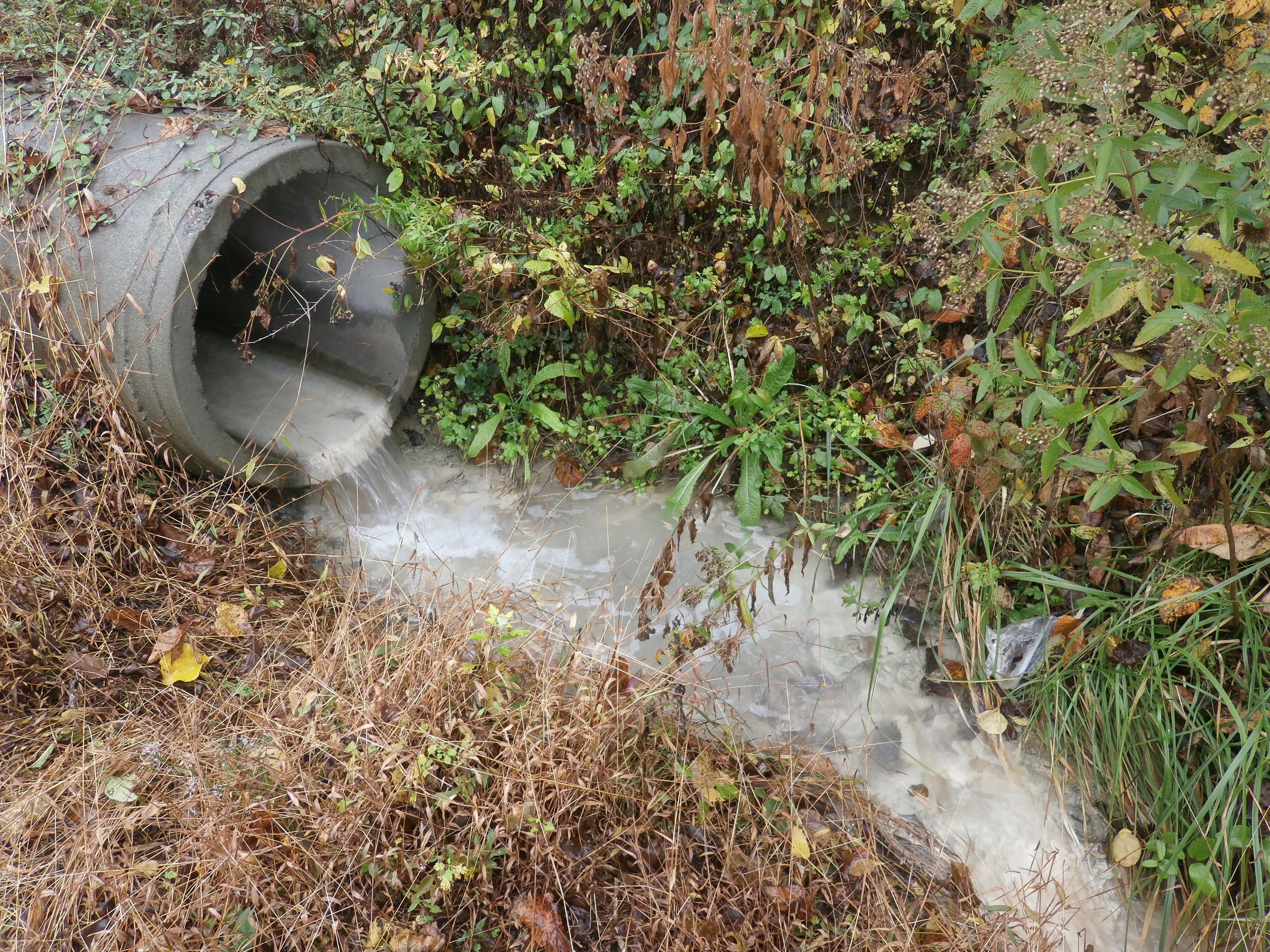
Salt Domes, Fleet Maintenance, Fueling, and Stockpiles: How DEP's Industrial Stormwater Rules and MS4 Permits Apply to Municipal Yards
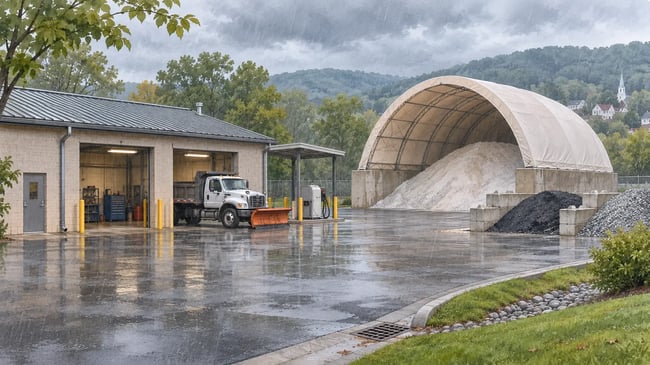
A township or borough public works yard looks a lot like a small industrial site. There's a garage where the trucks get repaired, a fuel tank or two, a salt dome or a pile of salt under a tarp, stockpiles of stone and asphalt millings, and a lot of pavement that drains somewhere. Supervisors and public works directors often assume the yard is exempt from DEP's industrial stormwater rules because the municipality owns it, or that the municipality's own stormwater permit already covers it. Neither assumption holds up reliably, and the real answer depends on what happens at the yard and where the water goes.
This article walks through how Pennsylvania's industrial stormwater general permit (PAG-03) can apply to a municipal yard, what DEP says about salt storage, when a No Exposure Certification fits, and how a municipality's MS4 permit and its good housekeeping duties fit in. The short version is that ownership doesn't decide anything. The activities at the yard do, so a yard that only parks vehicles and stores material may need nothing from DEP's industrial program while a yard with outdoor vehicle repair or uncovered fueling is a likely candidate for coverage. If you'd like a second set of eyes on your yard, you can reach out to RMA at any point.
Table of Contents
TL;DR
Sometimes. DEP decides whether a public works yard needs industrial stormwater coverage by what happens there, such as outdoor vehicle maintenance, equipment washing, fueling, and salt storage, not by the fact that a township or borough owns it. Depending on those activities, a yard might need PAG-03 coverage, might qualify for a No Exposure Certification, or might need neither. Municipalities with an MS4 permit also have good housekeeping duties at their yards, but that permit doesn't replace industrial coverage when a yard needs it, so the safest move is to inventory the activities and confirm the answer with DEP.
What Is the Short Answer on Public Works Yard Stormwater Permits in Pennsylvania?
A few terms first, because municipal staff rarely deal with them. NPDES is the permit system that governs discharges to streams and rivers, and in Pennsylvania DEP runs it. PAG-03 is DEP's general permit for stormwater from industrial activity. A general permit is a pre-written permit that a facility signs up for by filing a Notice of Intent (NOI) instead of negotiating a custom permit from scratch. An MS4, short for municipal separate storm sewer system, is the network of inlets, pipes, and ditches a municipality owns that carries runoff to local waterways. A PPC Plan, short for Preparedness, Prevention and Contingency Plan, is the written plan that maps a site, lists what could reach stormwater, and lays out spill prevention and response.
With those in hand, a public works yard lands in one of three places. If it has an industrial activity DEP regulates, it needs PAG-03 coverage, or in some cases an individual permit. If it has those activities but they're all indoors or under cover, it may qualify for a No Exposure Certification, which is a formal filing that says nothing at the site can touch rain or snowmelt. If it has neither, it may not need anything from the industrial program, though the municipality can still have MS4 duties. DEP's own industrial stormwater FAQ ties coverage to a facility's primary industrial code or activity, and it doesn't carve out a category for municipal owners.
That leaves public works yards in a gray area more often than a factory would be. A factory has an obvious industrial code. A public works department does a bit of everything, so the question usually turns on which activities are happening and whether DEP would treat them as covered. We'd treat public ownership as a reason to look carefully, not as an exemption.
Which Public Works Yard Activities Create Stormwater Exposure?
Stormwater becomes a problem when rain or snowmelt touches something that can pollute it and then leaves the site. Most public works yards have several of these at once, and they tend to be spread across the lot rather than neatly contained. The table below lays out the usual suspects.
| Yard Activity |
What Can Reach Stormwater |
Why It Draws Attention |
| Fleet repair and maintenance |
Oil, hydraulic fluid, antifreeze, brake dust, solvents, used batteries |
Vehicle maintenance shops are a core trigger for DEP's land transportation rules |
| Equipment and truck washing |
Soaps, oil, grease, salt, sediment |
Wash water isn't an authorized discharge under PAG-03 |
| Fueling |
Gasoline and diesel from drips, overfills, and spills |
An uncovered fueling station rules out a No Exposure Certification |
| Salt domes, salt piles, and brine |
Chloride in runoff and loading-area spillage |
DEP has a dedicated section of PAG-03 for salt storage |
| Stone, millings, topsoil, and asphalt stockpiles |
Sediment and, for millings, hydrocarbons |
Piles near inlets wash straight into the storm sewer |
| Leaf and yard debris handling |
Nutrients, organic matter, sediment |
Can overlap with DEP's waste programs depending on scale |
| Drums, totes, and chemical storage |
Used oil, paint, herbicides, deicing products, line-marking materials |
Uncovered containers and leaking lids are easy inspection findings |
The problems we'd expect to find walking a typical yard are pretty consistent. Salt gets tracked out of the loading area every time a spreader fills. Equipment parked outside drips onto the same patch of pavement all winter. A stockpile gets built up against a catch basin because that's where the loader had room. A floor drain in the shop connects to the storm sewer when someone assumed it went to the sanitary sewer. None of these require bad intent, and most of them are cheaper to fix than to explain to an inspector.
How Does PAG-03 Apply to a Municipal Public Works Yard?
Federal stormwater rules define industrial activity either by an industrial classification code or by a narrative description of the activity. For transportation facilities, the trigger is vehicle maintenance shops, equipment cleaning operations, and airport deicing. DEP's FAQ also treats fueling that's tied to vehicle maintenance as part of the regulated activity, while fueling at a transient or retail site isn't. DEP's PAG-03 sorts land transportation into Appendix L, and it keeps a catch-all, Appendix J, for facilities that don't fit another appendix. DEP can also point a facility to an appendix when its activities are similar to that appendix, even if the classification code doesn't line up exactly.
Here's where municipal yards get tricky. Our look at public school bus garages found the same pattern: public ownership isn't an exemption, but how the operation is classified can differ from a private company doing the same work. We cover that in detail in our article on Pennsylvania school bus garages, and the same reasoning carries over to a township garage that repairs plow trucks and dump trucks outdoors. A yard that does heavy repair, painting, or fueling outside is the kind DEP tends to focus on. A yard that only parks vehicles and stores material often isn't, though we wouldn't state that flatly without looking at the site.
If a yard needs PAG-03 coverage, the obligations are what any other industrial facility faces. The application package includes the NOI and a PPC Plan, and DEP charges application and annual fees, which you should confirm against DEP's current schedule. Under Appendix L, DEP's fact sheet describes monitoring once every six months, with an oil and grease benchmark of 30 mg/L. The reissued permit also added total nitrogen and total phosphorus monitoring across all appendices. Benchmarks aren't legal limits, but repeated exceedances trigger a corrective action plan. Results go to DEP through eDMR, its electronic discharge monitoring report system, twice a year, and every permittee does semiannual visual inspections. The current PAG-03 runs from March 24, 2023 through March 23, 2028. If you want the full picture of what the permit asks for, our guide to determining whether a facility needs PAG-03 walks through the checks DEP expects you to make.
What Does DEP Say About Salt Domes and Road Salt Storage?
Salt gets its own section of PAG-03, Appendix K, which covers existing salt storage and distribution sites. That section is the reason a municipal salt dome can sit in a different place on the decision tree than the garage next to it. DEP's PAG-03 materials say small stockpiles generally don't need permit coverage when the Appendix K best management practices are in place, unless DEP directs otherwise in writing. The reverse is also true. A new large stockpile needs an individual permit or other DEP approval, even if it sits at a site that has other covered activity, and DEP's FAQ puts the general threshold for new stockpiles at 3,000 tons.
The details matter for monitoring too. DEP's FAQ says salt that's under cover or properly tarped, with good housekeeping in place, can avoid Appendix K monitoring and may still qualify for a No Exposure Certification, and that smaller piles may be able to reduce monitoring to once a year. Where monitoring applies, the chloride benchmark in the fact sheet is 2,000 mg/L. Many municipal salt storage areas are well under the 3,000-ton line, but the number to check is your actual storage capacity, not a rough guess, because the answer changes above it.
If the municipality is planning a new salt shed or a bigger dome, that's the time to ask DEP early. A new facility of that size isn't a small paperwork task, and the permitting path for the storage itself is separate from whatever the garage needs.
When Can a Public Works Yard File a No Exposure Certification?
A No Exposure Certification (NEC) is for a facility that would otherwise need PAG-03 but keeps all industrial materials and activities indoors or under a storm-resistant cover. DEP requires it to be renewed every five years, and it goes in with the PAG-03 NOI along with DEP's certification form. Our article on what no exposure means goes through the mechanics.
For a public works yard, a few DEP positions decide whether it's realistic. Indoor-only vehicle maintenance can qualify, but outdoor storage of vehicles waiting for repair disqualifies it. A fueling station without a roof or cover is ineligible. Salt can qualify when it's secured under cover. The less clear part is the rest of the lot: whether outdoor stockpiles of stone or millings count against a yard is a question to confirm with DEP for your site instead of assuming. Most yards with an outdoor repair bay or open fueling won't fit, and a yard with a real garage, a covered fuel island, and a salt dome might.
One more thing worth knowing, since municipalities sometimes try to use it as a shortcut. Sending the yard's runoff into the township's storm sewer doesn't take the yard out of the program. DEP's FAQ says facilities that discharge to an MS4 or a private storm sewer still must apply for permit coverage or a No Exposure Certification, and DEP's fact sheet says the MS4's permit can't stand in for the facility's own coverage.
How Does an MS4 Permit Change Stormwater Duties at a Public Works Yard?
Many Pennsylvania townships and boroughs, especially those in urbanized areas, hold coverage under DEP's small MS4 general permit, PAG-13. DEP reported roughly 490 MS4s with PAG-13 coverage as of late 2024. Not every municipality is an MS4, so check whether yours is rather than assuming either way. The permit is built around six minimum control measures, and the sixth, pollution prevention and good housekeeping, is the one that lands on the public works yard.
That measure has three parts, according to the PennDOT training sheet on it. The municipality inventories its facilities and activities that could send pollutants to the MS4, writes an operations and maintenance program for each, and trains staff who do the work, with public works at the top of that list. Salt and chemical storage, street sweeping, vehicle washing, fueling, and material handling all show up as typical municipal operations. DEP's pages link to a sample municipal inventory and O&M plan, which is a helpful starting point.
The two programs overlap but they aren't the same thing. MCM 6 is a municipal duty that applies because the municipality has an MS4 permit. PAG-03 is a facility permit that applies because of what the facility does. A yard can have one, both, or neither. The good news is that the work transfers well. An honest MCM 6 inventory of the yard is most of what you'd need to describe the site in a PPC Plan. Our comparison of SWPPPs and PPC Plans for PAG-03 shows what the plan itself contains.
Do Combined Sewers and Local Rules Change the Public Works Stormwater Answer?
They can. DEP's FAQ says discharges to a separate or combined sanitary sewer generally don't need independent stormwater permit coverage, though pretreatment rules can apply. Some older Pennsylvania municipalities have combined sewers, where stormwater and sewage share a pipe that runs to a treatment plant. If a yard's runoff goes that way, the sewer authority's rules may govern instead of a DEP stormwater permit. We wouldn't say flatly whether a yard in any specific city or borough needs PAG-03 without knowing where each drain ends up.
Local rules are a separate layer. Townships, boroughs, and sewer authorities can have their own ordinances, fees, and approvals that differ from one municipality to the next, so confirm what applies to your situation. And if your yard hosts a leaf composting or yard waste drop-off, that activity can fall under DEP's waste program depending on its scale, which is a separate conversation from stormwater.
What Stormwater Controls Work at Public Works Yards?
Good housekeeping beats treatment at a yard like this. Most of the fixes are about keeping rain away from the material or the material away from the drain, and they apply whether the yard ends up under PAG-03, under an NEC, or under neither. The table pairs the common problems with the controls we'd start with.
| Problem Area |
Practical Controls |
| Salt dome and salt piles |
Store under a roof or a tight cover on an impervious pad, load trucks inside or under cover, sweep spilled salt back into the pile, keep brine tanks in secondary containment |
| Fleet maintenance |
Do repairs indoors, use drip pans under leaking equipment, cover drums and used oil, keep spill kits stocked, confirm where every floor drain goes |
| Equipment washing |
Wash indoors and route the water to a sanitary sewer with the authority's approval, or use an off-site wash, and never to the storm drain |
| Fueling area |
Add a roof over the dispenser, use overfill protection, clean small spills dry, keep absorbent at the pump |
| Stone, millings, and soil stockpiles |
Keep piles away from inlets, use berms or barriers at the downhill edge, cover piles that sit through the wet season, protect nearby inlets |
| Chemicals and containers |
Store indoors or under cover with lids on, label everything, keep an inventory so nothing sits outside by default |
Beyond the physical fixes, regular inspections and a short routine for the crew keep the yard in shape between visits. Our guides on finding stormwater pollutant sources and stormwater best management practices cover the walkthrough and the control menu in more depth. Staff training matters here, because the person who parks the loader against a catch basin is usually the person no one trained. Our online training library is one option for that.
How Can a Municipality Figure Out Which Stormwater Rules Apply to Its Yard?
Start by writing down every activity at the yard, indoors and out, including the ones that only happen in winter. Then trace where each drain goes: a stream, a separate storm sewer, a combined sewer, or a sanitary sewer. Those two lists answer most of the question by themselves. From there, check whether the municipality is an MS4, since that tells you whether MCM 6 duties already exist, and compare the yard's activities against the PAG-03 appendices. When something doesn't fit cleanly, that's the point to call the DEP regional office that covers your county, because DEP can tell you how it would classify the site. Our article on which Pennsylvania stormwater permit you need lays out the broader decision between PAG-03, an individual permit, and no exposure.
Construction comes up a lot with municipal yards, since a salt shed, a new garage, or a yard expansion all involve ground disturbance. The construction-phase requirements, including erosion and sediment control plans and construction stormwater coverage, are handled by your engineer, contractor, or a soil erosion specialist, and RMA doesn't prepare them. What we do help with is the part that starts once the yard is running. A new or expanded yard almost always needs a plan for how its operations will handle stormwater, and that's where we can help.
The honest answer for some yards is that they don't need an industrial permit at all. A yard that mostly parks vehicles and stores material under cover may fall outside the program, and we'll say so when that's the case instead of selling you coverage you don't need.
How Does RMA Help Pennsylvania Municipalities With Public Works Stormwater?
We work with Pennsylvania facilities all the time, and municipal yards are a good fit for the kind of walk-through this topic calls for. We can help you inventory what's happening at the yard, work out whether PAG-03, a No Exposure Certification, or neither is the right path, and tell you where your MS4 duties and any industrial coverage overlap. If coverage makes sense, we can prepare the NOI and the PPC Plan, and we can help with sampling, eDMR reporting, and inspection prep afterward. What it costs depends on the permit category, how many outfalls and activities the yard has, whether a plan already exists, and how much sampling is involved, and our article on what RMA charges for PAG-03 and PPC Plan services gives typical ranges.
There's no pressure here. If you'd like to talk through your yard, you can call us, email us, or fill out the form on our website, and we'll give you a straight read on what applies. You can contact RMA whenever it's useful. You can also browse our Pennsylvania NPDES and stormwater resources, our NPDES resources library, and every article we've published on Pennsylvania NPDES topics.